UN Seeks Probe into Reported Mass Killing of Afghans Migrating to Iran

Iranians drive past an anti-Israeli billboard with a sentence reading in Persian and Hebrew, 'Israel is no longer a safe place for living' at the Palestine Square in Tehran, Iran, 16 October 2024. EPA/ABEDIN TAHERKENAREH
TT

UN Seeks Probe into Reported Mass Killing of Afghans Migrating to Iran

Iranians drive past an anti-Israeli billboard with a sentence reading in Persian and Hebrew, 'Israel is no longer a safe place for living' at the Palestine Square in Tehran, Iran, 16 October 2024. EPA/ABEDIN TAHERKENAREH

The United Nations' mission in Afghanistan called on Thursday for an investigation into reports that a large group of Afghan migrants had been shot and killed on the Afghanistan-Iran border.
Afghan media outlets including Tolo News, citing witnesses, said more than 200 Afghan migrants who entered Iran illegally were attacked on Iranian territory, and that dozens had been killed and injured.
Iran's ambassador to Afghanistan, Hassan Kazemi Qomi, denied the reports of the "death of dozens of illegal nationals" in a post on X.
Tolo News quoted an "Iranian human rights organization" saying that Iranian border guards had attacked the migrants.
Afghanistan's Taliban-run administration has not confirmed the incident and said it was investigating.
The United Nations' Assistance Mission in Afghanistan (UNAMA) in a statement expressed "deep concern over disturbing reports of an incident on 14 to 15 October in Sistan province, Sarbaz district, Kala Gan border area of Iran, with allegations that a large group of Afghan migrants were opened fire on, resulting in deaths and injuries."
It did not make any reference to who might have carried out the alleged attack.
UNAMA called for a "thorough and transparent" investigation into the alleged incident, stressing that the rights of migrants, refugees and asylum-seekers are protected by international law.
Afghanistan authorities have been unable to confirm the incident because it happened "beyond Afghanistan's borders," deputy spokesman of the government Hamdullah Fitrat said in a statement.
He said a high-ranking delegation with officials from the interior, foreign and defense ministries had begun an investigation and would submit a report once the facts were clear.



Iran Rejects Curbs on Its Uranium Enrichment Program

FILE - This satellite image provided by Vantor shows the Natanz nuclear complex in Iran on March 7, 2026, with no new damage seen at the facility or the tunnels. (Satellite image ©2026 Vantor via AP, file)
TT

Iran Rejects Curbs on Its Uranium Enrichment Program

FILE - This satellite image provided by Vantor shows the Natanz nuclear complex in Iran on March 7, 2026, with no new damage seen at the facility or the tunnels. (Satellite image ©2026 Vantor via AP, file)

The head of Iran’s Atomic Energy Organization, Mohammad Eslami, on Thursday ruled out accepting any restrictions on the country’s uranium enrichment program, as demanded by the United States and Israel.

In an interview with the ISNA news agency, Eslami said: “The demands and conditions set by our enemies to restrict Iran’s enrichment program are nothing but daydreams that will be buried,” AFP reported.

The remarks come as talks between Washington and Tehran are expected to be held at the end of the week under Islamabad’s auspices, as part of a ceasefire agreement brokered by Pakistan. The discussions are expected to address Tehran’s nuclear program.

Western powers accuse Iran of seeking to acquire a nuclear weapon and have worked to prevent it from doing so, while Tehran has consistently denied the allegations.

During his first term, US President Donald Trump withdrew from the landmark 2015 agreement that had placed limits on Iran’s nuclear enrichment activities in exchange for sanctions relief, a deal opposed by Israel.


Germany's Merz: We Do Not Want NATO to Split over US-Iran War

Commemorative photo of NATO leaders in The Hague in 2025 (Turkish Presidency).
TT

Germany's Merz: We Do Not Want NATO to Split over US-Iran War

Commemorative photo of NATO leaders in The Hague in 2025 (Turkish Presidency).

German Chancellor Friedrich Merz said on Thursday he did not want US-Iran war to place any further strain on relations between the United States and its European NATO partners.

"We do not want – I do not want – NATO to split. NATO is a guarantor of our security, including and above all in Europe," he said, speaking to journalists.

He added he had encouraged US President Donald Trump in a call to pursue negotiations with Iran with urgency.

Germany was resuming direct talks with Iranian leadership in Tehran, Merz said in Berlin.


Pentagon Leaders Assert Destruction of Iran’s Military Capabilities, Threaten to Resume Operations

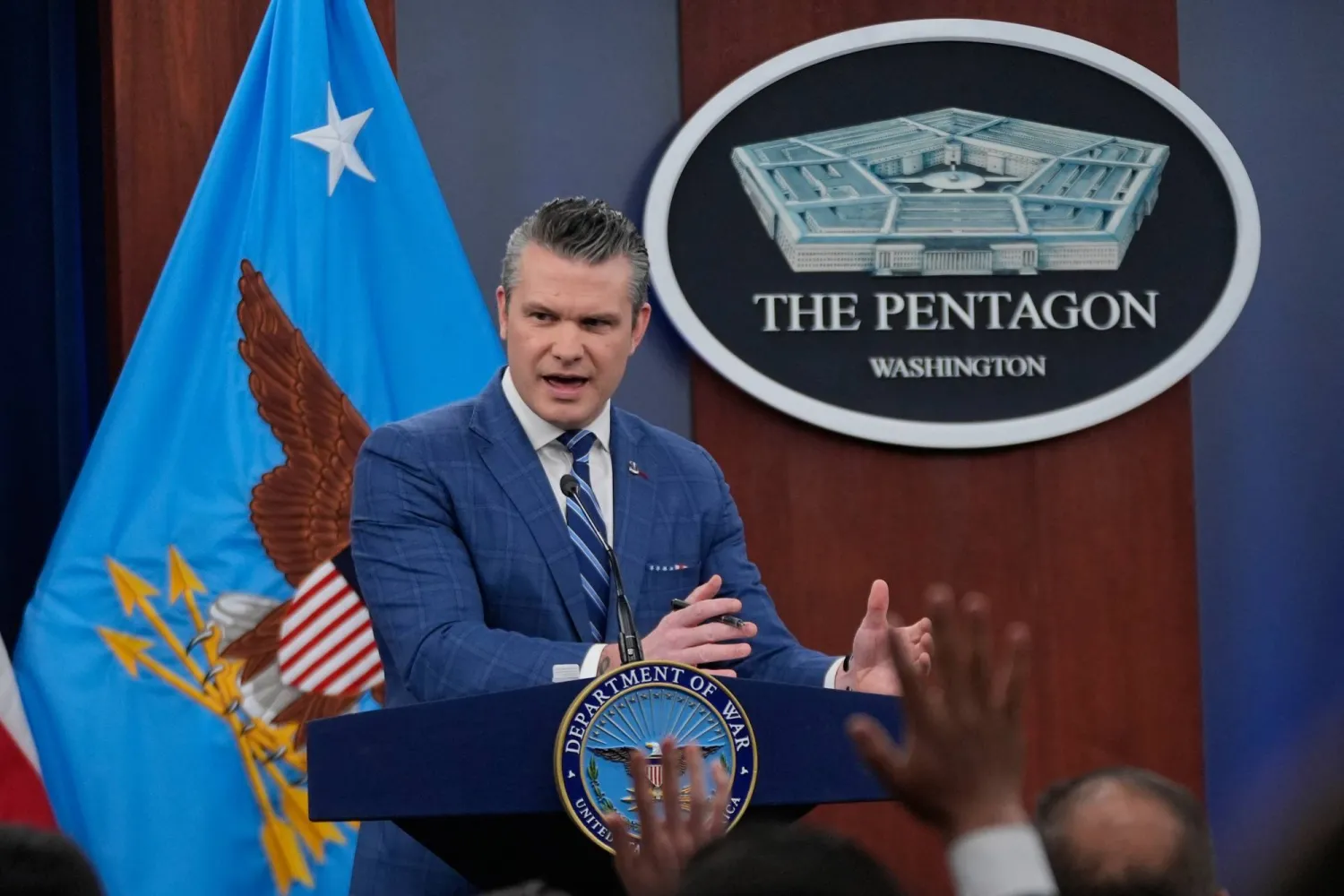
Defense Secretary Pete Hegseth speaks to members of the media during a press briefing at the Pentagon in Washington, Wednesday, April 8, 2026. (AP Photo/Manuel Balce Ceneta)
TT

Pentagon Leaders Assert Destruction of Iran’s Military Capabilities, Threaten to Resume Operations

Defense Secretary Pete Hegseth speaks to members of the media during a press briefing at the Pentagon in Washington, Wednesday, April 8, 2026. (AP Photo/Manuel Balce Ceneta)

The US war against Iran has "completely" destroyed the country's ability to build missiles or other sophisticated weaponry, Defense Secretary Pete Hegseth said Wednesday

"We finished completely destroying Iran's defense-industrial base, a core pillar of our mission," Hegseth told reporters.

"They can no longer build missiles."

For his part, Chairman of the Joint Chiefs of Staff Dan Caine said: “We attacked, along with our partners, approximately 90 percent of their weapons factories,” including facilities producing Shahed-type drones, as well as facilities manufacturing guidance systems used by these drones.

Regarding the naval fleet, Caine said that it will take years before Iran can rebuild its surface combatant capabilities.

The general added that approximately 80 percent of Iran’s nuclear industrial base was targeted, significantly undermining its nuclear weapons development efforts.

He warned that US forces remain ready to resume fighting with Iran if the ceasefire ends, stating: “Let’s be clear: the ceasefire is just a temporary pause. The armed forces remain ready, if ordered, to resume combat operations with the same speed and precision demonstrated over the past 38 days.”

Statements by Dan Caine, and his warning about a possible resumption of fighting, suggest that the announcement of a suspension of the war came under US pressure, according to Michael Rubin, a researcher at the American Enterprise Institute.

As for the restoration of freedom of navigation, military officials’ statements did not indicate that it has been fully secured, instead emphasizing the need to “ensure Iran’s compliance” and the safe passage of vessels.

At the same time, there were continued indications that ships received messages from Iranian forces stating that they require permission to transit the strait, suggesting that Tehran is seeking to establish a new equation: keeping Hormuz open on the condition of recognizing a supervisory or sovereign role for itself.

If that is the case, the region and the global economy would be entering a phase that goes beyond a mere ceasefire, as the risk shifts from missiles to the rules governing transit, insurance, pricing, and maritime fees.

Statements by Pentagon leaders, followed by remarks from Donald Trump, reveal that the real dispute is not over the ceasefire itself, but over what comes after it. Washington rejects the continuation of Iranian uranium enrichment and is demanding that the stockpile of highly enriched uranium be handed over, or “taken” by force if necessary.

By contrast, narratives circulating in Iranian media about the “ten points” of the ceasefire agreement point in a completely different direction: recognition of Iran’s right to enrich, the lifting of sanctions, and no clear position on the fate of the enriched stockpile.

This is precisely where the structural contradiction lies, one that could undermine the negotiating round from its very first day, according to Michael Rubin.

The second aspect of the dispute concerns the scope of de-escalation. The United States and Israel have made clear that a ceasefire with Iran does not mean a halt to Israeli operations in Lebanon against Hezbollah, while reports continued of missile and drone attacks on Gulf states in the hours following the truce. This suggests that the region is facing a form of “selective de-escalation,” according to observers: a direct easing between Washington and Tehran, while proxy arenas and exchanges of messages remain active.

Remarks by Hegseth that Washington had been prepared, just hours earlier, to strike power stations, bridges, and oil and energy infrastructure “that Iran cannot rebuild” indicate that the decision to halt hostilities did not stem from a fully realized settlement, but rather from the suspension of a massive escalatory strike against Tehran.

Accordingly, the ceasefire appears more like a testing window: if Tehran complies with conditions related to navigation and the transfer of uranium, the truce could hold and pave the way toward a definitive end to the war. If not, the United States may return to the option of large-scale destruction of infrastructure.