Iraq's Kurdish Region Goes to the Polls With a Flagging Economy and Political Infighting Top of Mind

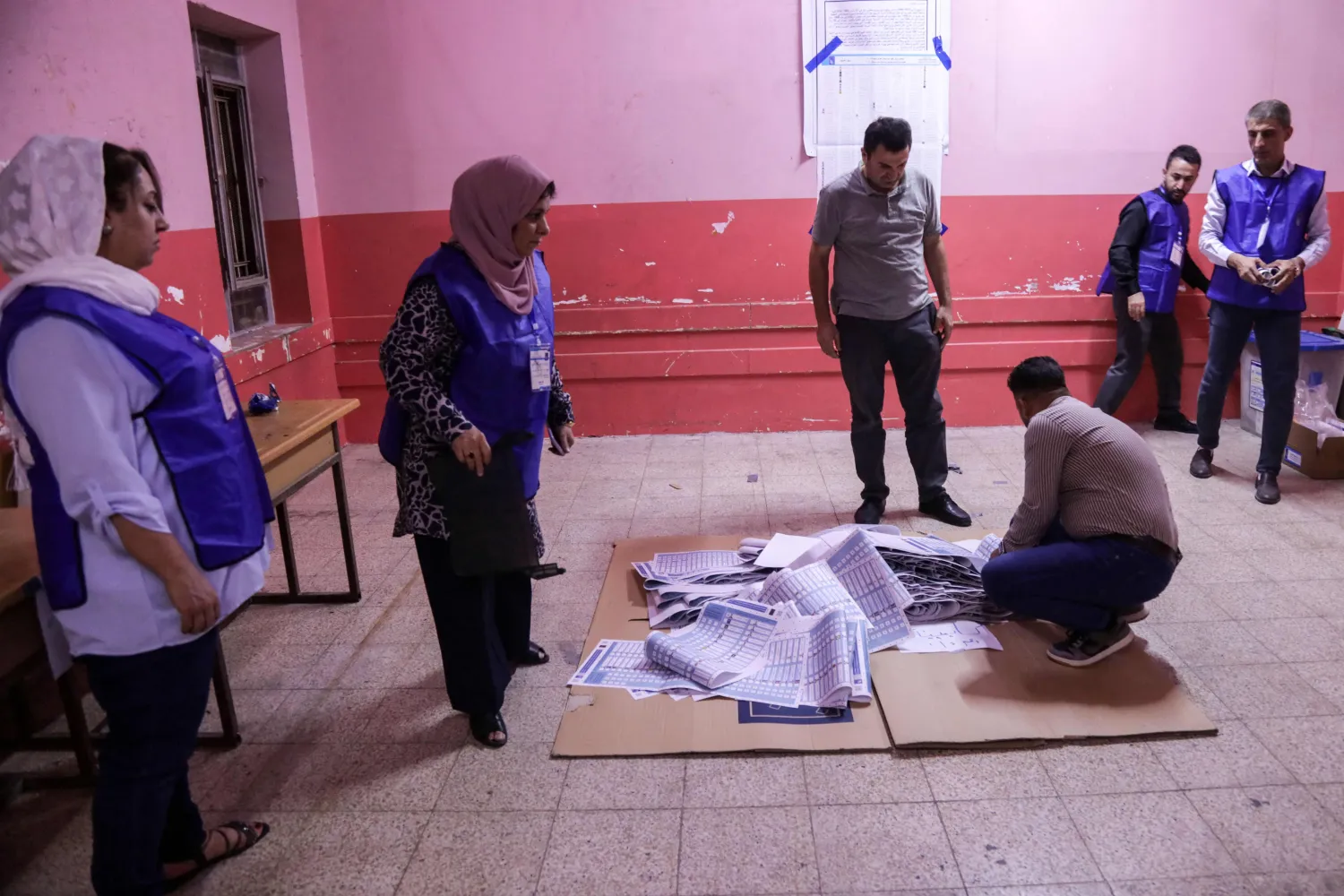
Employees of Iraq's Independent High Electoral Commission (IHEC) count votes at the end of the parliamentary election, at a polling station in Irbil, the capital of Iraq's autonomous northern Kurdish region, on October 20, 2024. (Photo by Safin HAMID / AFP)
TT

Iraq's Kurdish Region Goes to the Polls With a Flagging Economy and Political Infighting Top of Mind

Employees of Iraq's Independent High Electoral Commission (IHEC) count votes at the end of the parliamentary election, at a polling station in Irbil, the capital of Iraq's autonomous northern Kurdish region, on October 20, 2024. (Photo by Safin HAMID / AFP)

Residents of Iraq’s semi-autonomous northern Kurdish region went to the polls in long-awaited parliamentary elections Sunday under the shadow of ongoing rivalries, economic instability and unresolved disputes with Baghdad.
The primary competitors are the two dominant Kurdish parties: the Kurdistan Democratic Party and the Patriotic Union of Kurdistan. The two have historically controlled different parts of the region, with the KDP overseeing the regional capital, Irbil, and Dohuk and the PUK governing Sulaymaniyah.
This division has frequently led to political deadlock. The parliamentary elections, originally set for 2022, were postponed several times amid disputes over the election law and procedures.
Ministry of Interior personnel and peshmerga forces — the regional military — voted in special elections Friday, with the general public voting Sunday.
In Friday’s special election, the KDP secured a significant lead, capturing 60% of the votes, while the PUK got around 30%. The New Generation Movement, an opposition party that has seen a gradual rise in support, garnered 5.3% of the total, up from 3% in the 2018 special election. In that special election, the KDP garnered 40% of the vote and the PUK 28.5%.
While New Generation’s appeal continues to grow, particularly among younger voters frustrated with the traditional political system, it still faces significant challenges in competing with the well-established dominance of the KDP and PUK.
Results of Sunday's vote were expected to be announced Monday.
At some polling centers, there were delays due to malfunctions in fingerprint scanners used for biometric verification of voters’ identities. In some cases, it was unclear if voters whose fingerprints could not be scanned would be able to vote at all.
At a center in Irbil's Ankawa district, resident Raman Ramzi said his wife and mother hadn't been able to vote due to fingerprint and ID recognition issues caused by the biometric machines. A number of other would-be voters left the station without casting a vote due to the same issue.
At another polling station in Irbil, coordinator Sirwan Gardi said that three to four percent of prospective voters' fingerprints were not being recognized by the devices, particularly older people and women.
Rizgar Maghdid, whose fingerprint was not recognized, said he felt sad because he could not vote. Voting “is an essential right of humans,” he said. “I would like to vote for the person who would serve us and our country.”
Regional government Prime Minister Masrour Barzani, a KDP official, called on voters to “reward service and truthfulness and punish the parties that are playing with the rights and destiny of the people of Kurdistan," using the region's local name.
The region’s economic struggles are voters’ primary concern. Despite its oil wealth, the Kurdish region faces significant economic issues, including delayed payment of salaries to civil servants, fluctuating oil prices, and budget cuts from Baghdad. The public is deeply dissatisfied with the economy and lack of opportunities, and many blame political leaders for mismanagement.
“People want to have electricity and get paid their salary on time, and to have more jobs. This is all they want," said Ghazi Najib, who went to the polls in Irbil.
Corruption is also among the central issues in the election. For years, the regional government has faced allegations of nepotism and lack of transparency. Many voters, particularly among the younger generation, are calling for reforms to address these concerns.
Many voters, however, have lost hope for reforms and are also skeptical of opposition parties’ ability to make changes, given the longstanding hold the two major parties have over the political landscape.
Political cooperation with the central government is another key electoral issue. Relations between Irbil and Baghdad have remained tense since a 2017 referendum over independence for the Kurdish region, particularly over issues of oil revenue sharing and budget allocations.
Iraqi Prime Minister Mohammed al-Sudani in a recent visit to Irbil said, “We are committed to ensuring the rights of the Kurdish people, but this must be done within Iraq’s constitution.”
In certain areas, the current elections are significantly influenced by security concerns since the ISIS group sleeper cells are still active in areas that are disputed between the regional and central governments.
“We hope that Kurdistan will be more developed, and to see more safety and reconstruction in Kurdistan,” said Jamila Mohammed Amin, a voter in Irbil. “All political parties and entities should work together and achieve these goals and protect it against enemies.”



Rescue Teams Search for Survivors in Building Collapse that Killed at Least 2 in Northern Lebanon

A Lebanese flag is pictured, in the aftermath of a massive explosion, in Beirut's damaged port area, Lebanon August 17, 2020. REUTERS/Hannah McKay
TT

Rescue Teams Search for Survivors in Building Collapse that Killed at Least 2 in Northern Lebanon

A Lebanese flag is pictured, in the aftermath of a massive explosion, in Beirut's damaged port area, Lebanon August 17, 2020. REUTERS/Hannah McKay

At least two people were killed and four rescued from the rubble of a multistory apartment building that collapsed Sunday in the city of Tripoli in northern Lebanon, state media reported.

Rescue teams were continuing to dig through the rubble. It was not immediately clear how many people were in the building when it fell.

The bodies pulled out were of a child and a woman, the state-run National News Agency reported.

Dozens of people crowded around the site of the crater left by the collapsed building, with some shooting in the air.

The building was in the neighborhood of Bab Tabbaneh, one of the poorest areas in Lebanon’s second largest city, where residents have long complained of government neglect and shoddy infrastructure. Building collapses are not uncommon in Tripoli due to poor building standards, according to The AP news.

Lebanon’s Health Ministry announced that those injured in the collapse would receive treatment at the state’s expense.

The national syndicate for property owners in a statement called the collapse the result of “blatant negligence and shortcomings of the Lebanese state toward the safety of citizens and their housing security,” and said it is “not an isolated incident.”

The syndicate called for the government to launch a comprehensive national survey of buildings at risk of collapse.


Israel to Take More West Bank Powers and Relax Settler Land Buys

A view of Israeli settlement of Maale Adumim, in the West Bank, Sunday, June 18, 2023. (AP)
TT

Israel to Take More West Bank Powers and Relax Settler Land Buys

A view of Israeli settlement of Maale Adumim, in the West Bank, Sunday, June 18, 2023. (AP)

Israel's security cabinet approved a series of steps on Sunday that would make it easier for settlers in the occupied West Bank to buy land while granting Israeli authorities more enforcement powers over Palestinians, Israeli media reported.

The West Bank is among the territories that the Palestinians seek for a future independent state. Much of it is under Israeli military control, with limited Palestinian self-rule in some areas run by the Western-backed Palestinian Authority (PA).

Citing statements by Finance Minister Bezalel Smotrich and Defense Minister Israel Katz, Israeli news sites Ynet and Haaretz said the measures included scrapping decades-old regulations that prevent Jewish private citizens buying land in the West Bank, The AP news reported.

They were also reported to include allowing Israeli authorities to administer some religious sites, and expand supervision and enforcement in areas under PA administration in matters of environmental hazards, water offences and damage to archaeological sites.

Palestinian President Mahmoud Abbas said the new measures were dangerous, illegal and tantamount to de-facto annexation.

The Israeli ministers did not immediately respond to requests for comment.

The new measures come three days before Prime Minister Benjamin Netanyahu is scheduled to meet in Washington with US President Donald Trump.

Trump has ruled out Israeli annexation of the West Bank but his administration has not sought to curb Israel's accelerated settlement building, which the Palestinians say denies them a potential state by eating away at its territory.

Netanyahu, who is facing an election later this year, deems the establishment of any Palestinian state a security threat.

His ruling coalition includes many pro-settler members who want Israel to annex the West Bank, land captured in the 1967 Middle East war to which Israel cites biblical and historical ties.

The United Nations' highest court said in a non-binding advisory opinion in 2024 that Israel's occupation of Palestinian territories and settlements there is illegal and should be ended as soon as possible. Israel disputes this view.


Arab League Condemns Attack on Aid Convoys in Sudan

A general view shows the opening session of the meeting of Arab foreign ministers at the Arab League Headquarters (Reuters)
TT

Arab League Condemns Attack on Aid Convoys in Sudan

A general view shows the opening session of the meeting of Arab foreign ministers at the Arab League Headquarters (Reuters)

Arab League Secretary-General Ahmed Aboul Gheit strongly condemned the attack by the Rapid Support Forces on humanitarian aid convoys and relief workers in North Kordofan State, Sudan.

In a statement reported by SPA, secretary-general's spokesperson Jamal Rushdi quoted Aboul Gheit as saying the attack constitutes a war crime under international humanitarian law, which prohibits the deliberate targeting of civilians and depriving them of their means of survival.

Aboul Gheit stressed the need to hold those responsible accountable, end impunity, and ensure the full protection of civilians, humanitarian workers, and relief facilities in Sudan.