


Eutelsat Uses SpaceX Rocket to Launch First Satellites after Merger

REUTERS/Dado Ruvic Purchase Licensing Rights
TT

Eutelsat Uses SpaceX Rocket to Launch First Satellites after Merger

REUTERS/Dado Ruvic Purchase Licensing Rights

Eutelsat (ETL.PA) the world's third-biggest satellite operator by revenue, launched 20 satellites for its communications network on Sunday, using Elon Musk's SpaceX in its first move since the merger of two European companies last year.

A SpaceX Falcon 9 rocket took of, with Eutelsat satellites from California's Vandenberg Space Force Base at 0513 GMT.

"This is the first OneWeb launch of the satellites since the merger," CEO Eva Berneke told Reuters in an interview. "We will be launching more satellites over the coming years."

The Paris-based group formed by the merger in September last year of France's Eutelsat and Britain's OneWeb has a constellation of over 600 low earth orbit satellites that cater to broadcasters, telecom companies and radio stations.

"We really want to integrate into the telco ecosystem," Berneke said. "Satellites are an interesting niche in the overall connectivity ecosystems where telcos are the big boys in the class and satellite will always be a smaller part."

Advertisement · Scroll to continue

Eutelsat counts telecom operators such as France's Orange (ORAN.PA), and Australia's Telstra (TLS.AX), as clients and is in talks with others such as AT&T (T.N), in the US.

India - a market set to grow 36% a year to $1.9 billion by 2030 - is in the process to allowing satellite services> It has experienced friction between domestic players and companies such as Starlink.

"We have some of our backlog sitting in the Indian market... It sits there until India gets open, the day it gets open, we'll start building," Berneke said.

The company is also in talks with aviation companies to offer in-flight connectivity, including internet browsing, and expects revenue to start increasing from next year, she said.



Forbes Travel Guide Grants Red Sea Destination the World’s First Comprehensive Destination Accreditation

This accreditation follows a year of rigorous efforts and meticulous evaluations aimed at elevating hospitality standards across The Red Sea. - SPA
TT

Forbes Travel Guide Grants Red Sea Destination the World’s First Comprehensive Destination Accreditation

This accreditation follows a year of rigorous efforts and meticulous evaluations aimed at elevating hospitality standards across The Red Sea. - SPA

Red Sea Global announced in a press release today a historic milestone in the global tourism sector as The Red Sea became the first destination ever to receive a comprehensive accreditation from Forbes Travel Guide.

This accreditation follows a year of rigorous efforts and meticulous evaluations aimed at elevating hospitality standards across The Red Sea. The process included a strategic collaboration with Forbes Travel Guide to develop and implement exceptional service standards across five key stages of the guest journey: reservations, land transport, marine transport, air transport, and guest experiences, SPA reported.

Red Sea Global CEO John Pagano stated: "At Red Sea Global, we have always believed that true luxury is defined not only by the beauty of a place, but by how guests feel throughout their entire journey. Receiving Forbes Travel Guide’s accreditation at a destination level is a powerful testament to the culture of exceptional service we have embedded across our teams and operators at every guest touchpoint. This is not merely a hotel standard, but a fully integrated destination-wide system."

Forbes Travel Guide CEO Hermann Elger also praised the milestone, saying: "We congratulate Red Sea Global and The Red Sea team on earning the world’s first accreditation of its kind as a Verified Destination. This achievement marks a significant moment for the hospitality industry. Delivering and sustaining service excellence at a destination scale requires deep commitment across every stage of the guest experience—from booking to farewell. The Red Sea has successfully established a new international benchmark for tourism destinations."

To ensure the consistency of this excellence, Red Sea Global established 182 precise service standards, organized into eight core categories: personalized service, courtesy, efficiency, cleanliness, luxury, comfort, technical skills, and professional appearance. These standards were embedded through a comprehensive institutional framework integrating training, communication, and continuous review, ensuring guests experience this level of excellence throughout the entire destination—not only within resort boundaries.

In parallel with this accomplishment, the first resorts opened at The Red Sea were included in Forbes Travel Guide’s prestigious Star Awards list for this year. The list featured three iconic properties: Six Senses Southern Dunes, The Red Sea; The St. Regis Red Sea Resort; and Nujuma, a Ritz-Carlton Reserve.

Forbes Travel Guide ratings are known for their objectivity and independence, with anonymous inspectors posing as guests to evaluate hundreds of exacting standards focused on service excellence and facility quality. Assessments also extend to intangible elements that shape memorable stays, such as a property’s ability to enhance well-being and the unique sense of place created by design and location.


SpaceX Launches 12th Long-duration Crew to ISS

NASA’s Crew-12 members, Russian cosmonaut Andrey Fedyaev, NASA astronauts Jack Hathaway, Jessica Meir, and ESA astronaut Sophie Adenot walk out of the Operations & Checkout Building at the Kennedy Space Center before transport to Launch Complex 40, ahead of their launch to the International Space Station, in Cape Canaveral, Florida, US, February 13, 2026. REUTERS/Steve Nesius
TT

SpaceX Launches 12th Long-duration Crew to ISS

NASA’s Crew-12 members, Russian cosmonaut Andrey Fedyaev, NASA astronauts Jack Hathaway, Jessica Meir, and ESA astronaut Sophie Adenot walk out of the Operations & Checkout Building at the Kennedy Space Center before transport to Launch Complex 40, ahead of their launch to the International Space Station, in Cape Canaveral, Florida, US, February 13, 2026. REUTERS/Steve Nesius

A SpaceX rocket lifted off from Florida early on Friday with a crew of two US NASA astronauts, a French astronaut and a Russian cosmonaut headed to the International Space Station for an eight-month science mission in Earth orbit.

The two-stage Falcon 9 rocket, topped with an autonomously operated Crew Dragon capsule dubbed Freedom, was launched from the Cape Canaveral Space Force Station, along Florida's Atlantic Coast, at about 5:15 a.m. EST (1015 GMT).

A live NASA-SpaceX webcast showed the 25-story-tall vehicle rising from the launch tower as its nine Merlin engines roared to life, gulping 700,000 gallons of fuel per second, emitting clouds of vapor and a reddish fireball that lit up the predawn sky, Reuters reported.

The four crew were set to ‌reach the space ‌station on Saturday afternoon after a 34-hour flight, docking with ‌the orbiting ⁠laboratory platform some ⁠250 miles (420 km) above Earth.

The mission, designated Crew-12, marks the 12th long-duration ISS team that NASA has flown aboard a SpaceX launch vehicle since the private rocket venture founded in 2002 by billionaire Elon Musk began sending US astronauts to orbit in May 2020.

Crew-12 was led by Jessica Meir, 48, a veteran astronaut and marine biologist on her second trip to the space station, nearly seven years after making history with NASA colleague Christina Koch by ⁠completing history's first all-female spacewalk.

Joining her was Jack Hathaway, 43, ‌a former US Navy fighter pilot and rookie ‌astronaut; European Space Agency astronaut Sophie Adenot, 43, a master helicopter pilot from France; and Russian cosmonaut ‌Andrey Fedyaev, a former military pilot on his second mission to the ISS.

Upon ‌arrival, the team will get busy with a host of scientific, medical and technical research tasks in microgravity, according to NASA.

Those include studies of pneumonia-causing bacteria to improve treatments on Earth, and experiments with plant and nitrogen-fixing microbe interactions to boost food production in space.

Crew-12 will be welcomed aboard ‌the space station by three current ISS occupants - NASA astronaut Chris Williams and Roscosmos cosmonauts Sergey Kud-Sverchkov and Sergei Mikaev.

Four Crew-11 ⁠members who were ⁠supposed to have stayed aboard until the arrival of Crew-12 departed a few weeks early, when an undisclosed serious health condition affecting one forced an unprecedented medical evacuation flight home in mid-January.

The ISS, which spans the length of a football field and ranks as the largest human-made object in space, has been continuously operated by a US-Russian-led consortium that includes Canada, Japan and 11 European countries.

The first hardware for the outpost was launched more than a quarter century ago. It was conceived as part of a multinational venture to improve ties between Washington and Moscow following the Soviet Union's collapse and the end of Cold War rivalries that spurred the original US-Soviet space race in the 1950s and 1960s.

NASA has said it is committed to keeping the space station operating until the end of 2030.


Saudi Arabia: King Abdulaziz Royal Reserve Plants 10,000 Native Trees to Combat Desertification

The project engaged 300 volunteers from government agencies and educational institutions to rehabilitate local ecosystems. SPA
TT

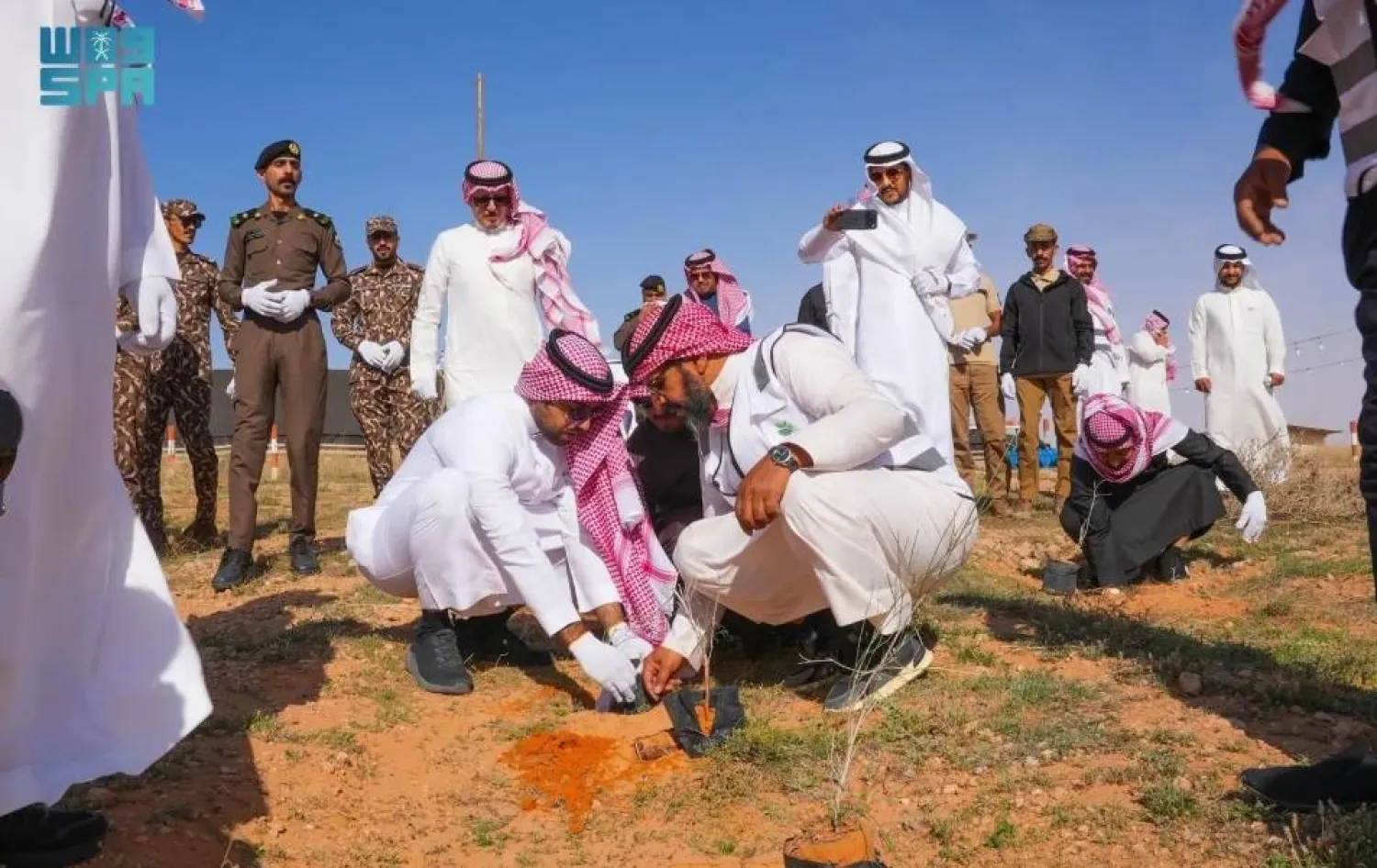
Saudi Arabia: King Abdulaziz Royal Reserve Plants 10,000 Native Trees to Combat Desertification

The project engaged 300 volunteers from government agencies and educational institutions to rehabilitate local ecosystems. SPA

The King Abdulaziz Royal Reserve Development Authority, in partnership with the Green Dahna Association, has launched an initiative to plant 10,000 Arta trees in the Al-Dahna sands.

The project engaged 300 volunteers from government agencies and educational institutions to rehabilitate local ecosystems and promote a culture of environmental stewardship.

Chosen for its high adaptability to harsh desert climates and its effectiveness in soil stabilization, the Arta tree serves as a strategic investment in biodiversity and desertification control.

Authority CEO Maher AlGothmi‏ highlighted that this collaboration exemplifies the institutional integration required to meet Saudi Green Initiative and Vision 2030 goals, ensuring the sustainability of natural resources for future generations through research and community engagement.