


Blinken Urges Israel to Capitalize on Hamas Leader’s Killing to End Gaza War

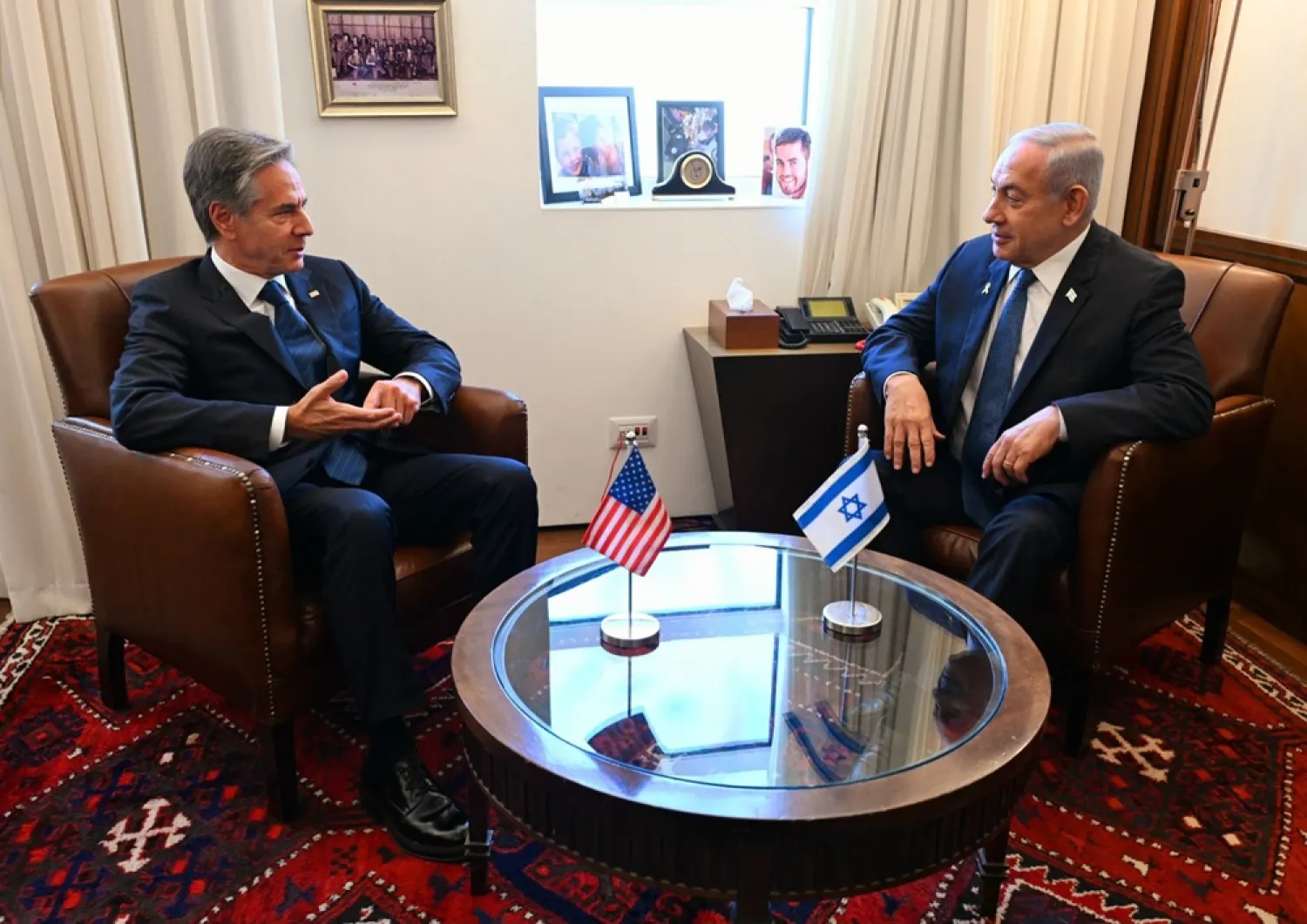
A handout photo made available by Israel's Government Press Office (GPO) shows Israeli Prime Minister Benjamin Netanyahu (R) and US Secretary of State Antony Blinken, meeting in Jerusalem 22 October 2024. (EPA/Handout)
TT

Blinken Urges Israel to Capitalize on Hamas Leader’s Killing to End Gaza War

A handout photo made available by Israel's Government Press Office (GPO) shows Israeli Prime Minister Benjamin Netanyahu (R) and US Secretary of State Antony Blinken, meeting in Jerusalem 22 October 2024. (EPA/Handout)

US Secretary of State Antony Blinken pressed Israeli Prime Minister Benjamin Netanyahu in talks on Tuesday to capitalize on the killing of Hamas' leader by securing the release of the Oct. 7 attack hostages and ending the war in Gaza.

After repeated abortive attempts to broker a ceasefire between Israel and Hamas, Blinken was making his 11th trip to the Middle East since the Gaza war erupted - and the last before a presidential election that could upend US policy.

Blinken was also looking for ways to defuse an escalating spillover conflict between Israel and the Iran-backed armed group Hezbollah in Lebanon, where overnight at least 18 people were killed, including four children, and 60 injured by an Israeli airstrike near Beirut's main state hospital.

Blinken faced an uphill struggle on both fronts.

He spelled out US hopes that the death of Hamas leader Yahya Sinwar - blamed for triggering a year of devastating warfare by planning the deadly militant assault from Gaza on Israeli territory on Oct. 7 last year - will provide a new opportunity for peace.

"The Secretary underscored the need to capitalize on Israel's successful action to bring Yahya Sinwar to justice by securing the release of all hostages and ending the conflict in Gaza in a way that provides lasting security for Israelis and Palestinians alike," the US State Department said in a statement on the Jerusalem meetings.

In a statement issued by his office, Netanyahu said Sinwar's elimination "may have a positive effect on the return of the hostages, the achievement of all the goals of the war, and the day after the war".

But there was no mention of a possible ceasefire after a year of war in which Hamas' military capabilities have been greatly degraded and Gaza largely reduced to rubble, with most of its 2.3 million Palestinians displaced.

Western allies of Israel see Sinwar's killing last week as a potential breakthrough by providing Netanyahu's far-right government political cover to assert that its objectives have been achieved in Gaza.

But Israel has maintained that it will not stop fighting until the Palestinian armed group has been utterly destroyed as a military force and governing entity in Gaza.

For its part, Hamas has refused to free scores of hostages in Gaza seized in its Oct. 7, 2023 raid on Israel without an Israeli pledge to end the war and pull out of the territory.

The State Department said Blinken and Netanyahu also discussed ways of implementing a long moribund 2006 UN resolution passed after the last Israel-Hezbollah war that would restore security and calm along the Israeli-Lebanese border and allow civilians on both sides to return to their homes.

But as Blinken was huddled with Israeli leaders, Hezbollah ruled out negotiations while fighting continues with Israel, and it claimed responsibility for a drone attack targeting Netanyahu's holiday home on Saturday.

In his statement, Netanyahu also said there was a need for a change in the security and political situation in Lebanon that would allow Israelis to return safely to homes that had come under Hezbollah rocket fire.

Hezbollah announced dozens of attacks against Israeli targets on Tuesday, including what it said were Israeli military sites near Haifa and Tel Aviv, suggesting its capabilities have survived Israel's biggest onslaught in decades of hostilities.

Israel has so far shown no sign of relenting in its Gaza and Lebanon campaigns even after assassinating several leaders of Iran's allies Hamas and Hezbollah, which lost its powerful secretary-general Hassan Nasrallah in a Sept. 27 airstrike.

Diplomats say Israel aims to lock in a strong position before a new US. administration takes over following the Nov. 5 election between Vice President Kamala Harris and former president Donald Trump.

MORE HEAVY AIRSTRIKES ON BEIRUT

UN Human Rights Chief Volker Türk on Tuesday said he was "appalled" by the Israeli strike near the Rafik Hariri University Hospital in Beirut overnight.

The hospital had suffered damage, probably by flying missile debris, according to its director Jihad Saadeh. While there were no casualties among the staff, efforts to rescue people in front of the hospital were ongoing, he added.

The Israeli military said the hospital was not among the targets during a night of heavy airstrikes in Beirut's southern suburbs and south Lebanon.

Israeli strikes continued across Lebanon on Tuesday, including one of which caused the precipitous collapse of a multi-storey building near central Beirut, sending more panicked residents fleeing.

Israel's offensive has driven at least 1.2 million Lebanese from their homes and killed 2,530 people, including at least 63 over the past 24 hours, the Lebanese government said on Tuesday.

Nasser Yassin, Lebanon's minister in charge of coordinating the response to the crisis, told Reuters on Tuesday that at least $250 million was needed monthly to support the displaced.

Wholesale conflict has spread from Gaza to Lebanon over the past month with Israel launching a ground campaign and intensified air assaults on Hezbollah, which had been firing across the frontier for a year in solidarity with Hamas.

Blinken was in Israel at the start of a week-long trip that will also take him to Jordan and Qatar. US officials say he is exploring plans for rebuilding and governing Gaza after the war, key to reaching a ceasefire.

Before the talks, a senior State Department official said Blinken would also address Israel's anticipated retaliation for an Oct. 1 ballistic missile attack by Iran.

Allies are worried that Israel's response could disrupt oil markets and ignite a full-blown war between the arch-enemies.



Yemen’s Presidential Leadership Council Praises Saudi Arabia’s Continued Support

Yemeni Presidential Leadership Council meeting in Riyadh (Asharq Al-Awsat)
TT

Yemen’s Presidential Leadership Council Praises Saudi Arabia’s Continued Support

Yemeni Presidential Leadership Council meeting in Riyadh (Asharq Al-Awsat)

Yemen’s Presidential Leadership Council renewed its appreciation to the Kingdom of Saudi Arabia for its continued support of the Yemeni people, the Saudi Press Agency said on Saturday.

The council praised the Kingdom’s leadership under Custodian of the Two Holy Mosques King Salman bin Abdulaziz Al Saud and Prince Mohammed bin Salman bin Abdulaziz Al Saud, Crown Prince and Prime Minister, for their sincere and steadfast positions in backing Yemen. It also commended Saudi Arabia’s dedicated efforts to enhance security and stability, strengthen state institutions, and provide generous humanitarian and development assistance.

The remarks were made during a meeting of the Presidential Leadership Council held on Friday in Riyadh.

The meeting reviewed local developments across various levels, including progress toward restoring recovery and normalizing conditions in the temporary capital, Aden, and in the liberated governorates.

Discussions also focused on the ongoing efforts of local authorities, as well as security and military agencies, to stabilize the situation and advance institutional performance.


Lebanese Army Chief Faces Labeling Dispute During Washington Visit

Lebanese Army Commander General Rodolphe Haykal during his visit to Washington (Lebanese Army Command)
TT

Lebanese Army Chief Faces Labeling Dispute During Washington Visit

Lebanese Army Commander General Rodolphe Haykal during his visit to Washington (Lebanese Army Command)

What was meant to be a routine visit by Lebanese Army Commander General Rodolphe Haykal to Washington to discuss military support and aid coordination turned into a political flashpoint, after a brief meeting with US Senator Lindsey Graham ignited a dispute over whether the army chief would describe Hezbollah as a “terrorist organization.”

The controversy was sparked by a brief meeting with hardline Republican Senator Lindsey Graham, who publicly said he cut the meeting short after Haykal declined to use the designation in what he called the “context of Lebanon.”

What happened in the Graham meeting

In a post on X, Graham said: “I just had a very brief meeting with the Lebanese Chief of Defense General Rodolphe Haykal. I asked him point blank if he believes Hezbollah is a terrorist organization. He said, “No, not in the context of Lebanon.” With that, I ended the meeting.”

“They are clearly a terrorist organization. Hezbollah has American blood on its hands. Just ask the US Marines,” he added.

“They have been designated as a foreign terrorist organization by both Republican and Democrat administrations since 1997 – for good reason.”

“As long as this attitude exists from the Lebanese Armed Forces, I don’t think we have a reliable partner in them.”

“I am tired of the double speak in the Middle East. Too much is at stake,” Graham concluded.

The reaction went beyond expressions of displeasure. Some US coverage suggested Graham effectively raised questions about the “usefulness” of continuing support for the Lebanese army if such a gap persists between the US position and Lebanon’s official language.

Haykal’s answer raises its cost in Washington

Inside Lebanon, the issue is not limited to the stance on Hezbollah. Still, it extends to the army’s role as a unifying institution in a country whose political balance rests on sectarian arrangements and deep sensitivities.

Adopting an external designation, even a US one, in official language by the head of the military could be interpreted domestically as a move that risks triggering political and sectarian division or drawing the army into confrontation with a component that has organized political and popular representation.

That explains why Lebanese voices, including some critics of Hezbollah, defended the logic that “the state does not adopt this classification.” Therefore, the army commander cannot formally do so.

In other words, Haykal sought to avoid two conflicting languages: Washington’s legal and political framing of Hezbollah, and the Lebanese state’s language, which walks a fine line between the demand for exclusive state control over arms and the avoidance of reproducing internal fractures.

US State Department position

Amid the controversy surrounding the Graham meeting, an official US position emerged on Tuesday through the US Embassy in Beirut, welcoming the visit and focusing on the core US message.

The statement said that “the Lebanese Armed Forces’ ongoing work to disarm non-state actors and reinforce national sovereignty as Lebanon’s security guarantor is more important than ever.”

The wording was notable because it separated two levels: continued US reliance on the army as a state institution, and, in practice, linking that reliance to the issue of disarming non-state actors.

The phrase avoids direct naming but, in the Lebanese context, is widely understood to refer primarily to Hezbollah.

The visit’s broader track

Despite the political awkwardness, Haykal’s visit was not reduced to a single meeting. He held senior-level military talks, including meetings with US Central Command chief Admiral Brad Cooper and Chairman of the Joint Chiefs of Staff General Dan Caine.

According to a statement from a Joint Chiefs spokesperson, the meeting “reaffirmed the importance of enduring US defense relationships in the Middle East.”

The visit coincided with broader discussions in Washington on support for the Lebanese army and plans to extend state authority, as international reports spoke of Lebanon entering new phases of a plan to dismantle illegal weapons structures in the south and north.

The army commander’s visit had initially been delayed for reasons that add another layer to understanding Washington’s sensitivity to the military’s language.

In November 2025, sources quoted the US State Department as saying Washington canceled scheduled meetings with the Lebanese army commander after objecting to an army statement on border tensions with Israel, prompting the visit to be postponed to avoid a pre-emptive political failure.


Egypt Steps Up Efforts to Support Gaza Administration Committee After Entry Stalled

Displaced Palestinians inspect the damage after Israeli aircraft targeted a five floor house last night, in Khan Younis southern Gaza Strip on February 6, 2026. (AFP)
TT

Egypt Steps Up Efforts to Support Gaza Administration Committee After Entry Stalled

Displaced Palestinians inspect the damage after Israeli aircraft targeted a five floor house last night, in Khan Younis southern Gaza Strip on February 6, 2026. (AFP)

Egypt is intensifying efforts to back the National Committee for the Administration of Gaza, hoping it can begin operating inside the enclave to implement commitments under the second phase of the ceasefire agreement, which started about two weeks ago but has yet to take shape on the ground.

Experts told Asharq Al-Awsat that those Egyptian efforts, through phone calls and meetings with international partners, are focused on two main objectives: pushing for the deployment of police forces and an international stabilization force on the one hand, and securing a gradual Israeli withdrawal on the other, increasing pressure on Israel to move the agreement forward.

A member of the administration committee said in a brief phone statement to Asharq Al-Awsat, speaking on condition of anonymity, that there is still no specific date for entering the enclave.

In the Slovenian capital, Ljubljana, Egyptian Foreign Minister Badr Abdelatty stressed Cairo’s full support for the work of the committee headed by Dr. Ali Shaath.

He made the remarks during a dialogue session of the Arab-Islamic committee on Gaza with Slovenian Foreign Minister Tanja Fajon.

The foreign ministers of Saudi Arabia, Jordan, and Bahrain attended the meeting. Abdelatty stressed the importance of the committee’s role in managing the daily affairs of Gaza’s residents and meeting their basic needs during the transitional phase.

He underscored the need to ensure the continued flow of humanitarian and relief aid into the enclave, as well as the formation and deployment of an international stabilization force to monitor the ceasefire.

Abdelatty reiterated his stance during a phone call on Friday with British Foreign Secretary Yvette Cooper.

The Gaza committee, established under the ceasefire agreement, operates under the supervision of the Board of Peace, chaired by US President Donald Trump. The committee has been holding meetings in Cairo since it was announced last month and has yet to enter Gaza.

Ahmed Fouad Anwar, a member of the Egyptian Council for Foreign Affairs and an academic specializing in Israeli affairs, said Egypt is making significant efforts to facilitate the committee’s mission as quickly as possible and enable it to operate.

He said this would limit Israeli obstacles, increase pressure on Israel, and place it under the obligations set out in the plan, particularly withdrawal from Gaza. This would counter intense pressure from Tel Aviv to accelerate the disarmament of Hamas without implementing its Gaza agreement commitments.

Palestinian political analyst Abdel Mahdi Motawea said Israel objected not only to the committee’s work but even to its emblem.

He noted, however, that Israel is not the only party hindering the committee. Hamas and other factions want to impose conditions on the committee’s work.

He warned of serious concerns that the committee could be marginalized, stressing that Egypt’s extensive efforts to support it are crucial at this critical stage of the Gaza agreement.

Hamas announced days ago that it was ready to hand over management of the enclave to the committee, while Israel continues to obstruct it.

Anwar expects the committee to begin operating in the enclave soon if Egypt’s efforts and those of international partners succeed and Washington responds positively.

He warned that the committee's failure would threaten the ceasefire agreement.