In East Lebanon, Looming Winter Hints at Stretched Aid Response

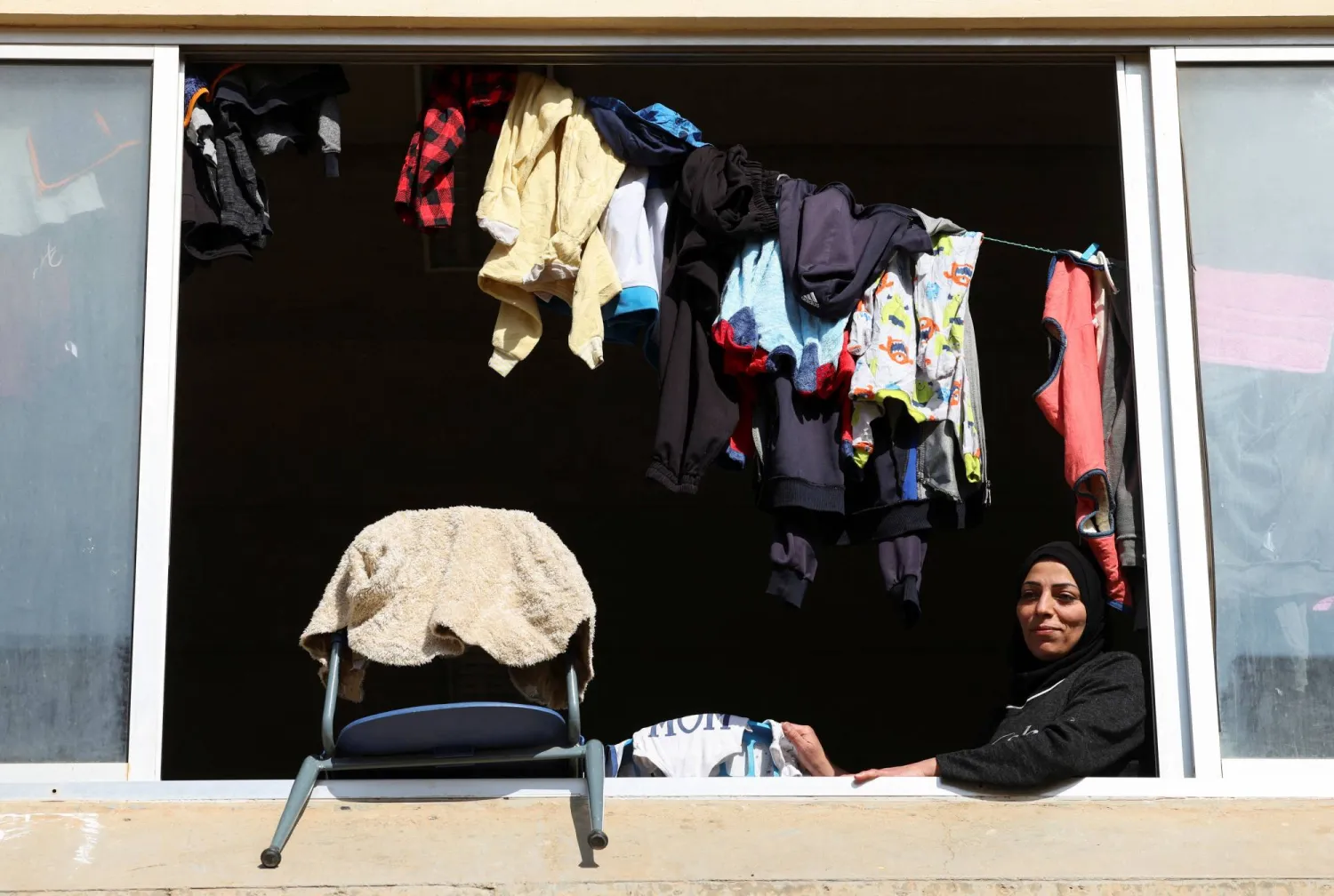
A displaced woman looks out from a window at a school turned into a shelter housing displaced people who fled from Baalbek and surrounding areas, in the mountainous Christian town of Deir al-Ahmar in eastern Lebanon October 31, 2024. REUTERS/Mohamed Azakir
TT

In East Lebanon, Looming Winter Hints at Stretched Aid Response

A displaced woman looks out from a window at a school turned into a shelter housing displaced people who fled from Baalbek and surrounding areas, in the mountainous Christian town of Deir al-Ahmar in eastern Lebanon October 31, 2024. REUTERS/Mohamed Azakir

Nerjes Hassan was so worried her children would fall ill from bathing in the frigid water of a displacement shelter in northeast Lebanon that she drove back into her hometown to give them a hot bath and pick up food preserves.
While at home on Wednesday morning in the town of Buday, near the eastern city of Baalbek, an Israeli air strike killed her, her husband and her two children, according to her coworkers and neighbors.
Hassan, who worked for the Lebanese Organization for Studies and Training (LOST) aid organization, was among thousands seeking refuge from Israeli strikes in the mountainous Christian town of Deir al-Ahmar in eastern Lebanon.
The town was already hosting more than 10,000 displaced people before Israel escalated its strikes on predominantly Shi'ite Muslim Baalbek and nearby towns starting on Wednesday this week.
Thousands more are flowing into Deir al-Ahmar as Israel's bombardment continues. The needs are growing, temperatures are dropping, and supplies in the town are getting tight.
In one school now serving as a shelter, aid groups that once served two meals have cut breakfast to feed more at lunch. Townspeople have put together donation drives for winter clothes and blankets but are facing shortages, leaving displaced sharing blankets overnight.
"If we flee the bombing, are we meant to die of cold?" said Suzanne Qassem, a mother of two at one displacement center, whose home in Buday had been destroyed.
"I'm sick, I've been taking medicine for a week and I'm still coughing... If my son gets sick, am I going to be able to get him medicine?"
'LIKE A SIEGE'
Temperatures in Deir al-Ahmar are dropping to 6 degrees Celsius (43 degrees Fahrenheit) overnight even before winter fully sets in and the schools have no diesel to run central heating systems.
"At night, we're shaking. I put my mattress up next to my daughter and tell her to hug me so that we can keep warm. But we're not keeping warm," said Neyfe Mazloum, 69.
Most families fled with just the clothes on their backs, rushing out of their homes after Israeli evacuation warnings for Baalbek and surrounding towns on Wednesday and Thursday.
More than 1.2 million people have been displaced by Israeli strikes on Lebanon over the last year in its campaign against militant group Hezbollah. That includes nearly 190,000 who have sought refuge in shelters. Others are staying with relatives, have rented out homes, or are sleeping in the streets.
Lebanon's crisis management cell says that out of 1,130 accredited shelters, 948 have reached maximum capacity. Most of the displaced are in the districts of Mount Lebanon and Beirut - easy to reach for most aid organizations.
But Deir al-Ahmar is much further afield.
The quickest routes run through the massive area that the Israeli military says must evacuate. To avoid it, aid groups planning to deliver supplies this week will travel further north through mountain peaks before cutting back down to the town.
Imran Riza, the United Nations humanitarian coordinator for Lebanon, told Reuters that aid deliveries to the Baalbek region had to be postponed this week due to Israeli air strikes. Other deliveries of medical aid to Lebanon from foreign countries have been delayed due to strikes near the airport.
"Access is becoming more and more difficult. The needs are growing in Deir al-Ahmar. It's up to us to try to get there, and to plan a way to be able to access it in a way that is reasonably safe," he said.
Local volunteers are worried that the looming winter will cut off the only safe route into Deir al-Ahmar, leaving them stranded.
"That road will close with the first snow. It will be like a siege," said Khodr Zeaiter, a volunteer with LOST. Displaced himself, he is now helping to organize aid in Deir al-Ahmar.
Beyond the immediate concerns of food and fuel, Zeaiter is worried about the education ministry's directive that public schools - now hosting displaced - will need to reopen for students in three weeks.
Volunteers are studying the possibility of refurbishing an abandoned school to host morning and evening classes, he said.
"We're grateful to the people of Deir al-Ahmar so much. It's their solidarity that has gotten us through this. But how long that will last - who knows."



Rescue Teams Search for Survivors in Building Collapse that Killed at Least 2 in Northern Lebanon

A Lebanese flag is pictured, in the aftermath of a massive explosion, in Beirut's damaged port area, Lebanon August 17, 2020. REUTERS/Hannah McKay
TT

Rescue Teams Search for Survivors in Building Collapse that Killed at Least 2 in Northern Lebanon

A Lebanese flag is pictured, in the aftermath of a massive explosion, in Beirut's damaged port area, Lebanon August 17, 2020. REUTERS/Hannah McKay

At least two people were killed and four rescued from the rubble of a multistory apartment building that collapsed Sunday in the city of Tripoli in northern Lebanon, state media reported.

Rescue teams were continuing to dig through the rubble. It was not immediately clear how many people were in the building when it fell.

The bodies pulled out were of a child and a woman, the state-run National News Agency reported.

Dozens of people crowded around the site of the crater left by the collapsed building, with some shooting in the air.

The building was in the neighborhood of Bab Tabbaneh, one of the poorest areas in Lebanon’s second largest city, where residents have long complained of government neglect and shoddy infrastructure. Building collapses are not uncommon in Tripoli due to poor building standards, according to The AP news.

Lebanon’s Health Ministry announced that those injured in the collapse would receive treatment at the state’s expense.

The national syndicate for property owners in a statement called the collapse the result of “blatant negligence and shortcomings of the Lebanese state toward the safety of citizens and their housing security,” and said it is “not an isolated incident.”

The syndicate called for the government to launch a comprehensive national survey of buildings at risk of collapse.


Israel to Take More West Bank Powers and Relax Settler Land Buys

A view of Israeli settlement of Maale Adumim, in the West Bank, Sunday, June 18, 2023. (AP)
TT

Israel to Take More West Bank Powers and Relax Settler Land Buys

A view of Israeli settlement of Maale Adumim, in the West Bank, Sunday, June 18, 2023. (AP)

Israel's security cabinet approved a series of steps on Sunday that would make it easier for settlers in the occupied West Bank to buy land while granting Israeli authorities more enforcement powers over Palestinians, Israeli media reported.

The West Bank is among the territories that the Palestinians seek for a future independent state. Much of it is under Israeli military control, with limited Palestinian self-rule in some areas run by the Western-backed Palestinian Authority (PA).

Citing statements by Finance Minister Bezalel Smotrich and Defense Minister Israel Katz, Israeli news sites Ynet and Haaretz said the measures included scrapping decades-old regulations that prevent Jewish private citizens buying land in the West Bank, The AP news reported.

They were also reported to include allowing Israeli authorities to administer some religious sites, and expand supervision and enforcement in areas under PA administration in matters of environmental hazards, water offences and damage to archaeological sites.

Palestinian President Mahmoud Abbas said the new measures were dangerous, illegal and tantamount to de-facto annexation.

The Israeli ministers did not immediately respond to requests for comment.

The new measures come three days before Prime Minister Benjamin Netanyahu is scheduled to meet in Washington with US President Donald Trump.

Trump has ruled out Israeli annexation of the West Bank but his administration has not sought to curb Israel's accelerated settlement building, which the Palestinians say denies them a potential state by eating away at its territory.

Netanyahu, who is facing an election later this year, deems the establishment of any Palestinian state a security threat.

His ruling coalition includes many pro-settler members who want Israel to annex the West Bank, land captured in the 1967 Middle East war to which Israel cites biblical and historical ties.

The United Nations' highest court said in a non-binding advisory opinion in 2024 that Israel's occupation of Palestinian territories and settlements there is illegal and should be ended as soon as possible. Israel disputes this view.


Arab League Condemns Attack on Aid Convoys in Sudan

A general view shows the opening session of the meeting of Arab foreign ministers at the Arab League Headquarters (Reuters)
TT

Arab League Condemns Attack on Aid Convoys in Sudan

A general view shows the opening session of the meeting of Arab foreign ministers at the Arab League Headquarters (Reuters)

Arab League Secretary-General Ahmed Aboul Gheit strongly condemned the attack by the Rapid Support Forces on humanitarian aid convoys and relief workers in North Kordofan State, Sudan.

In a statement reported by SPA, secretary-general's spokesperson Jamal Rushdi quoted Aboul Gheit as saying the attack constitutes a war crime under international humanitarian law, which prohibits the deliberate targeting of civilians and depriving them of their means of survival.

Aboul Gheit stressed the need to hold those responsible accountable, end impunity, and ensure the full protection of civilians, humanitarian workers, and relief facilities in Sudan.