Saudi Arabia’s AROYA Cruises Announces First Voyage in Decemberhttps://english.aawsat.com/varieties/5079445-saudi-arabia%E2%80%99s-aroya-cruises-announces-first-voyage-december
Saudi Arabia’s AROYA Cruises Announces First Voyage in December
The three-night voyage will depart from Jeddah Port to a Red Sea island exclusively for cruise passengers
AROYA Cruises, a subsidiary of Cruise Saudi and wholly owned by the Public Investment Fund (PIF), announced that its inaugural cruise would be on December 16.
The three-night voyage will depart from Jeddah Port to a Red Sea island exclusively for cruise passengers.
AROYA Cruises aims to provide authentic Arabian experiences inspired by Saudi heritage. As the first Arab cruise line, it seeks to offer a new model for holidays with a distinctive Arabian feel, catering specifically to Arab preferences and tastes.
This underwater photo taken on September 25, 2026 shows an endangered adult green sea turtle resting on the sandy seabed next to a coral reef formation off the coast of Mataking Island in Semporna, in Malaysia's eastern state of Sabah. (Photo by SAI AUNG MAIN / AFP)
As Species Decline, Green Turtles Offer Glimmer of Hope
This underwater photo taken on September 25, 2026 shows an endangered adult green sea turtle resting on the sandy seabed next to a coral reef formation off the coast of Mataking Island in Semporna, in Malaysia's eastern state of Sabah. (Photo by SAI AUNG MAIN / AFP)
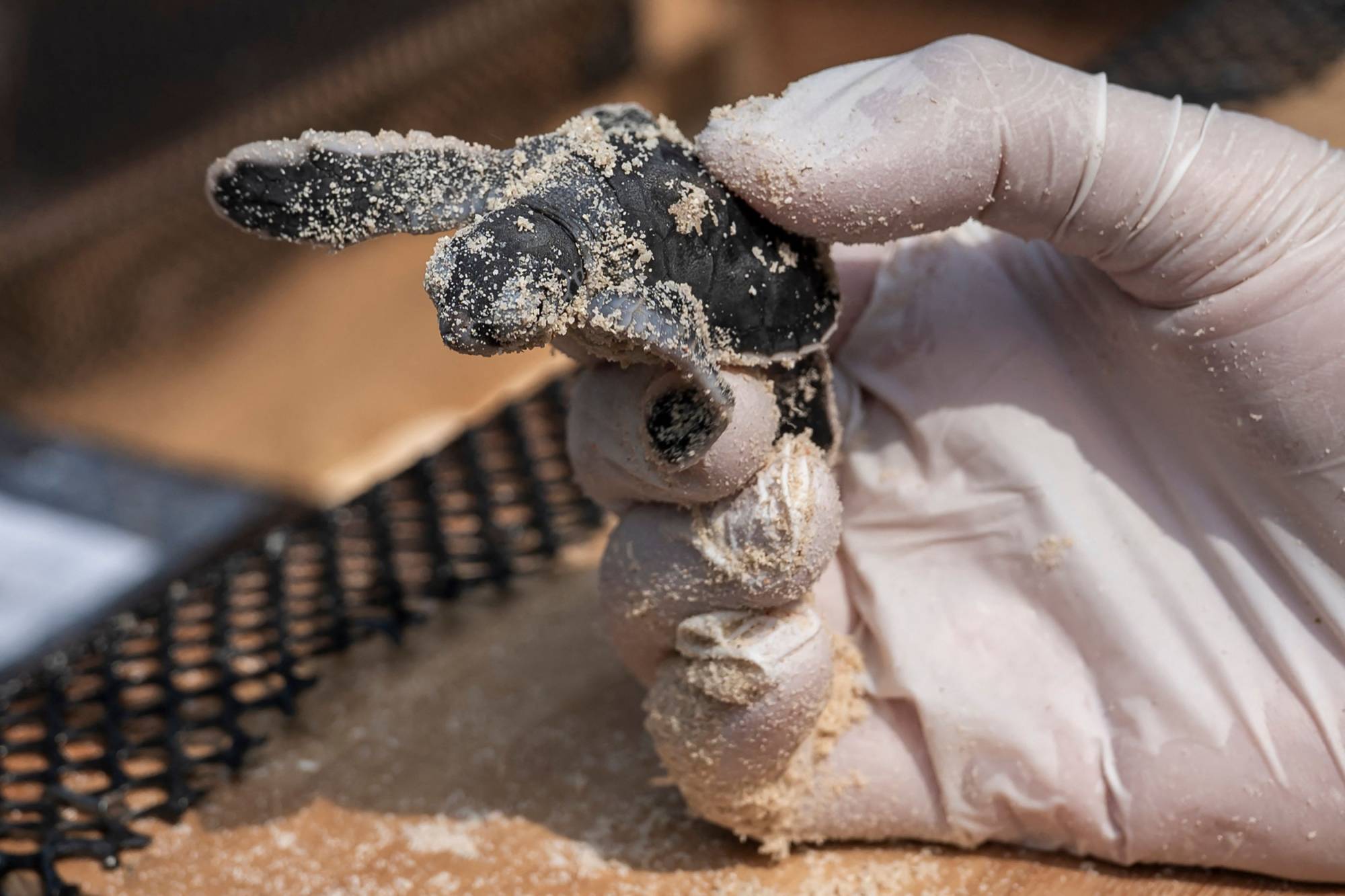
The palm-sized green turtle hatchling flailing through the sand on a Malaysian island may seem vulnerable, but its species has emerged as a symbol of hope for wildlife conservation.
Green turtles have made the rare jump from endangered to "least concern" in global conservation rankings, a remarkable success when many species are declining.
Conservation NGO World Wildlife Fund (WWF), in its biannual Living Planet Report released Thursday, found a 73-percent decline in the average size of monitored wildlife populations over 53 years.
But around 50 percent of the thousands of vertebrates monitored for the report are stable or increasing.
That includes green turtles, thanks to decades of efforts including egg relocation, marine protection and trade bans.
Malaysian turtle expert Juanita Joseph has spent years on the frontlines, carrying out cutting-edge genetic research and even convincing her own father to stop eating turtle eggs.
Still, when the International Union for the Conservation of Nature last year announced green turtles were no longer endangered, she could hardly believe it.
"Never in my mind (did I think) that one day turtles can be 'least concern'. I cried... I said I've done my part," she told AFP at Universiti Malaysia Sabah, where she is a professor.
This photo taken on September 24, 2026 shows a conservationist holding a green sea turtle hatchling on Mataking Island, off Semporna in Malaysia's eastern state of Sabah. (Photo by SAI AUNG MAIN / AFP)
All six other sea turtle species are still vulnerable or critically endangered, apart from the flatback turtle, whose status is unclear because of data shortages.
Turtles are targeted for food and their shells, killed in fishing nets, and constrained by development and pollution at nesting beaches and feeding grounds.
Climate change also skews populations more female because heat determines sex development in eggs.
Even now, recovery is uneven. While green turtles globally are "least concern", some regional populations are still endangered and declining.
- 'Our heritage' -
Malaysia is something of a regional exception. Green turtle nesting at Sabah state's Turtle Islands has tripled since the 1970s to over 20,000 nests annually.
That reflects "over five decades" of work, said Sabah Parks director Maklarin Lakim.
The Turtle Islands have been protected since 1977, and Sabah banned turtle meat and egg consumption in 1997.
"This is our heritage, this is our biodiversity," Maklarin said.
"We would like to protect that as long as possible."
Much of the conservation success has relied on people like Sitti Rasah Abdul, 50, from a fishing community on Malaysia's Omadal island.
Since 2012, she and other members of a women's cooperative have relocated turtle eggs from beaches to a hatchery to protect them from predators and poachers.
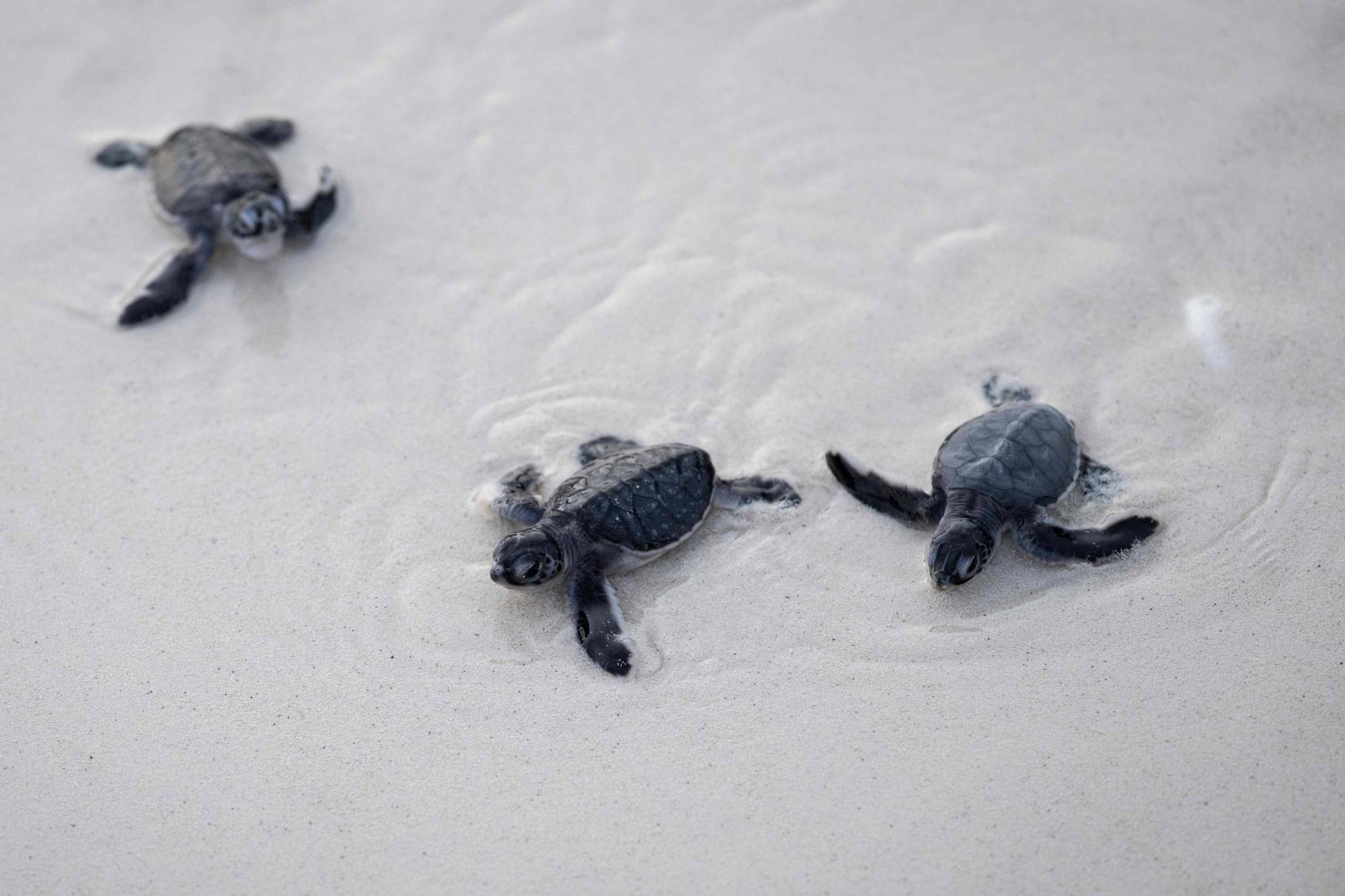
This photo taken on September 25, 2026 shows newborn green turtles crawling across a sandy beach towards the sea after being released from a wildlife protected area on Mataking Island, Semporna, in Malaysia's Sabah region. (Photo by SAI AUNG MAIN / AFP)
The 20-strong team started conservation work with WWF, but now self-funds, ploughing 10 percent of revenue from their handicraft and catering business into turtle protection.
"I'm already old," said Rasah, on the wooden jetty that extends from her home into aquamarine seawater.
"But I feel a sense of responsibility to ensure that there are still turtles around for the next generation."
A 45-minute boat ride away, green and hawksbill turtle hatchlings emerged from relocated nests in a hatchery at the high-end Mataking Reef Resort.
Hotel owner Sophia Sie fell in love with turtles decades ago when her father acquired land on Mataking island, and now around 10 percent of her staff works on conservation.
In 2006, "we had about 600 eggs collected... today we have about 36,000 eggs," Sie told AFP.
Guests can release hatchlings, and while Sie considers conservation a passion, it is also good business.
"The survival of our business here is very much dependent on the natural resources and the beauty around us," she said.
- 'Long-term project' -
The hatchlings tipped from a basket onto a Mataking beach face long odds. Just one in 1,000 will survive to sexual maturity at 20 years old.
Hatchlings spend around a decade in the open ocean, a period sometimes called the "lost years" because scientists know so little about it.
Working out where turtles spend those years, and where they forage and reproduce, is key to sustaining conservation success, said Gavin Jolis, marine species strategy manager at WWF-Malaysia.
The NGO has created the world's first global turtle DNA database, Shellbank, using samples from turtle tissue and shells to trace populations and even target poachers.
"In order to save sea turtles, we have to look at the life cycle," said Jolis.
"That's where the genetic work comes in."
The neat rows of test tubes in Joseph's lab contain bits of hatchling flipper snipped from babies that did not survive.
Sequencing them reveals a turtle's "haplotype", a kind of genetic fingerprint.
The work has already helped show that turtles foraging in parts of Malaysia come from Micronesia, and identified the likely source of turtle shell intercepted in Britain.
While each conservation effort faces different challenges, the battle to protect green turtles teaches "to really be resilient and patient with the work", said Jolis.
"We should not look at just a short-term project, it's a long-term project."
Damaged and Drained, Indonesia's Peatlands Go Up in Smokehttps://english.aawsat.com/varieties/5328990-damaged-and-drained-indonesias-peatlands-go-smoke
Damaged and Drained, Indonesia's Peatlands Go Up in Smoke
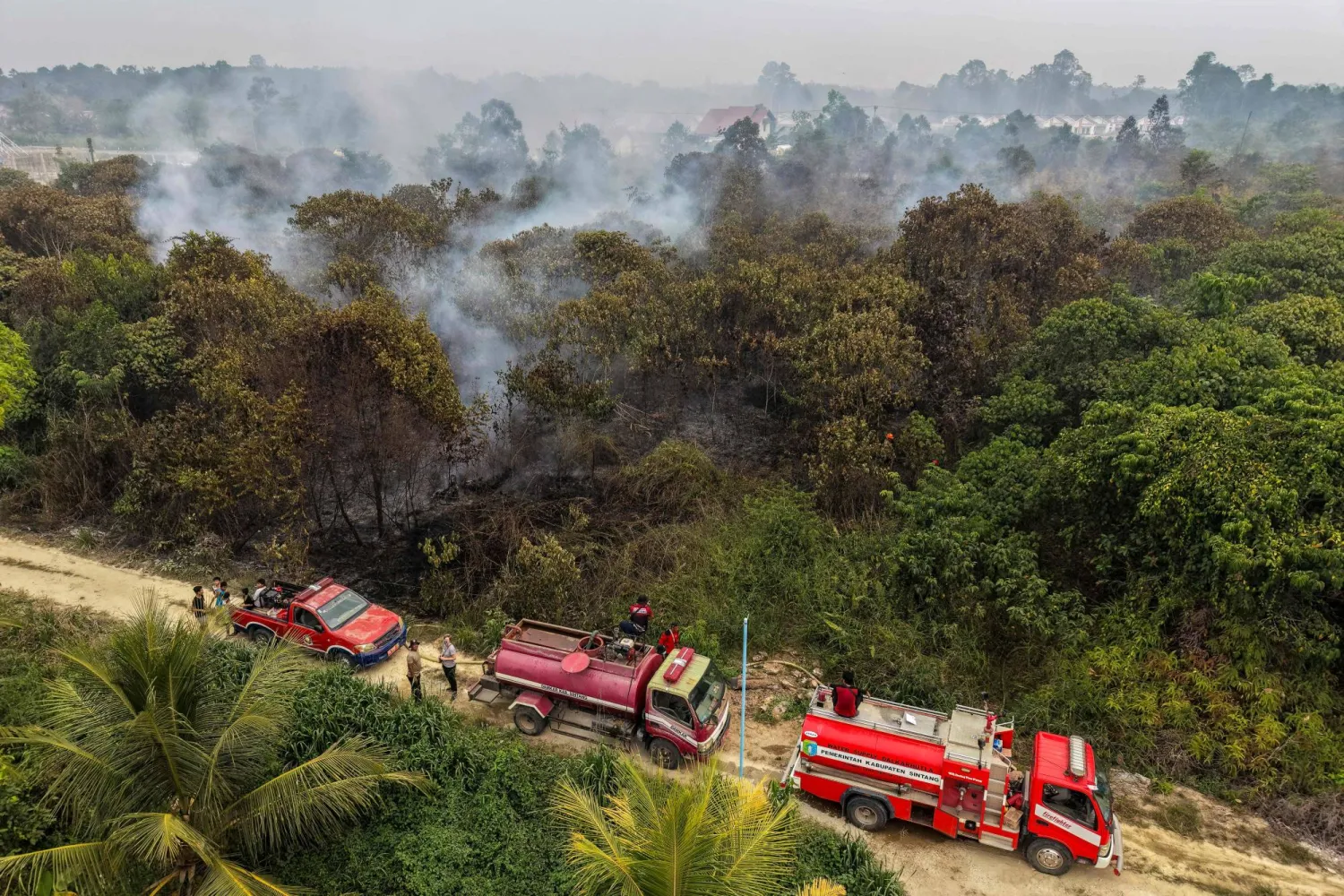
(FILES) This aerial picture shows fire fighters battling peatland fires in Sintang, West Kalimantan on September 5, 2026. (Photo by BAY ISMOYO / AFP)
For weeks on end, parts of Indonesian Borneo have resembled an Armageddon landscape with masked residents immersed in a putrid, red-brown haze as wildfires devour peatlands near homes and farms.
Burning slowly, mostly under the surface and sometimes for months on end, peatland fires are responsible for much of the dry season haze that this year has tainted air as far afield as Malaysia, Singapore and the Philippines.
- What are peatlands? –
Peatlands are composed of organic material that does not completely decompose in water-logged conditions and has settled over thousands of years into a layered soil-like substance.
Healthy peatlands are home to diverse plants and trees like nutmeg and durian, and animals that can include endangered orangutans, clouded leopards, Sumatran tigers, sun bears and tapirs.
They are porous and absorbent, making them critical for flood containment.
While they cover only about three percent of global land, peatlands store about a third of the world's soil carbon -- double that trapped by forests.
Indonesia has the world's biggest share of tropical peatland, about a third of the global total.
- Why are they burning? –
Of Indonesia's estimated 24.2 million hectares (93,400 square miles) of peatland, 16.4 million hectares have been degraded and are vulnerable to fire, according to the Pantau Gambut NGO.
The culprit is mainly industrial-scale plantations for timber, pulp and paper, rice paddies and palm oil, of which Indonesia is the world's biggest producer by far.
To cultivate peatlands, they are drained with canal networks that in Indonesia span about 285,000 kilometers (177,000 miles), according to Pantau Gambut research -- seven times the circumference of Earth.
The water runs into rivers or the sea, leaving the dried-out peatlands vulnerable to burning, especially in strong El Nino years that can bring severe drought to Indonesia.
Peatland fires are often imperceptible but for the foul smoke they emit and the heat they generate underfoot, AFP reported.
The many layers of thick carbon can keep smoldering in "zombie fires" for weeks, and are hard to put out.
- What are the impacts? -
While less than a third of wildfires in Indonesia are on peatlands, they produce most of the haze, according to Greenpeace research.
This toxic smog contains harmful elements including formaldehyde, hydrogen cyanide and ammonia, as well as PM2.5 particles small enough to penetrate the lungs or bloodstream.
The World Health Organization has linked PM2.5 exposure to increased illness and death.
Indonesia and Malaysia have shut hundreds of schools over haze, and more than 170,000 people in Indonesia required treatment for acute respiratory infections in August and September, according to the health ministry.
Many more fell ill in Malaysia and Singapore.
Peatland fires also ravage the habitats of animals, further imperiling already endangered species such as orangutans and Sumatran rhinos.
- What about greenhouse gases? -
By October 6, Indonesian wildfires had emitted 140.5 megatons of planet-warming carbon, around 13 percent of the global total this year, according to the Copernicus Atmosphere Monitoring Service.
That was the highest figure for Indonesia fire emissions since 2019, another strong El Nino year.
Indonesia emits significant greenhouse gases from its coal-powered electricity grid, and is seeking to reduce its emissions in part by relying on forests, peatlands and other land ecosystems to absorb more than they emit.
- What is being done? -
Activists and experts say concession licenses for extractive activities on peatlands must be revoked, and peatlands should be rewetted and planted with native species.
Canals should be blocked, they say.
Indonesia has a moratorium in place on new permits to clear 66 million hectares of land designated as primary forest and peatland.
In a statement last year, the government said it had rewetted 4.16 million hectares of peatland, built 45,000 canal barriers and replanted various native species.
But there are doubts about some of that work.
"Today, some of the peat hydrological units that have received major restoration efforts... have experienced fires and have some of the highest hotspot counts," Greenpeace forest campaigner Belgis Habiba told AFP.
Last month, the government announced the creation of a new National Peatland and Mangrove Management agency to replace a body whose mandate expired in 2024.
The agency's remit and resources are still being worked out, but there are concerns its name mentions neither restoration nor protection.
"Does managing in this context serve as a pretext for the state to grant new concessions on peatlands?" asked Belgis.
The forestry ministry did not reply to AFP's request for input.
Siberian Hunters Declare Open Season on Bears after Spate of Deadly Attackshttps://english.aawsat.com/varieties/5328985-siberian-hunters-declare-open-season-bears-after-spate-deadly-attacks
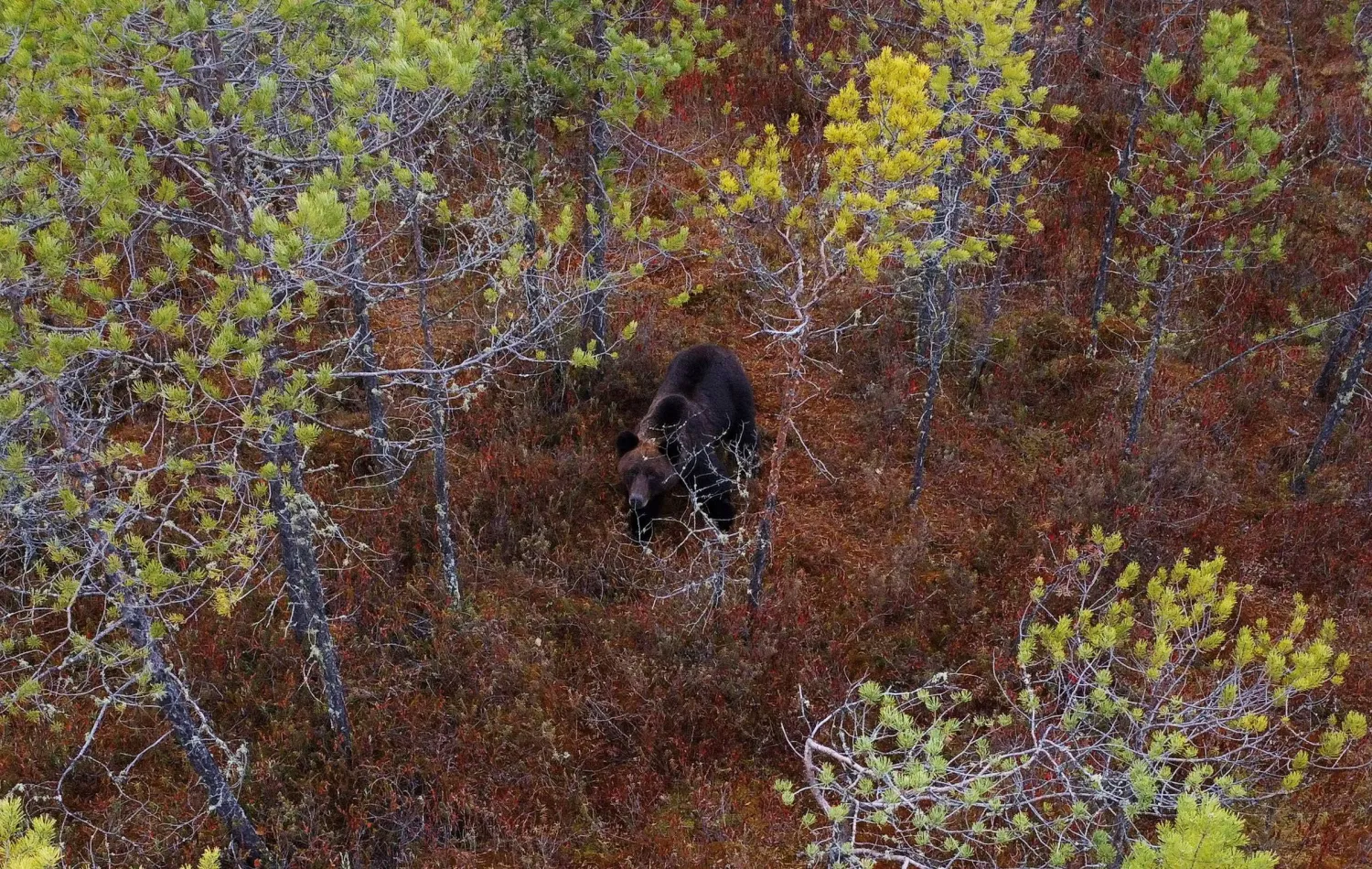
A drone view of a bear in the Siberian taiga outside the settlement of Podtesovo, on the banks of the Yenisei River in the Krasnoyarsk region, Russia, September 27, 2026. REUTERS/Vladislav Nekrasov
Siberian Hunters Declare Open Season on Bears after Spate of Deadly Attacks
A drone view of a bear in the Siberian taiga outside the settlement of Podtesovo, on the banks of the Yenisei River in the Krasnoyarsk region, Russia, September 27, 2026. REUTERS/Vladislav Nekrasov
A brown bear bounds across the Siberian taiga before two hunters close in on their prey. Three shots ring out and the bear quickly drops dead in the long grass.
Cradling his rifle as he rests his hand on the dead animal's fur, hunter Mikhail Kondakov says he and others have heeded requests from residents in the nearby settlement of Podtesovo after a fatal bear attack on local women.
"The bear situation in the settlement is very difficult at the moment," Kondakov told Reuters.
"Bears have increasingly been coming directly into the settlement. This year we had a tragedy — two women who went mushroom picking were killed by a man-eating bear. We decided to start hunting bears because there are so many of them."
The problem is nationwide. The Russian government said last month it was drawing up urgent measures to control the population of brown bears that has spiraled out of control in some regions, with at least 22 people killed in attacks since this spring, according to state media.
The population of brown bears has more than doubled in the last three decades to 308,000 according to government data, in part due to shorter and milder winters.
Experts cited in Russian media have said bears have been forced to look further afield for food this year because an early and dry spring meant there was a lack of berries for them to feed on. People have also been blamed for leaving food waste out in the open where it attracts bears and for ignoring safety rules.
In Krasnoyarsk, the Siberian region where Kondakov is hunting and which is home to nearly 27,000 bears, investigators said last month that they had opened a criminal case into the local environment ministry, accusing it of failing to keep bear numbers under control, negligence which they said had led to the deaths of seven people in September alone.
In Podtesovo, a settlement of around 3,500 people perched on the right bank of the River Yenisei, a simple wooden cross stands on the grave of Zoya Gubanova along with a color photograph of the late pensioner. Gubanova, 67, was killed on August 31 in a bear attack while out gathering mushrooms, a popular Russian pastime.
Chatting outside her wooden house, Yulia Markova, a local resident, says the situation has become intolerable.
"We have been living in fear for almost two months now, we cannot even go out for a walk in the evening. People are afraid to let their children go out alone. This is not a cuddly toy, it is not some soft, harmless teddy bear. It is a wild animal. And who knows what its intentions are, what kind of mood it is in when it comes here. Maybe it is simply curious, or maybe it is looking for its next victim," she said.
Markova said that locals, like bear attack victim Gubanova, had not fully understood the danger posed by bears and that people had initially felt sorry for them because they clearly did not have enough nuts and berries to eat this year.
But she said hearts had hardened after the bears started coming into the settlement in large numbers.
"We have never seen an invasion like this before," said Markova.
Watching her daughter relax at the local playground, pregnant mother Valeriya Efremova said heightened bear activity had changed locals' lives.
"When the bears started coming out of the forest, we restricted outings as much as possible, even to the park. It was really frightening because bears were even coming into the park where children play. Going out after dark was absolutely out of the question. Even now, although the number of sightings seems to have fallen, at least according to the information we have, you still walk around looking over your shoulder," she said.
Nikolai Zhilinsky, another local, said people were waiting for the weather to get colder and for the bears to hibernate, but he said people would still be worried even when that happened.
"We are not sure that all of the bears will hibernate. There are too many of them and they are hungry," he said. He was afraid to go fishing in his boat in case he was attacked by a bear, he added.
Vladimir Vagin, another local, said people feared they could be attacked in their own gardens. He pointed to an area near a raspberry bush in his own garden where he believed a bear had been.
Driving through the settlement after dark, he noted how empty the streets were.
"People don't go out because they are afraid," he said.
لم تشترك بعد
انشئ حساباً خاصاً بك لتحصل على أخبار مخصصة لك ولتتمتع بخاصية حفظ المقالات وتتلقى نشراتنا البريدية المتنوعة