New Israel FM Says Palestinian State Not ‘Realistic’https://english.aawsat.com/arab-world/5080659-new-israel-fm-says-palestinian-state-not-%E2%80%98realistic%E2%80%99
New Israel FM Says Palestinian State Not ‘Realistic’
Israel's new Foreign Minister Gideon Saar speaks during a hand over ceremony at the Ministry of Foreign Affairs in Jerusalem on November 10, 2024. (AFP)
TT
TT
New Israel FM Says Palestinian State Not ‘Realistic’
Israel's new Foreign Minister Gideon Saar speaks during a hand over ceremony at the Ministry of Foreign Affairs in Jerusalem on November 10, 2024. (AFP)
Israeli Foreign Minister Gideon Saar on Monday rejected the establishment of a Palestinian state as a "realistic" goal, after Palestinian President Mahmoud Abbas reiterated his commitment to a "sovereign" country.
"I don't think this position is realistic today and we must be realistic," the newly appointed minister said in response to a question about the creation of a Palestinian state in exchange for a normalization of ties between Israel and Arab countries.
The normalization drive was a part of the 2020 Abraham Accords overseen by Donald Trump, and the process could resume after the president-elect returns to the White House in January.
A Palestinian state would be "a Hamas state", Saar added of the Palestinian armed group in Gaza with which Israel has been at war for more than a year.
Abbas, in comments carried by the official Palestinian news agency WAFA, said Sunday that "security and stability" could only be achieved with the establishment of "sovereignty and independence on the land of the Palestinian state".
The Palestinian Authority leader was speaking ahead of the 20th anniversary Monday of the death of iconic Palestinian leader Yasser Arafat.
Abbas also reaffirmed his push for "peace, and we will continue to work to achieve it".
As Saar spoke in Jerusalem, Arab and Muslim leaders gathered in Saudi Arabia for a summit addressing the wars in Gaza and Lebanon, where Israel is also fighting Hamas ally Hezbollah.
A draft resolution at the summit stressed "firm support" for "national rights" for the Palestinian people, "foremost among which is their right to freedom and to an independent, sovereign state".
The war in Gaza erupted with Hamas's unprecedented attack on southern Israel on October 7 last year, which resulted in 1,206 deaths, mostly civilians, according to an AFP tally of Israeli official figures.
Israel's retaliatory campaign has killed more than 43,603 people in Gaza, most of them civilians, according to data from the Hamas-run territory's health ministry that the United Nations considers reliable.
Lebanon-based Hezbollah, which like Hamas is backed by Iran, began firing on Israel after the October 7 attack.
The regular cross-border exchanges escalated in late September when Israel intensified its air strikes and later sent ground troops into southern Lebanon.
Palestinian electoral officials set up a polling station in a tent for municipal elections in Deir al-Balah, Gaza Strip, on April 25, 2026. (AFP)
TT
TT
Palestinians Vote in First Elections Since Gaza War
Palestinian electoral officials set up a polling station in a tent for municipal elections in Deir al-Balah, Gaza Strip, on April 25, 2026. (AFP)
Palestinians in the West Bank and a central area of Gaza began voting Saturday in municipal elections in the first vote since the Gaza war, marked by a narrow political field and widespread disillusionment.
Nearly 1.5 million people are registered to vote in the Israeli-occupied West Bank, as well as 70,000 people in Gaza's Deir al-Balah area, according to the Ramallah-based Central Elections Commission.
Polling stations opened at 7 am (0400 GMT).
AFP footage from Al-Bireh in the West Bank and Deir al-Balah in Gaza showed election officials in polling stations as Palestinians came to cast ballots.
Most electoral lists are aligned with President Mahmoud Abbas's secular-nationalist Fatah party or feature candidates running as independents.
There are no lists affiliated with Fatah's archrival Hamas, which controls nearly half of the Gaza Strip.
In most cities, Fatah-backed tickets will run against independent lists headed by candidates from factions such as the Popular Front for the Liberation of Palestine (Marxist-Leninist).
"We must see change every four years through elections... We can't change the situation but we hope to replace people... people who might be better and help develop the community," said Khalid Eid, 55, after he voted in Al-Bireah.
Municipal councils are responsible for basic services such as water, sanitation and local infrastructure and do not enact legislation.
The Palestinian Authority faces widespread criticism over corruption, stagnation and declining legitimacy.
Western and regional donors have increasingly tied financial and diplomatic support to visible reforms, particularly at the local governance level, as national elections remain frozen.
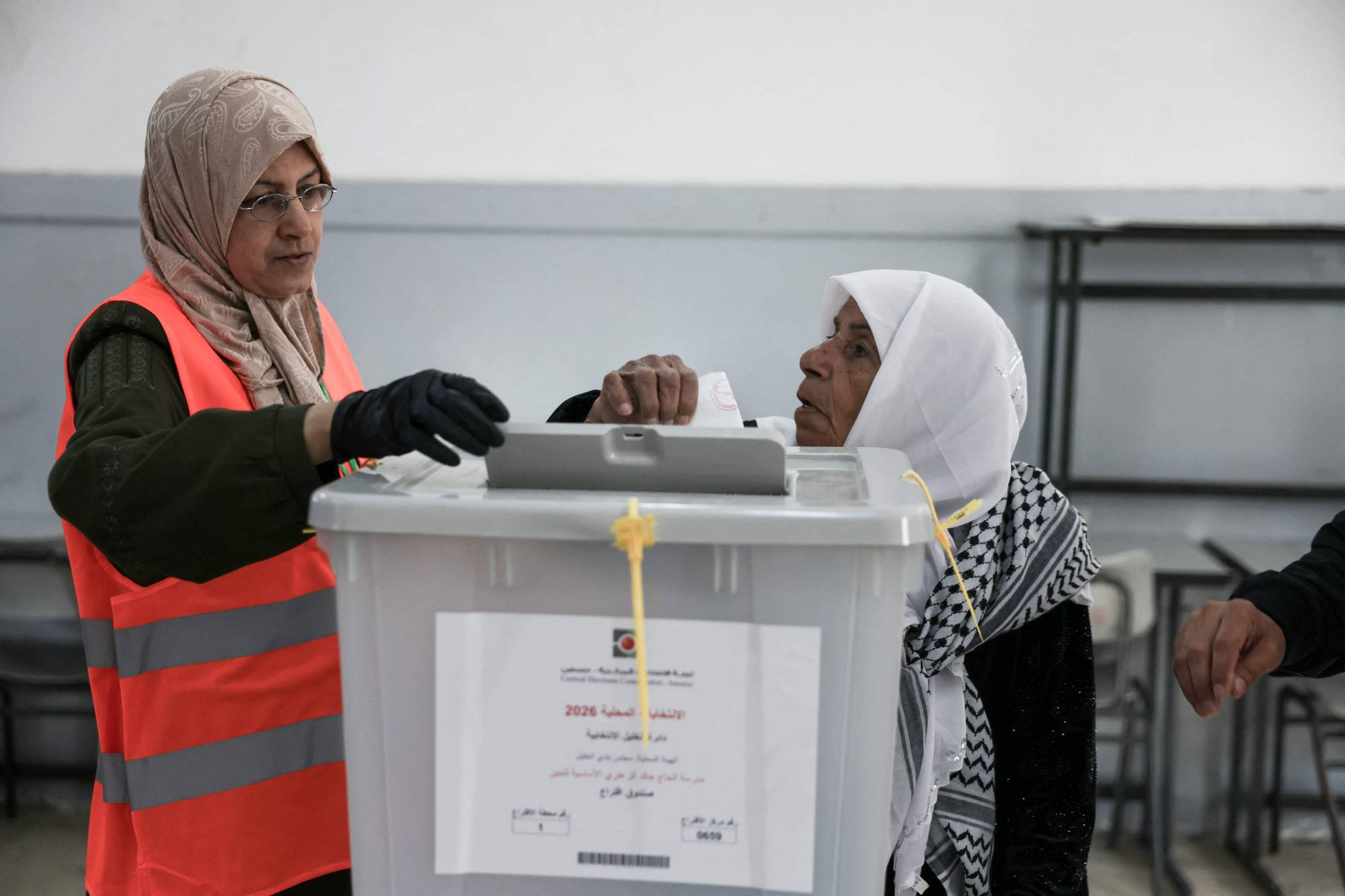
A Palestinian woman casts her ballot in a polling station during municipal elections in the Israeli-occupied West Bank city of Hebron on April 25, 2026. (AFP)
With no presidential or legislative elections held since 2006, municipal councils have become one of the few functioning democratic institutions under PA administration.
UN coordinator Ramiz Alakbarov commended the election commission for organizing a "credible process".
"Saturday's elections represent an important opportunity for Palestinians to exercise their democratic rights during an exceptionally challenging period," Alakbarov said in a statement ahead of the polls.
Mahmoud Bader, a businessman from the northern West Bank city of Tulkarem, where two adjacent refugee camps have been under Israeli military control for over a year, said he would vote despite having little hope for meaningful change.
"Whether candidates are independent or partisan, it has no effect and will have no effect or benefit for the city," he told AFP on Friday.
"The (Israeli) occupation is the one that rules Tulkarem. It would only be an image shown to the international media -- as if we have elections, a state or independence."
Polling stations in the West Bank will close at 7 pm, while polls in Deir al-Balah will close at 5 pm to facilitate counting in daylight due to the lack of electricity in the war-devastated strip, the elections commission told AFP.
Two years of war that started in October 2023 have left swathes of Gaza destroyed and more than 72,000 people dead, according to the territory's health ministry, whose figures are considered reliable by the UN.
Public infrastructure, sanitation services and the health sector are struggling to function.
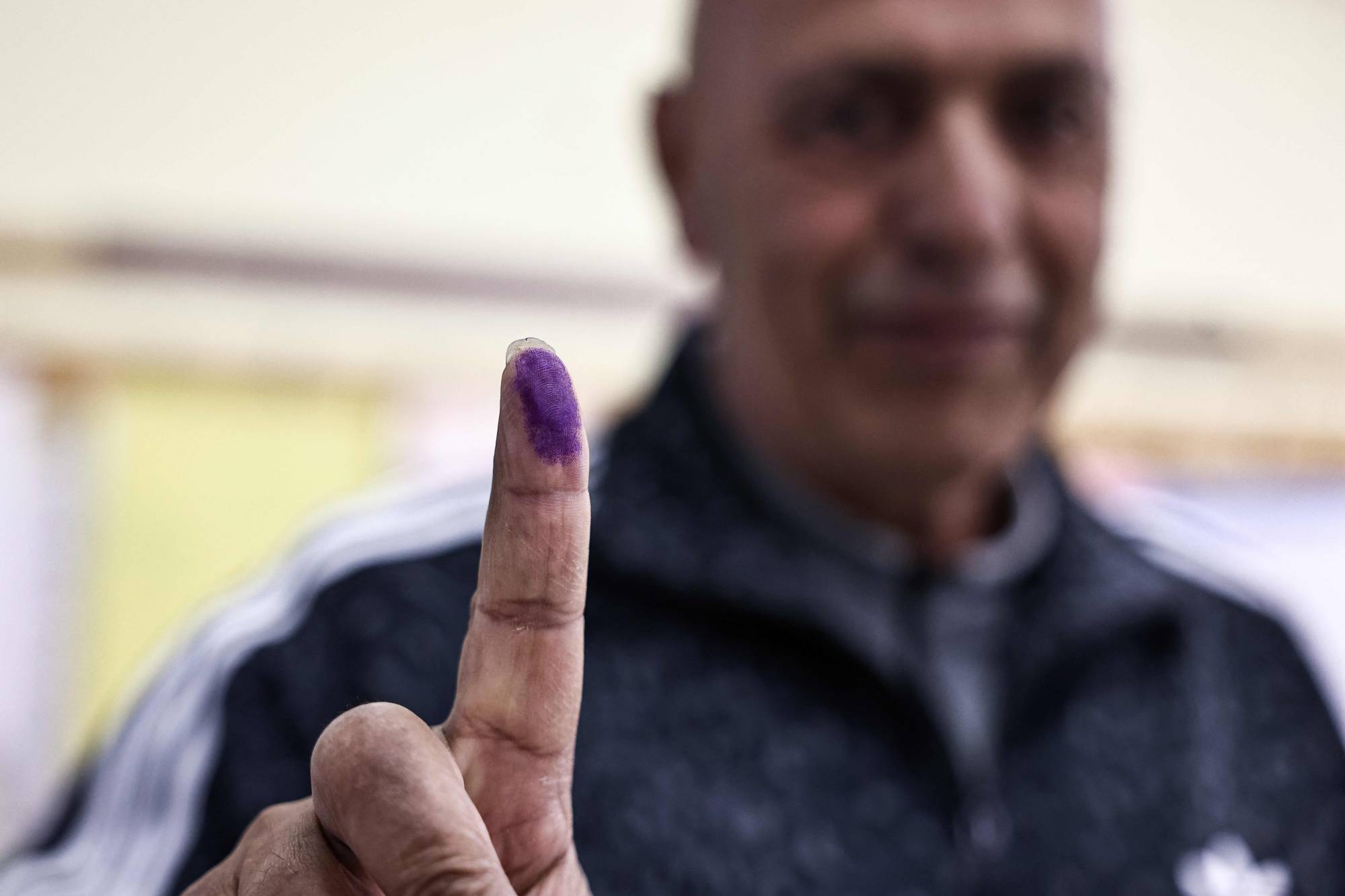
A Palestinian man shows his marked finger after casting his ballot at a polling station during municipal elections in the Israeli-occupied West Bank city of Al-Bireh on April 25, 2026. (AFP)
- 'Strong determination' -
Gaza, which has been under Hamas control since 2007, is holding its first vote since legislative elections of 2006 that the Islamist movement won.
The Palestinian Authority is holding elections only in Deir al-Balah "as an experiment (to test its own) success or failure, since there are no post-war opinion polls", Jamal al-Fadi, a political scientist at Cairo's Al-Azhar University, told AFP.
Deir al-Balah was chosen as it was one of the only places in Gaza where "the population has remained largely in place and not been displaced" by more than two years of war between Hamas and Israel, Fadi said.
The election commission has recruited polling staff from civil society organizations and hired "a private security company to secure polling centers" for the Gaza vote, its spokesman Fareed Taamallah told AFP.
Mohammed al-Hasayna, 24, said after voting in Deir al-Balah that although the elections were largely symbolic, they served as a sign of people's "will to live".
"We are an educated people with strong determination, and we deserve to have our own state," he told AFP.
"We want the world to help us overcome the catastrophe of war. Enough wars -- it is time to work towards rebuilding Gaza."
Houthis Rename Schools in Yemen’s Sanaa After their Fallen Fightershttps://english.aawsat.com/arab-world/5266246-houthis-rename-schools-yemen%E2%80%99s-sanaa-after-their-fallen-fighters
Houthis Rename Schools in Yemen’s Sanaa After their Fallen Fighters
A Yemeni child visits a cemetery for Houthi fallen fighters in Sana'a (EPA)
Yemen’s Houthi-run capital, Sanaa, is witnessing a new wave of changes in the education sector, as the group renames a number of public and private schools in what education sources say is part of a broader effort to reshape public awareness along ideological lines with a sectarian dimension.
The measures go beyond renaming schools and extend to reshaping the learning environment, including cultural activities and educational content, the sources said, describing a push to entrench a single ideological narrative within schools.
They warned that the moves are fueling growing concern about the future of education in areas under Houthi control.
The changes have affected schools long known by their historical names, replacing them with names of figures linked to the group or fighters killed in its ranks.
Among the most prominent examples, the “Azal al-Wadi” school in al-Wahda district has been renamed after a Houthi fighter known as “Abu Zaabal,” while the “Moussa bin Nusseir” school in the Maeen district has been renamed “Hani Toumar.”
The move has sparked widespread discontent among educators and students. Teachers and parents described it as an attempt to erase educational and national identity, noting that school names form part of cultural memory.
They said the changes reflect a drive to impose Houthi symbols carrying sectarian connotations.
Education sector workers said the renaming decisions were accompanied by changes to school and cultural activities, reinforcing an ideological narrative within schools.
Specialists said the shifts could narrow intellectual diversity and turn educational institutions into tools for promoting specific ideological agendas.
Students in the affected schools also voiced frustration, saying education should remain free from political or sectarian influence.
Some parents expressed concern, with some considering transferring their children to other schools, despite limited alternatives.
The developments come as Yemen faces a deepening education crisis, with deteriorating infrastructure, unpaid teacher salaries, and severe resource shortages.
The United Nations Children’s Fund, UNICEF, said about 3.2 million children in Yemen are out of school, highlighting the scale of the challenges facing the education system.
UNICEF said it plans in 2026 to return more than 172,000 children to classrooms, distribute educational supplies to over 316,000 students, and support around 1,200 teachers through training and professional development programs.
However, these efforts face a complex reality shaped by ongoing conflict and economic and social pressures.
Observers warned that continued interference in education, whether through school renaming or curricular changes, could deepen social divisions and undermine prospects for recovery, stressing that keeping education neutral is essential to safeguarding future generations.
UN Project Supports Thousands of Coffee Farmers in Yemen's Taizhttps://english.aawsat.com/arab-world/5266242-un-project-supports-thousands-coffee-farmers-yemens-taiz
UN Project Supports Thousands of Coffee Farmers in Yemen's Taiz
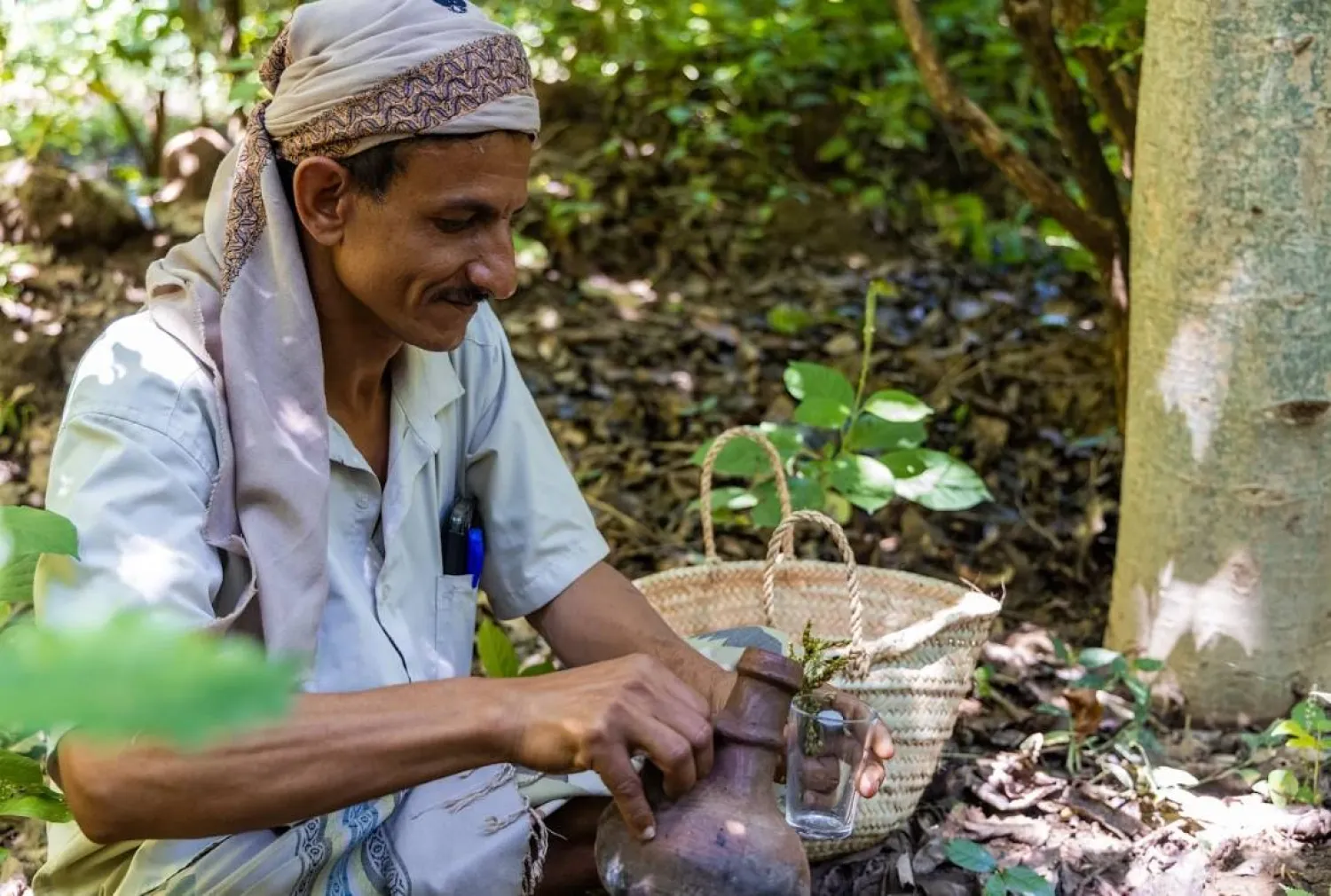
A Yemeni man in Taiz prepares coffee from the beans harvested on his farm. (United Nations)
A UN-backed food security project in Yemen has become a model for creating jobs, helping farmers confront food insecurity, and developing coffee farming as a heritage and strategic crop.
The project, implemented by the United Nations Development Program in the Taiz governorate, southwest Yemen, and funded by the World Bank, has created direct job opportunities for more than 43,000 people, including 4,000 women.
It has also provided 200,000 cubic meters of water in newly built reservoirs and improved 8,351 hectares of land.
The Food Security Response and Resilience Project has enabled 17,000 farmers to regain the ability to use their land efficiently. It has also supported farmers in coffee-producing areas, especially in Taiz, by building water infrastructure that reduces the impact of declining rainfall.
According to a UNDP report, the project focuses on building rainwater-harvesting reservoirs that can be used during droughts to ensure continued irrigation. In the Sabir Al-Mawadim district, two reservoirs were built, each with a capacity of 400 cubic meters.
Project data showed that farmers who gained access to these resources recorded a notable improvement in production during the latest season compared with those who continued to rely on irregular rainfall.
The project is based on an estimated funding of $64 million and covers 47 districts across several Yemeni governorates, particularly areas among the most agriculturally fragile. Its work is scheduled to continue until next December.
The UNDP is focusing on developing agricultural infrastructure and strengthening rural communities’ ability to cope with climate change, in cooperation with the Social Fund for Development and the Public Works Project.
Yemeni agricultural engineer Saeed al-Sharjabi told Asharq Al-Awsat that coffee farming in Yemen needs a package of infrastructure measures, including linking production areas to a network of main, secondary, and agricultural roads to reduce transport costs.
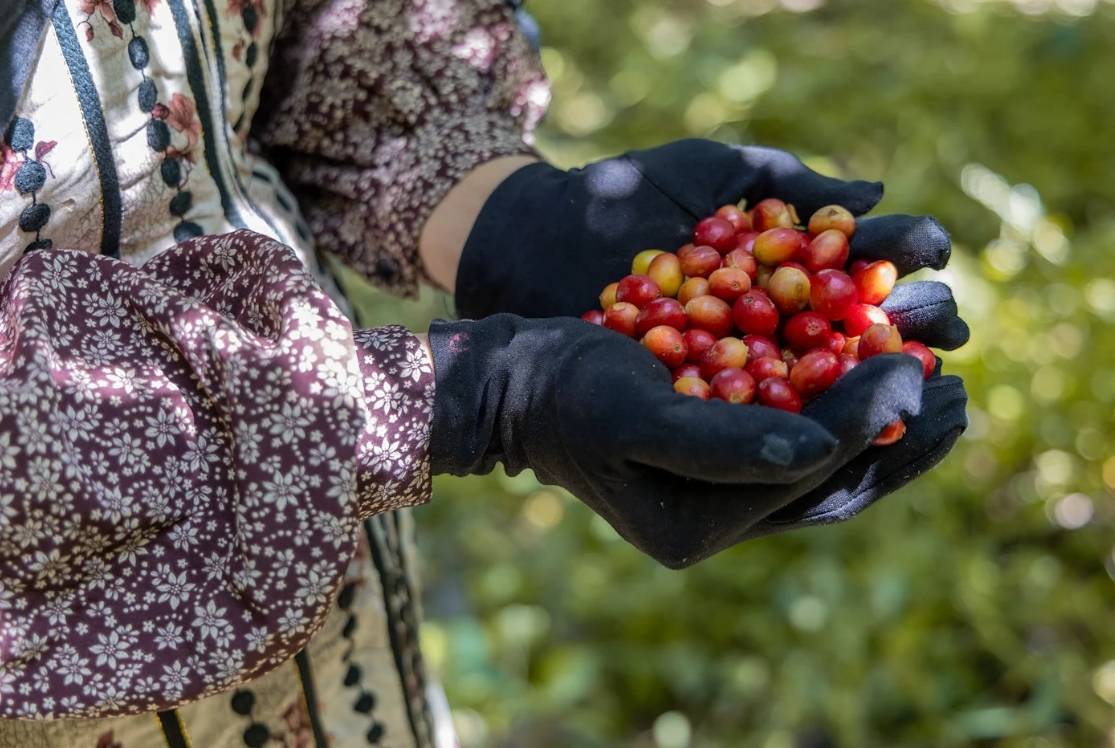
A Yemeni woman displays a sample of coffee beans harvested from her farm. (United Nations)
He said such roads could also support eco-tourism or agritourism.
Sharjabi called for building dams, barriers and water reservoirs, connecting them to suitable irrigation networks that help rationalize water consumption, establishing nurseries to produce coffee seedlings, setting technical standards for them, and encouraging investment in coffee-related fields such as production, marketing and the manufacture of environmentally friendly production supplies.
Project activities included rehabilitating more than 201 kilometers of agricultural roads, helping farmers reach their land and markets more easily. They also included building and improving water reservoirs with a total capacity of more than 200,000 cubic meters to reduce reliance on seasonal rainfall and support more stable irrigation.
According to UNDP data, the project provided more than 1.3 million workdays, including about 130,000 for women, while more than 22,000 farmers improved their access to water.
Samir al-Maqtari, an agricultural engineer and government employee, said many agricultural lands in rural Taiz have been abandoned due to water shortages or internal migration in search of services.
He warned that this threatens to leave the land exposed to deterioration and collapse because of sudden heavy rains after years of drought and desertification.
Speaking to Asharq Al-Awsat, Maqtari urged the government, the UN and international authorities to expand projects that support food security and to seize the opportunity created by thousands of farmers abandoning qat by supporting its replacement with coffee trees, especially since the environmental and climatic conditions needed for both crops are largely similar.
Initial results show that better water management is a decisive factor in protecting coffee farming, which has traditionally depended on fluctuating rainfall. These interventions also help reduce crop losses, stabilize farmers’ incomes and strengthen rural communities’ resilience.
لم تشترك بعد
انشئ حساباً خاصاً بك لتحصل على أخبار مخصصة لك ولتتمتع بخاصية حفظ المقالات وتتلقى نشراتنا البريدية المتنوعة