


Tropical Storm Sara Drenches Honduras’ Northern Coast, with Flash Flooding and Mudslides in Forecast

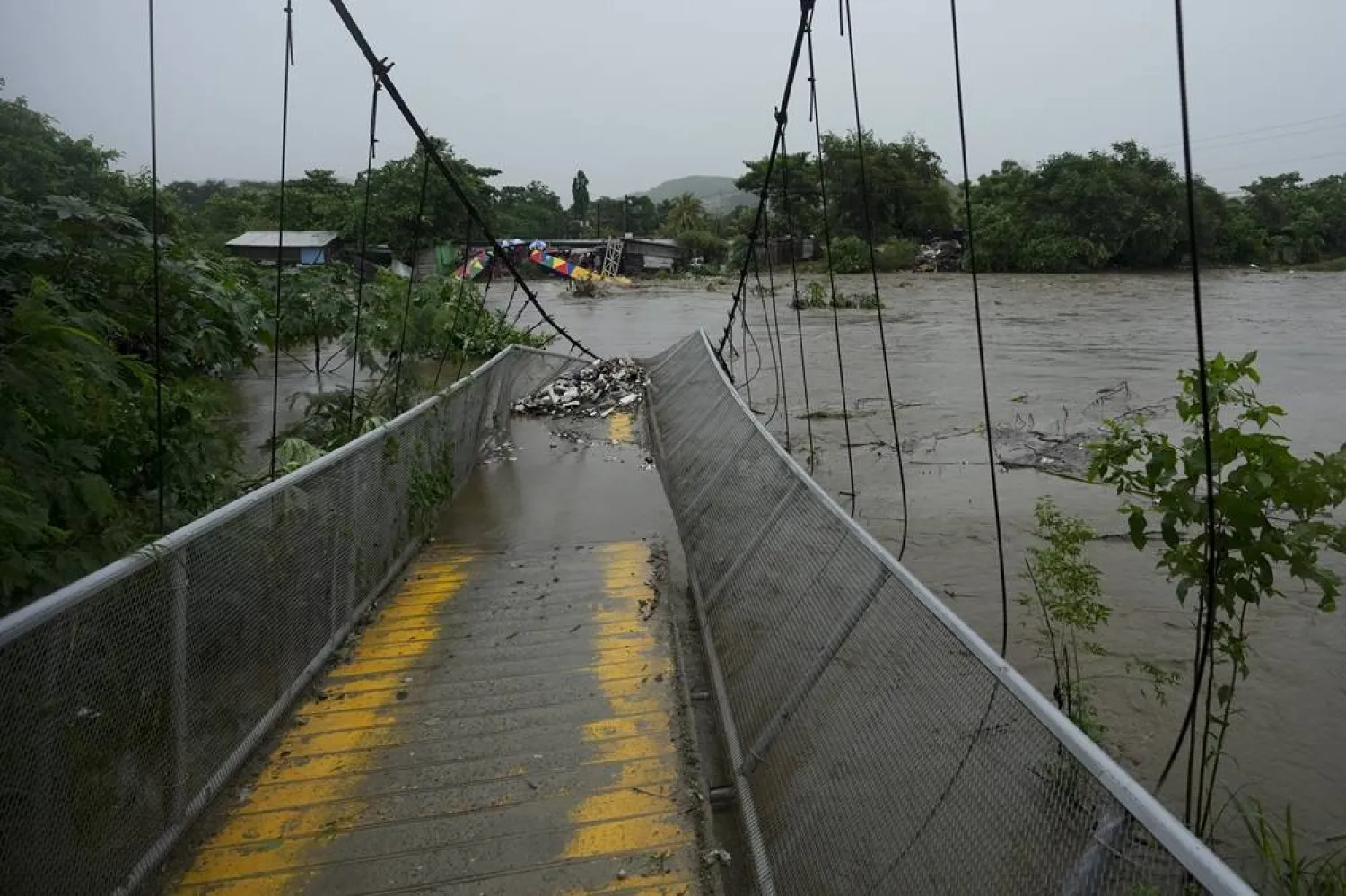
 A pedestrian bridge collapsed due to flooding caused by rains brought on by Tropical Storm Sara in San Pedro Sula, Honduras Saturday, Nov. 16, 2024. (AP)
A pedestrian bridge collapsed due to flooding caused by rains brought on by Tropical Storm Sara in San Pedro Sula, Honduras Saturday, Nov. 16, 2024. (AP)
TT

Tropical Storm Sara Drenches Honduras’ Northern Coast, with Flash Flooding and Mudslides in Forecast

 A pedestrian bridge collapsed due to flooding caused by rains brought on by Tropical Storm Sara in San Pedro Sula, Honduras Saturday, Nov. 16, 2024. (AP)
A pedestrian bridge collapsed due to flooding caused by rains brought on by Tropical Storm Sara in San Pedro Sula, Honduras Saturday, Nov. 16, 2024. (AP)

Tropical storm Sara stalled over Honduras Saturday, drenching the northern coast of the Central American nation and swelling rivers.

The area could see life-threatening flash flooding and mudslides through the weekend, according to the Miami-based National Hurricane Center. Sustained rain fell overnight and continued into the morning in the city of San Pedro Sula, where there were no immediate signs of serious flooding.

People watched nervously as the conditions brought back memories of the disastrous November 2020 hurricane season, when two powerful storms passed through the region, displacing hundreds of thousands of people and causing widespread damage.

The weather system made landfall late Thursday about 105 miles (165 kilometers) west-northwest of Cabo Gracias a Dios, on the Honduras-Nicaragua border. The Hurricane Center expects the storm will move near the Bay Islands of Honduras on Saturday before approaching Belize.

Sara is then expected to turn northwesterly towards Mexico’s Yucatan Peninsula, though forecasters said it probably will not reemerge into the Gulf after crossing the Yucatan.

The storm, however, did not stop a CONCACAF Nations League match Friday in San Pedro Sula. Under heavy rain, Mexico lost 2-0 at Honduras.

In November 2020, Eta and Iota passed through Honduras after initially making landfall in Nicaragua as powerful Category 4 hurricanes. Northern Honduras caught the worst of the storms with torrential rains that set off flooding that displaced hundreds of thousands. Eta alone was responsible for as much as 30 inches of rain along the northern coast.



Millions of Chinese Students Sit for Grueling 'Gaokao'

A student enters a school on the first day of China's National College Entrance Examination, known as "gaokao". WANG Zhao / AFP
TT

Millions of Chinese Students Sit for Grueling 'Gaokao'

A student enters a school on the first day of China's National College Entrance Examination, known as "gaokao". WANG Zhao / AFP

Hundreds of young Chinese students clutching pens and their IDs shuffled into a testing center in blue-skied Beijing on Sunday, swarmed by parents, joining millions sitting for the national high-stakes university entrance exam.

Around 12.9 million students nationwide registered for this year's "gaokao", according to the Ministry of Education, which for most is the sole determining factor in admission to a Chinese university.

The multi-day exam, which began Sunday, drills test-takers on subjects including Chinese, mathematics, English, science and the humanities -- with the tallied scores to be released later this month, said AFP.

"It's my first time, so I'm a bit anxious," said student Zhang Xinnan moments before entering the exam hall.

The spectacled Beijinger admitted he was nervous for the essay portion of the Chinese test, as he said he thought the prompts had become harder to respond to.

But, wearing his school uniform, the 18-year-old told AFP that despite the jitters he thought he would do well, having spent the last year drilling practice questions.

"The things we needed to master have been mastered," said Zhang, who hopes to work with new energy vehicles.

"Just go in with self-confidence; you'll be solid."

Some mothers and fathers clustered outside the exam halls dressed in red, a symbol of good fortune in Chinese culture.

Dozens of police and security guards milled about as parents stood beside the line of students waiting to enter the exam hall, hoping to film their children walking inside.

- Shifting attitudes -

High-level education has expanded rapidly in China in recent decades as an economic boom pushed up living standards -- as well as parental expectations for their children's careers.

Yet the job market that fresh graduates enter is no longer as rosy as it once was, with high youth unemployment a significant concern.

Roughly one in six Chinese between the ages of 16 and 24, excluding students, are jobless, according to official data.

Attitudes toward the test are changing, with students and parents more and more unwilling to trade physical and mental health for high test scores.

"I'm pretty free range," said mother Deng Ju, standing across from the exam hall holding a stack of practice books for her daughter, revising last minute with her friend nearby.

"Just perform normally; that's enough," said Deng, 53. "I care more about physical health; the test is just a formality."

For Deng, whose daughter isn't aiming for a "name school" such as the elite Tsinghua or Peking University in the capital, doing away with the gaokao would be ideal.

"No more gaokao. Let's not gaokao anymore," she told AFP. "But that's impossible," she said, smiling.

For many Beijing students, the gaokao was still a step toward achieving their dream.

"I hope I can go to my ideal university," said student Zhang.

His friends also cared about the exam, he said.

"But if we can calm down, we should be able to get to a stable mentality," said Zhang.

"Mentality is the most important when it comes to the gaokao."


'I Thought I Would Perish': Everest Survivor Recounts Ordeal

Medics and rescuers carry mountaineer Dawa Sherpa upon his arrival at the HAMS Hospital in Kathmandu on June 4, 2026. (Photo by PRABIN RANABHAT / AFP)
TT

'I Thought I Would Perish': Everest Survivor Recounts Ordeal

Medics and rescuers carry mountaineer Dawa Sherpa upon his arrival at the HAMS Hospital in Kathmandu on June 4, 2026. (Photo by PRABIN RANABHAT / AFP)

A Nepali mountaineer who survived nearly a week on Mount Everest said he "chewed ice" to stay alive, as he recovered in a hospital after a miraculous rescue that stunned the climbing community.

Dawa Sherpa, 57, disappeared in brutal conditions on the upper slopes of the world's tallest mountain on May 30 during one of the final climbs of the spring season.

With few climbers still on the peak and his oxygen exhausted, relatives had given up hope and begun ritual mourning prayers, believing he had died on the mountain.

"I didn't think I would be alive," he told BBC Nepali on Friday from his hospital bed.

"I thought I would perish this way. I didn't get lost. As the oxygen ran out, I fell behind. After the oxygen finished, I couldn't walk."

Left stranded in freezing temperatures near Everest's "death zone", where oxygen levels are critically low, Dawa Sherpa said he survived for days with almost no food or water.

"I didn't eat anything for the first two days. Then I began chewing ice. It hurt my teeth. I chewed the ice hard," AFP quoted him as saying.

He survived on a few chocolates and snacks he found in his pockets.

"I soaked them in water and had them," he said.

Dawa Sherpa, also known as "Hillary" after legendary climber Edmund Hillary, had told others after his rescue that at one point he fell into a crevasse before managing to climb out.

"Stepping on the snow, I stood up and looked above... It felt I could get out from there," he said.

"I then looked for ropes and found one. Then I held on to it and walked... eventually I came down."

He said he walked day and night towards base camp until finally encountering people almost a week later.

He was found crawling towards the base camp on the morning of June 4 by the Sagarmatha Pollution Control Committee (SPCC), a Nepali team that helps set routes on Everest and clean up waste left behind.

"Boys from SPCC were going up to collect the waste. I met them. They carried me down."

He was flown to Kathmandu for treatment for frostbite, severe dehydration and a fractured thigh bone, doctors said.

"He is doing well. We had a chat," his daughter Mendo Lhamu Sherpa told AFP.

His survival has sparked celebration among fellow climbers, but also anger from family members who accused rescue teams of failing to locate him sooner.

Nepal Mountaineering Association President Fur Gelje Sherpa called the survival extraordinary but said the incident highlighted serious concerns over climber safety.

"It is irresponsible and inhumane to leave a person behind," he said. "I believe that an investigation committee must be formed to hold the responsible people accountable for this."

Everest guide Rinji Sherpa, who comes from the same village as Dawa Sherpa, said the climber was highly experienced and familiar with the dangers of high-altitude mountaineering.

"He is very lucky, he has had several close calls before but he has survived," he said.

At least five climbers -- two Indians and three Nepalis -- died during this year's Everest season.

More than 1,000 climbers reached Everest's summit this season, according to preliminary Nepali government figures, making it the busiest season on record.


Shark Attack Kills Man Off Western Australia Coast

A shark swims close to a diving cage during a shark cage diving experience off the coast of Gansbaai, Western Cape, South Africa, May 15, 2026. REUTERS/Esa Alexander
TT

Shark Attack Kills Man Off Western Australia Coast

A shark swims close to a diving cage during a shark cage diving experience off the coast of Gansbaai, Western Cape, South Africa, May 15, 2026. REUTERS/Esa Alexander

A man has died after being attacked by a shark while fishing off the coast of Western Australia state, police said on Saturday, the third fatal shark attack in Australia in three weeks.

The 35-year-old was attacked on Saturday morning while spearfishing with family off the state's south coast at Michaelmas Island, close to ⁠the town of ⁠Albany, about 388 km (241 miles) south of state capital Perth, police said.

Reuters said he was taken ashore where he was treated by paramedics but died of his ⁠injuries.

A 4.5 meter (14.8 feet) shark, of an unknown species, was spotted by a member of the public near Michaelmas Island, a nature reserve that receives few visitors, on Saturday, state authorities said.

On May 24, a 39-year-old man died after being attacked by a shark while fishing on ⁠the ⁠Great Barrier Reef. The death followed that of a 38-year-old mauled off an island near Perth 10 days earlier.

There are around 20 shark attacks in Australia every year but the vast majority are not fatal, according to data from conservation groups. Far more people drown on the country's beaches.