


Venezuela Depreciation Risks Reversing Years of Inflation Gains

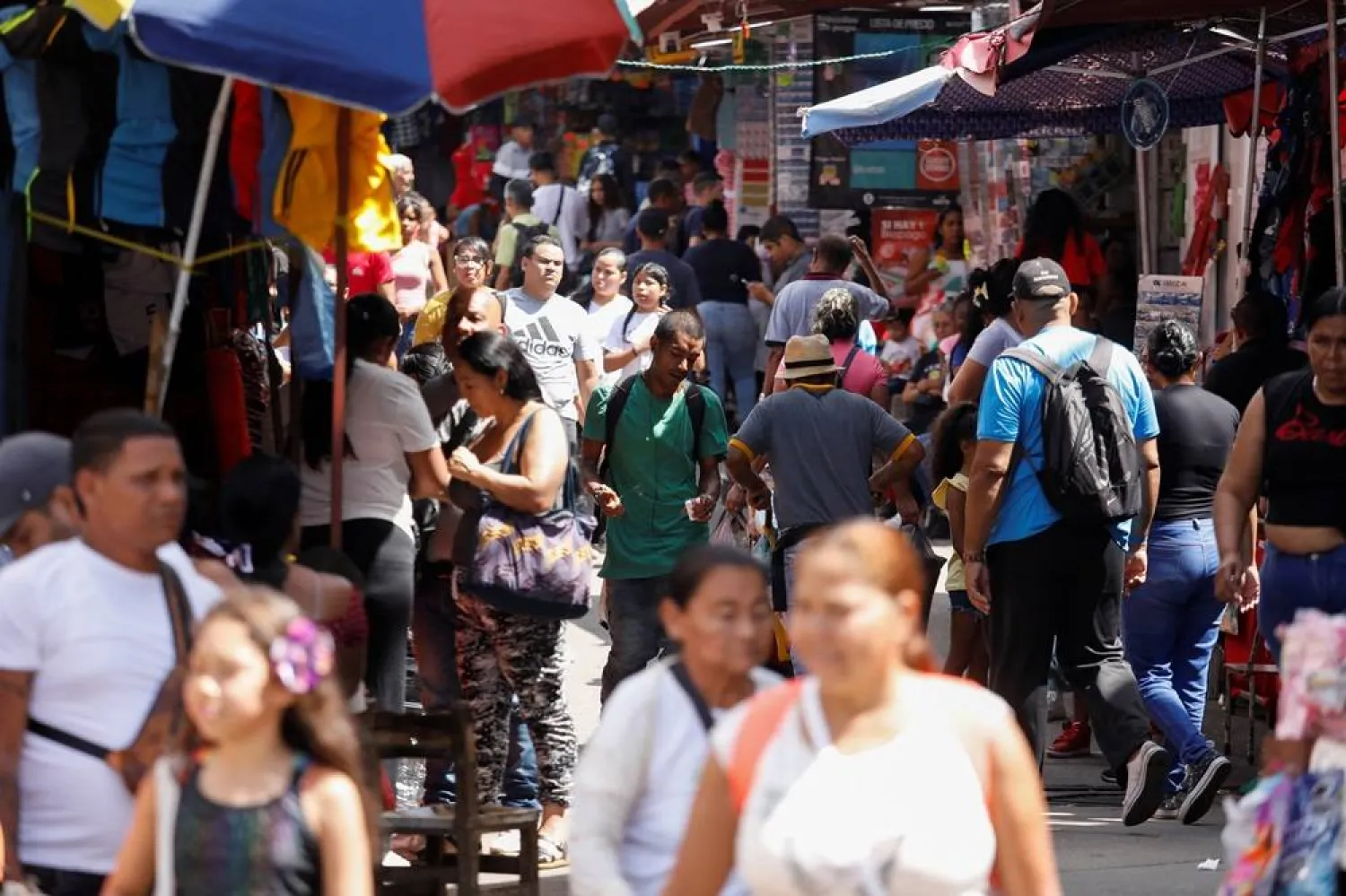
People walk through a market in the low-income Petare neighborhood, in Caracas, Venezuela November 16, 2024. (Reuters)
TT

Venezuela Depreciation Risks Reversing Years of Inflation Gains

People walk through a market in the low-income Petare neighborhood, in Caracas, Venezuela November 16, 2024. (Reuters)

Currency depreciation is set to reverse years of declining inflation in economically beleaguered Venezuela, public and private sector sources say, as foreign currency sales fall short of demand and the socialist government keeps tight-lipped about its strategy.

After years of hyperinflation and amid broad US sanctions, in 2022 the administration of President Nicolas Maduro began using orthodox policies including credit restrictions, lower public spending, a fixed dollar-bolivar rate and central bank sales of billions of dollars in foreign currency to tamp down consumer prices.

Maduro, who will begin his third term in January after a disputed election that the opposition and international observers say he lost, has said his government defeated inflation of more than 100,000% and prices in 2024 are similar to those in 2014.

But the administration's policy has now changed.

After more than nine months of the exchange rate being held at 36.5 bolivars to the dollar, the government in mid-October allowed the currency to float, beginning a depreciation that has seen the bolivar slide to about 45 versus the dollar, according to central bank figures.

Analysts say the over-valued currency made imports cheaper than locally-produced goods, impacting Venezuela's private sector and helping push prices up by 12% in nine months.

The untethering of the exchange rate will also put upward pressure on prices in the final quarter of 2024, financial and business sources said, with analysts predicting in a LatinFocus survey the rate will end the year at 50 bolivars to the dollar.

Year-on-year inflation was 25% through September. Official figures for October have not yet been released.

"For nine months the depreciation of the currency was zero while inflation was rising, which exposed problems in the exchange scheme," said economics professor and consultant Daniel Cadenas, who added the market depends on oil income. "For the system to function, there needs to be a growing source of exchange and that's not possible."

The government had predicted internally that inflation would close the year at 30%, two sources with knowledge of the projection said, but depreciation could increase the figure and local analysts have estimated inflation between 35% and 40%.

"There has been a necessary adjustment in the exchange rate that will have an impact on inflation," said Asdrubal Oliveros, head of local think tank Ecoanalitica. "The government has understood it needs to devaluate."

REDUCED CENTRAL BANK SALES

Vice President Delcy Rodriguez, who until recently also served as finance minister, told an event with business people last month that there must be "reflection" about the use of foreign exchange.

"We should all be concerned with how foreign exchange is used in imports. It is a subject the Finance Ministry is reviewing," she said. "We need to take care of foreign exchange because this is a blockaded country and there cannot be cheap exchange for hair dye."

Rodriguez's comments are the only ones made on the subject by the government since devaluation began. Neither the central bank nor the communications or finance ministries responded to requests for comment.

Private sector demand for cheap foreign exchange increased during the nine months the rate was held, even as the quantity of dollars being injected into the market by the central bank was reduced, sources said.

In July the bank was offering some $800 million, but by October that figure had fallen to $400 million, according to calculations by local consultancy Sintesis Financiera.

The central bank did not respond to a question about the reduction.

"The strategy in exchange policy is not going ahead," a government source said, without giving further details.

Food and medicine companies in Venezuela are allowed to pay for some of their goods with foreign currency, while other companies are given central bank promissory notes indexed to a specific exchange rate.

Two private sector sources said many businesses are eating through their inventories in the face of import difficulties.


India, Malaysia Renew Pledges to Boost Trade and Collaboration

Malaysia's Prime Minister Anwar Ibrahim shakes hands with India's Prime Minister Narendra Modi in Putrajaya on February 8, 2026. (Photo by Hasnoor Hussain / POOL / AFP)
TT

India, Malaysia Renew Pledges to Boost Trade and Collaboration

Malaysia's Prime Minister Anwar Ibrahim shakes hands with India's Prime Minister Narendra Modi in Putrajaya on February 8, 2026. (Photo by Hasnoor Hussain / POOL / AFP)

India's Prime Minister Narendra Modi and his Malaysian counterpart Anwar Ibrahim renewed pledges on Sunday to bolster trade and explore potential collaborations in semiconductors, defense and other fields.

Modi is on a two-day visit to the Southeast Asian nation, his first since the two countries elevated ties to ⁠a comprehensive strategic partnership in August 2024.

Anwar said the partnership included deep collaborations in multiple fields, including trade and investments, food security, defense, healthcare and tourism.

"It's really comprehensive, and we believe ⁠that we can advance this and execute in a speedy manner with the commitment of our both governments," he told a press conference after hosting Modi at his official residence in the administrative capital Putrajaya.

Following their meeting, Anwar and Modi also witnessed the exchange of 11 cooperation agreements, including ⁠on semiconductors, disaster management and peacekeeping, Reuters reported.

Anwar said India and Malaysia would continue efforts to promote the use of local-currency settlement for cross-border activities and expressed hope that bilateral trade would surpass last year's $18.6 billion.

Malaysia will also support India's efforts to open a consulate in Malaysia's Sabah state on Borneo island, Anwar said.


Saudi Arabia, Syria Sign Joint Airline and Telecoms Deals

Officials pose after signing a framework agreement for developmental cooperation and the launch of 45 development initiatives between the Syrian Development Fund and Saudi Arabia's Development Committee at the People's Palace in Damascus, Syria, Saturday, Feb. 7, 2026. (AP)
TT

Saudi Arabia, Syria Sign Joint Airline and Telecoms Deals

Officials pose after signing a framework agreement for developmental cooperation and the launch of 45 development initiatives between the Syrian Development Fund and Saudi Arabia's Development Committee at the People's Palace in Damascus, Syria, Saturday, Feb. 7, 2026. (AP)

Syria and Saudi Arabia signed deals Saturday that include a joint airline and a $1-billion project to develop telecommunications, officials said, as Syria seeks to rebuild after years of war.

The new authorities in Damascus have worked to attract investment and have signed major agreements with several companies and governments.

Syrian Investment Authority chief Talal al-Hilali announced a series of deals including "a low-cost Syrian-Saudi airline aimed at strengthening regional and international air links".

The agreement also includes the development of a new international airport in the northern city of Aleppo, and redeveloping the existing facility.

Hilali also announced an agreement for a project called SilkLink to develop Syria's "telecommunications infrastructure and digital connectivity".

Syrian Telecommunications Minister Abdulsalam Haykal told the signing ceremony that the project would be implemented "with an investment of around $1 billion".

For decades, Syria was unable to secure significant investments because of Assad-era sanctions.

But the United States fully removed its remaining sanctions on Damascus late last year, paving the way for the full return of investments.

Syria and Saudi Arabia also inked an agreement on water desalination and development cooperation on Saturday.

At the ceremony, Saudi Investment Minister Khalid Al-Falih announced the launch of an investment fund for "major projects in Syria with the participation of the (Saudi) private sector".

The deals are part of "building a strategic partnership" between the two countries, he said.

Syria's Hilali said the agreements targeted "vital sectors that impact people's lives and form essential pillars for rebuilding the Syrian economy".

Syria has begun the mammoth task of trying to rebuild its shattered infrastructure and economy.

In July last year, Riyadh signed investment and partnership deals with Damascus valued at $6.4 billion to help rebuild the country's infrastructure, telecommunications and other major sectors.

A month later, Syria signed agreements worth more than $14 billion, including investments in Damascus airport and other transport and real estate projects.

This week, Syria signed a preliminary deal with US energy giant Chevron and Qatari firm Power International to explore for oil and gas offshore.


India’s Modi Lauds Interim Trade Pact After US Tariff Rollback

Indian Prime Minister Narendra Modi addresses the media before the budget session of Parliament at Parliament House in New Delhi, India, 29 January 2026. (EPA)
TT

India’s Modi Lauds Interim Trade Pact After US Tariff Rollback

Indian Prime Minister Narendra Modi addresses the media before the budget session of Parliament at Parliament House in New Delhi, India, 29 January 2026. (EPA)

Indian Prime Minister Narendra Modi on Saturday hailed an interim trade agreement with the United States, saying it would bolster global growth and deepen economic ties between the two countries.

The pact cuts US "reciprocal" duties on Indian products to 18 percent from 25 percent, and commits India to large purchases of US energy and industrial goods.

US President Donald Trump, while announcing the deal Tuesday, had said Modi promised to stop buying Russian oil over the war in Ukraine.

The deal eases months of tensions over India's oil purchases -- which Washington says fund a conflict it is trying to end -- and restores the close ties between Trump and the man he describes as "one of my greatest friends."

"Great news for India and USA!" Modi said on X on Saturday, praising US President Donald Trump's "personal commitment" to strengthening bilateral ties.

The agreement, he said, reflected "the growing depth, trust and dynamism" of their partnership.

Modi's remarks came hours after Trump issued an executive order scrapping an additional 25 percent levy imposed over New Delhi's purchases of Russian oil, in a step to implement the trade deal announced this week.

Modi, who has faced criticism at home about opening access of Indian agricultural markets to the United States and terms on oil imports, did not mention Russian oil in his statement.

"This framework will also strengthen resilient and trusted supply chains and contribute to global growth," he said.

It would also create fresh opportunities for Indian farmers, entrepreneurs and fishermen under the "Make in India" initiative.

In a separate statement, Commerce Minister Piyush Goyal said the pact would "open a $30 trillion market for Indian exporters".

Goyal also said the deal protects India's sensitive agricultural and dairy products, including maize, wheat, rice, soya, poultry and milk.

Other terms of the agreement include the removal of tariffs on certain aircraft and parts, according to a separate joint statement released Friday by the White House.

The statement added that India intends to purchase $500 billion of US energy products, aircraft and parts, precious metals, tech products and coking coal over the next five years.

The shift marks a significant reduction in US tariffs on Indian products, down from a rate of 50 percent late last year.

Washington and New Delhi are expected to sign a formal trade deal in March.