


Nadal Retires at Davis Cup after he Loses and Spain is Eliminated

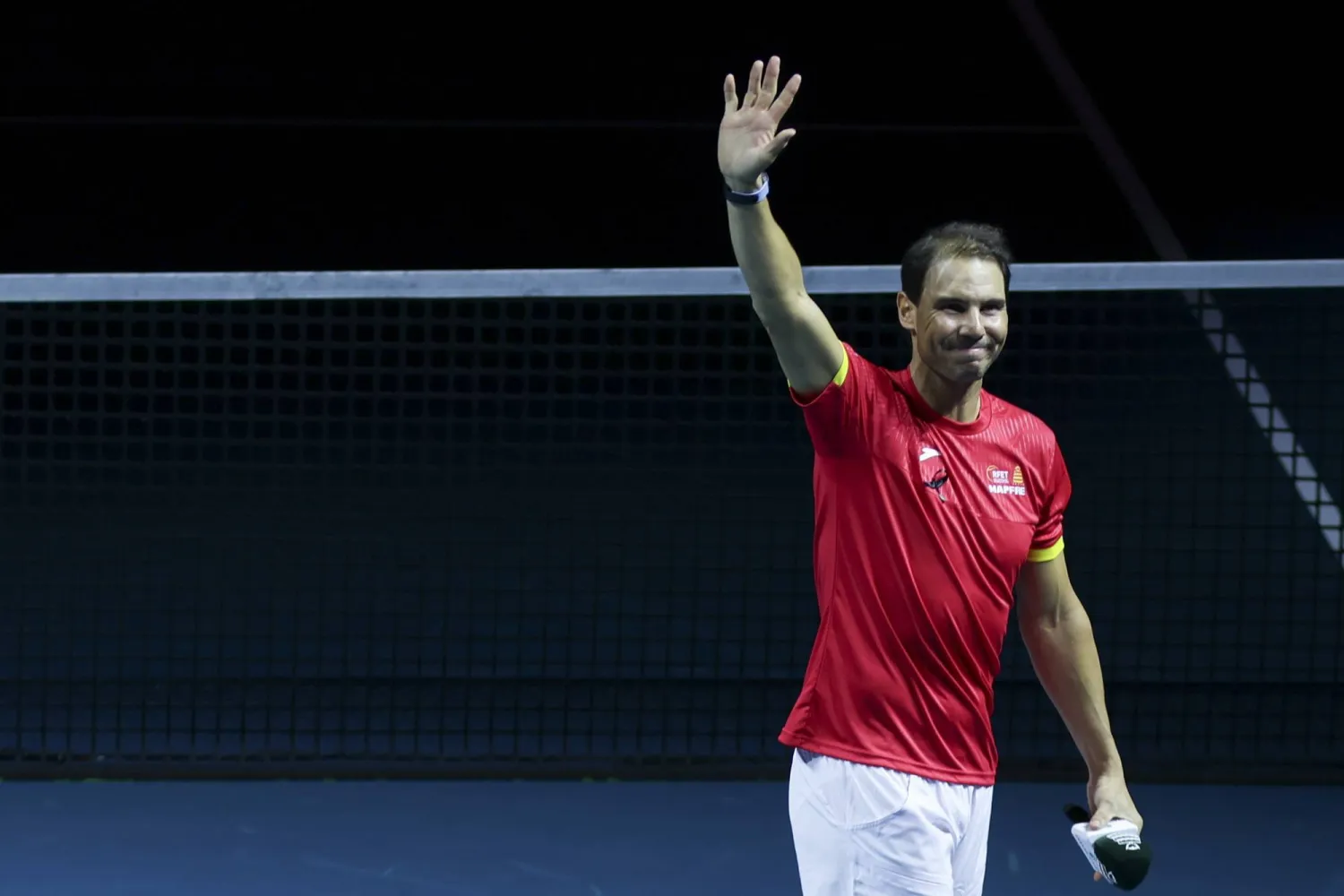
Rafa Nadal of Spain waves during a tribute received after the Spanish doubles match against the Netherlands during the Davis Cup quarterfinal between Netherlands and Spain at the Jose Maria Martin Carpena Sports Palace in Malaga, Spain, 19 November 2024.  EPA/JORGE ZAPATA
Rafa Nadal of Spain waves during a tribute received after the Spanish doubles match against the Netherlands during the Davis Cup quarterfinal between Netherlands and Spain at the Jose Maria Martin Carpena Sports Palace in Malaga, Spain, 19 November 2024. EPA/JORGE ZAPATA
TT

Nadal Retires at Davis Cup after he Loses and Spain is Eliminated

Rafa Nadal of Spain waves during a tribute received after the Spanish doubles match against the Netherlands during the Davis Cup quarterfinal between Netherlands and Spain at the Jose Maria Martin Carpena Sports Palace in Malaga, Spain, 19 November 2024.  EPA/JORGE ZAPATA
Rafa Nadal of Spain waves during a tribute received after the Spanish doubles match against the Netherlands during the Davis Cup quarterfinal between Netherlands and Spain at the Jose Maria Martin Carpena Sports Palace in Malaga, Spain, 19 November 2024. EPA/JORGE ZAPATA

Rafael Nadal bit his lower lip and his reddened eyes welled with tears as he stood alongside his Davis Cup teammates for Spain's national anthem Tuesday before what he — and everyone — knew might be the last match of his career.

Hours after Nadal's 6-4, 6-4 loss to Botic van de Zandschulp of the Netherlands was over, the evening did turn out to represent the 22-time Grand Slam champion's farewell to professional tennis, because the Dutch eliminated the Spaniards in the quarterfinals just after midnight, The Associated Press reported.

And it was during an on-court, post-match ceremony to honor Nadal that he cried and cried, at the singsong chorus of “Raaa-faaa” from the spectators, at the video showing highlights from his more than two decades on tour and the collection of recorded tributes from current or former players such as his Big Three rivals Roger Federer and Novak Djokovic, Serena Williams, Conchita Martinez and Andy Murray, and stars from other sports such as golf's Sergio Garcia or soccer's David Beckham.

“The titles, the numbers, are there, so people probably know that, but the way I would like to be remembered is as a good person from a small village in Mallorca,” the 38-year-old Nadal told the flag-waving, sign-toting crowd at the sold-out Palacio de Deportes Jose Maria Martin Carpena. “Just a kid that followed their dreams, worked as hard as possible. ... I have been very lucky.”

He had said beforehand that his feelings would need to be put on hold, that this week was about attempting to claim one last trophy for his country, not about pondering his impending retirement, which he announced last month would come after this event.

But he acknowledged after playing that "the emotions were difficult to manage,” and that he felt nerves out there amid the roars of an adoring audience that mostly showed up for one player and one player only.
After Nadal, a 14-time French Open champion, was beaten on the indoor hard court in southern Spain, he became a cheerleader for his heir apparent, Carlos Alcaraz, who evened the matchup against the Netherlands at 1-all by getting past Tallon Griekspoor 7-6 (0), 6-3 in the other singles match. But then van de Zandschulp and Wesley Koolhof clinched the victory for the Dutch by defeating Alcaraz and Marcel Granollers 7-6 (4), 7-6 (3) in the deciding doubles match.
Even if Spain had managed to get past the Netherlands, Nadal said that if he were his team's captain, he wouldn't pick himself to play again in the semifinals after that performance against the 80th-ranked van de Zandschulp.
At least he was in a joking mood after the result put a stop to his 29-match winning streak in Davis Cup singles. The only other blemish on his record, which stood at 29-1 entering Tuesday, came in his 2004 debut.
“I lost my first match in the Davis Cup, and I lost my last one,” Nadal said with a wide grin. “So we close the circle.”
When a forehand found the net to close his last match, Nadal walked to the net for a quick hug with his opponent.
“That was a tough, tough match to play,” said van de Zandschulp, noting that he idolized Nadal while growing up.
In certain ways, this was, unmistakably, the Nadal that van de Zandschulp — and so many others — can remember. The white headband, marked with the red bull logo Nadal made famous. The white tape wrapped around all four of his left, racket-holding fingers. The water bottles by his sideline bench, placed just so.
There was the occasional ace right on a line. The occasional serve-and-volley foray. The occasional over-the-shoulder putaway. And, yes, the occasional uppercut and scream of “Vamos!” There also were — neither to Nadal’s or most of the 9,200 spectators’ liking — several points where he looked like a once-dominant figure diminished by age and injuries.
Nadal was just not able to bring his best, no matter how many chants of “Ra-fa!” or “España!” or “Si, se puede!” (“Yes, you can!”) broke out, no matter how many scarves reading “Gracias, Rafa!” or red-and-yellow Spanish flags of all sizes filled the arena.
This version of Nadal had hip issues, including surgery in June 2023, and abdominal problems that combined to limit him to only 24 matches over the past two years. He went 12-8 in singles in 2024.
The match against van de Zandschulp — who upset Alcaraz at the US Open — was Nadal’s first outing that counted since early August at the Paris Olympics. He lost there in the second round of singles to Djokovic and bowed out in the doubles quarterfinals alongside Alcaraz.
Nadal and Alcaraz practiced with each other hours before the start of play. The day, much like the entire Davis Cup leadup, was largely about memories of, and praise for, Nadal.
“You know very well what you have meant to the tennis world,” said Spain's captain, David Ferrer, who lost to Nadal in the 2013 French Open final. “We will miss you a lot.”
Nadal’s appeal was found in how he played tennis, relentless and striking each shot as if it might be his last, and the humility he displayed away from competition. No one cared for him as much as his fellow Spaniards. He is a national hero, transcending sports, and that was clear from the love expressed over and over via shouts and standing ovations — when Nadal entered the court, when he won a point, when his match ended, and so on.
“When we heard the news that Rafa was retiring, this really became something special — a chance to see the greatest sportsman in the country’s history,” said Luis Julve, a 19-year-old college student who made the trip from Madrid with his mother and aunt.
When the matches, the ceremony, the night and his career were over, Nadal hugged his teammates and left the court, pausing to wave goodbye to his fans one last time.
“The truth is that nobody ever wants to arrive at this moment,” Nadal said. “I’m not tired of playing tennis, but it’s my body that doesn’t want to play anymore, so I have to accept the situation. Honestly, I feel super privileged for having been able to make a career out of my hobby, and for having played for much longer than I could ever have imagined."



‘Don’t Jump in Them’: Olympic Athletes’ Medals Break During Celebrations

Gold medalists team USA celebrate during the medal ceremony after the Team Event Free Skating of the Figure Skating competitions at the Milano Cortina 2026 Winter Olympic Games, in Milan, Italy, 08 February 2026. (EPA)
TT

‘Don’t Jump in Them’: Olympic Athletes’ Medals Break During Celebrations

Gold medalists team USA celebrate during the medal ceremony after the Team Event Free Skating of the Figure Skating competitions at the Milano Cortina 2026 Winter Olympic Games, in Milan, Italy, 08 February 2026. (EPA)

Handle with care. That's the message from gold medalist Breezy Johnson at the Milan Cortina Winter Olympics after she and other athletes found their medals broke within hours.

Olympic organizers are investigating with "maximum attention" after a spate of medals have fallen off their ribbons during celebrations on the opening weekend of the Games.

"Don’t jump in them. I was jumping in excitement, and it broke," women's downhill ski gold medalist Johnson said after her win Sunday. "I’m sure somebody will fix it. It’s not crazy broken, but a little broken."

TV footage broadcast in Germany captured the moment biathlete Justus Strelow realized the mixed relay bronze he'd won Sunday had fallen off the ribbon around his neck and clattered to the floor as he danced along to a song with teammates.

His German teammates cheered as Strelow tried without success to reattach the medal before realizing a smaller piece, seemingly the clasp, had broken off and was still on the floor.

US figure skater Alysa Liu posted a clip on social media of her team event gold medal, detached from its official ribbon.

"My medal don’t need the ribbon," Liu wrote early Monday.

Andrea Francisi, the chief games operations officer for the Milan Cortina organizing committee, said it was working on a solution.

"We are aware of the situation, we have seen the images. Obviously we are trying to understand in detail if there is a problem," Francisi said Monday.

"But obviously we are paying maximum attention to this matter, as the medal is the dream of the athletes, so we want that obviously in the moment they are given it that everything is absolutely perfect, because we really consider it to be the most important moment. So we are working on it."

It isn't the first time the quality of Olympic medals has come under scrutiny.

Following the 2024 Summer Olympics in Paris, some medals had to be replaced after athletes complained they were starting to tarnish or corrode, giving them a mottled look likened to crocodile skin.


African Players in Europe: Ouattara Fires Another Winner for Bees

Football - Premier League - Newcastle United v Brentford - St James' Park, Newcastle, Britain - February 7, 2026 Brentford's Dango Ouattara celebrates scoring their third goal with Brentford's Rico Henry. (Reuters)
TT

African Players in Europe: Ouattara Fires Another Winner for Bees

Football - Premier League - Newcastle United v Brentford - St James' Park, Newcastle, Britain - February 7, 2026 Brentford's Dango Ouattara celebrates scoring their third goal with Brentford's Rico Henry. (Reuters)

Burkina Faso striker Dango Ouattara was the Brentford match-winner for the second straight weekend when they triumphed 3-2 at Newcastle United.

The 23-year-old struck in the 85th minute of a seesaw Premier League struggle in northeast England. The Bees trailed and led before securing three points to go seventh in the table.

Last weekend, Ouattara dented the title hopes of third-placed Aston Villa by scoring the only goal at Villa Park.

AFP Sport highlights African headline-makers in the major European leagues:

ENGLAND

DANGO OUATTARA (Brentford)

With the match at Newcastle locked at 2-2, the Burkinabe sealed victory for the visitors at St James' Park by driving a left-footed shot past Magpies goalkeeper Nick Pope to give the Bees a first win on Tyneside since 1934. Ouattara also provided the cross that led to Vitaly Janelt's headed equalizer after Brentford had fallen 1-0 behind.

BRYAN MBEUMO (Manchester Utd)

The Cameroon forward helped the Red Devils extend their perfect record under caretaker manager Michael Carrick to four games by scoring the opening goal in a 2-0 win over Tottenham after Spurs had been reduced to 10 men by captain Cristian Romero's red card.

ISMAILA SARR (Crystal Palace)

The Eagles ended their 12-match winless run with a 1-0 victory at bitter rivals Brighton thanks to Senegal international Sarr's 61st-minute goal when played in by substitute Evann Guessand, the Ivory Coast forward making an immediate impact on his Palace debut after joining on loan from Aston Villa during the January transfer window.

ITALY

LAMECK BANDA (Lecce)

Banda scored direct from a 90th-minute free-kick outside the area to give lowly Leece a precious 2-1 Serie A victory at home against mid-table Udinese. It was the third league goal this season for the 25-year-old Zambia winger. Leece lie 17th, one place and three points above the relegation zone.

GERMANY

SERHOU GUIRASSY (Borussia Dortmund)

Guirassy produced a moment of quality just when Dortmund needed it against Wolfsburg. Felix Nmecha's silky exchange with Fabio Silva allowed the Guinean to sweep in an 87th-minute winner for his ninth Bundesliga goal of the season. The 29-year-old has scored or assisted in four of his last five games.

RANSFORD KOENIGSDOERFFER (Hamburg)

A first-half thunderbolt from Ghana striker Koenigsdoerffer put Hamburg on track for a 2-0 victory at Heidenheim. It was their first away win of the season. Nigerian winger Philip Otele, making his Hamburg debut, split the defense with a clever pass to Koenigsdoerffer, who hit a shot low and hard to open the scoring in first-half stoppage time.

FRANCE

ISSA SOUMARE (Le Havre)

An opportunist goal by Soumare on 54 minutes gave Le Havre a 2-1 home win over Strasbourg in Ligue 1. The Senegalese received the ball just inside the area and stroked it into the far corner of the net as he fell.


Olympic Town Warms up as Climate Change Puts Winter Games on Thin Ice

 Milano Cortina 2026 Olympics - Alpine Skiing - Men's Team Combined Downhill - Stelvio Ski Centre, Bormio, Italy - February 09, 2026. Alexis Monney of Switzerland in action during the Men's Team Combined Downhill. (Reuters)
Milano Cortina 2026 Olympics - Alpine Skiing - Men's Team Combined Downhill - Stelvio Ski Centre, Bormio, Italy - February 09, 2026. Alexis Monney of Switzerland in action during the Men's Team Combined Downhill. (Reuters)
TT

Olympic Town Warms up as Climate Change Puts Winter Games on Thin Ice

 Milano Cortina 2026 Olympics - Alpine Skiing - Men's Team Combined Downhill - Stelvio Ski Centre, Bormio, Italy - February 09, 2026. Alexis Monney of Switzerland in action during the Men's Team Combined Downhill. (Reuters)
Milano Cortina 2026 Olympics - Alpine Skiing - Men's Team Combined Downhill - Stelvio Ski Centre, Bormio, Italy - February 09, 2026. Alexis Monney of Switzerland in action during the Men's Team Combined Downhill. (Reuters)

Olympic fans came to Cortina with heavy winter coats and gloves. Those coats were unzipped Sunday and gloves pocketed as snow melted from rooftops — signs of a warming world.

“I definitely thought we’d be wearing all the layers,” said Jay Tucker, who came from Virginia to cheer on Team USA and bought hand warmers and heated socks in preparation. “I don’t even have gloves on.”

The timing of winter, the amount of snowfall and temperatures are all less reliable and less predictable because Earth is warming at a record rate, said Shel Winkley, a Climate Central meteorologist. This poses a growing and significant challenge for organizers of winter sports; The International Olympic Committee said last week it could move up the start date for future Winter Games to January from February because of rising temperatures.

While the beginning of the 2026 Olympic Winter Games in Cortina truly had a wintry feel, as the town was blanketed in heavy snow, the temperature reached about 40 degrees Fahrenheit (4.5 degrees Celsius) Sunday afternoon. It felt hotter in the sun.

This type of February “warmth” for Cortina is made at least three times more likely due to climate change, Winkley said. In the 70 years since Cortina first held the Winter Games, February temperatures there have climbed 6.4 degrees Fahrenheit (3.6 degrees Celsius), he added.

For the Milan Cortina Games, there's an added layer of complexity. It’s the most spread-out Winter Games in history, so Olympic venues are in localities with very different weather conditions. Bormio and Livigno, for example, are less than an hour apart by car, but they are separated by a high mountain pass that can divide the two places climatically.

The organizing committee is working closely with four regional and provincial public weather agencies. It has positioned weather sensors at strategic points for the competitions, including close to the ski jumping ramps, along the Alpine skiing tracks and at the biathlon shooting range.

Where automatic stations cannot collect everything of interest, the committee has observers — “scientists of the snow”— from the agencies ready to collect data, according to Matteo Pasotti, a weather specialist for the organizing committee.

The hope? Clear skies, light winds and low temperatures on race days to ensure good visibility and preserve the snow layer.

The reality: “It’s actually pretty warm out. We expected it to be a lot colder,” said Karli Poliziani, an American who lives in Milan. Poliziani was in Cortina with her father, who considered going out Sunday in just a sweatshirt.

And forecasts indicate that more days with above-average temperatures lie ahead for the Olympic competitions, Pasotti said.

Weather plays a critical role in the smooth running and safety of winter sports competitions, according to Filippo Bazzanella, head of sport services and planning for the organizing committee. High temperatures can impact the snow layer on Alpine skiing courses and visibility is essential. Humidity and high temperatures can affect the quality of the ice at indoor arenas and sliding centers, too.

Visibility and wind are the two factors most likely to cause changes to the competition schedule, Bazzanella added. Wind can be a safety issue or a fairness one, such as in the biathlon where slight variations can disrupt the athletes' precise shooting.

American alpine skier Jackie Wiles said many races this year have been challenging because of the weather.

“I feel like we’re pretty good about keeping our heads in the game because a lot of people are going to get taken out by that immediately,” she said at a team press conference last week. “Having that mindset of: it’s going to be what it’s going to be, and we still have to go out there and fight like hell regardless.”