North Korea Sent More Conventional Weapons to Russia, South Korea Says

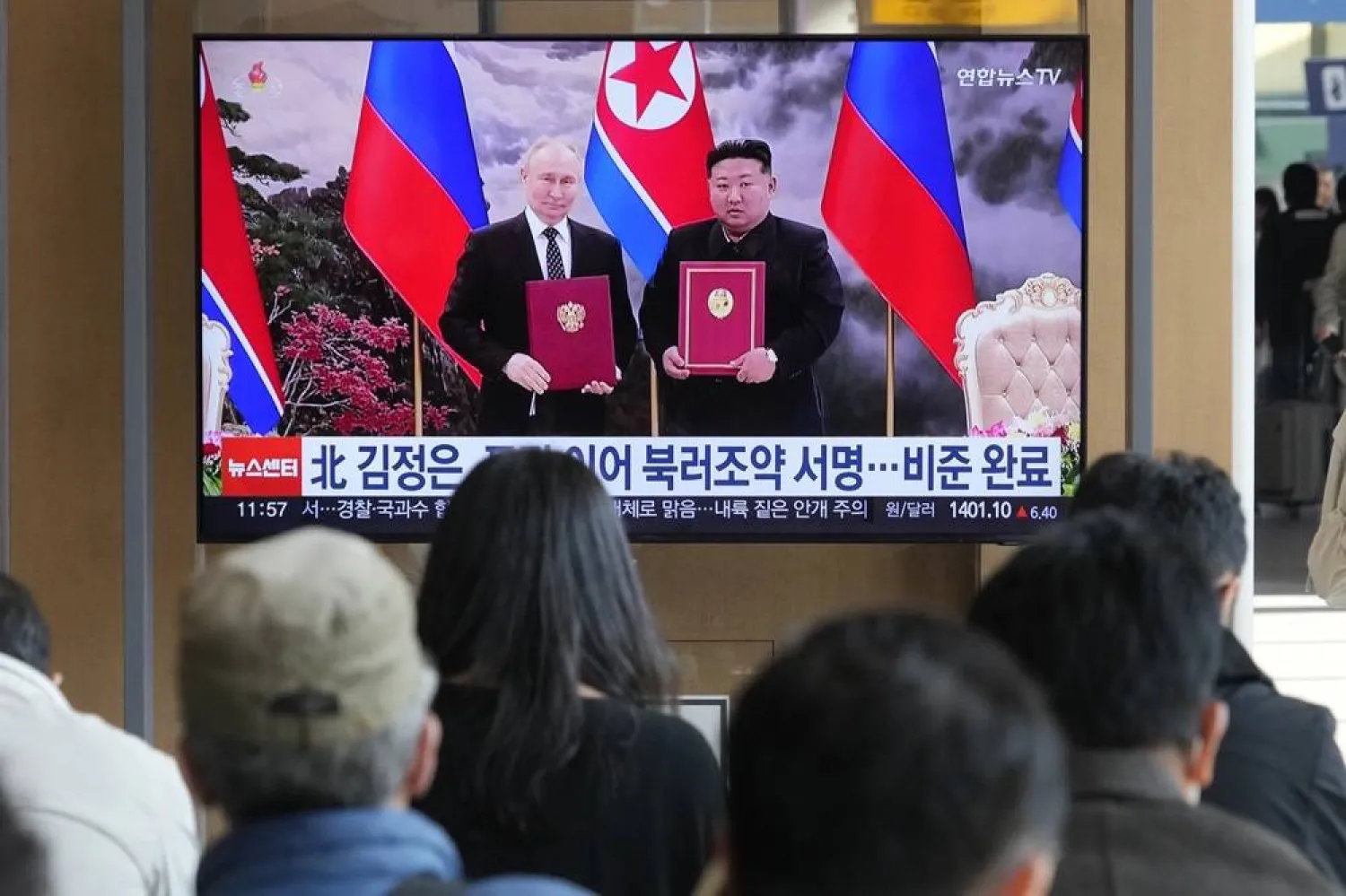
 A TV screen shows a file image of North Korean leader Kim Jong Un, right, and Russian President Vladimir Putin in Pyongyang, during a news program at the Seoul Railway Station in Seoul, South Korea, Tuesday, Nov. 12, 2024. (AP)
A TV screen shows a file image of North Korean leader Kim Jong Un, right, and Russian President Vladimir Putin in Pyongyang, during a news program at the Seoul Railway Station in Seoul, South Korea, Tuesday, Nov. 12, 2024. (AP)
TT

North Korea Sent More Conventional Weapons to Russia, South Korea Says

 A TV screen shows a file image of North Korean leader Kim Jong Un, right, and Russian President Vladimir Putin in Pyongyang, during a news program at the Seoul Railway Station in Seoul, South Korea, Tuesday, Nov. 12, 2024. (AP)
A TV screen shows a file image of North Korean leader Kim Jong Un, right, and Russian President Vladimir Putin in Pyongyang, during a news program at the Seoul Railway Station in Seoul, South Korea, Tuesday, Nov. 12, 2024. (AP)

North Korea recently supplied additional artillery systems to Russia to support its war efforts against Ukraine, while some of the thousands of North Korean troops deployed in Russia have begun engaging in combat, South Korea’s spy agency told lawmakers Wednesday.

The South Korean assessment came after Russia warned Monday that US President Joe Biden’s decision to let Ukraine strike targets inside Russia with US-supplied longer-range missiles adds “fuel to the fire” of the war. US officials said Biden’s decision was triggered almost entirely by North Korea’s entry into the war.

In a closed-door briefing at parliament, the National Intelligence Service said that North Korea exported 170mm self-propelled guns and 240mm multiple rocket launch systems to Russia, according to lawmaker Lee Seong Kweun, who attended the meeting.

Lee told reporters that the NIS assessed those weapons are a type of artillery the Russian military doesn’t operate so North Korea likely dispatched personnel to teach the Russians how to use them and handle their maintenance.

Last week, Russian Telegram channels and other social media posts published photos apparently showing North Korean’s “Koksan” 170mm self-propelled guns being moved by rail inside Russia. The Financial Times, citing Ukrainian intelligence assessments, reported Sunday that North Korea in recent weeks sent some 50 domestically produced 170mm self-propelled howitzers and 20 240mm multiple launch rocket systems to Russia.

The artillery systems are the latest conventional weapons that North Korea is believed to have provided to Russia as the two countries are sharply expanding their military cooperation in the face of separate confrontations with the US and its allies. Last month, the NIS said that North Korea had sent more than 13,000 containers of artillery, missiles and other conventional arms to Russia since August 2023 to replenish its dwindling weapons stockpiles.

During its Wednesday briefing, the NIS said that an estimated 11,000 North Korean soldiers in late October were moved to Russia’s Kursk region, where Ukrainian troops seized parts of its territory this year, following their training in Russia's northeast, Lee said. He cited the NIS as saying the North Korean soldiers were assigned to Russia’s marine and airborne forces units and some of them have already begun fighting alongside the Russians on the frontlines.

The US, Ukraine and others have similar estimates on the size of North Korea's troop deployment. They say the North Korean soldiers arrived in Russia in October and that some of them have since engaged in combat in the Kursk region. Observers say North Korea's participation in the almost 3-year war threatens to escalate the conflict.

Park Sunwon, another lawmaker who was present at the NIS meeting, made similar comments on the briefing. He said the spy agency couldn’t provide an assessment on possible North Korean casualties.

Moscow said Tuesday that Ukraine fired six US-made ATACMS missiles at Russia’s Bryansk region, in what would be Kyiv’s first use of the weapon inside Russia. Ukraine’s General Staff did not confirm whether the weapon was used, but said the armed forces struck an ammunition warehouse in the Bryansk region, which neighbors Kursk and was likely supplying Russian forces fighting there.

Since the first year of the war, Ukrainian leaders have lobbied Western allies to allow them to use advanced weapons to strike key targets inside Russia.


Netanyahu Vows to Eliminate Iran Threat ‘Once and for All’

10 November 2026, Israel, Jerusalem: Caretaker Israeli Prime Minister Benjamin Netanyahu delivers a speech on the sidelines of the opening session of the new Knesset. (dpa)
TT

Netanyahu Vows to Eliminate Iran Threat ‘Once and for All’

10 November 2026, Israel, Jerusalem: Caretaker Israeli Prime Minister Benjamin Netanyahu delivers a speech on the sidelines of the opening session of the new Knesset. (dpa)

Israel's caretaker prime minister Benjamin Netanyahu on Saturday reiterated his calls for a national unity government with his opponent Gadi Eisenkot, as well as his vow to eliminate the threat from Iran.

A meeting with Eisenkot on Thursday "only strengthened the conviction that it is essential to form a national unity government" to guarantee Israel's security, Netanyahu said in a video statement, adding that such a government could "eliminate the Iranian threat once and for all".


Ukraine’s Zelenskiy Escalates Criticism of SpaceX Over Speed Caps

Ukraine's President Volodymyr Zelenskiy holds a press briefing in Copenhagen November 10, 2026. (AFP)
TT

Ukraine’s Zelenskiy Escalates Criticism of SpaceX Over Speed Caps

Ukraine's President Volodymyr Zelenskiy holds a press briefing in Copenhagen November 10, 2026. (AFP)

Ukraine's President Volodymyr Zelenskiy ‌escalated his criticism of SpaceX on Saturday, saying speed restrictions on its military-grade Starshield satellite terminals had dangerous political implications and undermined critical air defenses.

Zelenskiy said Starshield terminals operating in temporarily Russian-occupied territories of Ukraine had been limited to a maximum speed of 161 kph for the past five days, hampering Ukraine's military capabilities.

The Ukrainian Defense Ministry has raised the issue with SpaceX at the ‌institutional level, ‌Zelenskiy said.

"The restrictions have now ‌been ⁠in place for ⁠five days. They say it is some kind of technical issue. We do not believe that is the case," Zelenskiy told reporters in remarks released by his office on Saturday.

"If you impose restrictions there, you are already partially recognizing the temporarily ⁠occupied territories as not ours. And ‌that is why I ‌believe we have the right to raise this ‌issue and restore the speed – so that there ‌are no restrictions at all."

Zelenskiy said the speed restrictions made it more difficult for Ukrainian air defense units to intercept Russian jet-powered drones and made Ukrainian cities ‌more vulnerable. He said he had ordered his top military and foreign ministry ⁠officials ⁠to address the issue and seek clarification.

SpaceX has pushed back against the allegations, denying that it introduced new restrictions or made any changes to its satellite operations.

It is the second such outage in recent weeks. In mid-October, Ukrainian officials said that SpaceX limited the speed of Starlink and its Starshield communication systems to about 160 kph (100 mph) amid tensions with US President Donald Trump's administration over Ukrainian attacks on Russian oil refineries. Service was then restored on October 24.


UN Official Urges Iran, US to Let Fertilizers Through Hormuz Strait

Jorge Moreira da Silva, Executive Director of UNOPS (United Nations Office for Project Services), and coordinator of the UN Strait of Hormuz Task Force established by the UN Secretary-General, speaks during an interview with AFP on the sidelines of the 31st United Climate Change Conference (COP31), at the media center located on the Antalya Expo Center in Antalya on November 14, 2026. (AFP)
TT

UN Official Urges Iran, US to Let Fertilizers Through Hormuz Strait

Jorge Moreira da Silva, Executive Director of UNOPS (United Nations Office for Project Services), and coordinator of the UN Strait of Hormuz Task Force established by the UN Secretary-General, speaks during an interview with AFP on the sidelines of the 31st United Climate Change Conference (COP31), at the media center located on the Antalya Expo Center in Antalya on November 14, 2026. (AFP)

Iran and the United States should "immediately" allow fertilizer shipments through the Strait of Hormuz to ease the crisis in some of the most vulnerable countries, a senior UN official said Saturday.

Jorge Moreira da Silva, head of the UN Office for Project Services, told the COP31 climate talks in the Turkish resort city of Antalya that the lack of fertilizers could push millions into poverty.

The Iranian blockade of the vital waterway, which started after the joint US-Israeli attack against Iran in late February, has choked shipping in the region and beyond. The US blockade of Iranian ports has further complicated matters.

While Iran and the United States are still trying to negotiate an end to the conflict, Moreira da Silva said he had the same message for both countries.

"They should continue their negotiations about the comprehensive deal -- but that deal should not avoid an immediate, exceptional, limited, and time-bound solution for the fertilizers," he said.

"Basically, what we need is five vessels a day with fertilizers," he added.

- Millions at risk -

Moreira da Silva heads up the UN task force dedicated to facilitating the safe passage of fertilizers during the crisis.

Before the conflict, a third of the world's fertilizers passed through the Strait of Hormuz, and since the blockades, their prices had risen by 30 percent, he said.

"But what I think is not sufficiently recognized is the disproportionate impact on the most vulnerable countries," he added.

Sudan's finance minister recently told him that the price of food there had doubled in six months, he added. In Nepal, they had told him that farmers could no longer afford to buy fertilizers.

"So, it's very important that we are aware that countries such as Mozambique, Kenya, Sudan, Somalia, Nepal, Bangladesh, Sri Lanka are facing very significant impact."

The effects of this shortage could be catastrophic, he warned.

"If we continue missing the planting seasons in different parts of the world we may have 45 million people facing severe and acute food insecurity," he said.

"We may have 30 million people being forced into poverty."

The UN had a system ready to get fertilizer shipments moving within seven to 10 days, he said.