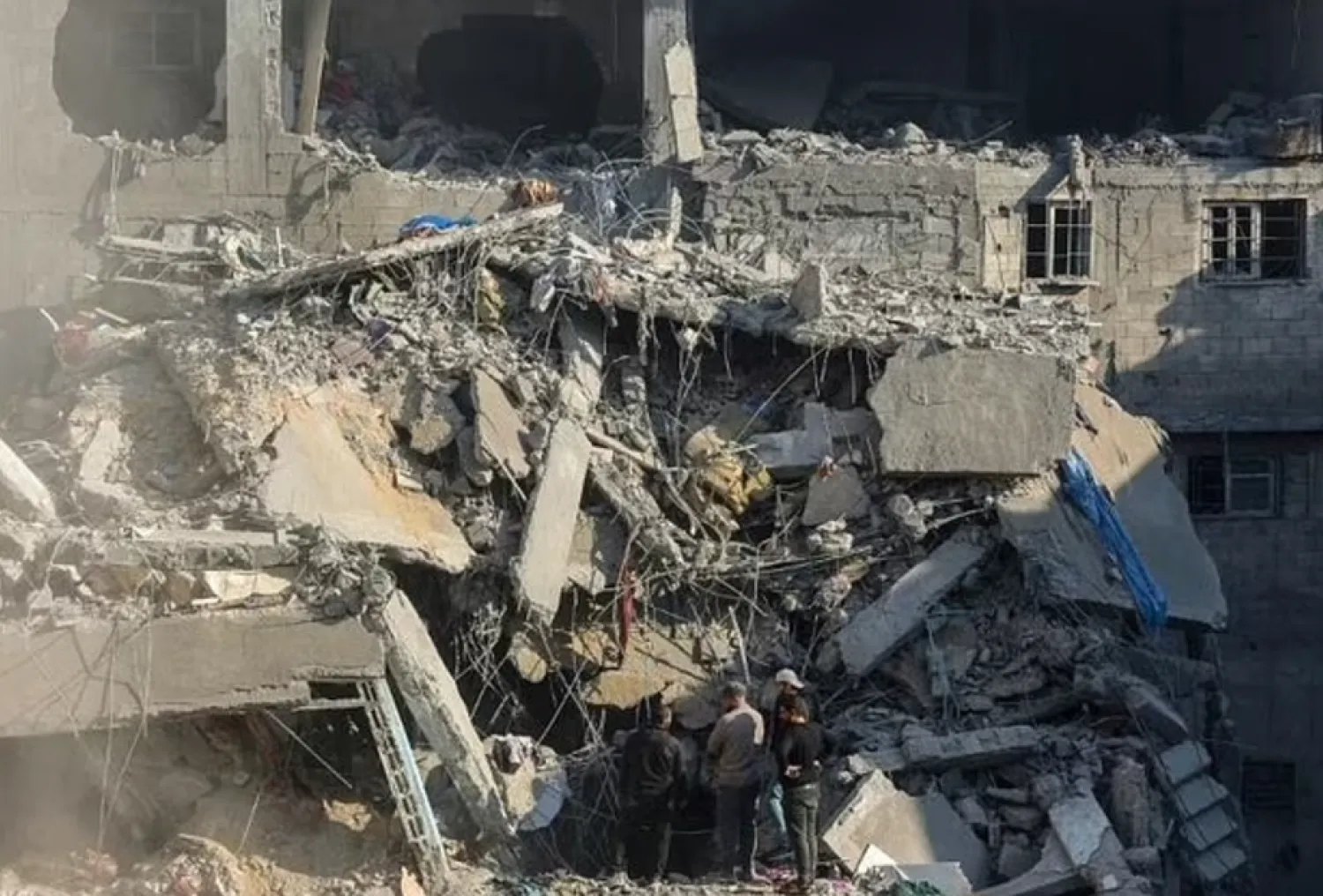
Fears for Gaza Hospitals as Fuel and Aid Run Low

The Palestinian health ministry in Gaza said Friday that hospitals have only two days' fuel left before they must restrict services, after the UN warned aid delivery to the war-devastated territory is being crippled. - AFP
TT

Fears for Gaza Hospitals as Fuel and Aid Run Low

The Palestinian health ministry in Gaza said Friday that hospitals have only two days' fuel left before they must restrict services, after the UN warned aid delivery to the war-devastated territory is being crippled. - AFP

The Palestinian health ministry in Gaza said Friday that hospitals have only two days' fuel left before they must restrict services, after the UN warned aid delivery to the war-devastated territory is being crippled.

The warning came a day after the International Criminal Court issued arrest warrants for Israeli Prime Minister Benjamin Netanyahu and former defence minister Yoav Gallant more than a year into the Gaza war.

The United Nations and others have repeatedly decried humanitarian conditions, particularly in northern Gaza, where Israel said Friday it had killed two commanders involved in Hamas's October 7, 2023 attack that triggered the war.

Gaza medics said an overnight Israeli raid on the cities of Beit Lahia and nearby Jabalia resulted in dozens killed or missing.

Marwan al-Hams, director of Gaza's field hospitals, told reporters all hospitals in the Palestinian territory "will stop working or reduce their services within 48 hours due to the occupation's (Israel's) obstruction of fuel entry".

World Health Organization chief Tedros Adhanom Ghebreyesus said he was "deeply concerned about the safety and well-being of 80 patients, including 8 in the intensive care unit" at Kamal Adwan hospital, one of just two partly operating in northern Gaza.

Kamal Adwan director Hossam Abu Safia told AFP it was "deliberately hit by Israeli shelling for the second day" Friday and that "one doctor and some patients were injured".

Late Thursday, the UN's humanitarian coordinator for the Palestinian territories, Muhannad Hadi, said: "The delivery of critical aid across Gaza, including food, water, fuel and medical supplies, is grinding to a halt."

He said that for more than six weeks, Israeli authorities "have been banning commercial imports" while "a surge in armed looting" has hit aid convoys.

Issuing the warrants for Netanyahu and Gallant, the Hague-based ICC said there were "reasonable grounds" to believe they bore "criminal responsibility" for the war crime of starvation as a method of warfare, and crimes against humanity including over "the lack of food, water, electricity and fuel, and specific medical supplies".

At least 44,056 people have been killed in Gaza during more than 13 months of war, most of them civilians, according to figures from Gaza's health ministry which the United Nations considers reliable.


Qassem’s Call to Topple Lebanon's Govt Exposes Differences with Berri

President Joseph Aoun chairs a cabinet meeting at the Baabda palace. (Lebanese Presidency file)
TT

Qassem’s Call to Topple Lebanon's Govt Exposes Differences with Berri

President Joseph Aoun chairs a cabinet meeting at the Baabda palace. (Lebanese Presidency file)

Hezbollah Secretary-General Sheikh Naim Qassem’s call to topple the Lebanese government was not only rejected by the group’s political opponents, but also appeared out of step with the position of its main ally, Parliament Speaker Nabih Berri, who along with Hezbollah has ministers in government.

While Qassem escalated his attack on the negotiations the Lebanese state is conducting with Israel and called on the street to bring down the government, the positions of Berri’s Development and Liberation bloc appeared closer to containing the escalation and stressing the priority of preserving institutions and internal stability.

In the absence of any practical signs that Hezbollah intends to move toward executive steps, such as the resignation of its ministers or an actual push to topple the government, Qassem’s remarks appeared closer to raising the political ceiling and maintaining media and popular pressure against the negotiations.

Qassem had called on Sunday evening for “toppling the government that is implementing the American Israeli project,” saying “the people have the right to take to the streets and topple the government and the American Israeli project.”

“There is no political sovereignty in Lebanon; it is subject to American tutelage,” he alleged.

He renewed his attack on the direct negotiations the Lebanese state is conducting with Israel, saying “they are rejected and a net gain for Israel,” and calling on the Lebanese authorities to abandon the talks and “not give America what it is asking for.”

Divergence within the Shiite duo

Ministerial sources close to the Lebanese presidency said Qassem’s remarks were merely “part of Hezbollah’s escalation and continuing attack on the negotiations, something that has not received a positive response, not only among Hezbollah’s opponents, but also among its allies.”

Hezbollah and Berri’s Amal movement are allies, commonly known as the Shiite duo.

“If Hezbollah wants to overthrow the government in which it is represented, it should first start by withdrawing its ministers from it, which it will not do under the current circumstances,” the sources told Asharq Al-Awsat.

MP Qassem Hashem, a member of Berri’s bloc, said Qassem’s call to topple the government “is nothing more and nothing less than an opinion.”

Hashem said in a radio interview that “more work must be done to unify the internal position and confront challenges in order to preserve common ground among the Lebanese, and this is Speaker Nabih Berri’s position.”

He ruled out any possibility that Hezbollah would withdraw its ministers, saying “the situation does not allow that.” He stressed “the need to preserve all institutions, especially as the government withstood the most difficult circumstances.”

President Joseph Aoun had issued a statement marking Liberation Day on Monday, hours after Qassem’s comments, in which he said that “Lebanon will not accept this reality and will not make peace with it. The path toward full Israeli withdrawal will remain a firm national demand that cannot be abandoned.”

He added that the Lebanese state was working to achieve this “through the option of negotiation, which will not be a concession or surrender, but an affirmation of Lebanon’s exclusive right to protect its land and sovereignty and extend its authority through its army and legitimate security forces.”

“The army will remain the sole guarantor of national security and territorial integrity,” he declared.

Rejection of Qassem’s attack

Aoun’s positions and the government’s decisions continue to receive broad support in Lebanon.

On the centenary of the Lebanese Constitution, the Kataeb Party stressed “the need to uphold its authority as the national pact among the Lebanese and the fundamental guarantee for the establishment of the state and the protection of freedoms.”

The Kataeb placed Qassem’s remarks “within the context of Iran’s insistence on undermining the independence of Lebanese decision-making,” saying that “if he objects to the government’s performance and decisions, it would be more appropriate for him to withdraw his ministers from it instead of resorting to fueling strife.”

It stressed the need to continue the direct Lebanese-Israeli negotiations and implement the Lebanese government’s decisions independently of any negotiations underway in the region, with the aim of securing a ceasefire, ensuring Israeli withdrawal, releasing prisoners, enabling the return of the displaced, reconstruction and the demarcation of the land border.

The Kataeb also called on Lebanon’s friends among Arab countries and Western countries to support the government in this effort and back the army as it implements the government’s decisions.

MP Ghada Ayoub, of the Lebanese Forces bloc. Said: “Qassem’s remarks are misplaced. Hezbollah is participating in the government, and if it has an objection to it or to the negotiations taking place in the United States, it should have taken the initiative to withdraw its ministers from the government first before targeting it.”

“I believe Qassem’s remarks are a threat that reveals Hezbollah’s plan to turn inward if the results of the negotiations are not in its favor,” she said in a radio interview, pointing to “confusion in the party’s position.”



Palestinians Say Israeli Forces Kill Man in Jenin Refugee Camp

 Israeli soldiers keep watch during a weekly settlers' tour in Hebron, in the Israeli-occupied West Bank, May 23, 2026. (Reuters)
Israeli soldiers keep watch during a weekly settlers' tour in Hebron, in the Israeli-occupied West Bank, May 23, 2026. (Reuters)
TT

Palestinians Say Israeli Forces Kill Man in Jenin Refugee Camp

 Israeli soldiers keep watch during a weekly settlers' tour in Hebron, in the Israeli-occupied West Bank, May 23, 2026. (Reuters)
Israeli soldiers keep watch during a weekly settlers' tour in Hebron, in the Israeli-occupied West Bank, May 23, 2026. (Reuters)

Israeli forces killed a Palestinian man inside the Jenin refugee camp in the northern West Bank, the Palestinian health ministry said on Tuesday.

"A citizen... was killed by Israeli fire in the Jenin camp, and ambulance crews transported his body to Jenin Government Hospital," the Ramallah-based ministry said in a statement, without specifying when he was killed.

Contacted by AFP, Israel's military said it was "checking" reports of the man's killing.

The director of Jenin's Government Hospital, Wissam Baker, identified the victim as Nasser al-Saadi, noting that "he arrived dead at the hospital after being shot in the thigh".

"It appears he bled heavily after being injured before an ambulance was called to transport him to the hospital," Baker told AFP.

The Palestinian Red Crescent had earlier announced that Israeli forces handed over the body of a 30-year-old from inside the Jenin refugee camp, which is adjacent to the city of Jenin.

Israeli forces have occupied and barred access to the Jenin refugee camp since January 2025, when they launched a wide-ranging operation aimed at uprooting Palestinian armed groups from the West Bank's densely populated refugee camps.

The operation has caused the displacement of nearly 40,000 people from the camps, according to the UN agency for Palestinian refugees, UNRWA.

At least 1,073 Palestinians, including several armed fighters, have been killed by Israeli soldiers or settlers since the outbreak of the Gaza war following Hamas's attack on 7 October 2023, according to an AFP tally based on Palestinian Authority data.

On the other hand, official Israeli data shows at least 46 Israelis -- civilians and soldiers -- have been killed in Palestinian attacks or during Israeli military operations in the same period.


Israel Issues Expropriation Order for West Bank Religious Site

 Israeli soldiers keep watch during a weekly settlers' tour in Hebron, in the Israeli-occupied West Bank, May 23, 2026. (Reuters)
Israeli soldiers keep watch during a weekly settlers' tour in Hebron, in the Israeli-occupied West Bank, May 23, 2026. (Reuters)
TT

Israel Issues Expropriation Order for West Bank Religious Site

 Israeli soldiers keep watch during a weekly settlers' tour in Hebron, in the Israeli-occupied West Bank, May 23, 2026. (Reuters)
Israeli soldiers keep watch during a weekly settlers' tour in Hebron, in the Israeli-occupied West Bank, May 23, 2026. (Reuters)

Israel has issued an expropriation order for land in the occupied West Bank near the site of a Biblical prophet's grave north of Jerusalem, an Israeli NGO reported Tuesday.

The site, known as Nabi Samuel, is believed in Christian, Jewish, and Muslim tradition to include the grave of the Biblical figure of prophet Samuel, and includes a mosque owned by Palestinian religious authorities, the Waqf.

"This marks the first time that the (Israeli) Civil Administration has expropriated a holy site owned by the Muslim Waqf in the occupied West Bank," Israeli settlement watchdog Peace Now said in a statement.

According to the Israeli order, dated May 9 but published this week, the area for expropriation will include 109.79 dunams (roughly 11 hectares), including access roads, agricultural land, and a mosque.

The order says the decision was made "for the development and preservation of the archaeological site of the Tomb of the Prophet Samuel".

A source in COGAT, the Israel defense ministry body in charge of civilian matters in the Palestinian territories, said the decision was made "following the refusal of Waqf officials to cooperate with the procedures required for the renovation of the tomb compound".

The Palestinian Authority's Ministry of Waqf and Religious Affairs issued a "strong condemnation" of the expropriation order for Nabi Samuel.

"This confiscation is part of a policy aimed at suffocating the mosque and completely isolating it from its Palestinian surroundings, turning it into a Jewish archaeological site by force of arms," the ministry said in a statement.

Peace Now's Yonatan Mizrahi pointed out that Israeli authorities had already taken over administration of much of the land by converting it into an Israeli national park in the 1990s, decades after demolishing a Palestinian village on the site.

"There was no need to decide about the expropriation of the land," Mizrahi told AFP, while Peace Now denounced "the messianic agenda of the Israeli government".

Israel has occupied the West Bank since 1967.

In 2025, Israel expropriated an area in the center of the Tomb of the Patriarchs in the southern West Bank city of Hebron, arguing the order concerned an open area intended for roofing works and not a religious structure.