Millions of People in Cuba without Power after Grid Collapse

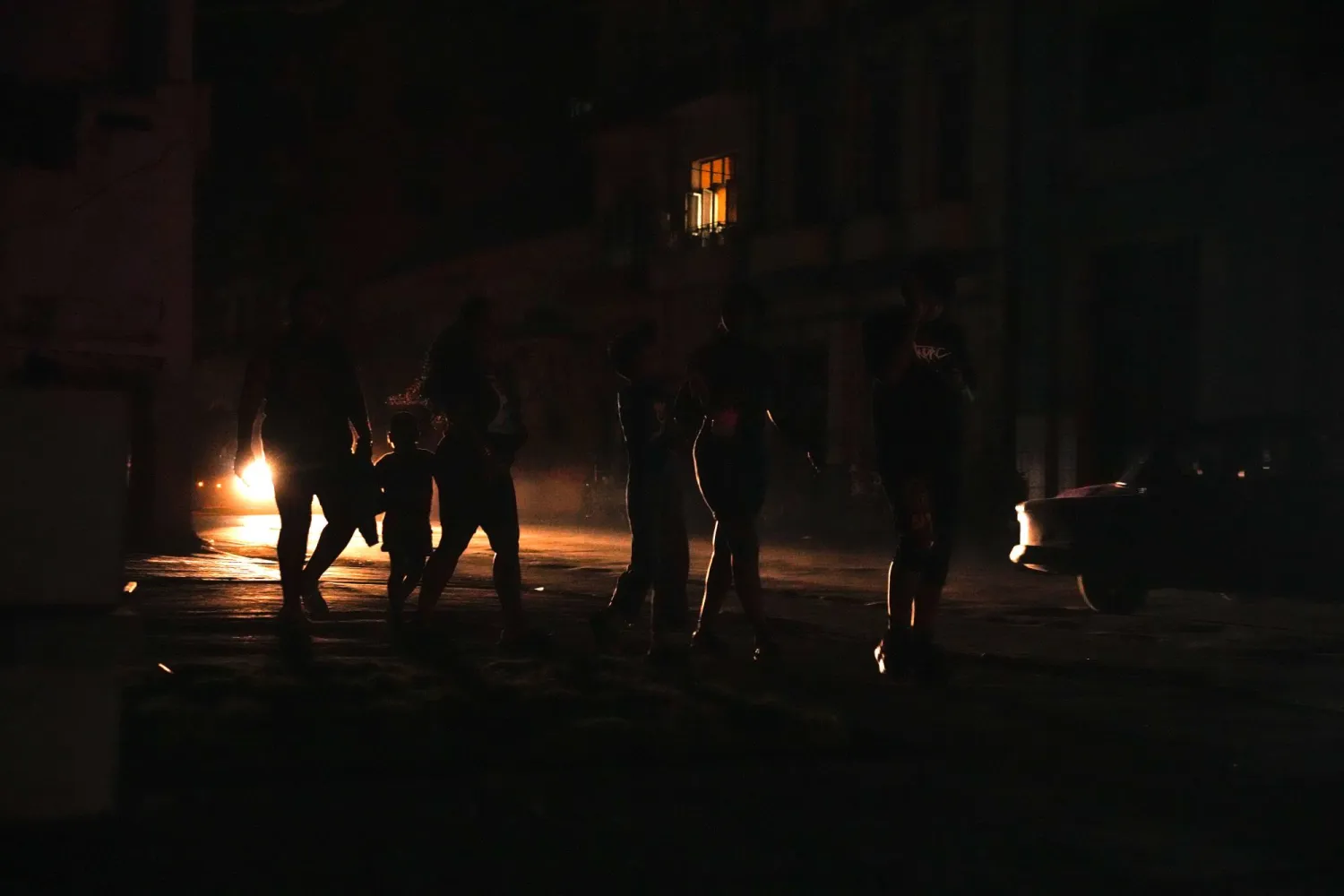
Residents walk on a street during a blackout following the failure of a major power plant in Havana, Cuba, Sunday, Oct. 20, 2024. (AP Photo/Ramon Espinosa)
TT

Millions of People in Cuba without Power after Grid Collapse

Residents walk on a street during a blackout following the failure of a major power plant in Havana, Cuba, Sunday, Oct. 20, 2024. (AP Photo/Ramon Espinosa)

Cuba said it had begun restoring power after the island's electrical grid collapsed, the latest in a string of nationwide blackouts that underscore the increasingly frail state of the country's power generation system.
Cuba’s energy minister Vicente de la O'Levy said the government had prioritized hospitals and water pumping facilities as it began restoring electricity to scattered circuits around the country.
But millions of Cubans across the island remained without power by midmorning, according to official reports, forcing the communist-run government to close schools and order non-official workers to stay home until electricity is restored.
The energy minister said he expected the system to be back online by Thursday, but said he would not rush the process.
"We have very capable specialists and they are all involved. We're going step by step," de la O'Levy said.
Cuba's grid has fallen into near-total disarray amid fuel shortages, natural disaster and economic crisis.
The island's oil-fired power plants, already obsolete and struggling to keep the lights on, reached a full crisis this year as oil imports from Venezuela, Russia and Mexico dwindled, contributing to multiple nationwide blackouts over two months.
Shortages of food, medicine, water and electricity have made life increasingly unbearable for many Cubans, who have fled the island in record-breaking numbers in the past three years.
Cuba blames US sanctions, which complicate financial transactions and the purchase of fuel, for the crisis.
PLANT FAIL
The Wednesday morning blackout was triggered by a failure at the Antonio Guiteras power plant in Matanzas, the island's top electricity producer, which shut down at around 2 a.m. local time.
Several other major power plants were undergoing maintenance and were offline when the Matanzas plant failed, starving the grid of electricity and leading to the nationwide collapse, the energy minister said.
Millions of people across Cuba were already seeing hours-long rolling blackouts daily before Wednesday's collapse.
Havana hotel worker Danielis Mora woke up frustrated and confused on Wednesday, like many Havana residents, who now experience regular blackouts throughout the week.
"I didn't know it was a total blackout again," Mora said. "Where I am living ... there is no gas either, if there is no electricity there is no way to make food, it has to be with firewood, or charcoal."
Scattered protests have erupted over the past two months over the repeated power failures as well as water, gas and food shortages.
The system failure on Wednesday morning had left the capital Havana almost completely in the dark.
Officials said floating power plants, contracted from Turkey's Karpowership, were generating electricity from offshore of Havana, providing power by midmorning to hospitals and a small number of the city`s 2 million residents.
Cuba's obsolete grid collapsed multiple times in October as fuel supplies dwindled and Hurricane Oscar struck the far eastern end of the island, then again in November with the passage of Hurricane Rafael.
Cuba`s government last week issued a decree ordering state and private businesses to generate more of their own electricity from renewable resources. The regulations also require businesses to limit their use of air conditioning, among other measures, as the country wrestles with the increasingly dire energy crisis.



Netanyahu Vows to Eliminate Iran Threat ‘Once and for All’

10 November 2026, Israel, Jerusalem: Caretaker Israeli Prime Minister Benjamin Netanyahu delivers a speech on the sidelines of the opening session of the new Knesset. (dpa)
TT

Netanyahu Vows to Eliminate Iran Threat ‘Once and for All’

10 November 2026, Israel, Jerusalem: Caretaker Israeli Prime Minister Benjamin Netanyahu delivers a speech on the sidelines of the opening session of the new Knesset. (dpa)

Israel's caretaker prime minister Benjamin Netanyahu on Saturday reiterated his calls for a national unity government with his opponent Gadi Eisenkot, as well as his vow to eliminate the threat from Iran.

A meeting with Eisenkot on Thursday "only strengthened the conviction that it is essential to form a national unity government" to guarantee Israel's security, Netanyahu said in a video statement, adding that such a government could "eliminate the Iranian threat once and for all".


Ukraine’s Zelenskiy Escalates Criticism of SpaceX Over Speed Caps

Ukraine's President Volodymyr Zelenskiy holds a press briefing in Copenhagen November 10, 2026. (AFP)
TT

Ukraine’s Zelenskiy Escalates Criticism of SpaceX Over Speed Caps

Ukraine's President Volodymyr Zelenskiy holds a press briefing in Copenhagen November 10, 2026. (AFP)

Ukraine's President Volodymyr Zelenskiy ‌escalated his criticism of SpaceX on Saturday, saying speed restrictions on its military-grade Starshield satellite terminals had dangerous political implications and undermined critical air defenses.

Zelenskiy said Starshield terminals operating in temporarily Russian-occupied territories of Ukraine had been limited to a maximum speed of 161 kph for the past five days, hampering Ukraine's military capabilities.

The Ukrainian Defense Ministry has raised the issue with SpaceX at the ‌institutional level, ‌Zelenskiy said.

"The restrictions have now ‌been ⁠in place for ⁠five days. They say it is some kind of technical issue. We do not believe that is the case," Zelenskiy told reporters in remarks released by his office on Saturday.

"If you impose restrictions there, you are already partially recognizing the temporarily ⁠occupied territories as not ours. And ‌that is why I ‌believe we have the right to raise this ‌issue and restore the speed – so that there ‌are no restrictions at all."

Zelenskiy said the speed restrictions made it more difficult for Ukrainian air defense units to intercept Russian jet-powered drones and made Ukrainian cities ‌more vulnerable. He said he had ordered his top military and foreign ministry ⁠officials ⁠to address the issue and seek clarification.

SpaceX has pushed back against the allegations, denying that it introduced new restrictions or made any changes to its satellite operations.

It is the second such outage in recent weeks. In mid-October, Ukrainian officials said that SpaceX limited the speed of Starlink and its Starshield communication systems to about 160 kph (100 mph) amid tensions with US President Donald Trump's administration over Ukrainian attacks on Russian oil refineries. Service was then restored on October 24.


UN Official Urges Iran, US to Let Fertilizers Through Hormuz Strait

Jorge Moreira da Silva, Executive Director of UNOPS (United Nations Office for Project Services), and coordinator of the UN Strait of Hormuz Task Force established by the UN Secretary-General, speaks during an interview with AFP on the sidelines of the 31st United Climate Change Conference (COP31), at the media center located on the Antalya Expo Center in Antalya on November 14, 2026. (AFP)
TT

UN Official Urges Iran, US to Let Fertilizers Through Hormuz Strait

Jorge Moreira da Silva, Executive Director of UNOPS (United Nations Office for Project Services), and coordinator of the UN Strait of Hormuz Task Force established by the UN Secretary-General, speaks during an interview with AFP on the sidelines of the 31st United Climate Change Conference (COP31), at the media center located on the Antalya Expo Center in Antalya on November 14, 2026. (AFP)

Iran and the United States should "immediately" allow fertilizer shipments through the Strait of Hormuz to ease the crisis in some of the most vulnerable countries, a senior UN official said Saturday.

Jorge Moreira da Silva, head of the UN Office for Project Services, told the COP31 climate talks in the Turkish resort city of Antalya that the lack of fertilizers could push millions into poverty.

The Iranian blockade of the vital waterway, which started after the joint US-Israeli attack against Iran in late February, has choked shipping in the region and beyond. The US blockade of Iranian ports has further complicated matters.

While Iran and the United States are still trying to negotiate an end to the conflict, Moreira da Silva said he had the same message for both countries.

"They should continue their negotiations about the comprehensive deal -- but that deal should not avoid an immediate, exceptional, limited, and time-bound solution for the fertilizers," he said.

"Basically, what we need is five vessels a day with fertilizers," he added.

- Millions at risk -

Moreira da Silva heads up the UN task force dedicated to facilitating the safe passage of fertilizers during the crisis.

Before the conflict, a third of the world's fertilizers passed through the Strait of Hormuz, and since the blockades, their prices had risen by 30 percent, he said.

"But what I think is not sufficiently recognized is the disproportionate impact on the most vulnerable countries," he added.

Sudan's finance minister recently told him that the price of food there had doubled in six months, he added. In Nepal, they had told him that farmers could no longer afford to buy fertilizers.

"So, it's very important that we are aware that countries such as Mozambique, Kenya, Sudan, Somalia, Nepal, Bangladesh, Sri Lanka are facing very significant impact."

The effects of this shortage could be catastrophic, he warned.

"If we continue missing the planting seasons in different parts of the world we may have 45 million people facing severe and acute food insecurity," he said.

"We may have 30 million people being forced into poverty."

The UN had a system ready to get fertilizer shipments moving within seven to 10 days, he said.