South Korea’s Yoon under Pressure to Resign as Threat of Impeachment Looms

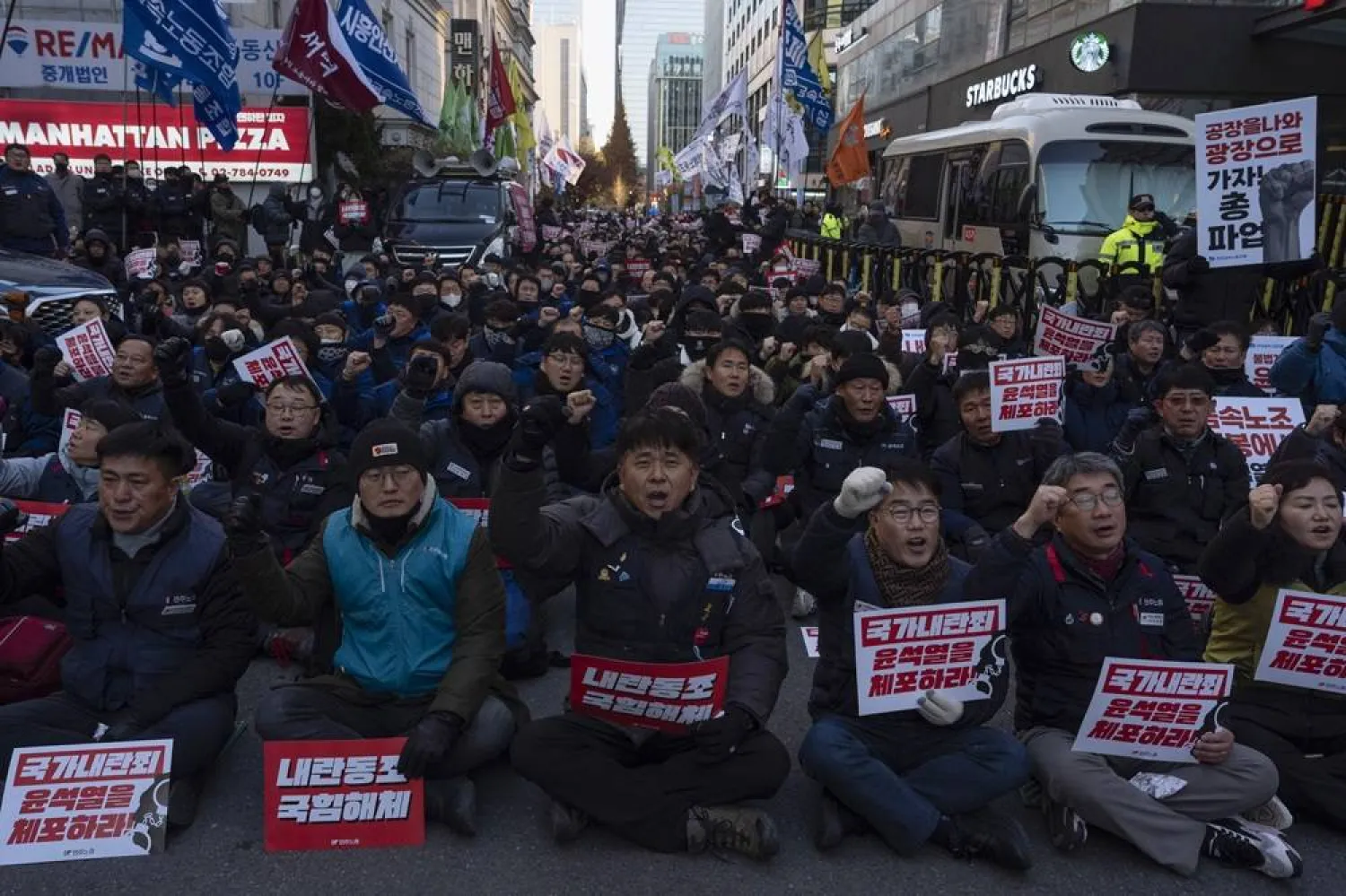
 Protesters against South Korean President Yoon Suk Yeol gather outside the ruling People Power Party headquarters in Seoul, South Korea, Friday, Dec. 6, 2024. (AP)
Protesters against South Korean President Yoon Suk Yeol gather outside the ruling People Power Party headquarters in Seoul, South Korea, Friday, Dec. 6, 2024. (AP)
TT

South Korea’s Yoon under Pressure to Resign as Threat of Impeachment Looms

 Protesters against South Korean President Yoon Suk Yeol gather outside the ruling People Power Party headquarters in Seoul, South Korea, Friday, Dec. 6, 2024. (AP)
Protesters against South Korean President Yoon Suk Yeol gather outside the ruling People Power Party headquarters in Seoul, South Korea, Friday, Dec. 6, 2024. (AP)

South Korea's ruling party leader said President Yoon Suk Yeol needed to be removed from power for trying to impose martial law, increasing the pressure on him to quit even though members of his People Power Party late on Friday reaffirmed its formal opposition to his impeachment.

On Saturday, lawmakers will vote on the main opposition Democratic Party's motion to impeach Yoon, who shocked the nation late on Tuesday when he gave the military sweeping emergency powers in order to root out what he called "anti-state forces" and overcome obstructionist political opponents.

Yoon rescinded the declaration about six hours later after parliament, including some members of his party, voted to oppose the decree.

The conservative PPP has vowed to oppose the impeachment bill, a position it reaffirmed on Friday night following a lengthy meeting of its lawmakers - at least some of whom would need to back it for the motion to succeed. Yoon said he would listen to the party's concerns, a PPP spokesperson told reporters.

Acting Defense Minister Kim Seon-ho said reports that had swirled throughout Friday that there might be another attempt to impose martial law were not true.

PPP leader Han had earlier added fuel to those rumors, and suggested the party's stance on impeachment might be shifting, when he said there was "a high risk of extreme actions such as this emergency martial law being repeated" while Yoon remained in power.

He also cited "credible evidence" that Yoon had on Tuesday intended to arrest and detain political leaders at Gwacheon, just south of Seoul, and called for Yoon's "immediate suspension". He did not explicitly call for impeachment or respond to reporters when asked for clarification.

The presidential office later denied any such order to arrest prominent politicians had been given, the Yonhap news agency reported.

Democratic Party leader Lee Jae-myung said there was still a possibility of another spontaneous late-night declaration by Yoon, though he did not offer substantive evidence.

"The situation is getting worse, there are fewer ways (for Yoon) to escape," Lee told Reuters in an interview. "That's why it's very dangerous tonight, because the only chance he has is tonight, and tomorrow morning".

Some PPP members urged Yoon to resign before the vote, saying they did not want a repeat of the 2016 impeachment of then-President Park Geun-hye, who left office following months of candlelit protests over an influence-peddling scandal. Her downfall triggered the implosion of the party and a victory by liberals in presidential and general elections.

In scenes reminiscent of those protests, thousands of demonstrators holding candles assembled outside parliament on Friday night demanding Yoon's impeachment.

YOON NOT SEEN IN PUBLIC

To succeed, an impeachment bill would need support from two-thirds of the 300-member assembly. Yoon's party has 108 legislators, so eight would have to side with the opposition for the bill to pass.

If parliament votes to impeach, the president is suspended from exercising his powers until an impeachment trial is held by the Constitutional Court. The prime minister serves as leader in an acting capacity.

Yoon has not been seen in public since rescinding martial law early on Wednesday and did not attend the PPP meeting on Friday.

Following media reports Yoon was on his way to parliament during the day, opposition lawmakers had poured out to the main lobby of the parliament building and set up a scrum to block him if he came.

The assembly speaker asked Yoon not to come to parliament, even if he planned to, and said his office would take steps to prevent him from reaching the assembly. Yoon's office denied any such plans.

A Reuters reporter saw dozens of official parliamentary vehicles parked across the open spaces surrounding parliament on Friday night - the same spaces in which military helicopters had offloaded troops on Tuesday.

Police have launched investigations into the president and Kim Yong-hyun, the defense minister who allegedly encouraged him to declare martial law and who has since resigned.

Government and military prosecutors had also decided to conduct a joint investigation into the martial law decision, according to broadcaster YTN. The defense ministry said three army commanders were suspended, while military prosecutors were seeking to bar 10 officers from travelling overseas.

'UNCONSTITUTIONAL'

Details were slowly emerging about the chaos that engulfed Seoul on Tuesday night following Yoon's surprise declaration, which stirred painful memories of the country's long years of military rule following World War Two.

Kwak Jong-geun, the special warfare commander, said he defied an order from then-defense minister Kim to drag lawmakers out of parliament, and instead ordered his troops to not carry live ammunition or enter the area where lawmakers were meeting.

"I told them not to go in," he told an opposition lawmaker's YouTube channel.

The National Election Commission said in a statement on Friday that around 300 martial law forces had entered premises under its control across the country following Yoon's shock announcement.

"The occupation of the National Election Commission, an independent organization under the constitution, is a clear unconstitutional and illegal act," the statement said.

Yoon's approval rating plunged to a new low of 13%, according to the latest Gallup Korea poll released on Friday.


Netanyahu Vows to Eliminate Iran Threat ‘Once and for All’

10 November 2026, Israel, Jerusalem: Caretaker Israeli Prime Minister Benjamin Netanyahu delivers a speech on the sidelines of the opening session of the new Knesset. (dpa)
TT

Netanyahu Vows to Eliminate Iran Threat ‘Once and for All’

10 November 2026, Israel, Jerusalem: Caretaker Israeli Prime Minister Benjamin Netanyahu delivers a speech on the sidelines of the opening session of the new Knesset. (dpa)

Israel's caretaker prime minister Benjamin Netanyahu on Saturday reiterated his calls for a national unity government with his opponent Gadi Eisenkot, as well as his vow to eliminate the threat from Iran.

A meeting with Eisenkot on Thursday "only strengthened the conviction that it is essential to form a national unity government" to guarantee Israel's security, Netanyahu said in a video statement, adding that such a government could "eliminate the Iranian threat once and for all".


Ukraine’s Zelenskiy Escalates Criticism of SpaceX Over Speed Caps

Ukraine's President Volodymyr Zelenskiy holds a press briefing in Copenhagen November 10, 2026. (AFP)
TT

Ukraine’s Zelenskiy Escalates Criticism of SpaceX Over Speed Caps

Ukraine's President Volodymyr Zelenskiy holds a press briefing in Copenhagen November 10, 2026. (AFP)

Ukraine's President Volodymyr Zelenskiy ‌escalated his criticism of SpaceX on Saturday, saying speed restrictions on its military-grade Starshield satellite terminals had dangerous political implications and undermined critical air defenses.

Zelenskiy said Starshield terminals operating in temporarily Russian-occupied territories of Ukraine had been limited to a maximum speed of 161 kph for the past five days, hampering Ukraine's military capabilities.

The Ukrainian Defense Ministry has raised the issue with SpaceX at the ‌institutional level, ‌Zelenskiy said.

"The restrictions have now ‌been ⁠in place for ⁠five days. They say it is some kind of technical issue. We do not believe that is the case," Zelenskiy told reporters in remarks released by his office on Saturday.

"If you impose restrictions there, you are already partially recognizing the temporarily ⁠occupied territories as not ours. And ‌that is why I ‌believe we have the right to raise this ‌issue and restore the speed – so that there ‌are no restrictions at all."

Zelenskiy said the speed restrictions made it more difficult for Ukrainian air defense units to intercept Russian jet-powered drones and made Ukrainian cities ‌more vulnerable. He said he had ordered his top military and foreign ministry ⁠officials ⁠to address the issue and seek clarification.

SpaceX has pushed back against the allegations, denying that it introduced new restrictions or made any changes to its satellite operations.

It is the second such outage in recent weeks. In mid-October, Ukrainian officials said that SpaceX limited the speed of Starlink and its Starshield communication systems to about 160 kph (100 mph) amid tensions with US President Donald Trump's administration over Ukrainian attacks on Russian oil refineries. Service was then restored on October 24.


UN Official Urges Iran, US to Let Fertilizers Through Hormuz Strait

Jorge Moreira da Silva, Executive Director of UNOPS (United Nations Office for Project Services), and coordinator of the UN Strait of Hormuz Task Force established by the UN Secretary-General, speaks during an interview with AFP on the sidelines of the 31st United Climate Change Conference (COP31), at the media center located on the Antalya Expo Center in Antalya on November 14, 2026. (AFP)
TT

UN Official Urges Iran, US to Let Fertilizers Through Hormuz Strait

Jorge Moreira da Silva, Executive Director of UNOPS (United Nations Office for Project Services), and coordinator of the UN Strait of Hormuz Task Force established by the UN Secretary-General, speaks during an interview with AFP on the sidelines of the 31st United Climate Change Conference (COP31), at the media center located on the Antalya Expo Center in Antalya on November 14, 2026. (AFP)

Iran and the United States should "immediately" allow fertilizer shipments through the Strait of Hormuz to ease the crisis in some of the most vulnerable countries, a senior UN official said Saturday.

Jorge Moreira da Silva, head of the UN Office for Project Services, told the COP31 climate talks in the Turkish resort city of Antalya that the lack of fertilizers could push millions into poverty.

The Iranian blockade of the vital waterway, which started after the joint US-Israeli attack against Iran in late February, has choked shipping in the region and beyond. The US blockade of Iranian ports has further complicated matters.

While Iran and the United States are still trying to negotiate an end to the conflict, Moreira da Silva said he had the same message for both countries.

"They should continue their negotiations about the comprehensive deal -- but that deal should not avoid an immediate, exceptional, limited, and time-bound solution for the fertilizers," he said.

"Basically, what we need is five vessels a day with fertilizers," he added.

- Millions at risk -

Moreira da Silva heads up the UN task force dedicated to facilitating the safe passage of fertilizers during the crisis.

Before the conflict, a third of the world's fertilizers passed through the Strait of Hormuz, and since the blockades, their prices had risen by 30 percent, he said.

"But what I think is not sufficiently recognized is the disproportionate impact on the most vulnerable countries," he added.

Sudan's finance minister recently told him that the price of food there had doubled in six months, he added. In Nepal, they had told him that farmers could no longer afford to buy fertilizers.

"So, it's very important that we are aware that countries such as Mozambique, Kenya, Sudan, Somalia, Nepal, Bangladesh, Sri Lanka are facing very significant impact."

The effects of this shortage could be catastrophic, he warned.

"If we continue missing the planting seasons in different parts of the world we may have 45 million people facing severe and acute food insecurity," he said.

"We may have 30 million people being forced into poverty."

The UN had a system ready to get fertilizer shipments moving within seven to 10 days, he said.