


Lebanese Govt Approves Plan for Deployment of Army in South

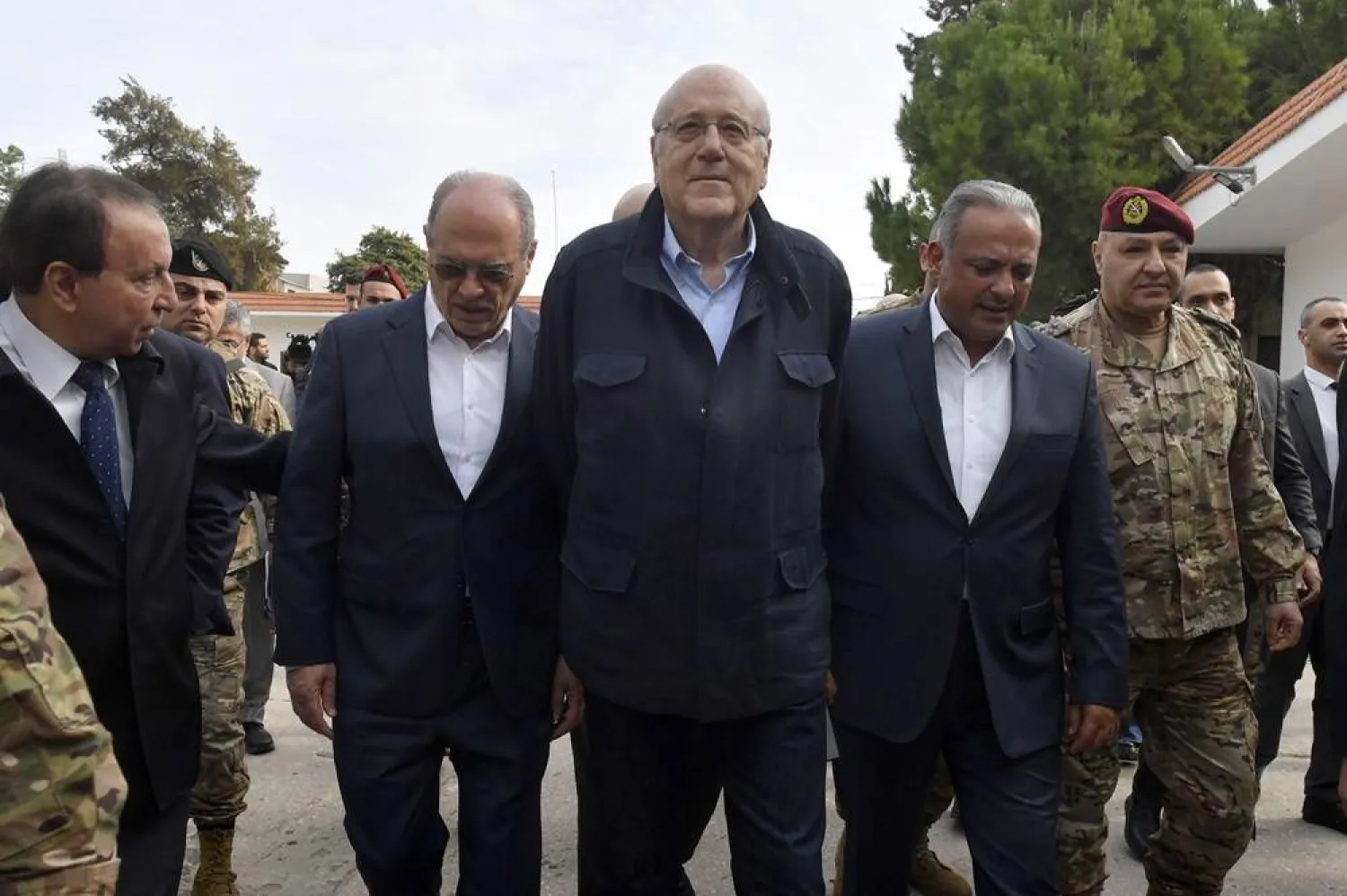
Lebanese caretaker Prime Minister Najib Mikati (C) arrives with cabinet ministers for a meeting at Benoit Barakat barracks in Tyre, southern Lebanon, 07 December 2024. (EPA)
TT

Lebanese Govt Approves Plan for Deployment of Army in South

Lebanese caretaker Prime Minister Najib Mikati (C) arrives with cabinet ministers for a meeting at Benoit Barakat barracks in Tyre, southern Lebanon, 07 December 2024. (EPA)

The Lebanese caretaker government approved a plan for the deployment of the Lebanese army south of the Litani River.

Holding an extraordinary meeting in the army barracks in the southern city of Tyre, the government also approved a plan for the country’s reconstruction after Israel’s war on Hezbollah.

Army commander Joseph Aoun, who attended the meeting, presented a plan of the deployment of the military.

Prime Minister Najib Mikati stressed that United Nations Security Council Resolution 1701 was the foundation for the ceasefire between Israel and Hezbollah.

He called on sponsors of the ceasefire to work “seriously” towards ending Israel’s violation of the truce and its withdrawal from Lebanese territories it has occupied.

He praised the military command that has proven its “discipline and responsibility” during these times.

Mikati also underscored the government’s support for the army’s cooperation with the UN Interim Force in Lebanon (UNIFIL).

Moreover, he stressed that the stability of the South and its reconstruction is key to stability in the Middle East.

“There can be no security and safety without the implementation of international resolutions,” he declared.

At the end of the cabinet meeting, Information Minister Ziad Makary said the government approved the army’s deployment plan, adding that he it has already sent forces to the South.

The military needs equipment and gear, he added, revealing that Aoun had spoken about assistance that will be received by the army soon.

Rubble will be removed from the South and areas will be cleared of cluster bombs, the minister added.



Israel, Hezbollah Agree Ceasefire as US-Iran Deal Under Strain

An Israeli flag tagged on a building in the southern Lebanese village of Taybeh, as seen from the Israeli side of the border in the Upper Galilee, northern Israel, 17 June 2026. EPA/ATEF SAFADI
TT

Israel, Hezbollah Agree Ceasefire as US-Iran Deal Under Strain

An Israeli flag tagged on a building in the southern Lebanese village of Taybeh, as seen from the Israeli side of the border in the Upper Galilee, northern Israel, 17 June 2026. EPA/ATEF SAFADI

Israel and Hezbollah agreed a ceasefire on Friday, a US official said, after deadly exchanges between the two sides in Lebanon put a deal to end the Middle East war under strain less than two days after it was signed.

Talks that were scheduled for Friday between the US and Iran in Switzerland to take the deal to the next stage were postponed amid the fighting, with no new date announced, AFP reported.

Tehran's top negotiator warned it would not bend on its red lines and that its finger was still "on the trigger", even as shipping appeared to pick up in the Strait of Hormuz, which had essentially been closed during the war.

The deal signed this week by President Donald Trump and his Iranian counterpart Masoud Pezeshkian aims to end a war that began on February 28 with US-Israeli strikes that killed supreme leader Ali Khamenei.

The agreement was also meant to halt the fighting in Lebanon, which Iran has always insisted should be covered under any accord, turning Israel's ongoing campaign there into a source of frustration for Washington.

Israel's military said Friday that it had struck more than 80 Hezbollah targets in Lebanon and killed dozens of members of the Iran-backed group.

Lebanon said 21 people were killed Friday in Israeli airstrikes in the south, while Israel's military reported four troops were killed, drawing furious reactions at home.

But a US official told AFP a truce between Israel and Hezbollah, beginning immediately, had been brokered by US and Qatari mediators following talks with Israel and Iran. A Gulf diplomat confirmed the ceasefire.

A previous truce agreed in April, however, did nothing to stop attacks by either side, and Prime Minister Benjamin Netanyahu had said just hours earlier that the Israeli army would stay in Lebanon "as long as necessary" and would make Iran-backed Hezbollah pay a "heavy price" for its attacks.

Far-right Israeli National Security Minister Itamar Ben Gvir went even further, saying after the soldiers' deaths that "all of Lebanon must burn".

Iranian Foreign Minister Abbas Araghchi accused Israel of only being interested in "permanent war".

Preparations had been made to host Iranian and US delegations led by Tehran's top negotiator Mohammad Bagher Ghalibaf and US Vice President JD Vance at the Swiss resort of Burgenstock, overlooking Lake Lucerne.

The talks were due to kick off a two-month period of negotiations to discuss outstanding issues not covered by the initial deal, notably Iran's nuclear program.

Switzerland's foreign ministry confirmed the discussions had been postponed but said it "remains ready to facilitate these talks".

Quoting diplomats, the Financial Times said Israel's strikes on Lebanon had led to the postponement but there was no immediate confirmation.

Ghalibaf said on Friday that talks with the United States would remain bound by Tehran's "red lines".

"If the enemy seeks to be excessive, we have proven that our fingers are on the trigger and we have no hesitation in giving a crushing response to the enemy," he said in remarks published by the official IRNA news agency.

Vance, meanwhile, has expressed a degree of exasperation with the Israeli government rare for a top US official, telling the New York Times "you can't just kill your way out of solving every single national security problem that you have".

Iran's new supreme leader Mojtaba Khamenei, who succeeded his father, said Thursday that he had approved the accord with the US, despite holding a "different view".

A key aspect of the deal was the immediate re-opening of the Strait of Hormuz, the key shipping bottleneck whose closure caused global energy prices to rise.

A total of 25 commercial vessels crossed the newly-reopened strait on Thursday, the highest number since mid-April, according to data from maritime tracking firm AXSMarine published on Friday.

A fifth of the world's oil and liquefied natural gas exports passed through the strait in peacetime, according to economists.

American forces on Thursday lifted their parallel naval blockade of Iranian ports, the US military said, noting that American warships "will remain in the general area".

Iran's maritime authority said on Friday that all ships seeking to cross the Strait of Hormuz should submit a transit request "48 hours in advance", despite its reopening.


Trump's Pledge to Intervene: Can It Break the Deadlock in the Ethiopian Renaissance Dam Crisis?

Egyptian President Abdel Fattah El Sisi meets US President Donald Trump on the sidelines of the G7 Summit (Egyptian Presidency)
TT

Trump's Pledge to Intervene: Can It Break the Deadlock in the Ethiopian Renaissance Dam Crisis?

Egyptian President Abdel Fattah El Sisi meets US President Donald Trump on the sidelines of the G7 Summit (Egyptian Presidency)

During a meeting between Egyptian President Abdel Fattah El Sisi and US President Donald Trump on the sidelines of the G7 Summit in France, Trump affirmed that he would give the Grand Ethiopian Renaissance Dam (GERD) issue the highest priority in order to reach a fair settlement. The remarks prompted diplomats and analysts to predict a possible breakthrough in a dispute that has remained stalled for years.

With this commitment, and amid a calmer regional environment following the easing of tensions surrounding the Iran war, experts believe the dam issue could regain international attention after years of stagnation.

Egypt announced in 2024 that negotiations with Ethiopia over the dam had come to a halt after years of talks, attributing the breakdown to "the lack of political will on the Ethiopian side," according to previous statements by the Ministry of Water Resources and Irrigation.

During his meeting with Trump on Wednesday, El Sisi reiterated the critical importance of the Nile River issue, describing it as a matter of Egyptian national security, and expressed appreciation for the US president's interest in the matter.

For his part, Trump said he understood all of Egypt's concerns and stressed that he would give the issue "the highest priority in order to reach a fair settlement," according to a statement issued by the Egyptian presidency.

Speaking to El Sisi in remarks carried by the media, Trump said: "I think Ethiopia has treated you unfairly." He added: "A dam was built in Ethiopia that is causing major problems for Egypt, and I am fully aware of that. We will see whether we can reach a settlement on it."

US Diplomatic Activity

Recent months have seen renewed US engagement after nearly two years of suspended negotiations between Egypt and Ethiopia over the Renaissance Dam.

US action to resolve the Ethiopian Grand Renaissance Dam issue (Reuters)

US Diplomatic Activity

On May 18, a phone call between Egyptian Foreign Minister Badr Abdelatty and Massad Boulos, Senior Adviser to the US President for Arab and African Affairs, addressed the Ethiopian dam dispute and Egypt's water security.

Abdelatty emphasized Egypt's "complete rejection of any unilateral measures" and stated that water is an existential issue for the country. Meanwhile, according to the Egyptian statement, Boulos affirmed the US administration's commitment to strengthening its strategic partnership with Egypt and maintaining close coordination between the two countries in addressing shared challenges.

Earlier, on May 12, Boulos wrote on X that he had held "productive and comprehensive meetings" with an Ethiopian delegation led by Foreign Minister Gedion Timothewos and including National Intelligence and Security Service Director General Redwan Hussein. He added: "We held constructive discussions on the Nile River and the Grand Ethiopian Renaissance Dam."

A well informed Egyptian source previously told Asharq Al Awsat that efforts were underway to revive the "Washington Document," which Cairo signed in February 2020 but Addis Ababa rejected, albeit in a revised form designed to secure broader consensus.

The document included a phased timetable for filling the reservoir, mechanisms for coordination during drought and prolonged drought conditions, arrangements for annual and long term dam operations under such circumstances, as well as provisions for dispute resolution and information sharing.

The Egyptian source's comments came days after Boulos told Asharq Al Awsat that the US president had expressed his country's readiness to resume mediation between Egypt and Ethiopia "to reach a responsible and final settlement of the Renaissance Dam issue."

In January, Trump sent an official letter to El Sisi expressing Washington's willingness to restart negotiations over the dam and reach a final and fair solution. The move followed three statements he made in June and July 2025, in which he said that "Washington funded the dam, and there must be a quick solution to this crisis."

Back on the International Agenda

Mohamed Hegazy, a member of the Egyptian Council for Foreign Affairs and former assistant foreign minister, believes Trump's commitment represents an important political development that returns the issue to the international spotlight after years of deadlock.

Speaking to Asharq Al Awsat, he said: "The significance of these statements lies in the fact that they reflect renewed US recognition of the link between water issues and regional security and stability, as well as an acknowledgment that Egypt's water security is a fundamental component of security in the Middle East and the Horn of Africa."

Hegazy added that raising the issue on the sidelines of the G7 Summit is particularly significant because it comes amid a reordering of international priorities following the easing of tensions between the United States and Iran and growing concern over Red Sea security and international maritime routes. In this context, he said, the Nile issue becomes part of a broader equation involving regional security, sustainable development, and the prevention of conflicts linked to natural resources.

According to Hegazy, the real challenge lies in translating US political support for Egypt into practical measures, whether by relaunching a serious and time bound negotiation process or by providing international guarantees that help the parties reach a legally binding agreement governing dam operations and management during periods of drought and prolonged drought. Such an agreement, he said, would balance Ethiopia's right to development with Egypt's right to life and water security.

Hegazy concluded that the Egyptian US presidential meeting could open a "diplomatic window" and provide fresh momentum toward resolving the crisis if followed by serious political and diplomatic efforts.

However, Ethiopian political analyst and African affairs specialist Anwar Ibrahim holds a different view. He believes strong US intervention in the Renaissance Dam issue could lead to "undesirable developments" and argues that the greatest challenge is the transfer of the file to Washington.

Speaking to Asharq Al Awsat, Ibrahim said that US involvement and what he described as "bias toward Egypt" were the main reasons negotiations over the Renaissance Dam failed during Trump's first term.

He added: "The United States will not succeed in creating any real rapprochement because it relies on a carrot and stick approach without understanding the importance of the Nile for all countries in the region."

Nevertheless, Ibrahim did not rule out the possibility of a solution, but only "on the basis of understanding everyone's needs and reaching mutual understandings without pressure being exerted on Addis Ababa. Otherwise, the process will fail again and the dispute will return as a major source of tension," he said.


Cairo Says FM to Meet Pakistan, Saudi, Türkiye Counterparts in Egypt Sunday

General view of part of Cairo (Reuters)
TT

Cairo Says FM to Meet Pakistan, Saudi, Türkiye Counterparts in Egypt Sunday

General view of part of Cairo (Reuters)

Egypt's foreign minister will host his counterparts from Pakistan, Saudi Arabia and Türkiye in the Mediterranean city of Alamein on Sunday, Cairo's foreign ministry said.

Badr Abdelatty "will hold a quadrilateral meeting on Sunday with Saudi Arabia's Foreign Minister Prince Faisal bin Farhan, Türkiye's Foreign Minister Hakan Fidan and Pakistan's Foreign Minister Ishaq Dar, followed by an expanded session of talks and a joint press conference", the ministry said in a statement late Thursday.

It did not specify the topic of the discussions, but the four countries have been involved in mediation efforts around the Middle East war.

The four foreign ministers last met in April on the sidelines of a diplomatic forum in the Turkish resort city of Antalya.

The Alamein meeting comes after US-Iran talks scheduled in Switzerland for Friday, aimed at following up on the US-Iran agreement to end the war, were postponed, according to the Swiss foreign ministry.

The White House confirmed that US Vice President JD Vance's planned trip to Switzerland for the talks had been cancelled.

The agreement, which was reached earlier this week, aims to end the fighting, reopen the Strait of Hormuz and begin a 60-day period of negotiations on broader issues, including Tehran's nuclear programme.

It was also meant to halt fighting in Lebanon. However, clashes have since resumed between Israeli forces and Iran-backed Hezbollah fighters.