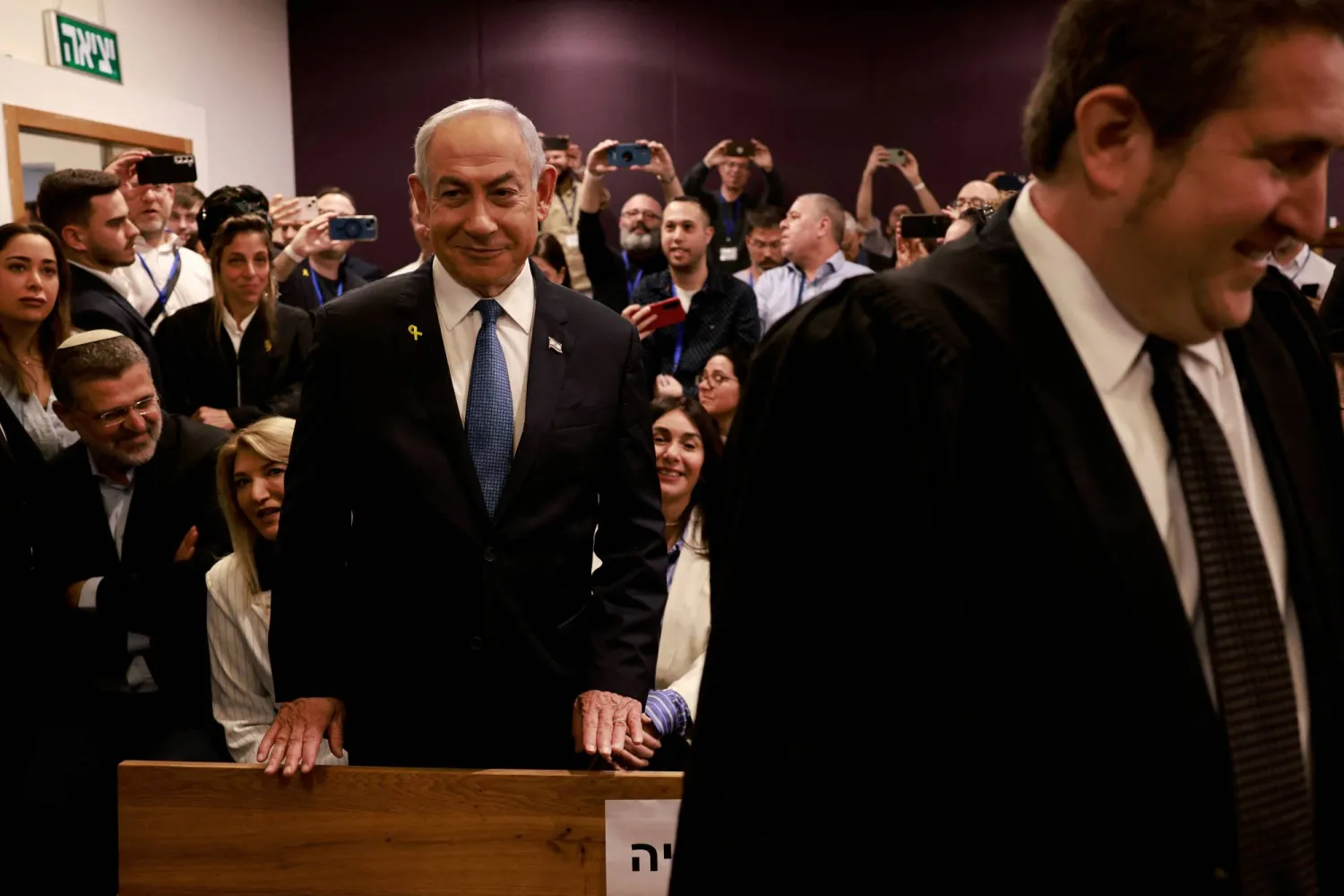
Netanyahu Takes the Stand in Long-running Corruption Trial

Israeli Prime Minister Benjamin Netanyahu smiles as he prepares to testify in his trial on corruption charges at the district court in Tel Aviv at the start of his hearing on corruption charges on December 10, 2024.      MENAHEM KAHANA/Pool via REUTERS
Israeli Prime Minister Benjamin Netanyahu smiles as he prepares to testify in his trial on corruption charges at the district court in Tel Aviv at the start of his hearing on corruption charges on December 10, 2024. MENAHEM KAHANA/Pool via REUTERS
TT

Netanyahu Takes the Stand in Long-running Corruption Trial

Israeli Prime Minister Benjamin Netanyahu smiles as he prepares to testify in his trial on corruption charges at the district court in Tel Aviv at the start of his hearing on corruption charges on December 10, 2024.      MENAHEM KAHANA/Pool via REUTERS
Israeli Prime Minister Benjamin Netanyahu smiles as he prepares to testify in his trial on corruption charges at the district court in Tel Aviv at the start of his hearing on corruption charges on December 10, 2024. MENAHEM KAHANA/Pool via REUTERS

Israeli Prime Minister Benjamin Netanyahu took the stand on Tuesday in his long-running trial for alleged corruption, as he faces an international arrest warrant for war crimes and the fighting in Gaza continues.

Upon starting his testimony, Netanyahu said “hello” to the judges. One judge told him he had the same privileges as other witnesses and could sit or stand as he chose.

“I waited eight years for this moment, to say the truth,” Netanyahu said, standing at a podium in a packed Tel Aviv courtroom. He called the charges against him “an ocean of absurdness” and promised his version would cut through the prosecution's case.

Netanyahu appeared at ease as he began telling his version of events and shared personal details about his life that he might hope would shape the judges’ perception of him. He said he used to lose sleep over media coverage but learned it had no meaningful bearing — in contrast to the prosecution's attempts to paint him as image-obsessed, The Associated Press reported.

Netanyahu will answer during his court appearances to charges of fraud, breach of trust and accepting bribes in three separate cases.

Netanyahu, 75, denies wrongdoing, saying the charges are a witch hunt orchestrated by a hostile media and a biased legal system out to topple his lengthy rule. His testimony caps years of scandals that have swirled around him and his family.
The testimony, set to take place six hours a day, three days a week for several weeks, will take up a significant chunk of Netanyahu’s working hours, prompting critics to ask if he can capably manage a country embroiled in a war on one front, containing the fallout from a second, and keeping tabs on other potential regional threats, including from Iran or the recent fall of Bashar Assad in Syria.
Netanyahu, in his testimony, said he could “find a balance” between both commitments.
Dozens of people gathered outside of the court in Tel Aviv, some protesting against Netanyahu, including family members of hostages held in Gaza, and also a group of his supporters. A banner draped in front of the court read: “Crime Minister."
Under Israeli law, indicted prime ministers are not required to step down. But the charges against Netanyahu cleaved deep divisions in Israel, with protesters demanding he resign and former political allies refusing to serve in government with the Israeli leader, triggering a political crisis that led to five elections in less than four years beginning in 2019.
Netanyahu's supporters view the charges as the result of the justice system’s bias and overreach.
Despite the pressure, the polarizing Netanyahu has rejected calls to step down and has used his position as prime minister to lash out at law enforcement, media and courts.
An Israeli court rejected a request by Netanyahu’s lawyers to reduce the expected testimony hours, as well as several other requests to delay the start of the testimony, which they said were necessary because of the prime minister’s busy schedule and the country's significant challenges.


Netanyahu Vows to Eliminate Iran Threat ‘Once and for All’

10 November 2026, Israel, Jerusalem: Caretaker Israeli Prime Minister Benjamin Netanyahu delivers a speech on the sidelines of the opening session of the new Knesset. (dpa)
TT

Netanyahu Vows to Eliminate Iran Threat ‘Once and for All’

10 November 2026, Israel, Jerusalem: Caretaker Israeli Prime Minister Benjamin Netanyahu delivers a speech on the sidelines of the opening session of the new Knesset. (dpa)

Israel's caretaker prime minister Benjamin Netanyahu on Saturday reiterated his calls for a national unity government with his opponent Gadi Eisenkot, as well as his vow to eliminate the threat from Iran.

A meeting with Eisenkot on Thursday "only strengthened the conviction that it is essential to form a national unity government" to guarantee Israel's security, Netanyahu said in a video statement, adding that such a government could "eliminate the Iranian threat once and for all".


Ukraine’s Zelenskiy Escalates Criticism of SpaceX Over Speed Caps

Ukraine's President Volodymyr Zelenskiy holds a press briefing in Copenhagen November 10, 2026. (AFP)
TT

Ukraine’s Zelenskiy Escalates Criticism of SpaceX Over Speed Caps

Ukraine's President Volodymyr Zelenskiy holds a press briefing in Copenhagen November 10, 2026. (AFP)

Ukraine's President Volodymyr Zelenskiy ‌escalated his criticism of SpaceX on Saturday, saying speed restrictions on its military-grade Starshield satellite terminals had dangerous political implications and undermined critical air defenses.

Zelenskiy said Starshield terminals operating in temporarily Russian-occupied territories of Ukraine had been limited to a maximum speed of 161 kph for the past five days, hampering Ukraine's military capabilities.

The Ukrainian Defense Ministry has raised the issue with SpaceX at the ‌institutional level, ‌Zelenskiy said.

"The restrictions have now ‌been ⁠in place for ⁠five days. They say it is some kind of technical issue. We do not believe that is the case," Zelenskiy told reporters in remarks released by his office on Saturday.

"If you impose restrictions there, you are already partially recognizing the temporarily ⁠occupied territories as not ours. And ‌that is why I ‌believe we have the right to raise this ‌issue and restore the speed – so that there ‌are no restrictions at all."

Zelenskiy said the speed restrictions made it more difficult for Ukrainian air defense units to intercept Russian jet-powered drones and made Ukrainian cities ‌more vulnerable. He said he had ordered his top military and foreign ministry ⁠officials ⁠to address the issue and seek clarification.

SpaceX has pushed back against the allegations, denying that it introduced new restrictions or made any changes to its satellite operations.

It is the second such outage in recent weeks. In mid-October, Ukrainian officials said that SpaceX limited the speed of Starlink and its Starshield communication systems to about 160 kph (100 mph) amid tensions with US President Donald Trump's administration over Ukrainian attacks on Russian oil refineries. Service was then restored on October 24.


UN Official Urges Iran, US to Let Fertilizers Through Hormuz Strait

Jorge Moreira da Silva, Executive Director of UNOPS (United Nations Office for Project Services), and coordinator of the UN Strait of Hormuz Task Force established by the UN Secretary-General, speaks during an interview with AFP on the sidelines of the 31st United Climate Change Conference (COP31), at the media center located on the Antalya Expo Center in Antalya on November 14, 2026. (AFP)
TT

UN Official Urges Iran, US to Let Fertilizers Through Hormuz Strait

Jorge Moreira da Silva, Executive Director of UNOPS (United Nations Office for Project Services), and coordinator of the UN Strait of Hormuz Task Force established by the UN Secretary-General, speaks during an interview with AFP on the sidelines of the 31st United Climate Change Conference (COP31), at the media center located on the Antalya Expo Center in Antalya on November 14, 2026. (AFP)

Iran and the United States should "immediately" allow fertilizer shipments through the Strait of Hormuz to ease the crisis in some of the most vulnerable countries, a senior UN official said Saturday.

Jorge Moreira da Silva, head of the UN Office for Project Services, told the COP31 climate talks in the Turkish resort city of Antalya that the lack of fertilizers could push millions into poverty.

The Iranian blockade of the vital waterway, which started after the joint US-Israeli attack against Iran in late February, has choked shipping in the region and beyond. The US blockade of Iranian ports has further complicated matters.

While Iran and the United States are still trying to negotiate an end to the conflict, Moreira da Silva said he had the same message for both countries.

"They should continue their negotiations about the comprehensive deal -- but that deal should not avoid an immediate, exceptional, limited, and time-bound solution for the fertilizers," he said.

"Basically, what we need is five vessels a day with fertilizers," he added.

- Millions at risk -

Moreira da Silva heads up the UN task force dedicated to facilitating the safe passage of fertilizers during the crisis.

Before the conflict, a third of the world's fertilizers passed through the Strait of Hormuz, and since the blockades, their prices had risen by 30 percent, he said.

"But what I think is not sufficiently recognized is the disproportionate impact on the most vulnerable countries," he added.

Sudan's finance minister recently told him that the price of food there had doubled in six months, he added. In Nepal, they had told him that farmers could no longer afford to buy fertilizers.

"So, it's very important that we are aware that countries such as Mozambique, Kenya, Sudan, Somalia, Nepal, Bangladesh, Sri Lanka are facing very significant impact."

The effects of this shortage could be catastrophic, he warned.

"If we continue missing the planting seasons in different parts of the world we may have 45 million people facing severe and acute food insecurity," he said.

"We may have 30 million people being forced into poverty."

The UN had a system ready to get fertilizer shipments moving within seven to 10 days, he said.