

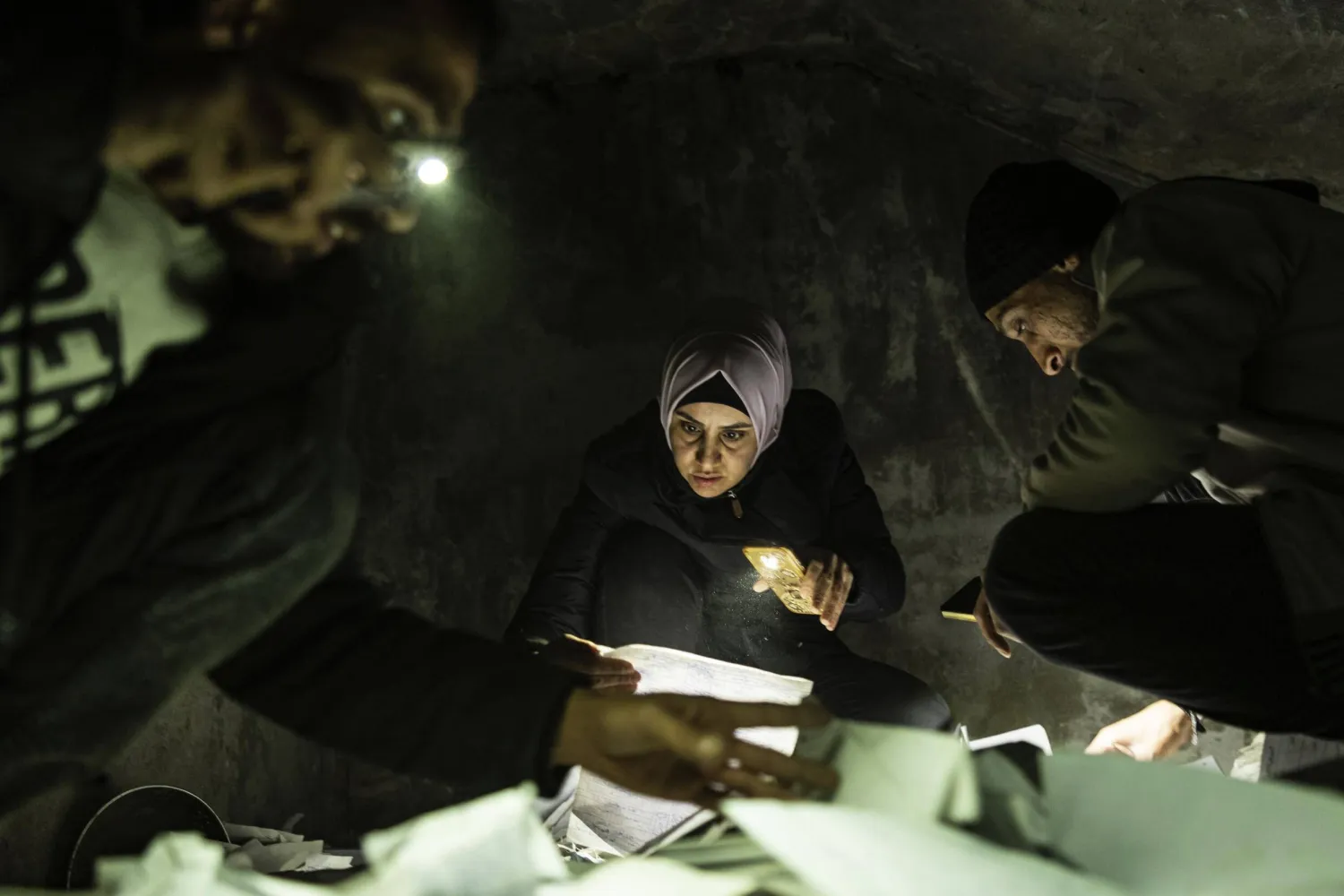

How an Ex-inmate of Brutal Syria Jail Overcame Trauma by Helping Others

The Association of Detainees and Missing Persons of Saydnaya Prison collects documentation and testimonies relating the horrors at what Amnesty International has called a 'human abattoir'. Sameer Al-DOUMY / AFP
TT

How an Ex-inmate of Brutal Syria Jail Overcame Trauma by Helping Others

The Association of Detainees and Missing Persons of Saydnaya Prison collects documentation and testimonies relating the horrors at what Amnesty International has called a 'human abattoir'. Sameer Al-DOUMY / AFP

Riyad Avlar spent 20 years languishing in Syria's jails, including a decade in the infamous Saydnaya prison, the scene of some of the Bashar al-Assad government's most brutal abuses.
Those long years behind bars have left him with one obsession: documenting and healing the atrocities committed inside the prison where he himself was locked up.
"I am sure we'll see Bashar al-Assad in court one day," predicted Avlar, who is Turkish.
In 2017, just months after he was freed, he co-founded the Association of Detainees and Missing Persons of Saydnaya Prison (ADMSP), which advocates for those jailed for daring to defy Assad's rule.
"We don't want revenge, we want justice," he told AFP at the organisation's headquarters in Gaziantep, southeastern Türkiye.
It is here that Avlar and others who survived the brutalities of Saydnaya collect and compile documentation and testimonies relating the horrors that occurred inside an institution Amnesty International has described as a "human abattoir".
Thousands of inmates in the prison just north of Damascus, some held since the 1980s, were freed on Sunday by the Syrian opposition who seized the capital in a lightning advance.
Images of the former captives walking free, haggard and emaciated, some needing help even to stand, were beamed around the world as a symbol of Assad's fall.
"It made me so happy to see them (freed) but when I saw images of the walls and the cells, it took me straight back there," said Avlar, who was arrested in 1996 while studying in Damascus over a letter sent to relatives relating to the government's abuses in Syrian prisons.
"I can still feel the trauma."
- 'So many people died' -
Even today, he sometimes jolts awake at night believing himself to still be behind bars -- he was once held inside a cell in pitch darkness for two months.
"I saw people die in front of my eyes, many from starvation," said the activist with fine-rimmed black glasses, whose salt-and-pepper beard hides a scar from the torture he was subjected to 25 years ago.
The guards, he said, would often throw scraps of food into the toilet in front of starving prisoners.
"The prisoners ate it because they had to stay alive," he said.
Part of his recovery was through theatre and learning the saz, a long-necked lute popular in Türkiye-- which for him was "art therapy".
But it has also helped being part of the association's work, through which he has been able to help countless families acquire proof of life for loved ones held inside Saydnaya.
That was thanks to "insiders", prison employees who secretly passed internal documents to the organisation, he said, without giving further details.
'No more'
Saydnaya, where hundreds of Syrians rushed this week in the desperate hope of finding their loved ones, now stands empty.
More than 4,000 inmates were freed by the opposition, the ADMSP said.
The group estimates that more than 30,000 people were either executed or died as a result of torture, starvation or lack of medical care between 2011 and 2018.

And with so many bodies, the authorities were forced to use rooms lined with salt as makeshift morgues to make up for the lack of cold storage.
Haunted by his grisly memories, Avlar has no interest in going back there but acknowledges he has long dreamed of the day when "Saydnaya would be turned into a place of remembrance".
"I am so happy there is not a single prisoner left in there," Avlar said.
"And I just hope there won't ever be any again."



Israel Calls Countries Condemning New West Bank Settlements ‘Morally Wrong’

Newly constructed buildings are pictured in the Israeli settlement of Givat Zeev near the Palestinian city of Ramallah in the occupied West Bank on October 24, 2025. (AFP)
TT

Israel Calls Countries Condemning New West Bank Settlements ‘Morally Wrong’

Newly constructed buildings are pictured in the Israeli settlement of Givat Zeev near the Palestinian city of Ramallah in the occupied West Bank on October 24, 2025. (AFP)

Israel reacted furiously on Thursday to a condemnation by 14 countries including France and Britain of its approval of new settlements in the occupied West Bank, calling the criticism discriminatory against Jews.

"Foreign governments will not restrict the right of Jews to live in the Land of Israel, and any such call is morally wrong and discriminatory against Jews," Foreign Minister Gideon Saar said.

"The cabinet decision to establish 11 new settlements and to formalize eight additional settlements is intended, among other things, to help address the security threats Israel is facing."

On Sunday, Israel's far-right Finance Minister Bezalel Smotrich announced that authorities had greenlit the settlements, saying the move was aimed at preventing the establishment of a Palestinian state.

Fourteen countries, including Britain, France, Germany, Spain and Canada, then issued a statement urging Israel to reverse its decision, "as well as the expansion of settlements".

Such unilateral actions, they said, "violate international law", and risk undermining a fragile ceasefire in Gaza in force since October 10.

They also reaffirmed their "unwavering commitment to a comprehensive, just and lasting peace based on the two-state solution... where two democratic states, Israel and Palestine, live side-by-side in peace and security".

Israel has occupied the West Bank following the 1967 Arab-Israeli war.

Excluding east Jerusalem, which was occupied and annexed by Israel in 1967, more than 500,000 Israelis live in the West Bank, along with about three million Palestinian residents.

Earlier this month, the United Nations said the expansion of Israeli settlements in the West Bank, all of which are illegal under international law, had reached its highest level since at least 2017.


Iraq Criminalizes Volunteering in Russia-Ukraine War

A photo circulated on social media shows a 24-year-old Iraqi who traveled to Russia to join its armed forces. (AFP)
TT

Iraq Criminalizes Volunteering in Russia-Ukraine War

A photo circulated on social media shows a 24-year-old Iraqi who traveled to Russia to join its armed forces. (AFP)

The Iraqi judiciary warned on Wednesday that people involved in the war between Russia and Ukraine will face jail as it attempts to crack down on the recruitment of Iraqis joining the conflict.

Faiq Zidan, the head of Iraq's Supreme Judicial Council, received on Wednesday National Security Advisor Qasim Al-Araji and members of a committee tasked with combating the recruitment of Iraqis.

Zaidan stressed that Iraq criminalizes any Iraqi who joins the armed forces of another nation without the approval of the government.

The judiciary does not have a fixed prison term for anyone accused of the crime, but a court in Najaf last week sentenced to life an Iraqi accused of human trafficking.

He was convicted of belonging to an international criminal gang that recruits Iraqis to fight for Russia in its war against Ukraine.

In November, Prime Minister Mohammed Shia al-Sudani ordered the formation of a committee, headed by Araji, to crack down on the recruitment of Iraqis to fight for the Russian and Ukrainian militaries.

Iraq does not have official figures detailing how many of its citizens have joined the war. Media reports said some 50,000 Iraqis have joined Russian ranks, while unofficial figures put the number at around 5,000, with 3,000 fighting for Russia and 2,000 for Ukraine.

The debate over the recruitment played out over the media between the Russian and Ukrainian ambassadors to Iraq.

Ukrainian Ambassador Ivan Dovhanych accused Russia of recruiting Iraqis. Last week, the Ukrainian government sent a letter to the Iraqi government about the recruitment.

It hailed Baghdad’s criminalization of such activity. The letter also revealed that Ukrainian authorities had arrested an Iraqi who was fighting for Russia.

Ukraine has denied that it has recruited Iraqis to join the conflict, but reports indicate otherwise.

Meanwhile, Russian Ambassador to Baghdad Elbrus Kutrashev acknowledged that Iraqi fighters had joined the Russian army.

Speaking to the media, he declined to give exact figures, but dismissed claims that they reached 50,000 or even 5,000, saying instead they number no more than a few hundred.

He confirmed that Iraqis had joined the Russian army and “that some four to five had lost their lives”.

He revealed that the Russian embassy in Baghdad had granted visas to Russia to the families of the deceased on humanitarian grounds.

Russian law allows any foreign national residing in Russia and who speaks Russian to join its army with a salary of around 2,500 to 3,000 dollars.

There have been mounting calls in Iraq for the authorities to crack down on human trafficking gangs.

Would-be recruits are often lured by the monthly salary and the possibility of gaining the Russian or Ukrainian nationality.

Critics of the authorities have said Iraqi youths are lured to join foreign wars given the lack of job opportunities in Iraq.


Somalia's Capital Votes in First Step toward Restoring Universal Suffrage

Members of the Justice and Solidarity Party (JSP) campaign in the streets as they share their political aims with voters in Mogadishu, Somalia, 22 December 2025. EPA/SAID YUSUF WARSAME
TT

Somalia's Capital Votes in First Step toward Restoring Universal Suffrage

Members of the Justice and Solidarity Party (JSP) campaign in the streets as they share their political aims with voters in Mogadishu, Somalia, 22 December 2025. EPA/SAID YUSUF WARSAME

Residents of Somalia's capital Mogadishu will vote on Thursday in municipal elections meant to pave the way for the East African country's first direct national polls in more than half a century.

With the exception of votes in the semi-autonomous region of Puntland and the breakaway region of Somaliland, Somalia last held direct elections in 1969, months before military general, Mohamed Siad Barre, took power in a coup, Reuters said.

After years of civil ‌war that ‌followed Barre's fall in 1991, indirect elections ‌were ⁠introduced in ‌2004. The idea was to promote consensus among rival clans in the face of an armed insurgency, although some Somalis say politicians prefer indirect elections because they create opportunities for corruption.

Under the system, clan representatives elect lawmakers, who then choose the president. The president, in turn, has been responsible for appointing Mogadishu's mayor.

The vote in Mogadishu, a ⁠city of some 3 million people where security conditions have improved in recent years ‌despite continuing attacks by al Qaeda-linked al ‍Shabaab militants, is seen as ‍a test run for direct elections at the national level.

Around ‍1,605 candidates are running on Thursday for 390 posts in Mogadishu's district councils, said Abdishakur Abib Hayir, a member of the National Electoral Commission. Council members will then choose a mayor.

"It shows Somalia is standing on its feet and moving forward," Hayir told Reuters. "After the local election, elections can and will take place in ⁠the entire country."

A 2024 law restored universal suffrage ahead of federal elections expected next year. However, President Hassan Sheikh Mohamud reached a deal in August with some opposition leaders stipulating that while lawmakers would be directly elected in 2026, the president would still be chosen by parliament.

Opposition parties have argued the rapid introduction of a new electoral system would benefit Mohamud's re-election prospects.

They also question whether the country is safe enough for mass voting given al Shabaab's control over vast areas of the countryside and regular strikes ‌on major population centers.