Israeli Airstrikes Kill Extended Families in Two Gaza Homes

 A Palestinian man inspects the damage at the site of an Israeli airstrike on a building in Gaza City's Daraj neighborhood on December 17, 2024, amid the ongoing war between Israel and Hamas. (AFP)
A Palestinian man inspects the damage at the site of an Israeli airstrike on a building in Gaza City's Daraj neighborhood on December 17, 2024, amid the ongoing war between Israel and Hamas. (AFP)
TT

Israeli Airstrikes Kill Extended Families in Two Gaza Homes

 A Palestinian man inspects the damage at the site of an Israeli airstrike on a building in Gaza City's Daraj neighborhood on December 17, 2024, amid the ongoing war between Israel and Hamas. (AFP)
A Palestinian man inspects the damage at the site of an Israeli airstrike on a building in Gaza City's Daraj neighborhood on December 17, 2024, amid the ongoing war between Israel and Hamas. (AFP)

Huge Israeli airstrikes killed extended families in homes in two parts of the northern Gaza Strip on Tuesday, while tanks in the south pushed towards a humanitarian zone on the Mediterranean coast, forcing displaced families to take flight again.

Medics said at least 10 people were confirmed killed in an airstrike on a house in the Daraj suburb of Gaza City that destroyed the building and damaged nearby houses.

Further north, in the town of Beit Lahiya which has been under Israeli siege since early October, at least 15 people were believed to be dead or missing under rubble of a house hit by an airstrike around dawn, said medics. Rescuers were unable to reach the site to confirm the toll.

At least 10 other Palestinians were killed in separate strikes elsewhere in Gaza City and Beit Lahiya, medics said.

There was no immediate comment from the Israeli military on Tuesday's strikes. Israel says it targets fighters and blames any harm to civilians on fighters for operating among them, which the fighters deny.

In Beit Lahiya Israel has been operating since October in what it calls an offensive to prevent Hamas fighters from regrouping; Palestinians say the army aims to depopulate a buffer zone on the enclave's northern edge, which Israel denies.

In the southern part of the enclave, in Rafah near the border with Egypt, Israeli tanks pushed deeper towards the western area of Mawasi, forcing dozens of families to flee northwards towards Khan Younis, residents said.

Hours later, residents said the army blew up several houses in the area and set several tents ablaze.

Israel has previously designated Mawasi, along the Mediterranean coast, as a humanitarian area. Thousands of Palestinians have lived there in tents for months, having obeyed Israeli orders to move there from other areas for safety.

Footage circulating on social media showed lines of thick black and grey smoke rising from the area beside the tent encampment. Reuters could not immediately verify the time or exact location of the images.

The war began when the Palestinian group Hamas stormed into Israel on Oct. 7, 2023, killing 1,200 people, mostly civilians, and taking more than 250 hostages back to Gaza, according to Israeli authorities.

Israel then launched an air and land offensive that has killed more than 45,000 people, mostly civilians, according to authorities in the Hamas-run Gaza Strip.

The campaign has displaced nearly the entire population and left much of the enclave in ruins.


Arab Interior Ministers Council Condemns Houthi UAV Launch Toward Makkah

Arab Interior Ministers Council Condemns Houthi UAV Launch Toward Makkah
TT

Arab Interior Ministers Council Condemns Houthi UAV Launch Toward Makkah

Arab Interior Ministers Council Condemns Houthi UAV Launch Toward Makkah

The General Secretariat of the Arab Interior Ministers Council strongly condemned reports that the terrorist Houthi militia launched a UAV toward Makkah on Wednesday.

The Royal Saudi Air Defense Forces successfully intercepted and destroyed the UAV before it entered Makkah's prohibited airspace, SPA reported.

In a statement, the General Secretariat said: “While expressing its firm condemnation and absolute denunciation of this cowardly terrorist attack, which constitutes a blatant violation of the rules of international law, a flagrant breach of the sanctity of the Grand Mosque and the holy sites, and a provocation to the feelings of all Muslims, the General Secretariat affirms its full solidarity and complete support for the Kingdom of Saudi Arabia in the measures it takes to protect its territory and holy sites, preserve its security and stability, and safeguard the safety of its citizens and residents.”


Raid on ISIS Site in Daraa Countryside Leaves 3 Syrian Security Personnel Dead

Syrian security forces personnel (AFP - File Photo)
TT

Raid on ISIS Site in Daraa Countryside Leaves 3 Syrian Security Personnel Dead

Syrian security forces personnel (AFP - File Photo)

Internal Security Forces raided a site in the town of Al-Sanamayn in the Daraa countryside on Thursday where an armed group affiliated with ISIS was holed up, after tightening the siege around the group and giving its members a deadline to surrender, which they did not heed.

The Internal Security Forces said through their official channels that the security operation in Al-Sanamayn was ongoing, confirming that the outlawed armed group was affiliated with ISIS.

The forces said they had tightened the siege around the group and given its members a deadline to surrender, but they did not respond, prompting the raid on the site where they were holed up.

Earlier on Thursday, three members of the Internal Security Forces were killed and others were wounded in a clash with an armed group in the town of Al-Sanamayn in Daraa Governorate, southern Syria, while carrying out a security raid targeting a wanted individual, according to a statement issued by the Internal Security Forces.

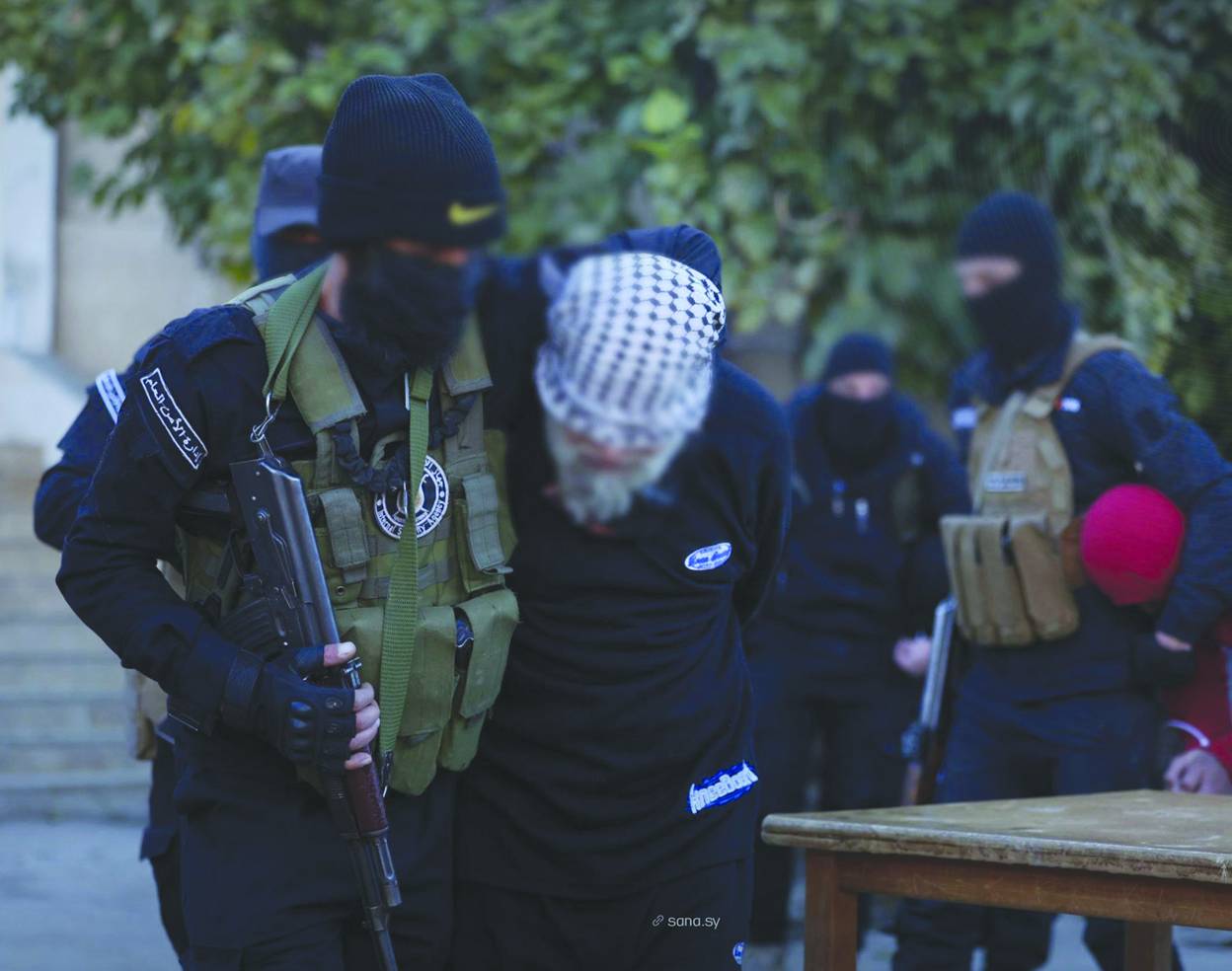
Member of an ISIS cell being arrested in Daraya, Damascus countryside (File Photo - SANA)

A government source said that an "outlawed armed group led by the wanted individual" had "targeted the patrol and engaged its members in a firefight while they were carrying out the mission."

It added that security forces had deployed throughout the town to pursue members of the group and announced a "temporary curfew" there.

A local government source told Agence France-Presse that the wanted individual who clashed with the security forces belonged to the group.

The group carries out attacks from time to time, particularly against Syrian security forces, after urging its members to fight the new authorities following the ouster of former President Bashar Al-Assad in December 2024.

The Syrian government officially joined the international coalition against the extremist group late last year. The group's presence in Syria was concentrated in the north and northeast and in the Badia region, but it also maintains cells in the south.

The group announced in 2022 that its leader, Abu Al-Hassan Al-Hashimi Al-Qurashi, had been killed in fighting whose date it did not specify. It later emerged that the fighting had taken place in Daraa Governorate.


Al-Alimi Orders Field Investigation to Document Houthi Violations

An elderly man sits on a wheelchair next to a woman at a temporary shelter for internally displaced people (IDPs) at the Shawkani school, north of Aden in southern Yemen, on September 15, 2026. (Photo by AFP) /
TT

Al-Alimi Orders Field Investigation to Document Houthi Violations

An elderly man sits on a wheelchair next to a woman at a temporary shelter for internally displaced people (IDPs) at the Shawkani school, north of Aden in southern Yemen, on September 15, 2026. (Photo by AFP) /

Yemeni Presidential Leadership Council Chairman Rashad Al-Alimi directed the National Commission to Investigate Alleged Human Rights Violations to intensify field monitoring and investigations in Taiz, Hodeidah, Marib, and areas affected by Houthi attacks, as a Yemeni rights network documented the deaths and injuries of dozens of civilians and hundreds of violations in Taiz Governorate in less than two weeks.

During a meeting with the chairman and members of the National Commission to Investigate Alleged Human Rights Violations, Al-Alimi said that the developments witnessed in the country in recent days, particularly in Taiz, Hodeidah, and the western coast, had been accompanied by widespread displacement and attacks on civilian facilities and objects protected under international law.

He noted that the affected sites included warehouses belonging to the United Nations and international organizations, as well as the King Salman Humanitarian Aid and Relief Centre.

Al-Alimi called on the commission, within the framework of its mandate and independence, to intensify monitoring and investigations into incidents related to the recent events, including the killing and starvation of civilians, displacement, forced displacement, attacks on homes and civilian, medical, and educational facilities, damage to displacement camps, the planting of landmines, and any other violations of international humanitarian law or human rights law.

661 Violations

In a separate report, the Yemeni Network for Rights and Freedoms said it had documented 661 crimes and violations that it said were committed by the Houthi group against civilians in Taiz Governorate between September 3 and 15.

According to the report, the incidents included killings, injuries, field executions, shelling of civilian objects, abductions, arrests, raids on homes, destruction of property, and attacks on vital facilities and infrastructure.

The network reported that 51 civilians were killed and 62 others injured, most of them children and women, as a result of sniper fire, artillery and mortar shelling, drones, and ballistic missiles.

It also said the Houthis carried out the field execution of nine military personnel in front of their children in the districts of Al-Wazi'iyah, Maqbanah, and Al-Kadaha.

According to the report, the violations included 167 cases of abduction and arrest, most of them in districts under Houthi control, as well as raids on 213 homes in Al-Wazi'iyah, Maqbanah, and Al-Kadaha.

The network also documented attacks on five mosques, six health facilities, 16 electricity stations and generators, and nine communications networks and stations, as well as two bridges and two main roads, including the Hija Al-Abed road linking Aden and Taiz, in addition to 34 civilian means of transportation.

Displacement and Vulnerable Groups

The rights network said the figures reflected the widening scope of violations over a short period, noting that attacks on homes, health facilities, mosques, communications and electricity networks, roads, and means of transportation affect not only individuals but also the basic foundations of civilian life, making access to food, water, healthcare, and transportation more difficult.

It added that the latest clashes had led to a deterioration in the humanitarian situation in Taiz, with thousands of families displaced from various areas and severe shortages of food, water, and medicines, along with a decline in basic services, particularly electricity and water.

In another development, the network's field monitoring team said it had documented widespread recruitment operations that it said affected large numbers of African refugees and migrants, as well as Yemeni children.

The network said some of them were lured or forced to join the Houthi ranks and sent to the front lines in Taiz Governorate. It considered this a violation of international rules concerning the protection of children and civilians and said it exposed the most vulnerable groups to direct risks.

The Yemeni Network for Rights and Freedoms warned of the continued deterioration of the humanitarian situation in Taiz, calling on the international community and human rights organizations to document violations, protect civilians, and pressure for an end to attacks on civilians and civilian objects, while ensuring that aid and essential services reach those affected and displaced.