


'Amphibious Mouse' among 27 New Species Discovered in Peru's Amazon

A clearwing butterfly (Oleria sp.) specimen, from one of the 218 species of butterflies observed during an expedition to the Peruvian region of Alto Mayo, is pictured, June 8, 2022. Conservation International/photo by Marlon Dag/Handout via REUTERS
TT

'Amphibious Mouse' among 27 New Species Discovered in Peru's Amazon

A clearwing butterfly (Oleria sp.) specimen, from one of the 218 species of butterflies observed during an expedition to the Peruvian region of Alto Mayo, is pictured, June 8, 2022. Conservation International/photo by Marlon Dag/Handout via REUTERS

An "amphibious mouse" with partially webbed feet that eats aquatic insects was among 27 new species discovered during a 2022 expedition to Peru's Amazon, according to Conservation International.

Scientists also discovered a spiny mouse, a squirrel, eight types of fish, three amphibians and 10 types of butterflies, Trond Larsen, head of Conservation International's Rapid Assessment Program, told Reuters this week.

He added that another 48 species found by investigators were potentially new, but needed further study.

The new species were found in Alto Mayo, a protected area with several ecosystems, Indigenous territories and villages.

"Discovering so many new species of mammals and vertebrates is really incredible, especially in such a human-influenced landscape as Alto Mayo," Larsen said.

The expedition between June and July 2022 was made up of 13 scientists plus local technicians and members of Indigenous groups.

"It was really fantastic to work so closely with the Awajun people. They have extensive traditional knowledge about the forests, animals and plants they live side-by-side with," Larsen said.

Among the new species, Larsen highlighted the spiny mouse that has stiff fur, the amphibious mouse, and a dwarf squirrel that measures 14 cm (5.5 in).

"(The squirrel) fits so easily in the palm of your hand. Adorable and beautiful chestnut-brown color, very fast," Larsen said. "It jumps quickly and hides in the trees."

Another favorite discovery was the blob-headed fish, a type of armored catfish, he said.

A total of 2,046 species were recorded during the 38-day expedition using camera traps, bioacoustic sensors and DNA sampling. Among them, 49 were classified as threatened, including the yellow-tailed woolly monkey and the tree monkey.

Larsen said the discoveries reinforced the need to protect the area.

"Unless steps are taken now to safeguard these sites and help restore parts of the landscape ... there's a strong chance they won't persist in the long term," Larsen said.
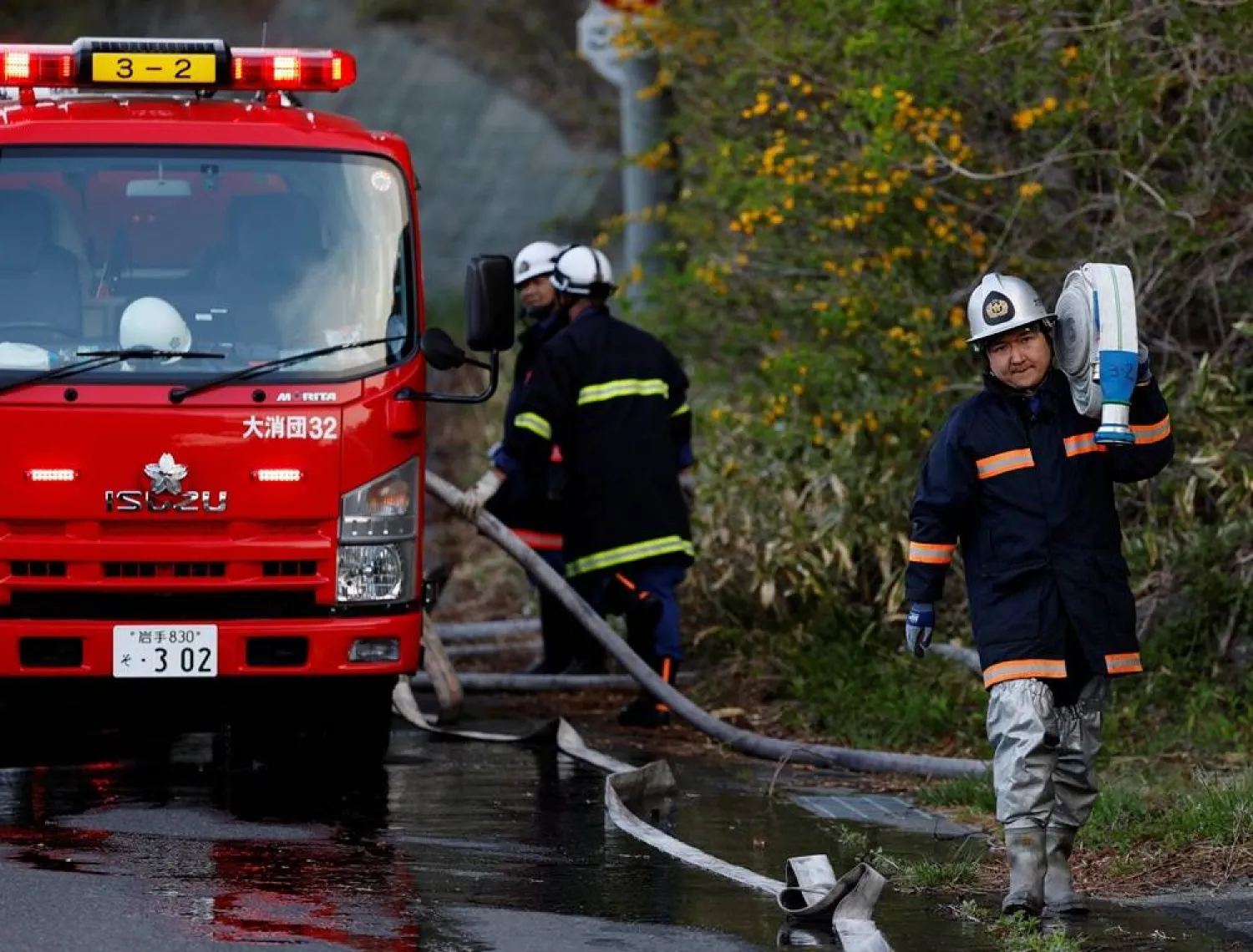



Tsunami Survivor Battles Wildfire to Protect Hometown in Japan’s Northeast

Volunteer firefighter Ryota Haga carries a fire hose to battle a wildfire in Otsuchi, Iwate Prefecture, Japan, April 26, 2026. (Reuters)
TT

Tsunami Survivor Battles Wildfire to Protect Hometown in Japan’s Northeast

Volunteer firefighter Ryota Haga carries a fire hose to battle a wildfire in Otsuchi, Iwate Prefecture, Japan, April 26, 2026. (Reuters)

Ryota Haga was in high school when the biggest earthquake ever recorded in Japan triggered a deadly tsunami and swept away his family home in the quiet northeastern town of Otsuchi in March 2011.

Now 31 with a wife and toddler, the volunteer firefighter faces another natural disaster: this time a wildfire raging for a sixth day and threatening his community after burning through more than 1,600 hectares of forest as of Monday morning.

"It's been 15 ‌years since the (Great ‌East Japan) Earthquake, and our lives were finally beginning ‌to ⁠settle down," Haga ⁠said at the end of another draining day battling the blaze on Sunday.

"We can't let people lose what is precious to them all over again. The fire is spreading and our exhaustion is at a limit, but it's our hometown. We will protect it at all costs, even if it feels like we're running on empty."

Otsuchi was among the hardest-hit coastal towns in 2011, when ⁠a tsunami estimated around 10 meters (33 ft) high swept through ‌the small fishing town. Nearly 1,300 ‌residents, or about a tenth of its population, perished, including its mayor.

The scale of ‌the current fire is nothing that Haga has ever experienced, he said. Some ‌1,400 firefighters and dozens of Self-Defense Force personnel have been deployed so far, with no prospects yet of bringing the blaze under control despite some scattered rain forecast on Monday.

While Japan has experienced relatively few large-scale wildfires compared with other parts of the ‌world, climate change has increased their frequency, especially as the early spring months before the humid rainy season have been ⁠hot, dry and ⁠with winds that can whip up flames. On Sunday, another wildfire started in Fukushima, also in Japan's northeastern region.

For Haga, the increasing instances of wildfires have added to a longer-term concern over the acute shortage of firefighters as the population declines and ages. Already, the fire brigade he belongs to is below the staffing level set by authorities, he says.

"If a forest fire breaks out when I'm in my 50s or 60s, and I'm the one gasping for breath while trying to fight it, I don't think we'll be able to stop it," he said.

Still, Haga grasps onto the hope that the firefighters' single-minded determination to save the community will not be wasted.

"The next generation might be inspired to join the volunteer fire brigade."


NGO: Orangutan Uses Indonesia Canopy Bridge in 'World First'

Surya, a female Bornean orangutan (Pongo pygmaeus), cradles her newborn on April 15, 2026 at the Madrid Zoo Aquarium, in Madrid. (Photo by Pierre-Philippe MARCOU / AFP)
TT

NGO: Orangutan Uses Indonesia Canopy Bridge in 'World First'

Surya, a female Bornean orangutan (Pongo pygmaeus), cradles her newborn on April 15, 2026 at the Madrid Zoo Aquarium, in Madrid. (Photo by Pierre-Philippe MARCOU / AFP)

A Sumatran orangutan has been filmed for the first time crossing a man-made canopy bridge constructed to help the endangered animals bypass a tarred road on the Indonesian island, an NGO said Sunday.

Conservation group Tangguh Hutan Khatulistiwa, in partnership with the UK-based charity Sumatra Orangutan Society (SOS) and local authorities, built five canopy bridges in the North Sumatra province in 2024, after a road that serves as a lifeline for remote communities had been expanded, cutting through the rainforest.

The first Sumatran orangutan has now been caught on camera using one of the hanging bridges, SOS said in a statement sent to AFP Sunday.

While other species including gibbons and long-tailed macaques have also been spotted crossing there, "this is a world first for Sumatran orangutans," it added.

The bridge's use by the orangutan was a "huge milestone for conservation", SOS chief executive Helen Buckland said.

"These canopy bridges demonstrate that human development and wildlife don't have to be at odds. Sometimes, the simplest solutions are the most effective," Buckland added.

The road is an important social and economic link for communities in Sumatra's Pakpak Bharat district.

But it has also split a population of some 350 orangutans, SOS said.

Erwin Alamsyah Siregar, executive director at Tangguh Hutan Khatulistiwa, said that habitat fragmentation was "one of the greatest challenges in contemporary conservation".

He said he hoped canopy bridges would become a "standard feature" of infrastructure planning across the region.

The International Union for Conservation of Nature classifies Sumatran orangutans, endemic to the island of Sumatra, as critically endangered.

Their decline is blamed on habitat loss and fragmentation as well as illegal hunting.

In the wild, orangutans are found only on Sumatra and the nearby island of Borneo, which is shared between Indonesia, Malaysia and Brunei.


Japan Deploys Hundreds of Firefighters as Wildfires Rage in North

A firefighter works as wildfires continue in Otsuchi, Iwate Prefecture, Japan, April 26, 2026. REUTERS/Kim Kyung-Hoon
TT

Japan Deploys Hundreds of Firefighters as Wildfires Rage in North

A firefighter works as wildfires continue in Otsuchi, Iwate Prefecture, Japan, April 26, 2026. REUTERS/Kim Kyung-Hoon

Japan has deployed 1,400 firefighters and dozens of Self-Defense Force personnel to battle mountain blazes that have been raging in the north for five days and threaten to reach homes in the picturesque coastal town of Otsuchi, officials said on Sunday.

Fanned by dry, windy weather, two more wildfires broke out elsewhere in the north on Sunday - one in Kitakata city and the other in Nagaoka, potentially stretching firefighting resources thin as local authorities send personnel to neighbouring areas.

The area burned by the Otsuchi fires reached 1,373 hectares (3,393 acres) as of Sunday morning, up 7% from a day earlier.

RESIDENTIAL AREAS AT RISK

The fires threaten residential districts of Otsuchi on the Pacific Coast - a town that lost nearly a 10th of its population in one of Japan's worst disasters, the March 2011 earthquake and tsunami.

Authorities expanded the scope of evacuation orders to 1,558 households or 3,257 residents by Sunday evening, roughly a third of Otsuchi's population.

"Although the Self-Defense Forces are fighting the fires from the sky (with helicopters), the dry weather and winds are helping the fires expand," Otsuchi Mayor Kozo Hirano told a press conference.

Some residents used hoses to spray water onto their houses and surrounding foliage, hoping to keep the flames at bay.

"I am prepared to evacuate by my car at any time. Fire won't be able to catch up to us since it does not move as fast as a tsunami," said resident Shigeki Fujiwara, 67.

Flames up in the mountain were visible from his home, and while his family has already been evacuated, he said he had chosen to stay behind because he was worried about the house.

FORECAST FOR RAIN

The only casualty to date has been one minor injury suffered when a person fell at an evacuation centre, Japan's Fire and Disaster Management Agency said on its website.

Rain is expected in some parts of Iwate prefecture's southern coastal region, where Otsuchi is located, according to the Japan Meteorological Agency.

The cause of the Otsuchi fires is not clear and is under investigation.

While Japan has experienced relatively few wildfires compared with other parts of the world, climate change has increased their frequency, especially as the early spring months before the humid rainy season have been hot, dry and with winds that can whip up flames.