


Americans Have Dimmer View of Biden than They Did of Trump or Obama as Term Ends, Poll Finds

President Joe Biden addresses the nation from the Oval Office of the White House in Washington, July 24, 2024, about his decision to drop his Democratic presidential reelection bid. (AP)
TT

Americans Have Dimmer View of Biden than They Did of Trump or Obama as Term Ends, Poll Finds

President Joe Biden addresses the nation from the Oval Office of the White House in Washington, July 24, 2024, about his decision to drop his Democratic presidential reelection bid. (AP)

As Joe Biden prepares to leave office, Americans have a dimmer view of his presidency than they did at the end of Donald Trump's first term or Barack Obama's second, a new poll finds.

Around one-quarter of US adults said Biden was a "good" or "great" president, with less than 1 in 10 saying he was "great," according to the survey from The Associated Press-NORC Center for Public Affairs Research.

It’s a stark illustration of how tarnished Biden’s legacy has become, with many members of his own party seeing his Democratic presidency as merely mediocre. About one-third described Trump as "good" or "great" on the eve of the Republican's departure from the White House in 2021, according to AP-NORC polling, including about 2 in 10 who said he was "great" — even after he helped sparked a deadly insurrection that saw a mob of his supporters overrun the US Capitol.

Americans were similarly likely to describe both Biden and Trump as "poor" or "terrible" — about half said this characterized each president’s time in office — but about 3 in 10 said Biden was "average," while less than 2 in 10 said this about Trump.

Biden's standing is also much lower than the last outgoing Democratic president, Obama, who left office with about half of Americans describing his tenure as "good" or "great," according to another AP-NORC poll.

Those findings are consistent with data released this week by Gallup, which found Biden’s standing similar to that of President Richard Nixon after the Republican resigned during the Watergate scandal.

The Gallup analysis found that other presidents who left with poor ratings — including Trump, Republican George W. Bush and Democrat Jimmy Carter — saw views of their presidencies grow warmer with time. But for now, few seem impressed with Biden's time in office, including a sizable chunk of Democrats.

"I’m not going to sound like ‘Star Wars,’ that he went over to the dark side and everything that might be implied there," John Cressey, a 79-year-old Democrat who lives in the Los Angeles area and does background work for films and movies, said of Biden. "But I think he just lost the pulse of the nation and that’s why Trump won."

Among supporters of Biden's party, only about 1 in 10 described his presidency as "great," while about 4 in 10 called it "good," and a similar share described it as "average."

Cressey said he saw the 82-year-old Biden declining physically and believes the president was increasingly controlled by aides. He says Biden let the situation on the US-Mexico border deteriorate into "a mess." And Cressey summed up his chagrin with Biden’s handling of the economy by saying, "Go buy a carton of eggs."

Disappointment especially high among Black and Hispanic Americans

Things weren't always so bad for Biden. About 6 in 10 Americans approved of the way he handled the presidency as he took office, according to AP-NORC polling, but by early 2022, that had fallen to about 4 in 10, where views largely stayed for the remainder of his term.

In the new poll, disappointment was especially palpable among Black and Hispanic Americans, who have traditionally leaned Democratic but shifted in larger numbers toward Trump in 2024.

The contrast with Obama was especially striking among Black Americans. About 6 in 10 said Obama, the nation's only Black president, had kept his promises at the end of his term, compared with around 3 in 10 who said the same for Biden. Similarly, about 7 in 10 Black Americans said they and their family were better off at the end of Obama’s presidency while only about a third said that about Biden.

"I feel as though the economy hasn’t progressed in a positive way since he’s been in office," said Evonte Terrell, 30, a sales manager at a telecommunications company from Detroit who described himself as a "waning Democrat."

Terrell, who is Black, said the party has become too focused on things like climate change and war while de-emphasizing rebuilding communities and helping the poor. He also bristled at Biden's pardoning of his son Hunter, saying that, "as a father, I would do the same" but "not everyone is going to have that capability."

Younger people were particularly likely to have a negative view of Biden’s presidency. Only about 1 in 10 Americans under age 30 say he was a "good" or "great" president, compared with about 4 in 10 ages 60 or older. Roughly 6 in 10 Americans ages 18 to 29 say Biden was a "poor" or "terrible" president.

Terrell, facing student loan payments, also pointed to Biden's efforts to ease educational debt that were struck down by the Supreme Court. He said that amounted to years of "just deferring" when "otherwise I could have been paying it off this entire time."

A perception of failed promises

The Biden administration helped oversee the passage of more large-scale legislation than did Trump or Obama — including on public works, microchip production and health care and promoting green jobs. The president also signed the first major gun safety package in decades.

Still, only about 2 in 10 Americans said the president made good on his campaign trail pledges. About 4 in 10 said he tried but failed to keep his promises, and a similar share said he has not kept his promises.

Mark Jeanmougin, 47, who is from Cincinnati and works in cybersecurity, voted for Trump in 2016 but backed Biden in 2020 and Democratic Vice President Kamala Harris in November.

He sees Biden as a good president who set the United States up for success on issues like climate change while delivering badly needed infrastructure funding. But, he said, Biden "definitely ran into some activist judges who were saying no to some of his policies."

Jeanmougin said Biden helped improve the post-COVID-19 economy and rising inflation was an expected consequence.

"A hard landing, lots of unemployment, or a soft landing with inflation," he said. "We knew that was what was going to happen. So the idea that so many of my fellow citizens were unaware or didn’t know is really hard."

In all, about half of Democrats said Biden tried and failed to keep his campaign promises, while about 4 in 10 said he succeeded.

Few believe they are better off

For the most part, Americans don't think Biden is leaving the country in a better position than when he took office four years ago — with a few exceptions.

On the issues of creating jobs and prescription drug costs, Americans were about as likely to say Biden had a positive impact as they were to say he’d had a negative impact. A similar share said he had no impact.

But many thought he'd done more harm than good in other key areas. At least half of Americans said Biden had a negative impact on the cost of living, immigration and the conflict between the Israelis and the Palestinians — compared with about 2 in 10 who said he had a positive impact in each of these arenas.

He was also perceived as having more of a negative impact than a positive one on Russia's war with Ukraine, despite his administration pushing for billions of dollars in military aid to Kyiv. The negative views toward Biden regarding Israel's war against Hamas were particularly pronounced among younger voters, with slightly less than 1 in 10 Americans under age 30 saying he had a positive impact on the Israeli-Palestinian conflict.

About 4 in 10 Americans said they and their families are somewhat or much worse off than they were when Biden became president, while about one-quarter said they are much or somewhat better off.

Only about one-quarter said they and their families were worse off at the end of either Trump's or Obama’s presidency.



Iran Rejects Curbs on Its Uranium Enrichment Program

FILE - This satellite image provided by Vantor shows the Natanz nuclear complex in Iran on March 7, 2026, with no new damage seen at the facility or the tunnels. (Satellite image ©2026 Vantor via AP, file)
TT

Iran Rejects Curbs on Its Uranium Enrichment Program

FILE - This satellite image provided by Vantor shows the Natanz nuclear complex in Iran on March 7, 2026, with no new damage seen at the facility or the tunnels. (Satellite image ©2026 Vantor via AP, file)

The head of Iran’s Atomic Energy Organization, Mohammad Eslami, on Thursday ruled out accepting any restrictions on the country’s uranium enrichment program, as demanded by the United States and Israel.

In an interview with the ISNA news agency, Eslami said: “The demands and conditions set by our enemies to restrict Iran’s enrichment program are nothing but daydreams that will be buried,” AFP reported.

The remarks come as talks between Washington and Tehran are expected to be held at the end of the week under Islamabad’s auspices, as part of a ceasefire agreement brokered by Pakistan. The discussions are expected to address Tehran’s nuclear program.

Western powers accuse Iran of seeking to acquire a nuclear weapon and have worked to prevent it from doing so, while Tehran has consistently denied the allegations.

During his first term, US President Donald Trump withdrew from the landmark 2015 agreement that had placed limits on Iran’s nuclear enrichment activities in exchange for sanctions relief, a deal opposed by Israel.


Germany's Merz: We Do Not Want NATO to Split over US-Iran War

Commemorative photo of NATO leaders in The Hague in 2025 (Turkish Presidency).
TT

Germany's Merz: We Do Not Want NATO to Split over US-Iran War

Commemorative photo of NATO leaders in The Hague in 2025 (Turkish Presidency).

German Chancellor Friedrich Merz said on Thursday he did not want US-Iran war to place any further strain on relations between the United States and its European NATO partners.

"We do not want – I do not want – NATO to split. NATO is a guarantor of our security, including and above all in Europe," he said, speaking to journalists.

He added he had encouraged US President Donald Trump in a call to pursue negotiations with Iran with urgency.

Germany was resuming direct talks with Iranian leadership in Tehran, Merz said in Berlin.


Pentagon Leaders Assert Destruction of Iran’s Military Capabilities, Threaten to Resume Operations

Defense Secretary Pete Hegseth speaks to members of the media during a press briefing at the Pentagon in Washington, Wednesday, April 8, 2026. (AP Photo/Manuel Balce Ceneta)
TT

Pentagon Leaders Assert Destruction of Iran’s Military Capabilities, Threaten to Resume Operations

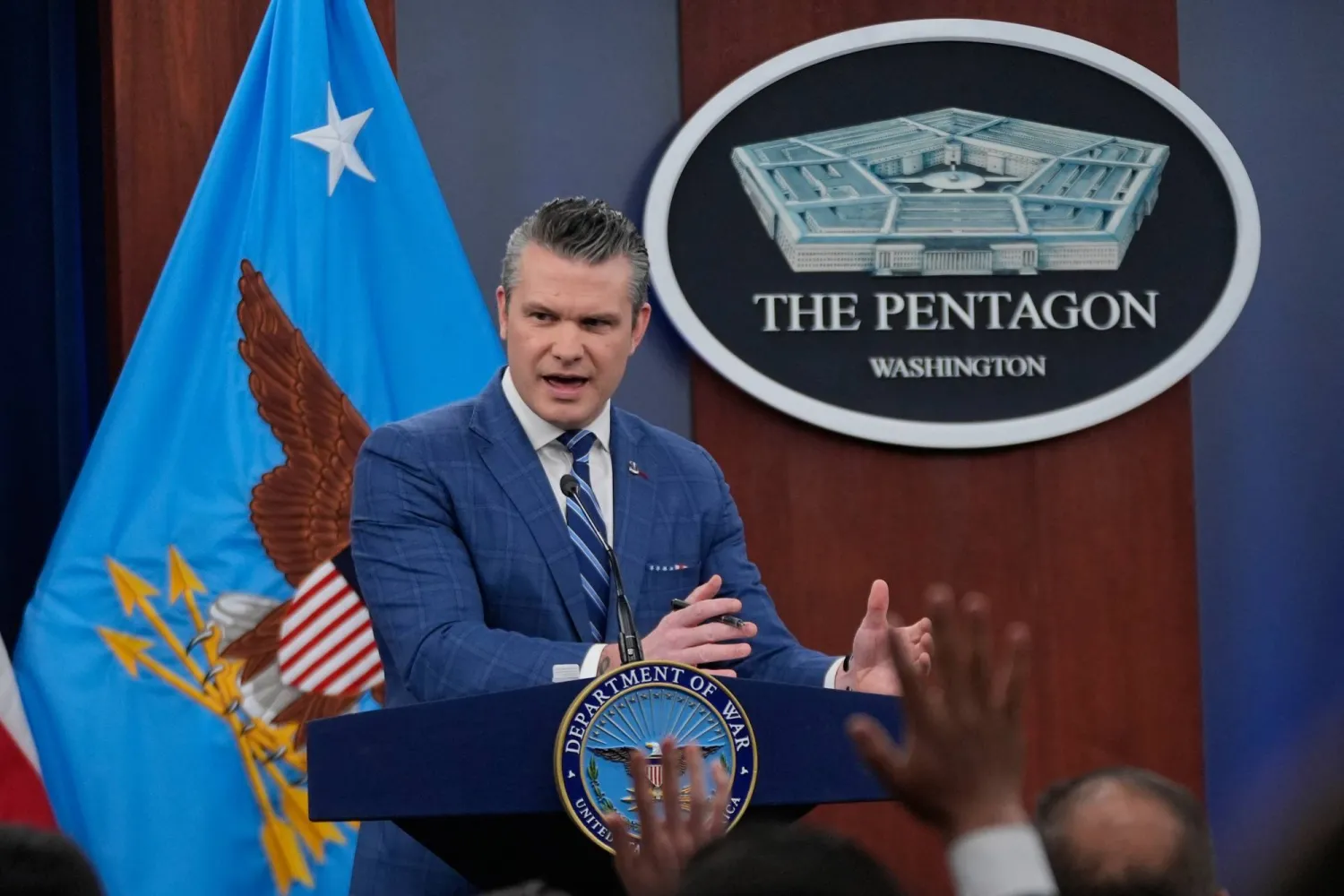
Defense Secretary Pete Hegseth speaks to members of the media during a press briefing at the Pentagon in Washington, Wednesday, April 8, 2026. (AP Photo/Manuel Balce Ceneta)

The US war against Iran has "completely" destroyed the country's ability to build missiles or other sophisticated weaponry, Defense Secretary Pete Hegseth said Wednesday

"We finished completely destroying Iran's defense-industrial base, a core pillar of our mission," Hegseth told reporters.

"They can no longer build missiles."

For his part, Chairman of the Joint Chiefs of Staff Dan Caine said: “We attacked, along with our partners, approximately 90 percent of their weapons factories,” including facilities producing Shahed-type drones, as well as facilities manufacturing guidance systems used by these drones.

Regarding the naval fleet, Caine said that it will take years before Iran can rebuild its surface combatant capabilities.

The general added that approximately 80 percent of Iran’s nuclear industrial base was targeted, significantly undermining its nuclear weapons development efforts.

He warned that US forces remain ready to resume fighting with Iran if the ceasefire ends, stating: “Let’s be clear: the ceasefire is just a temporary pause. The armed forces remain ready, if ordered, to resume combat operations with the same speed and precision demonstrated over the past 38 days.”

Statements by Dan Caine, and his warning about a possible resumption of fighting, suggest that the announcement of a suspension of the war came under US pressure, according to Michael Rubin, a researcher at the American Enterprise Institute.

As for the restoration of freedom of navigation, military officials’ statements did not indicate that it has been fully secured, instead emphasizing the need to “ensure Iran’s compliance” and the safe passage of vessels.

At the same time, there were continued indications that ships received messages from Iranian forces stating that they require permission to transit the strait, suggesting that Tehran is seeking to establish a new equation: keeping Hormuz open on the condition of recognizing a supervisory or sovereign role for itself.

If that is the case, the region and the global economy would be entering a phase that goes beyond a mere ceasefire, as the risk shifts from missiles to the rules governing transit, insurance, pricing, and maritime fees.

Statements by Pentagon leaders, followed by remarks from Donald Trump, reveal that the real dispute is not over the ceasefire itself, but over what comes after it. Washington rejects the continuation of Iranian uranium enrichment and is demanding that the stockpile of highly enriched uranium be handed over, or “taken” by force if necessary.

By contrast, narratives circulating in Iranian media about the “ten points” of the ceasefire agreement point in a completely different direction: recognition of Iran’s right to enrich, the lifting of sanctions, and no clear position on the fate of the enriched stockpile.

This is precisely where the structural contradiction lies, one that could undermine the negotiating round from its very first day, according to Michael Rubin.

The second aspect of the dispute concerns the scope of de-escalation. The United States and Israel have made clear that a ceasefire with Iran does not mean a halt to Israeli operations in Lebanon against Hezbollah, while reports continued of missile and drone attacks on Gulf states in the hours following the truce. This suggests that the region is facing a form of “selective de-escalation,” according to observers: a direct easing between Washington and Tehran, while proxy arenas and exchanges of messages remain active.

Remarks by Hegseth that Washington had been prepared, just hours earlier, to strike power stations, bridges, and oil and energy infrastructure “that Iran cannot rebuild” indicate that the decision to halt hostilities did not stem from a fully realized settlement, but rather from the suspension of a massive escalatory strike against Tehran.

Accordingly, the ceasefire appears more like a testing window: if Tehran complies with conditions related to navigation and the transfer of uranium, the truce could hold and pave the way toward a definitive end to the war. If not, the United States may return to the option of large-scale destruction of infrastructure.