


‘The Brutalist’ Doesn’t Work without Guy Pearce

 Guy Pearce poses for photographers upon arrival for the premiere of the film "The Brutalist" in London, Wednesday, Jan.15, 2025. (AP)
Guy Pearce poses for photographers upon arrival for the premiere of the film "The Brutalist" in London, Wednesday, Jan.15, 2025. (AP)
TT

‘The Brutalist’ Doesn’t Work without Guy Pearce

 Guy Pearce poses for photographers upon arrival for the premiere of the film "The Brutalist" in London, Wednesday, Jan.15, 2025. (AP)
Guy Pearce poses for photographers upon arrival for the premiere of the film "The Brutalist" in London, Wednesday, Jan.15, 2025. (AP)

Over the years, Guy Pearce has been good in most all things. But he’s been particularly good at playing characters with a refined disposition who harbor darker impulses underneath.

That was true of his breakout performance in “L.A. Confidential" as a squeaky clean police detective whose ambitions outstrip his ethics. It was true of his dashing upper-class bachelor in “Mildred Pierce.” And it’s most definitely true of his mid-Atlantic tycoon in “The Brutalist.”

“I’m really aware of how precarious we are as human beings,” Pearce says. “Good people can do bad things and bad people can do good things. Moment to moment, we’re trying to just get through the day. We’re trying to be good. And we can do good things for ourselves and other people, but pretty easily we can be tipped off course.”

That sense of duality has served Pearce’s characters well, especially his men of class who turn out to have less of it than they seem. His Harrison Lee Van Buren in “The Brutalist” may be Pearce’s most colossally two-faced concoction yet. If Brady Corbet’s film, which was nominated for 10 Oscars on Thursday, is one of the best films of the year, it’s Pearce’s performance that gives the movie its disquieting shiver.

Pearce’s Van Buren is a recognizable kind of villain: a well-bred aristocrat who, at first, is a benevolent benefactor to Adrien Brody’s architect László Tóth. But what begins as a friendship — Tóth, a Holocaust survivor is nearly destitute when they meet — turns increasingly ugly, as Van Buren’s patronage, warped by jealousy and privilege, turns into a creeping sense of ownership over Tóth. The psychodrama eventually boils over in a grim, climactic scene in which Van Buren pronounces Tóth “just a lady of the night.”

“What was great to discuss with Brady is that he is actually a man of taste,” said Pearce in a recent interview. “He’s a man of class and a man of sophistication. He’s not just a bull in a China shop. He’s not just about greed, taking, taking, taking. It’s probably as much of a curse as anything that he can recognize beauty and he can recognize other people’s artistry.”

For his performance, the 57-year-old Pearce on Thursday landed his first Oscar nomination – a long-in-coming and perhaps overdue honor for the character actor of “Memento,” “The Count of Monte Cristo” and “The King’s Speech.” For the Australian-born Pearce, such recognitions are as awkward as they are rewarding. He long ago decided Hollywood stardom wasn’t for him.

“I get uncomfortable with that, to be honest,” he says. “I’m really happy with doing a good performance. I can genuinely say within myself I’ve done a good job. Equally, I know when I’ve done a (bad) job. But I’m also well aware of how a performance can appear good purely because of the tone of the film. I might have done exactly the same performance in another movie with not such a good director, and people might have gone, ‘That was full-on but whatever.’ Whereas in this film, we are all better than we actually are because the film has integrity to it that elevates us all.”

Like F. Murray Abraham’s Saleri in “Amadeus,” Peace’s Van Buren has quickly ascended the ranks of great cinema villains to artists. The character likewise has some basis in reality, albeit extrapolated from a much different time and place. Corbet and Mona Fastvold, who are married and wrote “The Brutalist” together, were fueled by their hardships with financiers on their previous film, 2018's “Vox Lux.”

“We didn’t have a Van Buren but we certainly had our fill of complicated relationships with the people who hold the purse strings,” says Fastvold. “There’s a sense of: I have ownership of the project because I’m paying for it, and I almost have ownership of you.”

Pearce has been around the movie business long enough to shake hands with plenty of wealthy men putting money toward a film production. But he says none of his own experiences went into “The Brutalist.”

“There’s always this slew of producers at a higher level than us who come and visit the set,” Pearce says. “I’m polite and I go, ‘Hi, nice to meet you. Thanks.’ But I’m a little caught up with what I’m doing. Then three years later you’ll meet someone who says, ‘You know, I was a producer on “L.A. Confidential.”’ Ah, were you?”

Pearce, who lives in the Netherlands, has generally kept much of Hollywood at arm's length. In conversation, he tends to be chipper and humble — more interested in talking Aussie rules football than the Oscar race. “Any chance to have a kick, I'll have a kick,” he says with smile.

That youthful spirit Pearce tends to apply to his acting as well. Pearce, who started performing in the mid-'80s on the long-running Australian soap opera “Neighbors,” doesn't like to be precious about performing.

“If I’m hanging on to it all day, it’s exhausting,” Pearce says. “The thing that still exists for me is using our imagination, which is kind of a childlike venture. I think there’s something valuable about that even as adults. I think you can be all ages at all times.”

Pearce compares receiving the script from Corbet to “The Brutalist” to when Christopher Nolan approached him 25 years ago. Both times, he went back to watch the director's earlier films and quickly decided this was an opportunity to pounce at.

In digging into Van Buren, Pearce was guided less by real-life experience than the script. The hardest entry way to the character, he says, was the voice. “Thankfully,” Pearce says, “I’m friends with Danny Huston and he’s got a wonderfully old-fashioned voice.” He and Corbet didn't speak much about the director's hardships on “Vox Lux.”

“I know that it was troubled. Brady is going to have trouble on every film he makes, I reckon, because he is such a visionary,” says Pearce. “I know on this there were producers trying to get him to cut the time down. Of course, all those producers now are going, ‘I was with him all the way.’”

To a certain degree, Pearce says, he doesn't fully understand a performance while he's doing it. He's more likely to understand it fully afterward while watching. Take that “lady of the night scene.” While filming, Pearce felt he was saying that line to put Tóth in his place. “But when I watched it, I went: ‘I’m just telling myself. I’m purely telling myself,’” he says. “There’s something even more distasteful about it.”

It's ironic, in a way, that Van Buren, a man bent on control, is played so indelibly by an actor who seeks to impose so little of it, himself.

“There’s a performative element to Van Buren. He exhausts himself because he’s trying to dominate, to be the one in charge, be Mr. Charming,” Pearce says. “I don’t think he can ever enter a room without being self-conscious. That’s an exhausting way to be, I reckon.”


Afrobeats’ Tiwa Savage Nurtures Africa’s Future Talent

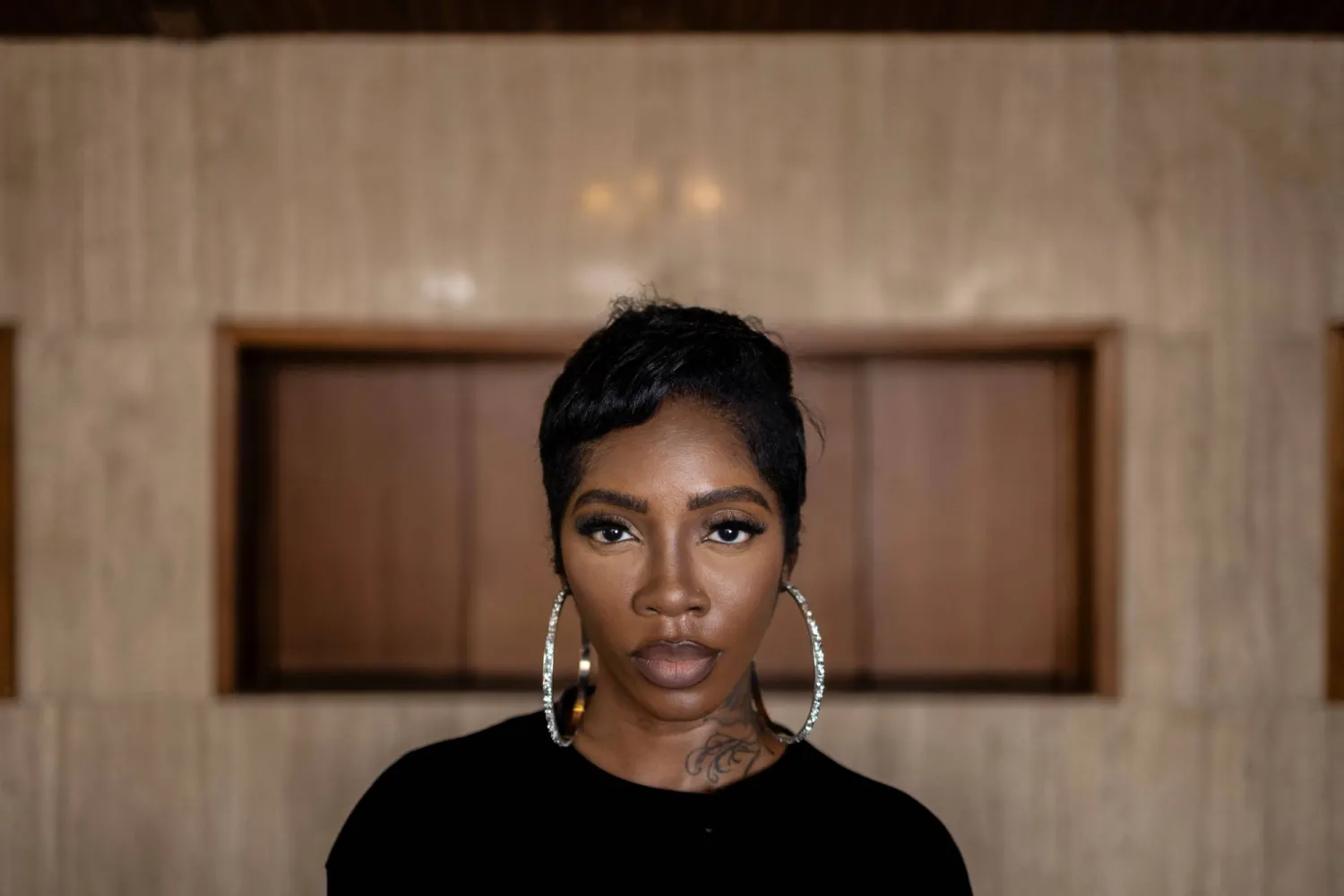
Nigerian singer Tiwa Savage poses for a photograph at the Muson School of Music in Lagos, on April 24, 2026. (AFP)
TT

Afrobeats’ Tiwa Savage Nurtures Africa’s Future Talent

Nigerian singer Tiwa Savage poses for a photograph at the Muson School of Music in Lagos, on April 24, 2026. (AFP)

Nigerian Afrobeats sensation Tiwa Savage walked around a music center in Lagos, smiling, listening and giving words of encouragement to scores of young artists in an elite music training program.

The multi-talented Savage, a prominent face in Nigeria's flourishing music scene, recently brought together 100 young, aspiring artists -- selected from 2,000 applications -- for instrumental workshops, vocal coaching and masterclasses on the inner workings of the music industry.

The group is the first cohort of her newly established music foundation.

Savage is partnering with the prestigious Berklee College of Music in the United States, where she studied around two decades ago.

"When I'm no longer here, I'm praying that a recipient of this foundation will be the next Michael Jackson, the next Quincy Jones, the next Wizkid, the next great artist or producer or songwriter," said the artist, whose global hits include "Koroba" and "Kele Kele".

Born in Lagos 46 years ago as Tiwatope Omolara Savage and raised partly in Britain, she established herself in the early 2010s after returning to Nigeria.

She is one of the most influential female voices in Afrobeats, a genre that has attracted a global audience by blending traditional African rhythms with contemporary pop sounds, with its roots in Nigeria.

Vocal drills, musical notes and frequent peals of laughter echoed from the classrooms where Berklee tutors worked with the students.

"I'm evolving as a beat maker and producer, and refining my piano artistry," said 24-year-old student Aliyu Olukoya, who called the experience "amazing".

The instructors from Berklee -- which is extending its academic program for the first time to the cultural behemoth that is Africa's most populous country -- adjusted and corrected the students as Savage watched closely.

"Being secure in who you are and what you have to offer, even in a competitive environment, is your superpower, and that's what we teach here," said vocal coach Nichelle J. Mungo, 51, whom Savage met at Berklee.

- 'Too good to just compete locally' -

Savage recalled seeing very few African students at the East Coast American college.

It was there that she started nurturing the idea of making it easier for young Africans to access high-level musical training.

"The problem isn't lack of talent or gift," she told AFP. "The problem is access -- access to education, music education in particular."

"As a musician in whatever capacity, you need to study the industry, especially the global industry, because we're too good to just compete locally," she said.

If Afrobeats is to match the staying power of R&B or rock'n'roll, Savage believes the entire ecosystem needs to become more professional.

"If we only focus on the artists, how are we going to sustain the industry for many, many years and decades to come?" she said, urging the professional development of producers, sound engineers, songwriters and marketers.

She also aims to raise the profile of talented artists who lack visibility due to limited resources, in a country marked by deep social inequalities.

"I see so much talent," she said, referring to already highly skilled musicians forced to practice without regular access to instruments.

Several young artists have already caught the attention of the Berklee professors who came to Nigeria to teach.

After their concert at the National Theater in Lagos, 18 students received scholarships to Berklee, with a total value of $2.1 million.

At the popular music hub in Lagos, the Muson Center, singer Irene Ugwuorah said that being one of the 100 artists selected for the new foundation was a "great opportunity".

"At every moment, at every turn, there's always something to learn. I'm already gaining a lot and I hope to use every single minute to gather as much knowledge as I can to help me grow as an artist," Ugwuorah said.

Savage's foundation provides the training for free and she hopes that will also make it accessible to people from other African countries.

"I definitely, definitely want to make this pan-African. It has to be pan-African. Talent doesn't stop in Nigeria. It's everywhere," she said.


Taylor Swift, Beyoncé, Chaka Khan and Vince Gill Recordings Enter National Registry

US singer Taylor Swift arrives for the MTV Video Music Awards at the Prudential Center in Newark, New Jersey, on September 12, 2023. (AFP)
TT

Taylor Swift, Beyoncé, Chaka Khan and Vince Gill Recordings Enter National Registry

US singer Taylor Swift arrives for the MTV Video Music Awards at the Prudential Center in Newark, New Jersey, on September 12, 2023. (AFP)

Albums and songs from Taylor Swift, Beyoncé, Chaka Khan and The Go-Go’s are joining America’s audio canon.

The new inductees into the National Recording Registry at the Library of Congress include Swift’s blockbuster 2014 pop album “1989,” Beyoncé’s era-defining 2008 anthem “Single Ladies (Put a Ring on It),” Khan’s genre-blending hit “I Feel for You,” Vince Gill’s emotional ballad “Go Rest High on That Mountain” and The Go-Go’s groundbreaking debut album “Beauty and the Beat.”

They were among the 25 recordings entering the archive in the class of 2026, acting Librarian of Congress Robert Newlen announced Thursday. The selections were chosen for their “cultural, historical or aesthetic importance in the nation’s recorded sound heritage”, The Associated Press said.

“Music and recorded sound are essential, wonderful parts of our daily lives and our national heritage,” Newlen said in a statement. “The National Recording Registry works to preserve our national playlist for generations to come.”

Other recordings entering the registry include Ray Charles’ groundbreaking country crossover album “Modern Sounds in Country and Western Music,” Reba McEntire’s “Rumor Has It,” Rosanne Cash’s “The Wheel” and Weezer’s self-titled debut known as “The Blue Album.”

Classic singles from Gladys Knight and the Pips, The Byrds, José Feliciano and Paul Anka also earned inclusion.

Among the more unconventional selections are the soundtrack to the influential 1993 video game "Doom" and the radio broadcast of “The Fight of the Century,” the legendary 1971 heavyweight boxing match between Muhammad Ali and Joe Frazier.

The oldest recording in this year’s class is Spike Jones and His City Slickers’ 1944 single “Cocktails for Two.” The newest is Swift’s “1989.”

This year also marks the first recordings by Swift and Beyoncé selected for the registry. The Library of Congress said more than 3,000 public nominations were submitted for consideration this year.


Madonna, Shakira, BTS to Headline First World Cup Final Half-time Show

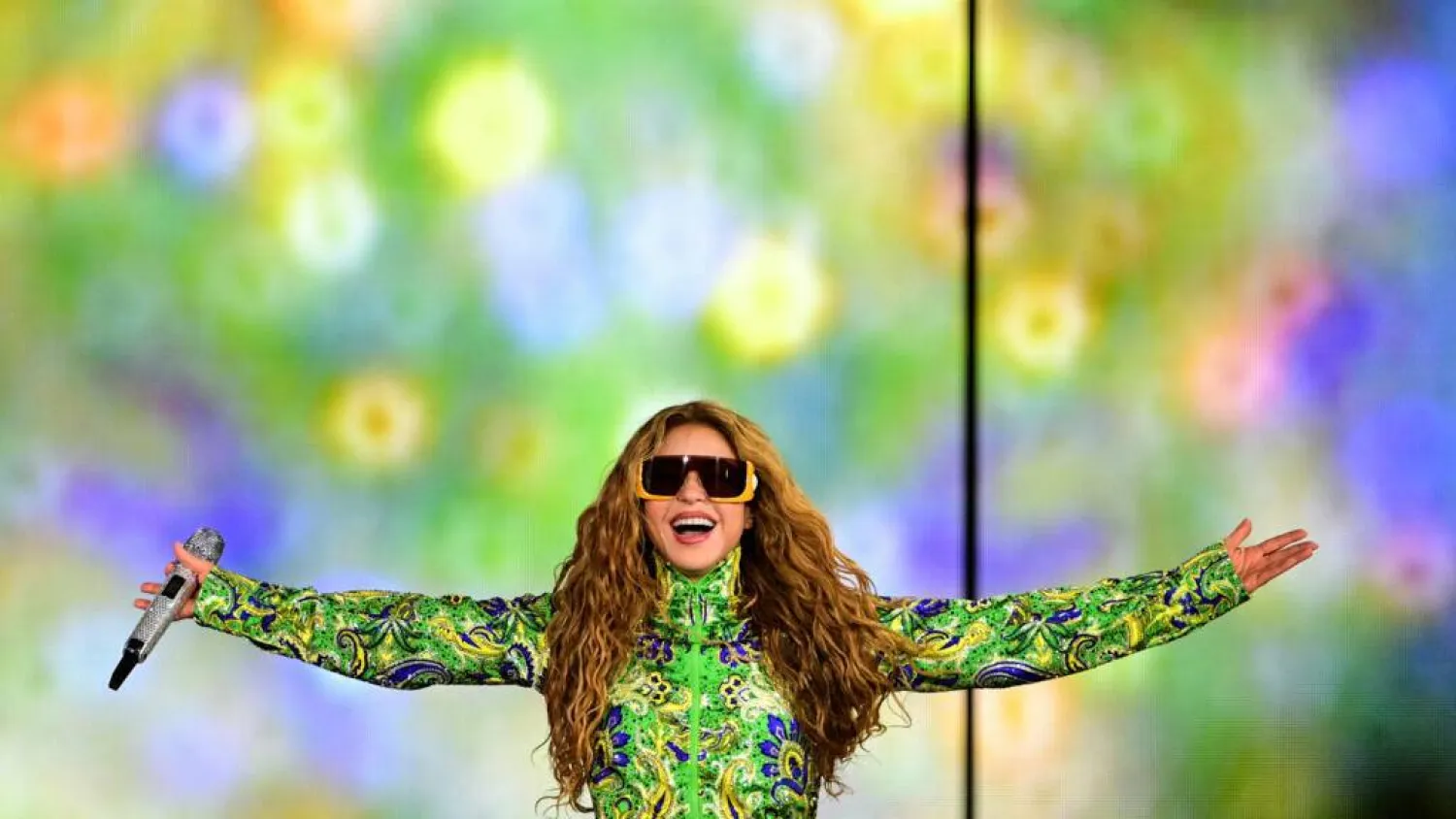
Colombian singer Shakira will headline the first World Cup Final half-time show along with Madonna and K-Pop giants BTS. Pablo PORCIUNCULA / AFP
TT

Madonna, Shakira, BTS to Headline First World Cup Final Half-time Show

Colombian singer Shakira will headline the first World Cup Final half-time show along with Madonna and K-Pop giants BTS. Pablo PORCIUNCULA / AFP

Madonna, Shakira and K-pop megastars BTS will headline a Super Bowl-style half-time show at the World Cup final on July 19 at MetLife Stadium in New Jersey, FIFA said Thursday.

Coldplay's Chris Martin is curating the show, which is a first for a football World Cup final but has raised concerns about how long half-time will be.

The biggest-ever World Cup, with 48 teams, kicks off on June 11 in the United States, Canada and Mexico, said AFP.

FIFA president Gianni Infantino announced in March last year that there would be "the first-ever half-time show at a FIFA World Cup final".

He did not say at the time who would be performing or how long the show would last.

"This will be a historic moment for the FIFA World Cup and a show befitting the biggest sporting event in the world," he said on Instagram.

The move mirrors the show held during the final of the 2024 Copa America in Miami, when Colombian star Shakira performed at half-time at the Hard Rock Stadium.

There was also a half-time show at last year's FIFA Club World Cup final, also at MetLife Stadium, which stretched the break in excess of the regulation 15 minutes.

Infantino added that FIFA also planned to "take over" New York's Times Square on the final weekend of the World Cup.

The half-time extravaganza will support FIFA's Global Citizen Education Fund, an initiative working to raise $100 million for children worldwide during the World Cup.

Shakira last week teased the new official song for the World Cup, releasing a brief video of the track filmed at Brazil's iconic Maracana Stadium.

The singer -- who also created the 2010 World Cup anthem "Waka Waka" -- announced the song, titled "Dai Dai" in a post on her Instagram account.

In the 67-second video, Shakira appears on the pitch at the Maracana in Rio de Janeiro, where she performed in a free concert at the city's Copacabana Beach before two million people.

Holding the "Trionda", the official match ball of the 2026 World Cup, Shakira performed excerpts of the song in English, joined by dancers dressed in the colors of teams including the United States and Colombia.

The song was produced with Nigerian artist Burna Boy and is set for official release on Thursday. The clip, also shared by the FIFA World Cup account, ends with the message: "We're ready!"

Shakira has a long association with the World Cup, performing at the 2006 and 2014 World Cup finals in addition to producing "Waka Waka" for the 2010 tournament.