Sudanese Army Closes in on Presidential Palace

(FILES) Sudanese army chief Abdel Fattah al-Burhan visits the Flamingo Marine Base in Port Sudan on August 28, 2023. (Photo by AFP)
TT

Sudanese Army Closes in on Presidential Palace

(FILES) Sudanese army chief Abdel Fattah al-Burhan visits the Flamingo Marine Base in Port Sudan on August 28, 2023. (Photo by AFP)

The Sudanese army is moving closer to reclaiming the presidential palace in central Khartoum, which has been under the control of the Rapid Support Forces (RSF) since April 2023.

The army is advancing from several directions, while its forces took back the town of Umm Ruwaba, the second-largest city in North Kordofan state.

The army also reported defeating an RSF attack on Umm Ruwaba on Wednesday, causing significant losses, and stated that its air force is chasing down retreating RSF fighters.

The army has been intensifying its attacks on RSF-held areas in recent days, making quick gains.

Witnesses in Khartoum say Sudanese army troops, advancing from the General Command headquarters, are engaged in fierce clashes with the RSF and moving toward the presidential palace, about two kilometers away.

Sources predict the army could soon reclaim the palace if its progress continues at this pace.

The army has also entered the Al-Azba district in Bahri, retaking the Dardoug and Nibta neighborhoods. It is nearing the Al-Shuqla area in East Nile, Bahri, and has made gains in the Umm Badda area of Omdurman.

The army and RSF continue to control overlapping areas in Khartoum, Omdurman, and Bahri.

On Wednesday, the army said it took control of a strategic bridge in Bahri and is advancing toward the city center. However, RSF forces still control several districts, including Kafouri, Kober, East Nile, and Soba, with some resistance in other areas.

In Khartoum city, the army regained control of the Rmaila, Al-Hilla Al-Jadida, and parts of Jabra neighborhoods.

The RSF holds areas east of the army’s General Command headquarters, Khartoum International Airport, and districts like Al-Sahafa, Khartoum 2, and Al-Durrah Extension, among others.

RSF forces also control southern Khartoum, including the central market and neighborhoods such as Al-Salmah, Soba, and Mayo, extending to the eastern Jabal Awlia area.

In Omdurman, the army has retaken much of the city, except for its southern and western parts. Some neighborhoods, including the Popular Market and Al-Shuqla, remain under RSF control.


Strike on WFP Aid Trucks in Sudan Kills One

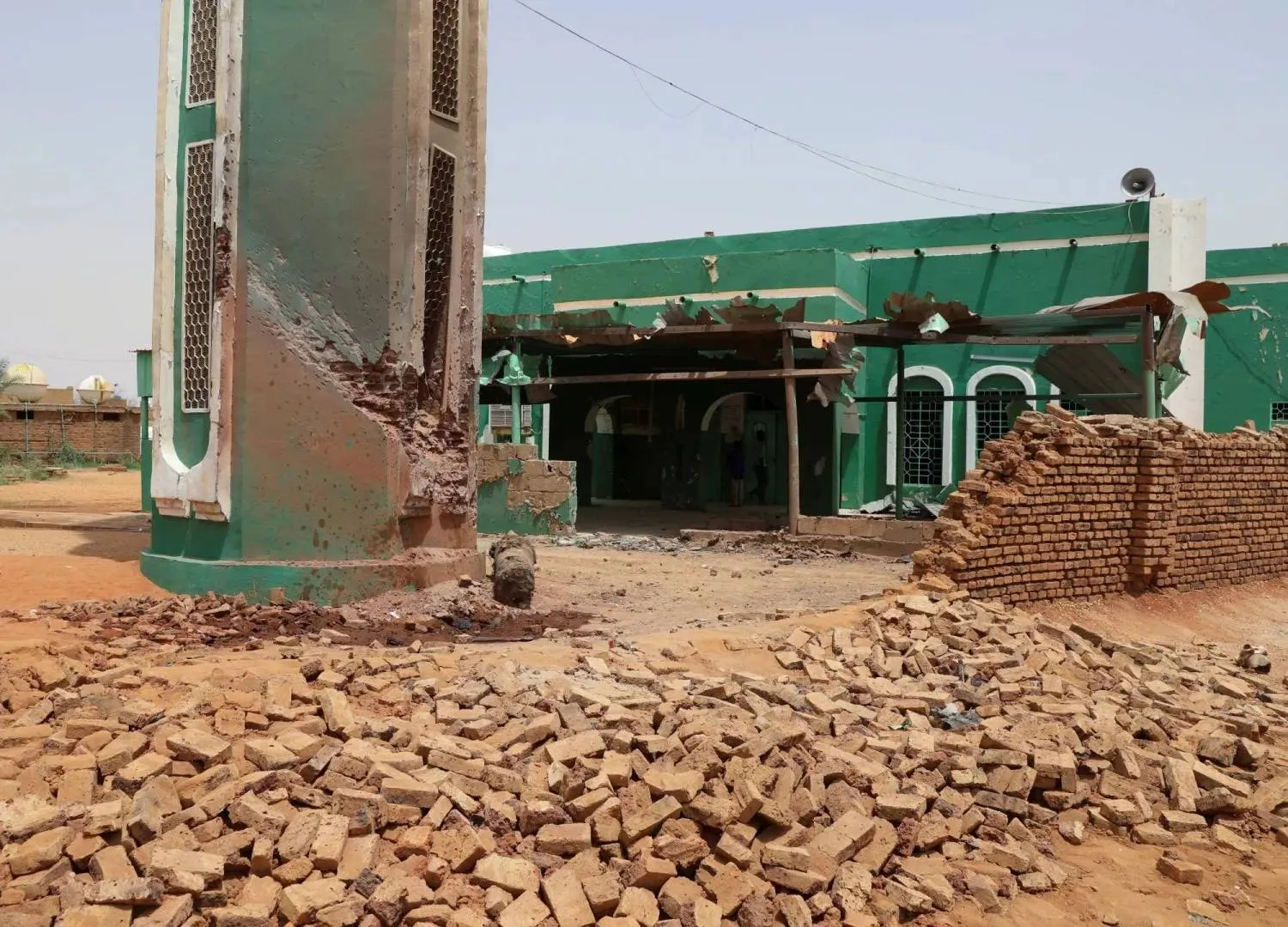
A collapsed mosque wall following a drone strike in Khartoum North, in Bahri city, Sudan on August 12, 2026. (Reuters) 
TT

Strike on WFP Aid Trucks in Sudan Kills One

A collapsed mosque wall following a drone strike in Khartoum North, in Bahri city, Sudan on August 12, 2026. (Reuters) 

One person was killed in an airstrike targeting a convoy carrying aid supplies in Sudan’s South Kordofan region on Saturday, the World Food Program (WFP) said.

Meanwhile, tensions gripped Port Sudan following a horrible murder that shocked the city.

In a statement issued on Sunday, the UN agency strongly condemned the aerial attack that hit two contracted trucks carrying WFP food commodities in South Kordofan.

The WFP trucks were travelling on Saturday between the two cities of Dilling and Kadugli when they came under attack, despite being “clearly marked as humanitarian vehicles,” WFP said, according to AFP.

“One driver was killed in the air strike,” it added, without specifying who was behind the attack.

Famine was confirmed last year in South Kordofan's Kadugli, and in El-Fasher in the western Darfur region, as fighting and access restrictions continue to hamper aid deliveries.

On Friday, a WFP truck had struck an explosive device in Dilling after delivering lifesaving food assistance.

The agency said it was assessing the damage and called for a prompt investigation into the incident.

Movement is difficult across much of western and southern Sudan due to damaged infrastructure, blocked roads and disrupted communications, as violence continues to escalate.

Both the army and the RSF have increasingly deployed drones in recent months, with the high-tech weapons killing more than 1,100 people in the first half of the year alone, according to UN figures.

Since the war began in April 2023, more than 200,000 people were killed, aid workers estimate, while more than 11 million are displaced, creating the world’s largest hunger and displacement crises.

Meanwhile, tension rose in Port Sudan on Sunday after the body of a resident was discovered near a hospital.

Sudanese newspaper Sout al-Umma (Voice of the Nation) quoted a local source as saying that the killing triggered anger among the victim’s relatives, who took to the streets, blocking some roads with stones and setting tyres on fire to prevent vehicles from passing.

The protestors asked authorities in the Red Sea city to make progress in identifying those responsible, according to dpa.

Several Sudanese states, including Khartoum, are facing growing security challenges, including widespread lawlessness, the proliferation of weapons, gang activity and rising crime rates, amid efforts to restore normal civilian life and basic services.

Observers say the war has severely degraded state institutions and triggered a surge in criminal activity across Sudan.


Israeli Army Says It Killed ‘Assailant’ in Southern Syria

Israeli soldiers during a reconnaissance operation in the occupied Syrian Golan Heights (Archive - Reuters)
TT

Israeli Army Says It Killed ‘Assailant’ in Southern Syria

Israeli soldiers during a reconnaissance operation in the occupied Syrian Golan Heights (Archive - Reuters)

The Israeli military said early Monday it had killed an “assailant” at an army outpost in the area it occupies in southern Syria.

The Israeli army said in a statement that its soldiers identified a suspect attempting to infiltrate an Israeli army post in the Security Zone in southern Syria.

"Following a quick identification, the soldiers fired toward the suspect and eliminated him," the Israeli army stated, adding that none of its personnel was injured.

Following the late-2024 overthrow of Bashar al-Assad by the opposition coalition, Israel carried out hundreds of strikes in Syria.

The Israeli army also carried out incursions into the south of the country and deployed troops in the UN-monitored buffer zone separating Israeli and Syrian forces in the Golan Heights.

Israeli officials have repeatedly stated their intention to maintain troops in the security area, where Israel seeks to establish a larger demilitarized zone.


Who Are Hezbollah's Remaining Allies in Lebanon?

Hezbollah supporter weeps during a ceremony to mark the second anniversary of the death of party leader Hassan Nasrallah . Nasrallah was killed in a massive Israeli air strike on September 27, 2024. Photo: Marwan Naamani/dpa
TT

Who Are Hezbollah's Remaining Allies in Lebanon?

Hezbollah supporter weeps during a ceremony to mark the second anniversary of the death of party leader Hassan Nasrallah . Nasrallah was killed in a massive Israeli air strike on September 27, 2024. Photo: Marwan Naamani/dpa

The second anniversary of the assassinations of former Hezbollah Secretary-General Hassan Nasrallah and Hashem Safieddine exposed a grim reality facing Hezbollah inside Lebanon. It showed that the group has lost its network of domestic allies, as evidenced by the absence, for the first time in two decades, of figures who had been allied with the group before the 2024 war.

Two years after the assassinations, observers closely following the group's situation say Hezbollah is facing not only the challenge of rebuilding its capabilities and reorganizing its ranks, but also the erosion of the network of alliances it built over many years. A number of political forces appear to have reconsidered the value of maintaining ties with the group amid shifts in the balance of power domestically and regionally.

Among its most prominent former allies, the only one to attend the commemoration of Nasrallah was Suleiman Frangieh, head of the Marada Movement, who had been the group's candidate for the presidency before President Joseph Aoun was elected, along with leaders representing the Amal Movement, its partner in the Shiite duo.

Political Cover Unravels

Hezbollah succeeded in building a broad network of political alliances spanning most of Lebanon's sects and denominations after signing the 2006 memorandum of understanding with the Free Patriotic Movement. According to its opponents, this enabled the group to secure "political cover" for retaining its weapons and expanding its influence, eventually entrenching a parallel reality alongside state institutions.

But this network began to gradually unravel after the "Gaza Support" war, alongside the major military setback suffered by Hezbollah and the resulting change in its position within Lebanon's political equation. One of the most prominent signs of this unraveling was the distancing of key allies, foremost among them the Free Patriotic Movement on the Christian political scene, along with the declining presence of its allies among Sunni and Druze forces.

The distancing of Hezbollah's allies is not linked solely to the shift in the balance of power after the war, but also to the political and financial risks that have come to accompany close ties with Hezbollah. This comes amid US sanctions that have already targeted individuals and entities linked to the group or accused of supporting it, as well as threats to expand the sanctions to include other allies and political figures. This has prompted some of the group's allies to reassess their calculations, fearing that their relationship with Hezbollah could turn from a source of political influence into a source of costs and sanctions.

Transactional Alliances

Dr. Hilal Khashan, a professor of political science at the American University of Beirut, said the "cross-sectarian network" the group sought to build after entering politics was essentially "marginal." He noted that "the group long benefited from its military strength to build broad political influence and from presenting itself as a force capable of establishing a balance with Israel."

According to Khashan, the group spent years "entrenching a narrative based on taking the battle to the Galilee and portraying the existence of a military balance with Israel," a narrative that "a large part of the Shiite community believed." But the military strength Hezbollah had amassed, which was considered one of its main sources of influence in the region, "suffered an unprecedented blow during the war, which inevitably affected its political position."

Khashan told Asharq Al-Awsat that Hezbollah had, throughout the past period, "provided political cover for parties and forces in exchange for obtaining cover for its policies and weapons, making many of the alliances closer to transactional alliances and exchanges of interests than to firmly established political or ideological partnerships."

Khashan believes that "the collapse of the balance of power that allowed the group to manage these relationships will make rebuilding its previous network of alliances extremely difficult, particularly as political forces that once saw benefits and political protection in an alliance with it now face a different reality." He expects the Amal Movement, through new figures, to assume leadership of the Shiite community in the coming phase.

Alienation Likely to Increase

Political writer and editor-in-chief of the Janoubia website Ali Al-Amin, for his part, said Hezbollah, which had been "a center of attraction for allies and political patronage for many years, is no longer so today, three years after the start of the Support War. It currently lacks allies and is facing an internal and external siege, a reality that can be readily observed." Al-Amin added: "This was clearly evident at the commemoration of the assassinations of its two former secretaries-general, as most of those who had once competed to sit in the front row were absent."

Al-Amin told Asharq Al-Awsat that "this alienation is likely to increase," noting that "the issue of weapons is another matter related to Hezbollah's role and position, which does not appear to have understood what befell it, the Shiites, and Lebanon as a result of a major catastrophe. It remains committed to its role as an Iranian tool subject to the calculations set by the Supreme Leader from inside Iran."

Al-Amin concluded: "In light of the current political and security circumstances, and with the group continuing to use rhetoric that is at odds with reality and its new facts, it will find no resonance beyond its supporters. Its visits to some political forces have not produced anything that could be described as a restoration of its alliances or friendships. In practical terms, it is trying to climb out of the hole it fell into by falling into more holes, which will deepen its predicament and expose its inability to redefine its existence on the foundations of the state."

He added: "In view of all this, it cannot be expected that the group will repair its fractured alliances. Rather, they will continue to collapse and disappear."