


In Shock Announcement, Trump Says US Wants to Take over Gaza Strip 

US President Donald Trump and Israeli Prime Minister Benjamin Netanyahu hold a joint press conference in the East Room at the White House in Washington, US, February 4, 2025. (Reuters)
TT

In Shock Announcement, Trump Says US Wants to Take over Gaza Strip 

US President Donald Trump and Israeli Prime Minister Benjamin Netanyahu hold a joint press conference in the East Room at the White House in Washington, US, February 4, 2025. (Reuters)

President Donald Trump said the US would take over the war-ravaged Gaza Strip and develop it economically after Palestinians are resettled elsewhere, actions that would shatter decades of US policy toward the Palestinian-Israeli conflict.

Trump unveiled his surprise plan, without providing specifics, at a joint press conference on Tuesday with visiting Israeli Prime Minister Benjamin Netanyahu.

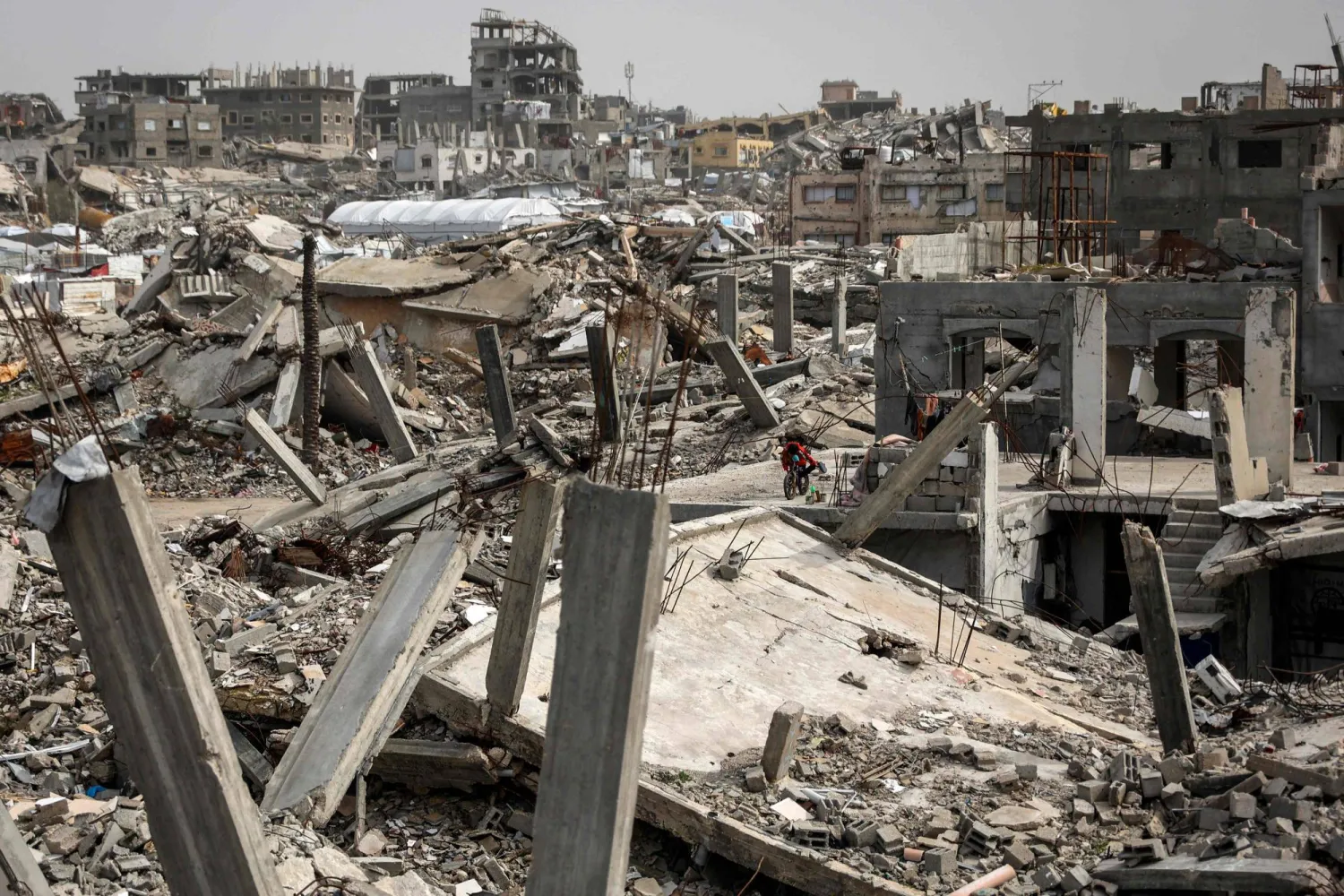
The announcement followed Trump's shock proposal earlier on Tuesday for the permanent resettlement of the more than two million Palestinians from Gaza to neighboring countries, calling the enclave - where the first phase of a fragile Israel-Hamas ceasefire and hostage release deal is in effect - a "demolition site."

Trump can expect allies and foes alike to strongly oppose any US takeover of Gaza.

The US taking a direct stake in Gaza would run counter to longtime policy in Washington and for much of the international community, which has held that Gaza would be part of a future Palestinian state that includes the occupied West Bank.

"The US will take over the Gaza Strip, and we will do a job with it too," Trump told reporters. "We'll own it and be responsible for dismantling all of the dangerous unexploded bombs and other weapons on the site."

"We're going to develop it, create thousands and thousands of jobs, and it'll be something that the entire Middle East can be very proud of," Trump said. "I do see a long-term ownership position and I see it bringing great stability to that part of the Middle East."

Asked who would live there, Trump said it could become a home to "the world's people." Trump touted the narrow strip, where Israel's military assault in response to Hamas' Oct. 7, 2023, cross-border attack has leveled large swaths, as having the potential to be “The Riviera of the Middle East.”

Trump did not directly respond to a question of how and under what authority the US can take over and occupy Gaza, a coastal strip 25 miles (45 km) long and at most 6 miles (10 km) wide, with a violent history. Successive US administrations, including Trump in his first term, had avoided deploying US troops there.

Several Democratic lawmakers quickly condemned the Republican president's Gaza proposals.

Netanyahu, referred to a few times by Trump by his nickname, "Bibi," would not be drawn into discussing the proposal in depth other than to praise Trump for trying a new approach.

The Israeli leader, whose military had engaged in more than a year of fierce fighting with Hamas in Gaza, said Trump was "thinking outside the box with fresh ideas" and was "showing willingness to puncture conventional thinking."

Netanyahu may have been relieved that Trump, who forged close ties with the Israeli leader during his first term in the White House, did not pressure him publicly to maintain the ceasefire. He faces threats from far-right members of his coalition to topple his government unless he restarts the fighting in Gaza to destroy Iran-backed Hamas.

Some experts have suggested Trump sometimes takes an extreme position internationally to set the parameters for future negotiations. In his first term, Trump at times issued what were seen as over-the-top foreign policy pronouncements, many of which he never implemented.

A UN damage assessment released in January showed that clearing over 50 million tons of rubble left in Gaza in the aftermath of Israel's bombardment could take 21 years and cost up to $1.2 billion.

TRUMP PROPOSES PERMANENT 'RESETTLEMENT'

Jonathan Panikoff, former deputy US national intelligence officer for the Near East, said Trump's plan would mean a lengthy US military commitment and if it came to fruition would be viewed by the Arab world as Washington "not learning its lessons from nation building in Iraq and Afghanistan."

Trump earlier repeated his call for Jordan, Egypt and other Arab states to take in Gazans, saying Palestinians there had no alternative but to abandon the coastal strip, which must be rebuilt after nearly 16 months of a devastating war between Israel and Hamas.

But this time Trump said he would support resettling Palestinians "permanently," going beyond his previous suggestions that Arab leaders had already steadfastly rejected.

Forced displacement of Gaza's population would likely be a violation of international law and would be fiercely opposed not only in the region but also by Washington's Western allies. Some human rights advocates liken the idea to ethnic cleansing.

Senior Hamas official Sami Abu Zuhri condemned Trump's calls for Gazans to leave as "expulsion from their land."

“We consider them a recipe for generating chaos and tension in the region because the people of Gaza will not allow such plans to pass," he said.

Trump offered no specifics on how a resettlement process could be implemented but his proposal echoed the wishes of Israel's far right and contradicted Democratic former President Joe Biden's commitment against mass displacement of Palestinians.

Aaron David Miller, a former Middle East adviser to Republican and Democratic administrations, said Trump had given Netanyahu a "huge pass" with his Gaza announcement. "He validated almost every right-wing fantasy in Israel," Miller said.

The Saudi government, in a statement, stressed its rejection of any attempt to displace Palestinians from their land and said it would not establish relations with Israel without establishment of a Palestinian state.

CRITICS DECRY EXPANSIONIST RHETORIC

Just two weeks into his second term, Trump was hosting Netanyahu at the White House to discuss the future of the Gaza ceasefire and strategies to counter Iran.

His Gaza proposal followed a frenetic first two weeks in office in which Trump has talked about a US takeover of Greenland, warned of the possible seizure of the Panama Canal and declared that Canada should be the 51st US state. Some critics have said Trump's expansionist rhetoric echoes old-style imperialism, suggesting it could encourage Russia in its war in Ukraine and give China justification for invading self-ruled Taiwan.

Trump described the Gaza Strip as a longtime "symbol of death and destruction" and said Palestinians there should be housed in "various domains" in other countries. He said the US will take over the Gaza Strip, "level the site" and create economic development but did not say how.

Trump, who had a career of developing real estate before getting into politics, cast a broad-brush, optimistic vision of a US takeover of Gaza while skirting details on how the United States would go about possessing the enclave and securing it.

He was also vague on where the Palestinian inhabitants of Gaza would go, saying he was confident Egypt and Jordan would take many of them, despite those governments already rejecting the idea.

What impact Trump's proposals have on negotiations over the second phase of the Gaza ceasefire deal was unclear, as Hamas has adamantly insisted it wants to remain in Gaza while Netanyahu has vowed to destroy the group and never allow it to again rule the territory.

Trump's Middle East envoy, Steve Witkoff, played a key role in helping the Biden administration secure the long-sought Gaza deal before the Jan. 20 transfer of power in the US. The first phase has led to Hamas' release of 18 hostages and Israel's release of hundreds of jailed Palestinians.

"We're in Phase 2 now," Witkoff told reporters earlier. He said he met Netanyahu on Monday to discuss parameters for the policy negotiations and would meet the prime minister of Qatar, a mediator in the negotiations, in the US on Thursday.


Israeli Military Says Detained Suspected ISIS Militant in Syria

FILE PHOTO: Israeli military vehicles manoeuvre along the Israel-Lebanon border, as seen from northern Israel, November 24, 2025. REUTERS/Shir Torem/File Photo
TT

Israeli Military Says Detained Suspected ISIS Militant in Syria

FILE PHOTO: Israeli military vehicles manoeuvre along the Israel-Lebanon border, as seen from northern Israel, November 24, 2025. REUTERS/Shir Torem/File Photo

The Israeli military said on Saturday its forces had arrested a suspected ISIS militant in Syria earlier this week and taken him back to Israel.

In a statement, the military said that on Wednesday "soldiers completed an operation in the area of Rafid in southern Syria to apprehend a suspected terrorist affiliated with ISIS.”

"The suspect was transferred for further processing in Israeli territory," the statement said.


Report: Colombian Mercenaries in Sudan ‘Recruited by UK-registered Firms’

(COMBO) This combination of satellite images released by Planet Labs PBC on December 19, 2025, shows from top left to bottom right:- the graves near the United Nations Children's Fund (UNICEF) headquarters in El-Fasher, taken on the following dates: on October 8, 2025, on October 27, 2025, on January 15, 2025, and on December 14, 2025. (Photo by Handout / Planet Labs / AFP)
TT

Report: Colombian Mercenaries in Sudan ‘Recruited by UK-registered Firms’

(COMBO) This combination of satellite images released by Planet Labs PBC on December 19, 2025, shows from top left to bottom right:- the graves near the United Nations Children's Fund (UNICEF) headquarters in El-Fasher, taken on the following dates: on October 8, 2025, on October 27, 2025, on January 15, 2025, and on December 14, 2025. (Photo by Handout / Planet Labs / AFP)

An exclusive investigation by UK’s The Guardian has found companies hiring hundreds of Colombian fighters for Sudan’s Rapid Support Forces.

A one-bedroom flat off north London’s Creighton Road in Tottenham is, according to UK government records, tied to a transnational network of companies involved in the mass recruitment of mercenaries to fight in Sudan alongside the RSF, said the report.

Colombian mercenaries were directly involved in the RSF’s seizure of the southwestern Sudanese city of El Fasher in late October, which prompted a killing frenzy that analysts say has cost at least 60,000 lives.

“The flat in Tottenham is registered to a company called Zeuz Global, set up by two individuals named and sanctioned last week by the US treasury for hiring Colombian mercenaries to fight for the RSF,” said The Guardian.

“Both figures – Colombian nationals in their 50s – are described in documents at Companies House, the government register of firms operating in the UK, as living in Britain,” it said.

“The day after the US treasury announced sanctions on those behind the Colombian mercenary operation –December 9 – Zeuz Global abruptly moved its operation to the very heart of London. On 10 December the firm shared “new address details” Its new postcode matches One Aldwych, a five-star hotel in Covent Garden,” the report added.

Yet the first line of Zeuz Global’s new address is, confusingly, “4dd Aldwych,” which corresponds to the Waldorf Hilton hotel 100 meters away, according to The Guardian.

Both hotels said they had no link to Zeuz Global and had no idea why the firm had used their postcodes.

“It is of major concern that the key individuals the US government claims are directing this mercenary supply have been able to set up a UK company operating from a flat in north London, and even to claim that they’re resident in the UK,” said Mike Lewis, a researcher and former member of the UN panel of experts on Sudan.

When Companies House was asked if it had any knowledge of what Zeuz Global actually did, or is doing, it did not respond. The government agency would also not confirm whether the sanctioned individuals were, in fact, resident in the UK.

Contacting Zeuz proved fruitless; its website, set up in May, was labelled as “under construction” with no contact details provided.


Egyptian President Urges UN Security Council Reforms for Africa's Larger Role

In this photo, provided by Egypt's presidency media office, Egyptian President Abdel-Fattah el-Sisi, front right, greets Russian Foreign Minister Sergei Lavrov, left, before their meeting at the Presidential Palace in Cairo, Egypt, Saturday, Dec. 20, 2025. (Egyptian Presidency Media Office via AP)
TT

Egyptian President Urges UN Security Council Reforms for Africa's Larger Role

In this photo, provided by Egypt's presidency media office, Egyptian President Abdel-Fattah el-Sisi, front right, greets Russian Foreign Minister Sergei Lavrov, left, before their meeting at the Presidential Palace in Cairo, Egypt, Saturday, Dec. 20, 2025. (Egyptian Presidency Media Office via AP)

Egypt’s President Abdel-Fattah el-Sisi on Saturday reiterated calls for structural changes in the UN Security Council to grant Africa a larger role in shaping global decisions.

El-Sisi made the plea for a “more pluralistic” world order at a conference of the Russia-Africa partnership held in Cairo, which was attended by Russian Foreign Minister Sergei Lavrov and ministers from more than 50 African countries along with representatives from several African and regional organizations.

“The voice of Africa should be present and influential in making global decisions given the continent’s human, economic, political and demographic weight,” el-Sisi said in a statement read out by his foreign minister at the plenary session of the conference.

According to The Associated Press, he added that international financial institutions need to undergo similar reforms to ensure Africa an equitable representation.

Since 2005, the African Union has been demanding that Africa be granted two permanent seats with veto powers in the Security Council, arguing that such reforms would contribute to achieving peace and stability on the continent, which has been struggling with wars for decades.

The Security Council, which is charged with maintaining international peace and security, has not changed from its 1945 configuration: 10 non-permanent members from all regions of the world elected for two-year terms without veto power, and five countries that were dominant powers at the end of World War II are permanent members with veto power: The United States, Russia, China, Britain and France.

In his statement, el-Sisi said that the Russia-Africa ministerial conference will develop a plan to consolidate the partnership ahead of next year’s summit of heads of state.

“We remain a reliable partner for African states in strengthening their national sovereignty, both politically and in matters of security, as well as in other dimensions,” Lavrov said at the plenary session. “We’re committed to further unlocking the existing enormous potential of our practical cooperation.”