

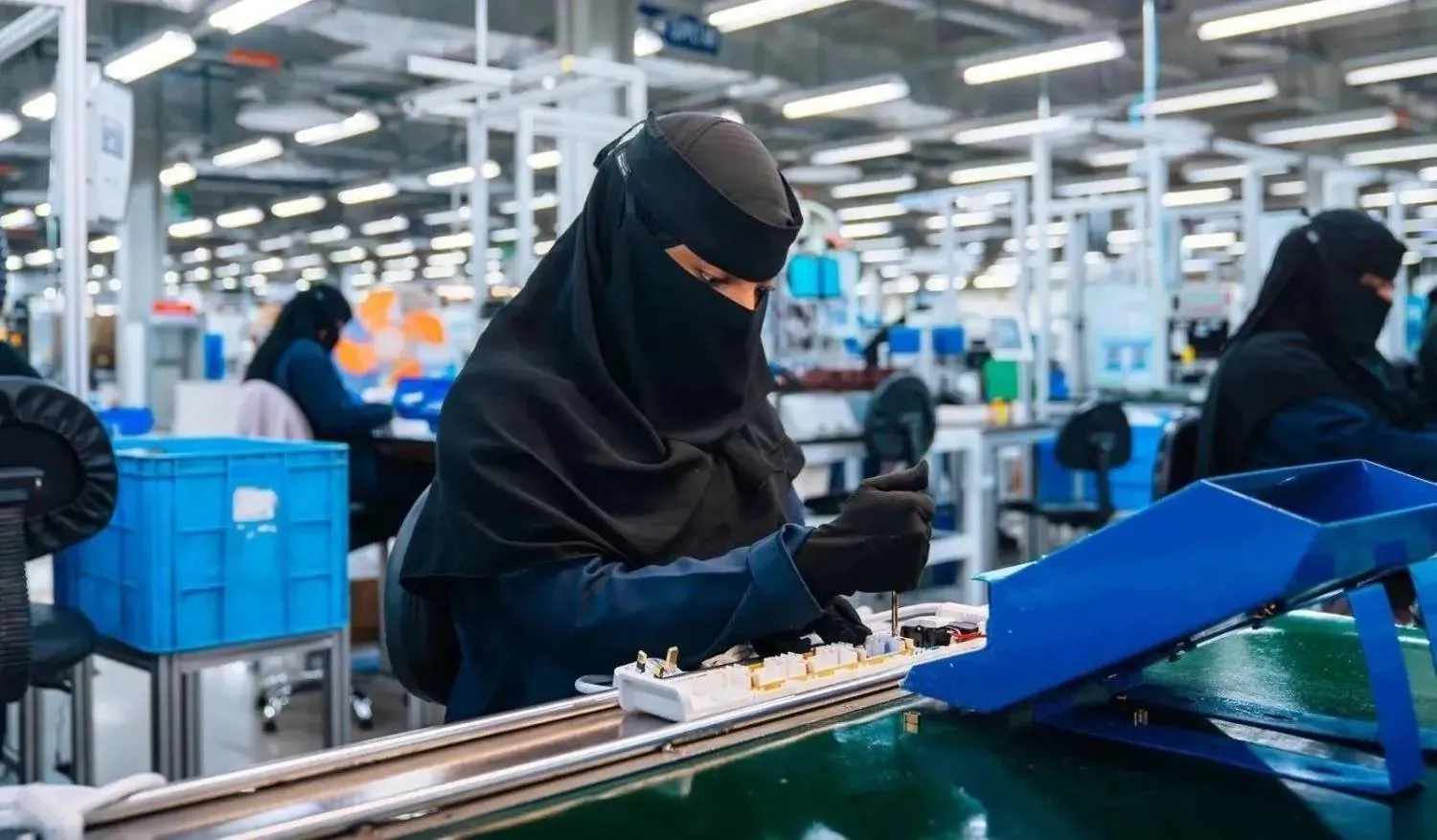

Saudi Arabia’s Non-Oil Private Sector Records Fastest Growth in a Decade

Workers at electrical equipment factory in Saudi Arabia. (Asharq Al-Awsat) 
TT

Saudi Arabia’s Non-Oil Private Sector Records Fastest Growth in a Decade

Workers at electrical equipment factory in Saudi Arabia. (Asharq Al-Awsat) 

Saudi Arabia’s non-oil private sector has expanded at its fastest pace in 10 years, driven by record-high demand and an increase in new orders at the sharpest rate since June 2011. This growth has encouraged business expansion and inventory buildup.

The Riyad Bank Purchasing Managers’ Index (PMI) climbed from 58.4 in December to 60.5 in January, marking its highest level since September 2014.

Experts told Asharq Al-Awsat that Saudi Arabia’s non-oil sector reflects the strength of industrial activity and expect continued expansion in government spending. They highlighted that the Kingdom’s business environment is increasingly attractive to investors, positioning it as a major commercial hub.

Economic expert Dr. Mohammed Makni explained that the PMI surge signifies rapid non-oil sector growth, which has been accelerating over the past four years. He expects government spending on non-oil activities to continue expanding for at least three more years, aligning with Saudi Arabia’s 2025 budget and Vision 2030 goals.

Makni noted that credit rating agencies and international financial institutions, including the IMF and World Bank, forecast Saudi Arabia’s non-oil sector to grow by at least 4% annually over the next three years, while local projections estimate growth closer to 6%.

Additionally, the Public Investment Fund (PIF) has committed SAR 150 billion ($40 billion) to private sector investment between 2021 and 2025, further accelerating expansion.

Economic analyst Ahmed Al-Jubair emphasized that Saudi Arabia’s economy is shifting away from oil dependence, with the non-oil private sector becoming a key driver of growth. He noted that the Kingdom’s mega projects provide extensive opportunities for private businesses, making Saudi Arabia a top destination for investment and business expansion.

The PMI report indicates growing business confidence, with expectations for future activity reaching a 10-month high. Businesses reported the fastest rise in new orders since June 2011, leading to a strong increase in commercial activity and inventory levels.

While the business environment has improved, companies are facing rising production costs, mainly due to higher material prices linked to geopolitical tensions.

The Saudi labor market also showed significant improvement, with higher employment levels reflecting growing demand.

According to Riyad Bank Chief Economist Naif Al-Ghaith, the PMI surge underscores the resilience of Saudi Arabia’s non-oil private sector, supported by rising new orders and strong business output.

Al-Ghaith highlighted that production activity reached an 18-month high, with 30% of businesses reporting increased operations—a direct result of government-led economic diversification efforts.

He also pointed out that 45% of companies experienced sales growth, driven by economic expansion and large-scale infrastructure projects. Additionally, higher export orders—particularly from Gulf Cooperation Council (GCC) countries—boosted domestic demand.



China Widens Foreign Investment Incentive List to Stem Falling Inflows

People visit a shopping center in Beijing on December 20, 2025. (AFP)
TT

China Widens Foreign Investment Incentive List to Stem Falling Inflows

People visit a shopping center in Beijing on December 20, 2025. (AFP)

China on Wednesday listed more sectors eligible for foreign investment incentives, from tax breaks to preferential ​land use, in its latest effort to stem a prolonged decline in overseas capital inflows.

Under the 2025 edition of the catalogue of industries for encouraging foreign investment, China added more than 200 and revised about 300, with a ‌focus on ‌advanced manufacturing, modern services and ‌green ⁠and ​high-tech ‌sectors, the list jointly issued by the National Development and Reform Commission and the commerce ministry showed.

The new catalogue, which takes effect on February 1, 2026, replaces the 2022 version and continues a policy framework ⁠that offers foreign-invested enterprises tariff exemptions on imported equipment, preferential ‌land pricing, reduced corporate income ‍tax rates in ‍designated regions and tax credits for reinvestment ‍of profits.

The catalogue also extends incentives to central and western regions, as well as the northeast and Hainan, as Beijing seeks to attract ​more foreign investment into less developed areas.

China has in recent months ⁠taken a raft of measures to boost foreign investment, including pilot programs in Beijing, Shanghai and other regions to expand market access in services such as telecoms, healthcare and education, amid trade tensions with the United States.

Foreign direct investment in China totaled 693.2 billion yuan ($98.84 billion) from January to November this year, down 7.5% from the ‌same period last year, data from the commerce ministry showed.


Environment Ministry Launches Saudi Citrus Season with Production Exceeding 158,000 Tons

The citrus production season in the Kingdom begins in July and continues through March each year. (SPA)
TT

Environment Ministry Launches Saudi Citrus Season with Production Exceeding 158,000 Tons

The citrus production season in the Kingdom begins in July and continues through March each year. (SPA)

The Saudi Ministry of Environment, Water and Agriculture launched on Wednesday the Kingdom’s citrus season in local markets as part of its efforts to support and develop the agricultural sector and enhance food security in the country, in line with the Saudi Vision 2030.

The is part of the ministry’s ongoing efforts to support national agricultural products, raise awareness of citrus varieties and their nutritional benefits and production areas, and highlight their year-round diversity across production seasons.

These efforts help in improving marketing efficiency, boost competitiveness, and achieve rewarding economic returns.

Citrus fruits are among the most widely cultivated crops in the Kingdom. They are grown in several regions that produce a variety of citrus types, most notably lemons, oranges, mandarins, grapefruit, citron, and kumquats.

The ministry said lemon production leads Saudi citrus output, with total production exceeding 123,000 tons and more than 1.5 million fruit-bearing trees. Orange production follows, with total output reaching 35,700 tons and more than 397,000 fruit-bearing trees.

The citrus production season in the Kingdom begins in July and continues through March each year, it added.

The ministry said the Saudi citrus season has been launched with a number of major retail markets across the Kingdom showcasing local products through innovative packaging and display methods. This boosts the quality and reliability of local products and increases consumer demand during production seasons.


SLB Awarded 5-Year Contract to Stimulate Unconventional Gas in Saudi Arabia

SLB has been awarded a five-year contract by Saudi Aramco to provide stimulation services for its unconventional gas fields. (Asharq Al-Awsat)
TT

SLB Awarded 5-Year Contract to Stimulate Unconventional Gas in Saudi Arabia

SLB has been awarded a five-year contract by Saudi Aramco to provide stimulation services for its unconventional gas fields. (Asharq Al-Awsat)

Global technology company, SLB, has been awarded a five-year contract by Saudi Aramco to provide stimulation services for its unconventional gas fields, the company said in a statement on Tuesday.

The move is part of a broader multi-billion contract, supporting one of the largest unconventional gas development programs globally, it said.

The contract encompasses advanced stimulation, well intervention, frac automation, and digital solutions, which are important to unlocking the potential of Saudi Arabia’s unconventional gas resources - a cornerstone of the Kingdom’s strategy to diversify its energy portfolio and support the global energy transition.

“This agreement is an important step forward in Aramco’s efforts to diversify its energy portfolio in line with Vision 2030 and energy transition goals,” said Steve Gassen, SLB executive vice president.

“With world-class technology, deep local expertise, and a proven track record in safety and service quality, SLB is well positioned to deliver tailored solutions that could help redefine operational performance in the development of Saudi Arabia’s unconventional resources,” he added.

These solutions provide the tools to work toward new performance benchmarks in unconventional gas development.

SLB is a global technology company that drives energy innovation for a balanced planet.

With a global footprint in more than 100 countries and employees representing almost twice as many nationalities, it works on innovating oil and gas, delivering digital at scale, decarbonizing industries, and developing and scaling new energy systems that accelerate the energy transition.