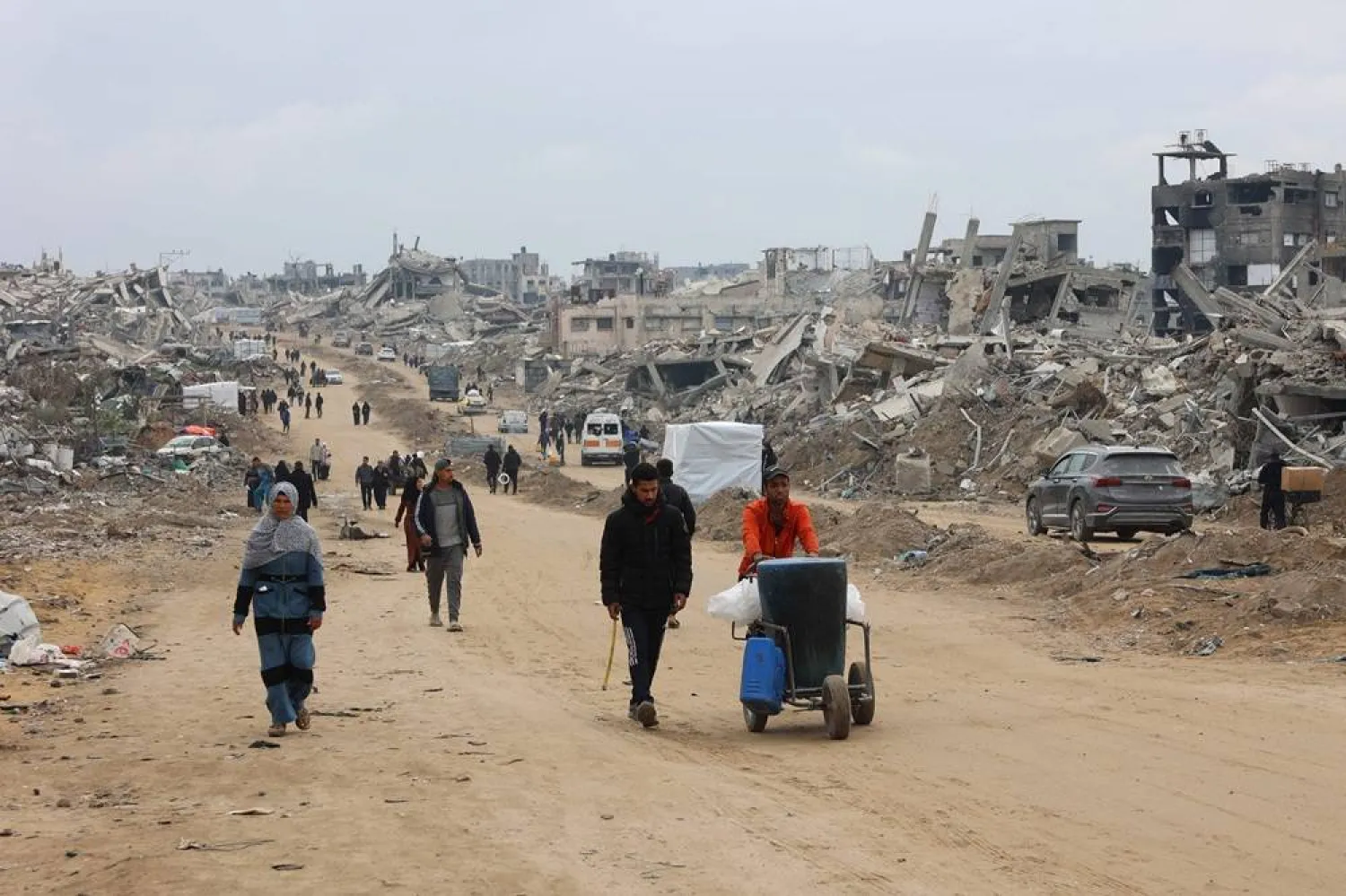
Arab League Slams Trump’s Plan to ‘Take Over’ the Gaza Strip

Palestinians walk past collapsed buildings along Saftawi street in Jabalia in the northern Gaza Strip on February 5, 2025 during a ceasefire deal in the war between Israel and Hamas. (AFP)
TT

Arab League Slams Trump’s Plan to ‘Take Over’ the Gaza Strip

Palestinians walk past collapsed buildings along Saftawi street in Jabalia in the northern Gaza Strip on February 5, 2025 during a ceasefire deal in the war between Israel and Hamas. (AFP)

The Arab League joined a chorus of rejections on Wednesday of President Donald Trump’s plan to “take over” the Gaza Strip.

The 22-member regional grouping said in a statement that Trump’s proposal “represents a recipe for instability” that does not advance Palestinian statehood.

It said it rejected the displacement of the Palestinians and that Gaza was an integral part of any future Palestinian state.

Trump’s suggestion came at a White House news conference on Tuesday with Israeli Prime Minister Benjamin Netanyahu, who smiled several times as the president detailed a plan to build new settlements for Palestinians outside the Gaza Strip, and for the US to take “ownership” in redeveloping the war-torn territory into “the Riviera of the Middle East.”

“The US will take over the Gaza Strip, and we will do a job with it too,” Trump said. “We’ll own it and be responsible for dismantling all of the dangerous unexploded bombs and other weapons on the site, level the site, and get rid of the destroyed buildings, level it out, create an economic development that will supply unlimited numbers of jobs.”

His remarks drew swift opposition from allies and adversaries alike.


Trump Rolls Out the White House Welcome Mat for New Iraqi PM

Iraqi Prime Minister Ali al-Zaidi departs on his visit to the US. (INA)
TT

Trump Rolls Out the White House Welcome Mat for New Iraqi PM

Iraqi Prime Minister Ali al-Zaidi departs on his visit to the US. (INA)

President Donald Trump is welcoming Iraq's new prime minister to the White House on Tuesday after strongly backing the political neophyte in his bid for office.

Ali al-Zaidi, a businessman with no political background, emerged as a consensus candidate in Iraq after months of deadlock over the premiership following last year’s parliamentary elections.

When al-Zaidi was formally installed as prime minister-designate in April, Trump said in a social media post that it was the “beginning of a tremendous new chapter between our Nations — Prosperity, Stability, and Success like never seen before.”

But Trump’s interest and involvement in the next leadership in Iraq began long before that statement.

Iraq’s dominant parliamentary bloc, the Coordination Framework — a coalition of Shiite parties allied with Iran — initially said it would back former Prime Minister Nouri al-Maliki, whom the Trump administration views as too close to Tehran.

The US president publicly announced his opposition to al-Maliki and threatened to cut off aid to Iraq if he was appointed, adding that “if we are there to help, Iraq has ZERO chance of Success, Prosperity, or Freedom.”

The issue of Iran is likely to loom large in the discussions Tuesday.

Iraq has been under pressure to disarm a network of Iran-backed armed factions operating in the country, some of which launched attacks on US bases and diplomatic facilities after the US and Israel launched their war against Iran in February.

Officially, the Iraqi government has given non-state armed groups until the end of September to disarm, but some of the most powerful factions have said they have no intention of doing so.

A Trump administration official said ahead of the Oval Office meeting that the US will make “informed” decisions based on Iraq’s efforts to disarm Iranian-backed factions inside its borders. The official was granted anonymity to discuss the administration’s strategy ahead of al-Zaidi’s visit.

Renad Mansour, director of the Iraq Initiative at the Chatham House think tank, said he expects that “the US will put significant pressure on al-Zaidi” to move ahead with disarmament during his Washington visit “and al-Zaidi will respond by saying, ‘But I need support — intelligence support, technical support, armed support.’”

“There is a scenario in which, if the Iraqi government starts going after these groups, they will also go after the government,” Mansour said. “And this is a scenario that I think that the Iraqi government is apprehensive about.”

Al-Zaidi received Trump’s blessing, despite the fact that he was chairman of a bank — Al-Janoob Islamic Bank — that was among the financial institutions banned by Iraq’s central bank in 2024 from dealing in dollars amid pressure from the US to crack down on money laundering and funneling of funds to Iran.

Since taking office, al-Zaidi has made a public show of cracking down on corruption. His government has conducted raids and arrested dozens of current and former lawmakers and government officials accused of corruption, including a number affiliated with former Prime Minister Mohammed Shia al-Sudani.

The Iraqi premier’s delegation to Washington includes a number of Iraqi businessmen as well as government officials, and al-Zaidi’s office said in a statement that the aim of the visit is to “strengthen economic and development partnerships, attract investment, and expand the role of US companies in implementing infrastructure projects” and to further develop the oil-rich country’s energy sector.


Lebanese President Pins Hopes on Rome Talks to Secure Israeli Withdrawal

Aoun receives former UN Special Coordinator for the Middle East Peace Process Sigrid Kaag and a delegation from the University of Balamand. (Lebanese Presidency)
TT

Lebanese President Pins Hopes on Rome Talks to Secure Israeli Withdrawal

Aoun receives former UN Special Coordinator for the Middle East Peace Process Sigrid Kaag and a delegation from the University of Balamand. (Lebanese Presidency)

Hours before the sixth round of Lebanese-Israeli negotiations in Rome on Tuesday, Lebanese President Joseph Aoun hoped that the two-day talks will produce tangible progress on the ground, starting with an Israeli withdrawal from Lebanese territory and the deployment of the Lebanese Army to areas vacated by Israeli forces.

The Lebanese delegation heads into the talks seeking to move from the framework agreement with Israel to the implementation phase, while Hezbollah has intensified its criticism of both the government and the accord, saying it undermines Lebanon’s sovereignty and targets the party itself.

Lebanon is pressing for the prompt launch of the “pilot zones” outlined in the agreement. Sources familiar with the negotiations told Asharq Al-Awsat that US-led efforts, through a delegation that arrived in Beirut from Israel on Saturday, to initiate an Israeli withdrawal from pilot areas remain active and should not be considered stalled.

“We are still awaiting signs that such a step can be achieved before Tuesday’s talks in Rome,” the sources said, adding that contacts are continuing until the last minute in hopes of securing an Israeli withdrawal from one or two villages before negotiations begin.

Two weeks ago, Prime Minister Nawaf Salam said that Israel would withdraw from Western Zawtar, Eastern Zawtar, and several other villages.

Ministerial sources said the Lebanese delegation includes Ambassador Simon Karam, Ambassador Nada Mouawad, and retired Brig. Gen. Ziad Haykal, a member of Aoun’s advisory team.

US Ambassador to Lebanon Michel Issa will not attend.

The talks will focus on mechanisms for implementing the framework agreement, establishing a timetable for an Israeli withdrawal, and launching the pilot zones through the deployment of the Lebanese Army as a prelude to reconstruction.

The framework agreement sets out broad principles for resolving the situation in southern Lebanon, including an Israeli withdrawal, the deployment of the Lebanese Army, and reconstruction. However, it does not include a binding implementation timetable, one of the main points of contention.

During meetings on Monday, Aoun said national unity was Lebanon’s “strongest weapon” and urged political leaders to “speak with one Lebanese voice,” stressing that loyalty should be to the nation rather than personal interests.

He vowed not to compromise on southern Lebanon or the country’s rights, saying the framework agreement calls for a full Israeli withdrawal from Lebanese territory and includes an Israeli commitment that it has no territorial ambitions in Lebanon.

Aoun argued that war had failed to bring security or stability and said diplomacy aims to achieve objectives broadly supported by Lebanese citizens, foremost among them an Israeli withdrawal, the return of displaced residents, the release of detainees and the remains of the dead, and the launch of reconstruction.

He said he would discuss ways to pressure Israel to implement the framework agreement during his upcoming meeting with US President Donald Trump in Washington.

As preparations for the Rome talks continued, Hezbollah stepped up its attacks on the Lebanese government and the framework agreement, arguing that it fails to safeguard Lebanon’s sovereignty, links ending the occupation to the issue of the group’s weapons, and grants Israel political gains it failed to achieve during the war.

MP Ali Al-Moqdad, a member of Hezbollah’s parliamentary bloc, called for the agreement to be abandoned, describing it as “an agreement of humiliation and disgrace” that betrays the sacrifices of those killed, wounded, and displaced.


Jordan Shoots Down 4 Rockets Fired by Iran as Sirens Sound in Bahrain

A view of Amman, Jordan. (Petra file)
TT

Jordan Shoots Down 4 Rockets Fired by Iran as Sirens Sound in Bahrain

A view of Amman, Jordan. (Petra file)

The Jordanian military announced on Tuesday that air defenses shot down four rockets fired from Iran. No injuries or material damage was reported.

Iran has intensified its attacks on US allies in the region in retaliation to the latest American strikes against it.

Meanwhile, sirens sounded in Bahrain three times as Iran targeted the country.

In Jordan, an official military source said the armed forces intercepted and downed four missiles that had entered the kingdom’s airspace at dawn, saying they were fired by Iran.

The interception was carried out with high efficiency in line with procedures to protect the kingdom's sovereignty and security and safety of its people.

The source stressed that any attempt to violate the kingdom’s sovereignty or its airspace will be met with “complete firmness within the reliable rules of engagement” to safeguard the national interest.

“The armed forces will not be lenient in taking all necessary measures to protect the nation and defend its security and stability,” it declared.

Iran’s Revolutionary Guards Corps (IRGC) said it targeted a “US air base” in Jordan with ballistic missiles.

Jordan had last Thursday intercepted eight rockets fired by Iran. The IRGC also claimed the attack was targeting an American military base.

Jordan has repeatedly said it does not host foreign bases on its territories. Any foreign troops in the country are deployed at Jordanian bases as part of joint agreements and training programs.

In April, Jordan said it had been targeted by 281 rockets and drones fired by Iran during the US-Israel war against Tehran that started on February 28. It said that it had intercepted 261 of the attacks, which had resulted in 30 injuries.