


Electric Vehicle Maker Nikola Goes Bankrupt

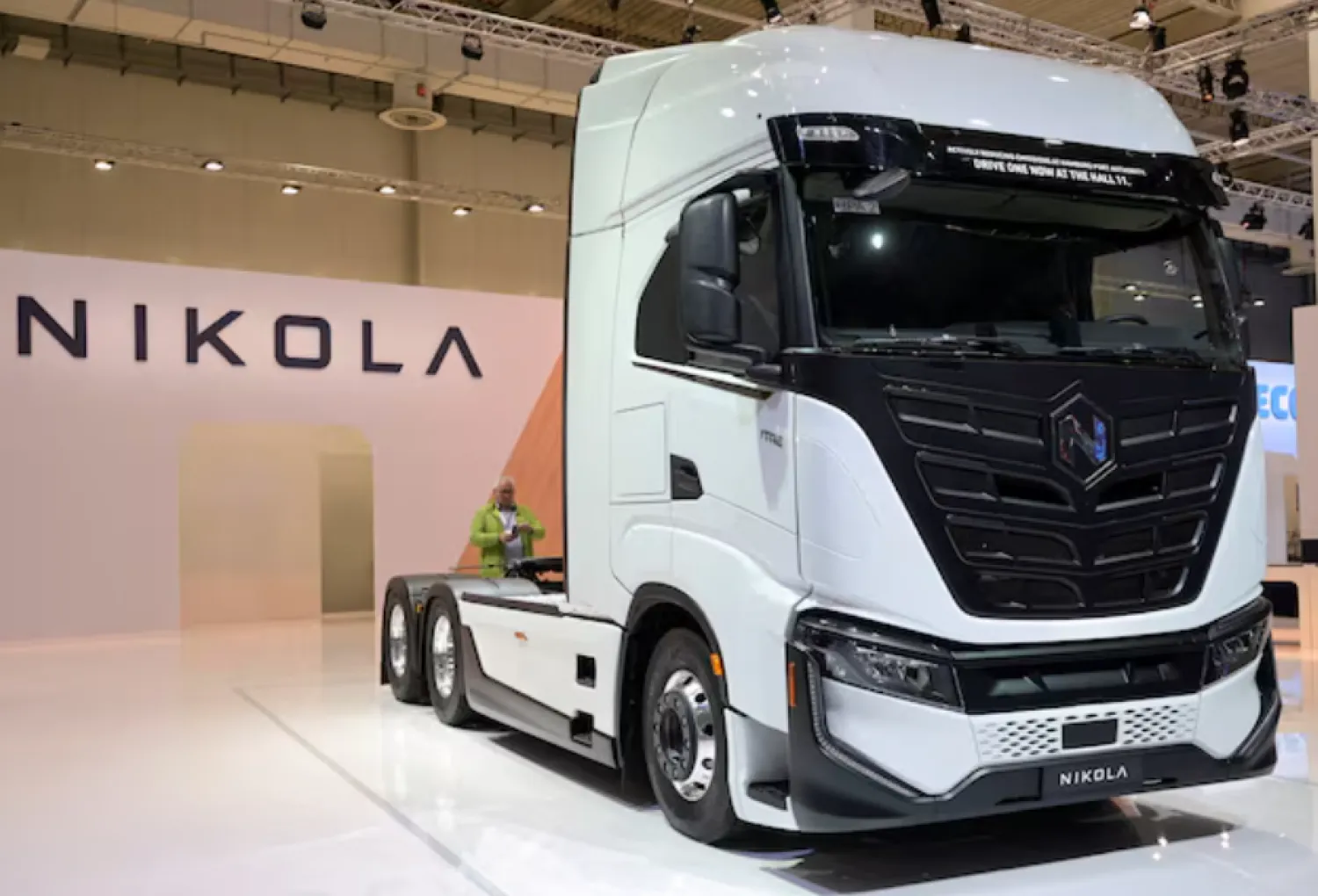
A member of the media stands behind a hydrogen-powered Artic truck at the booth of US truckmaker Nikola at the IAA Transportation fair, which will open its doors to the public on September 20, 2022, in Hanover, Germany, September 19, 2022. REUTERS/Fabian Bimmer/File Photo
TT

Electric Vehicle Maker Nikola Goes Bankrupt

A member of the media stands behind a hydrogen-powered Artic truck at the booth of US truckmaker Nikola at the IAA Transportation fair, which will open its doors to the public on September 20, 2022, in Hanover, Germany, September 19, 2022. REUTERS/Fabian Bimmer/File Photo

Nikola (NKLA.O) said on Wednesday it had filed for Chapter 11 bankruptcy protection and would pursue a sale of its assets, the latest electric-vehicle maker to stumble after grappling with tepid demand, rapid cash burn and funding challenges.

The development ends a challenging journey, which included several leadership changes, a plummeting share value and short-seller allegations.

EV firms that went public during the pandemic, promising to revolutionize the sector, such as Fisker, Proterra and Lordstown Motors have filed for bankruptcy in recent years as funding for the capital-intensive operations dried up due to high interest rates and flagging demand.

"Like other companies in the electric vehicle industry, we have faced various market and macroeconomic factors that have impacted our ability to operate," CEO Steve Girsky said in a statement, Reuters reported.

"Unfortunately, our very best efforts have not been enough to overcome these significant challenges," he added.

Elon Musk-led EV pioneer Tesla (TSLA.O), reported its first drop in annual sales in 2024 as high borrowing costs and an aging lineup crimped demand, despite offers and incentives.

Nikola, which started off making battery-powered semi trucks and pivoted to electric trucks that use hydrogen, said it decided to initiate a sale process of its assets to maximize value and ensure an orderly wind down.

The firm will continue some operations for trucks in the field and some hydrogen-fueling operations through the end of March.

Nikola listed assets of between $500 million and $1 billion, and estimated its liabilities were between $1 billion and $10 billion, according to a court filing.

Phoenix, Arizona-based Nikola was founded more than a decade ago. It went public in June 2020 and delivered its first vehicle in the December of the following year.

Nikola ramped up production of its hydrogen-powered trucks in 2024, but still lost hundreds of thousands of dollars on every vehicle sold as fleet operators were reluctant to invest in electric truck adoption amid high borrowing costs.

The stock fell about 45% on Wednesday premarket to around 41 cents.

STRUGGLING FINANCES

In the early days of the pandemic, Nikola struggled to increase its rate of production due to supply chain snags. High costs related to the ramp-up of manufacturing aggravated its woes.

Nikola's cash and cash equivalents dropped sharply to $198.3 million at the end of September, compared with $464.7 million at the end of 2023.

On Wednesday, the company said it was entering Chapter 11 proceedings with $47 million in cash on hand.

Its shares have lost more than 99% of their value since going public in 2020.

The stock has fallen below the $1-mark several times and the company resorted to a reverse stock split last year to comply with Nasdaq's listing rules.

SHORT-SELLER ALLEGATIONS

Shortly after the company went public in 2020 through a merger with a blank-check company, it was hit by a scathing report by short-seller Hindenburg, which disbanded earlier this year. Nikola had denied the allegations.

The report alleged that Nikola had rolled one of its trucks down a hill, portraying it as a functioning truck that could run under its own power, misleading investors.

Founder Trevor Milton was convicted of fraud in 2022 and sentenced to four years in prison the following year.



Microsoft to Invest $10 bn for Japan AI Data Centers

Microsoft's Vice Chair and President Brad Smith (4th L) and (L-R) Sakura Internet Inc President and CEO Kunihiro Tanaka, SoftBank Corp. President and CEO Junichi Miyakawa, Microsoft Japan President Miki Tsusaka, hold a meeitng with Japan's Prime Minister Sanae Takaichi (2nd R) and Vice Minister of Economy, Trade and Industry Toshiro Ino (R) at the Prime Minister's Office in Tokyo on April 3, 2026. Kazuhiro NOGI / POOL/AFP
TT

Microsoft to Invest $10 bn for Japan AI Data Centers

Microsoft's Vice Chair and President Brad Smith (4th L) and (L-R) Sakura Internet Inc President and CEO Kunihiro Tanaka, SoftBank Corp. President and CEO Junichi Miyakawa, Microsoft Japan President Miki Tsusaka, hold a meeitng with Japan's Prime Minister Sanae Takaichi (2nd R) and Vice Minister of Economy, Trade and Industry Toshiro Ino (R) at the Prime Minister's Office in Tokyo on April 3, 2026. Kazuhiro NOGI / POOL/AFP

Microsoft said Friday it will invest $10 billion in Japan over the next four years to build artificial intelligence data centers and related infrastructure.

Power-hungry data centers -- warehouse-like facilities that power AI tools from chatbots to image generators -- are springing up worldwide, and the sector is growing particularly fast in Asia.

Microsoft President Brad Smith met Japanese Prime Minister Sanae Takaichi at her office on Friday to announce the investment, said AFP.

Smith said in a statement that it was a "response to Japan's growing need for cloud and AI services".

Businesses in Japan, the world's fourth-largest economy, are keen to get ahead in the fast-moving AI field.

But data centers expansion there is constrained by limited space and relatively expensive electricity.

The US tech giant will collaborate with Japan's SoftBank Group and Sakura Internet to expand domestic tech infrastructure, it said in a press release.

It follows a $2.9 billion two-year investment Microsoft announced in 2024 to bolster the country's push into AI and strengthen its cyber defenses.

The investment unveiled Friday also includes funds to enhance cybersecurity partnerships with Japanese government agencies, and to train one million engineers in cooperation with telecom and tech giants NTT and NEC.

A rush to build data centers in the Asia-Pacific region, especially in India and Southeast Asia, has sparked concerns over the facilities' environmental impact.

That includes increased demand on electricity grids that are often reliant on fossil fuels, and on local water supplies used to cool the hot servers inside.

Microsoft says it has pledged to become carbon negative, zero-waste and "water positive" by 2030.

On Tuesday, the company announced plans to invest more than $1 billion in cloud and AI data center infrastructure and operations in Thailand over the next two years.


Kia to Sell Lower-priced Electric Vehicle in US

A KIA logo on an electric vehicle is seen on display at the Canadian International AutoShow in Toronto, Ontario, Canada, February 13, 2025. REUTERS/Carlos Osorio
TT

Kia to Sell Lower-priced Electric Vehicle in US

A KIA logo on an electric vehicle is seen on display at the Canadian International AutoShow in Toronto, Ontario, Canada, February 13, 2025. REUTERS/Carlos Osorio

Kia said Wednesday it will begin selling a lower-priced electric vehicle in the United States later this year as automakers work to recharge EV sales.

The Korean automaker said at the New York Auto Show it will offer the EV3 in the US market starting later this year, Reuters reported.

Automakers are facing a tougher EV market in the United States after Congress repealed the $7,500 EV tax credit last year but higher gasoline prices in recent weeks has prompted new interest in the EVs.


Passengers Stranded in Moving Traffic after Robotaxi Outage in China

This file photo taken on August 1, 2024 shows a general view of a driverless robotaxi autonomous vehicle developed as part of tech giant Baidu's Apollo Go self-driving project, in Wuhan, in central China's Hubei province. (Photo by PEDRO PARDO / AFP)
TT

Passengers Stranded in Moving Traffic after Robotaxi Outage in China

This file photo taken on August 1, 2024 shows a general view of a driverless robotaxi autonomous vehicle developed as part of tech giant Baidu's Apollo Go self-driving project, in Wuhan, in central China's Hubei province. (Photo by PEDRO PARDO / AFP)

Some robotaxi passengers were left stranded in the middle of fast-moving traffic in a major Chinese city after their driverless vehicles stopped running, according to police and media reports on Wednesday.

A preliminary investigation indicates more than 100 robotaxis came to a halt because of a “system malfunction,” police in the city of Wuhan said in a statement, without elaborating. No injuries were reported.

One passenger told Chinese media that their robotaxi stopped after turning a corner. An instruction on a screen read: “Driving system malfunction. Staff are expected to arrive in 5 minutes.” After no one showed up, the passenger pushed an SOS button and was told that staff were on their way. The car door could be opened, so the passenger got out on their own.

It is the first time a mass shutdown of robotaxis has been reported in China, The Associated Press said. In December, many of Waymo’s self-driving cars came to a stop in San Francisco because of a power outage.

The taxis in Wuhan are operated by Baidu, a major Chinese internet and AI company that is expanding its Apollo Go robotaxi business to overseas locations in Europe and the Mideast.

Baidu did not have any immediate comment.

Police said reports that taxis were coming to a halt started coming in around 9 p.m., while media reports said multiple people were rescued.

While some passengers were able to exit their taxis on their own, others were afraid to get out because their vehicle had stopped in the middle lane of a ring road with other vehicles passing on both sides, the reports said. Ring roads are elevated roads without traffic lights designed to move traffic quickly in urban areas.

Baidu operates hundreds of robotaxis in Wuhan, which hosted an early pilot project for the company.