



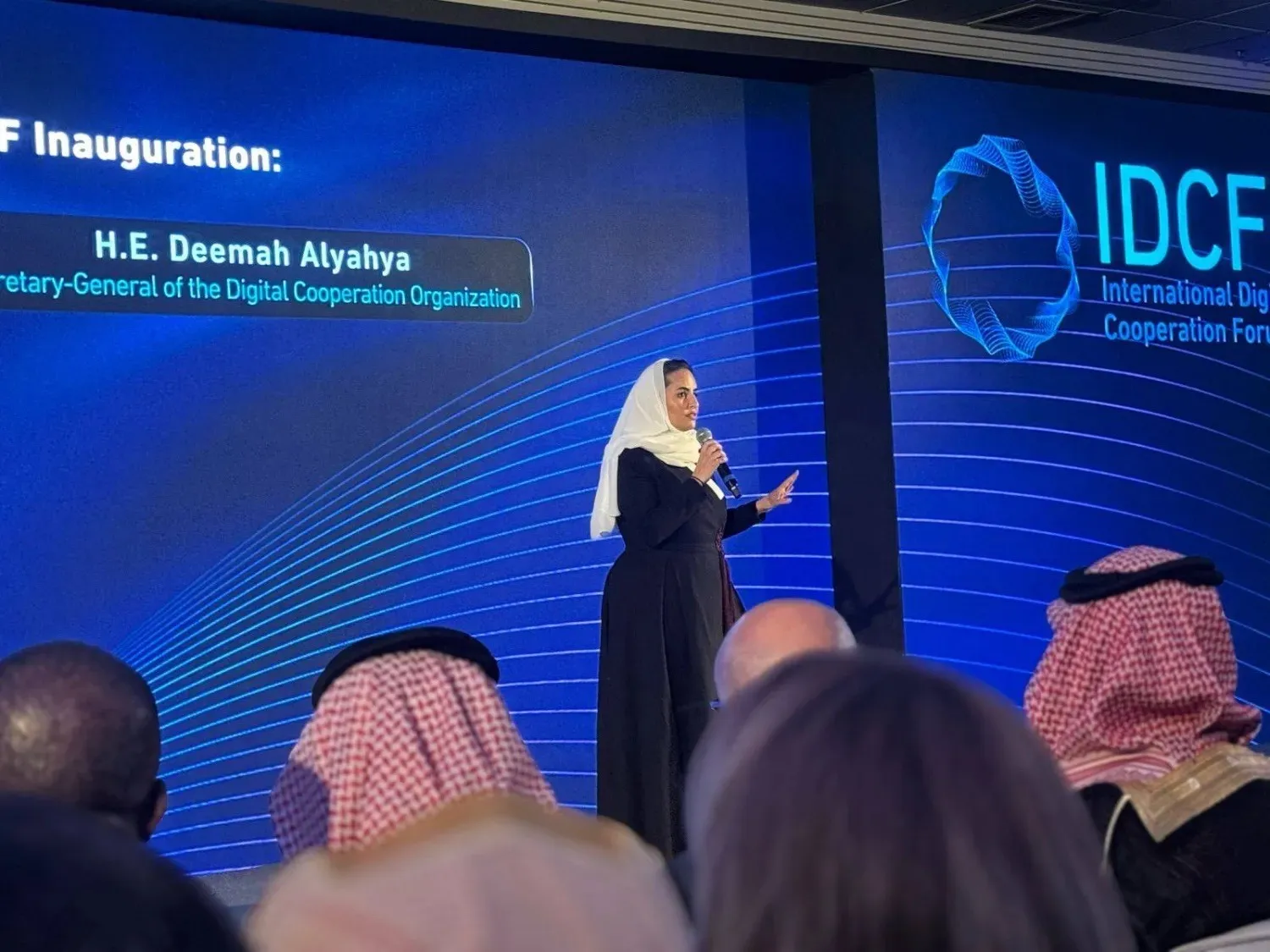

While individuals in some high-income countries rely on artificial intelligence for even the smallest aspects of daily life—such as scheduling appointments, making financial decisions, and even suggesting dinner menus—one-third of the world’s population remains without internet access.
To bridge this digital divide, international collaboration between governments, the private sector, and financial institutions has become an absolute necessity, according to Deemah Al-Yahya, Secretary-General of the Digital Cooperation Organization (DCO), in an interview with Asharq Al-Awsat.
Founded in 2020 and headquartered in Riyadh, the DCO consists of 16 member states, including five Gulf nations, representing a population of 800 million people. During its fourth General Assembly, held in Jordan over two days, the organization launched new initiatives aimed at reducing the global digital divide and approved its 2025–2028 agenda, which focuses on advancing digital maturity among its member states.
Al-Yahya outlined the DCO’s primary objectives, emphasizing its efforts to enhance regulatory frameworks in member states, attract foreign investments, and facilitate technology transfers between countries. One example is the potential adoption of Saudi Arabia’s “Absher” platform in countries such as Jordan and Morocco. Absher is an online system that allows Saudi citizens and residents to access government services, such as passport renewals and driver’s license applications, without visiting physical offices.
Additionally, the DCO connects developing country governments with financial institutions such as the World Bank and the Islamic Development Bank, as well as technology firms. This, Al-Yahya explained, contributes to narrowing both the digital and knowledge gaps between nations.
One of the biggest challenges to internet and AI expansion in developing countries—especially in the Global South—is access to electricity. For instance, ChatGPT consumes 25 times more energy than a traditional Google search. By 2030, AI’s energy consumption is expected to double that of an entire country like France, raising serious environmental and economic concerns. To overcome these barriers, multilateral international cooperation is no longer optional—it is essential. The digital world has no geographic boundaries, and no single country can tackle the complexities of digital transformation alone.
Al-Yahya stressed that fostering collaboration between governments, the private sector, and civil society is key to ensuring that the benefits of the digital revolution reach everyone, creating a brighter future without leaving anyone behind.
The issue is not just about internet access but also about equipping people with the skills to navigate new technologies. While AI could lead to job losses, it also has the potential to create new employment opportunities. The DCO works closely with member state governments to develop solutions and proposals for human capital development in the digital sector. Last month, International Labour Organization (ILO) Director-General Gilbert Houngbo predicted that between 70 and 80 million jobs will be created in the AI and technology sectors between 2023 and 2030. He emphasized the importance of re-skilling and adapting to AI to avoid exclusion from the workforce.
The digital economy is expanding at an unprecedented rate and is expected to reach $16.5 trillion by 2028, representing 17% of the global economy. Meanwhile, the global AI market is projected to surpass $800 billion by 2030. However, this growth remains concentrated in a handful of countries, with a significant lack of equal opportunities.
To address these challenges, the DCO is committed to uniting governments, the private sector, and civil society to promote inclusive and sustainable global digital prosperity. Reflecting on the DCO’s progress over the past four years, Al-Yahya acknowledged that significant milestones have been achieved but emphasized that there is still much work ahead to ensure digital economic growth benefits all. The 2025–2028 agenda marks the beginning of a new digital era, where global cooperation will be critical in driving inclusive and sustainable development—impacting over 800 million people across 16 member states and shaping a better future for future generations.
On the sidelines of the General Assembly, the DCO signed multiple Memorandums of Understanding (MoUs) with key organizations, including the Mohammed bin Salman Foundation (Misk), the HP Foundation, the Organization for Economic Cooperation and Development (OECD), and Oman’s government in partnership with 500 Global. Additionally, a memorandum was signed between the DCO and the United Nations Office for South-South Cooperation, reinforcing its commitment to international digital collaboration.


