
Doubts linger over the release of more than 600 Palestinian prisoners as Israel has yet to approve their release under a swap deal that saw Hamas free six Israeli hostages last Saturday.
Israeli Prime Minister Benjamin Netanyahu postponed the next batch of Palestinian prisoner releases, further delaying the exchange.
Palestinian faction sources involved indirectly in the negotiations told Asharq Al-Awsat that if talks through mediators progress smoothly, Hamas could hand over the bodies of two Israeli hostages on Monday, without formal ceremonies, in exchange for efforts to free the Palestinian detainees who were supposed to be released on Saturday and to double their number.
"If it doesn’t happen on Monday, it could take place on Tuesday or Wednesday," the sources said.
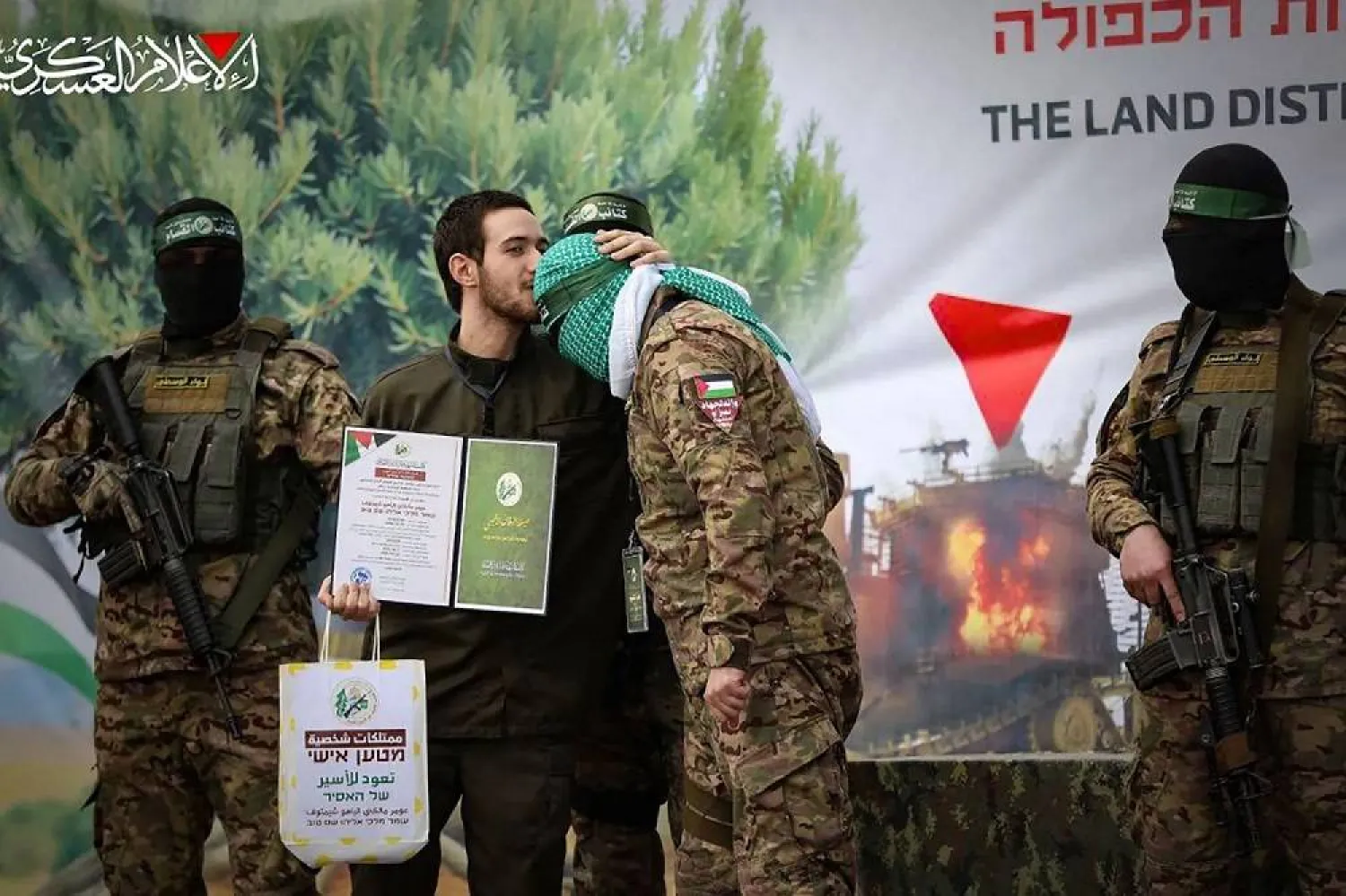
Israel has cited what it calls "humiliating handover ceremonies" by Hamas as the reason for suspending the Palestinian prisoner release, referring to the public displays staged by the group during hostage transfers.
Netanyahu’s office said in a statement on Saturday that the decision was made "in light of Hamas’ repeated violations, particularly the degrading ceremonies that dishonor our hostages and the cynical use of them for propaganda purposes."
The statement added that the suspension would remain in effect "until the release of the next hostages is secured without humiliating ceremonies."
Hamas condemned the delay, calling it a "blatant breach of the agreement."
Meanwhile, Netanyahu reiterated his commitment to dismantling Hamas’ rule in Gaza. Speaking at a military graduation ceremony, he said Israel was "prepared to resume intense combat at any moment," according to the Times of Israel, as cited by Germany’s dpa news agency.
Netanyahu vowed that all hostages held by Hamas would be brought back, reiterating that the group would not govern Gaza.
Uncertainty over Hamas’ next move
Mediators are working to bridge gaps between the parties and prevent further escalation.
If ongoing negotiations fail to resolve the crisis, clarity may emerge by Thursday - the deadline set under the agreement for Hamas to hand over the bodies of four more Israeli hostages.
However, uncertainty remains over whether Hamas will proceed with the transfer or delay it. Sources within the group told Asharq Al-Awsat that "all options are on the table" as long as Israel fails to uphold its commitments under the ceasefire agreement.
The sources did not rule out delaying the handover by several hours or even days if Israel does not proceed with the planned prisoner releases.
"If Israel claims our military parades humiliate its captives, it must acknowledge that it systematically degrades and mistreats our prisoners—shaving their heads, beating them, and forcing them to wear uniforms with revengeful and racist slogans," one source told Asharq Al-Awsat.
Hamas spokesman Abdel Latif al-Qanou warned that Israel’s failure to fully implement the first phase of the ceasefire deal "jeopardizes further hostage releases."
According to Palestinian media, al-Qanou told reporters that Hamas "will not engage in new negotiations unless Israel honors its commitments under the first phase of the deal."
He urged mediators and the international community to ramp up pressure on Israel to "preserve the ceasefire agreement and prevent Netanyahu from undermining it."
Talks on extending the ceasefire
Hamas sources said Israel has requested, through mediators, an extension of the first phase of the deal, including further hostage releases and a ceasefire lasting through the holy month of Ramadan, which is supposed to begin on Saturday.
The sources told Asharq Al-Awsat that Hamas is "open in principle" to releasing four more Israeli captives in two or more stages.
"The number of releases could increase, but not without a price," one source said.
The sources emphasized that any future releases would follow different terms, as the remaining captives include Israeli soldiers—both active-duty and reservists—as well as individuals linked to security agencies.
"The so-called ‘humanitarian criteria’ applied to those released until last Saturday do not apply to these captives," one source added, stressing that their release would come with clear conditions.
Hamas is open to any option that prevents a return to war in Gaza but not at any cost, sources close to the group said.
They stressed that Israel must first fulfill its commitments under the agreement, including releasing the remaining Palestinian prisoners and freeing all women and children detainees in exchange for the last batch of Israeli bodies.
These hostages were killed in Israeli airstrikes and military operations during the war on Gaza.
The sources said mediation efforts have been ongoing without interruption since Israel violated the agreement.
They noted that mediators are pushing to resolve the dispute and pressuring Israel to uphold its commitments, including implementing the humanitarian protocol for bringing heavy equipment, mobile homes, and other essential supplies into Gaza.