


Gold Eases after Hitting Record, Safe-haven Flows Strong

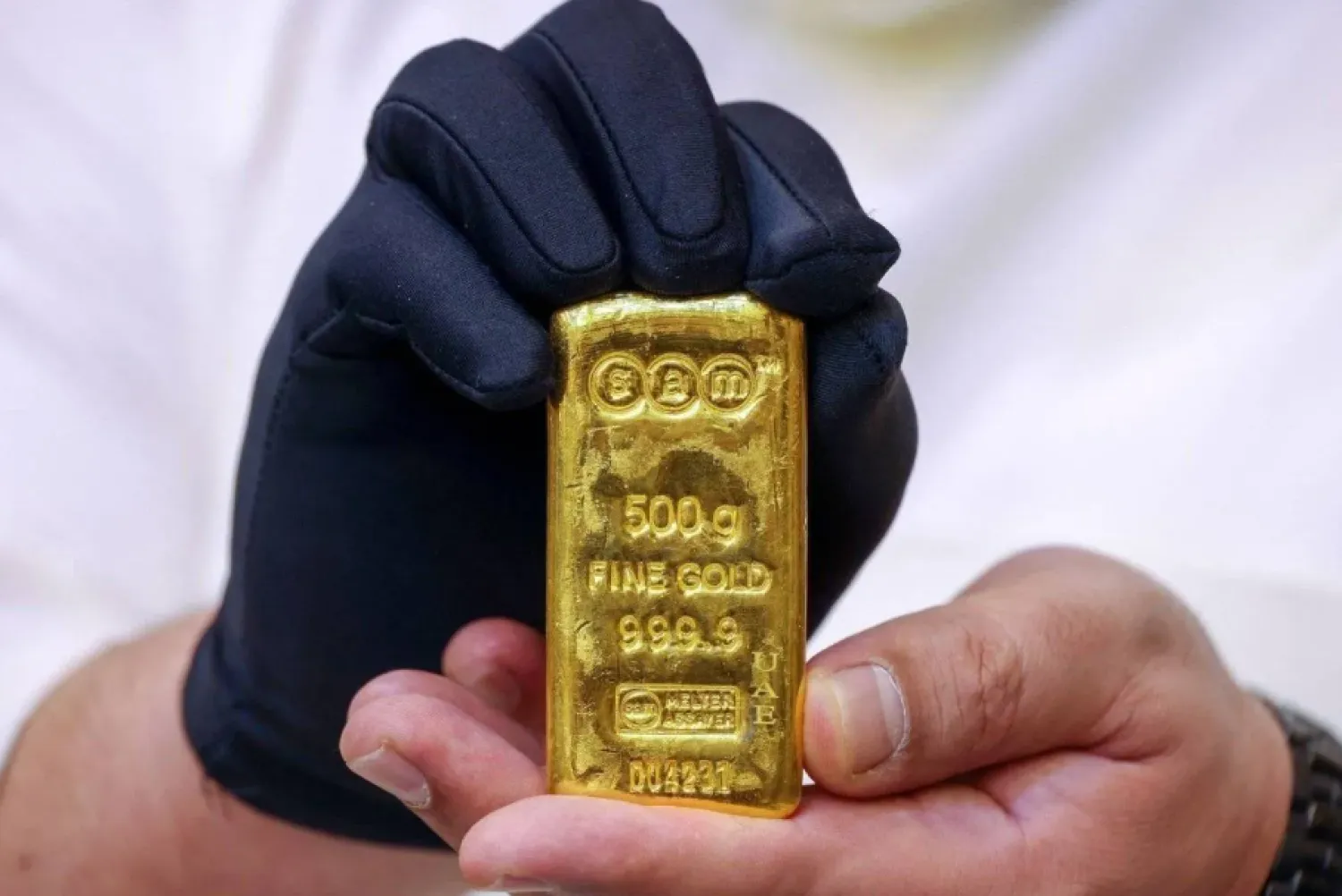
A jeweller shows a gold bar at his shop in downtown Kuwait City on May 20, 2024. (Photo by YASSER AL-ZAYYAT / AFP)
TT

Gold Eases after Hitting Record, Safe-haven Flows Strong

A jeweller shows a gold bar at his shop in downtown Kuwait City on May 20, 2024. (Photo by YASSER AL-ZAYYAT / AFP)

Gold prices hovered near an all-time high on Tuesday, as fears of a trade war and instability amid US President Donald Trump's tariff plans drove safe-haven flows.

Spot gold fell 0.4% to $2,938.63 an ounce by 1125 GMT, after reaching $2,956.15 on Monday — its eleventh record high this year.

US gold futures declined 0.3% to $2,953.30.

"I would call it a range trading environment in precious metals, driven by uncertainty of if and what tariffs are enacted by the Trump administration as we approach the end of the month," UBS analyst Giovanni Staunovo said, Reuters reported.

Trump said on Monday tariffs on Canadian and Mexican imports were "on time and on schedule" despite efforts by the countries to beef up border security and halt the flow of fentanyl into the US ahead of a March 4 deadline.

"Mexico and Canada are large mine producers of gold and silver, so if both metals are not exempted it would result in a likely further widening of the spread between US and London prices," Staunovo said.

Fears of a looming trade war, ignited by Trump's tariff strategy, have sent safe-haven gold soaring past the historic $2,950/oz threshold.

Meanwhile, investors and economists expect the US Federal Reserve to respond "strongly and systematically" to changes in inflation and the labor market, according to research published on Monday by the San Francisco Fed that underscores the current sensitivity of financial markets to US economic data.

Higher inflation may force the Fed to keep rates higher, tarnishing non-yielding gold's appeal.

Investors now await Friday's release of the US Personal Consumption Expenditures report, the Fed's preferred inflation gauge, for insights into the central bank's rate-easing path and monetary policy.

Spot silver shed 0.6% to $32.14 an ounce, platinum dropped 0.3% to $964.05 and palladium lost 0.3% to $937.44.



Egypt Imposes Business Curfew to Counter Soaring Fuel Costs

Cairo was forced to raise fuel prices by more than 30 percent, after strikes on regional oil infrastructure and threats against the Strait of Hormuz (File Photo)
TT

Egypt Imposes Business Curfew to Counter Soaring Fuel Costs

Cairo was forced to raise fuel prices by more than 30 percent, after strikes on regional oil infrastructure and threats against the Strait of Hormuz (File Photo)

Egypt has ordered shops, restaurants and shopping malls to close from 9:00 pm from Saturday, hoping to curb energy bills that have more than doubled because of the Iran war.

Prime Minister Mostafa Madbouly announced the curfew and said it would last for a month initially.

"Shops, shopping centers, restaurants and cafes will all close at 9:00 pm on weekdays," he said, adding that on Thursdays and Fridays at the weekend they will be allowed to stay open until 10:00 pm, Reuters reported.

The premier said that before the war, Egypt's monthly energy bill was $560 million. Today, for the same quantity, he said Egypt is paying $1.650 billion.

Madbouly said Cairo must work on the "worst-case scenario" in the face of a war whose outcome is unpredictable.

Tourism Minister Sherif Fathy said the new restrictions "will not affect tourists" or flagship destinations, a statement from his office said.

At the beginning of March, Cairo was forced to raise fuel prices by more than 30 percent, after strikes on regional oil infrastructure and threats against the Strait of Hormuz, the crucial shipping route now virtually paralysed by the war.

Around a fifth of global crude oil and liquefied natural gas passes through the waterway in peacetime.

The rerouting of shipping away from the Suez Canal is also depriving Cairo of a vital source of foreign currency.


Turkish Central Bank Forex Sales since Start of Iran War Close to $45 Billion

Turkish Central Bank (official website)
TT

Turkish Central Bank Forex Sales since Start of Iran War Close to $45 Billion

Turkish Central Bank (official website)

The Turkish Central Bank's balance sheet for this week will show foreign exchange sales amounting to near $20 billion, bringing the total forex sales since the beginning of the Iran war to nearly $45 billion, bankers said, Reuters reported.

According to calculations made by four bankers, based on preliminary data for the first part of the week and their estimates for the rest of the week, the central bank's balance sheet will show $18-21 billion in foreign exchange sales.

Bankers said that although $8 billion of the total $20 billion was made before a public holiday last week, this figure will be reflected in the balance sheet on the first day of this week.

The central bank sold $26 billion in foreign exchange in the first three weeks of the war, using its gold reserves as well, resulting in a $35 billion decrease in its net reserves.


Mawani Adds Marsa Ocean Shipping's RSX Service to Jeddah Islamic Port

Mawani Adds Marsa Ocean Shipping's RSX Service to Jeddah Islamic Port
TT

Mawani Adds Marsa Ocean Shipping's RSX Service to Jeddah Islamic Port

Mawani Adds Marsa Ocean Shipping's RSX Service to Jeddah Islamic Port

The Saudi Ports Authority (Mawani) has announced the addition of the RSX service by Marsa Ocean Shipping to Jeddah Islamic Port, featuring a capacity of up to 372 TEUs and connecting Jeddah with the regional ports of Aden, Hodeidah, and Djibouti, SPA reported.

This expansion aligns with the National Transport and Logistics Strategy, aiming to enhance the Kingdom’s operational efficiency and its ranking in global performance indicators.

As a primary gateway, Jeddah Islamic Port utilizes its 62 multipurpose berths and specialized terminals to support a total capacity of 130 million tons, reinforcing Saudi Arabia’s position as a global logistics hub connecting three continents.