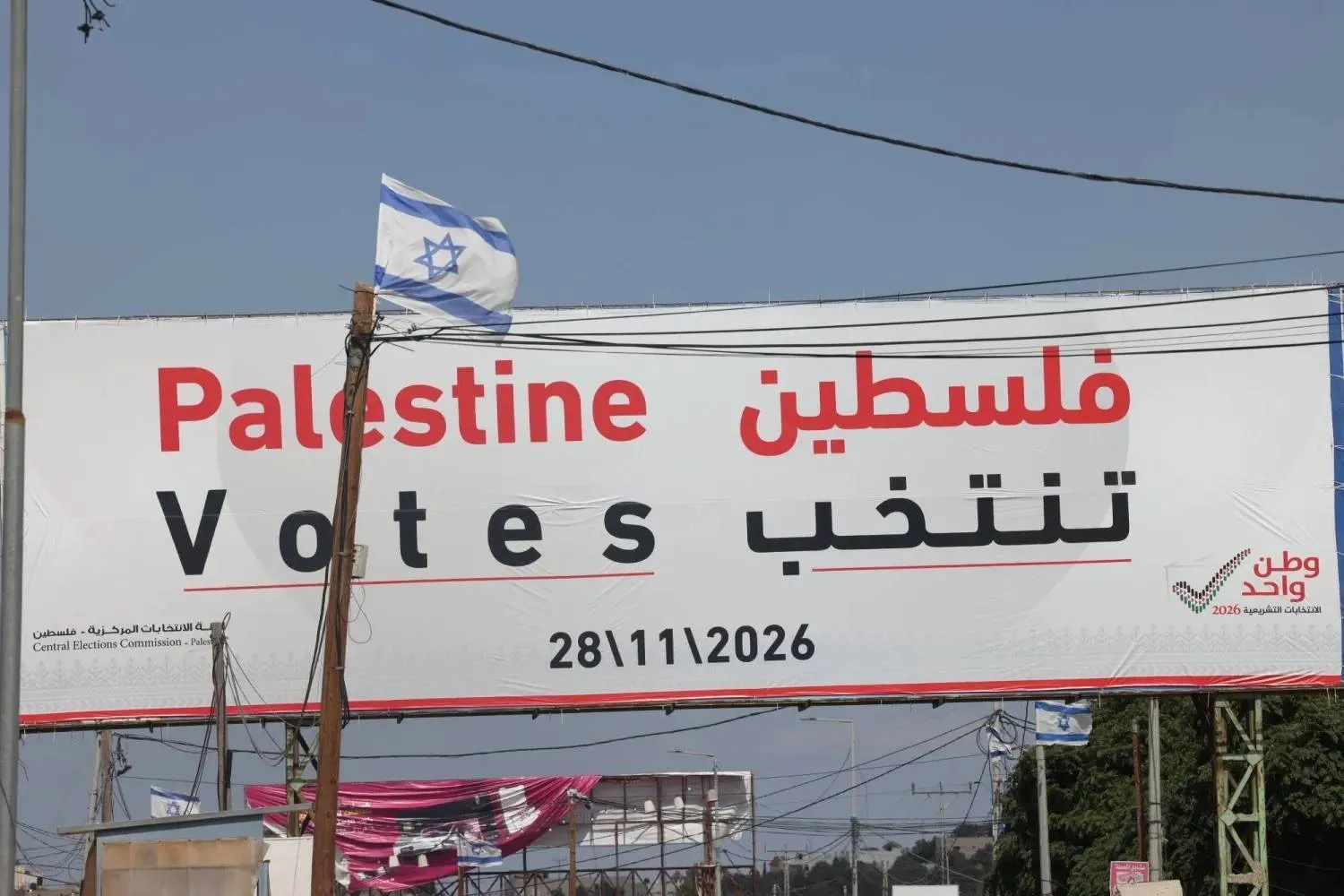
Palestinian President Mahmoud Abbas has issued a decree calling for simultaneous presidential and legislative elections on Sept. 11, 2027, canceling a legislative vote scheduled for Nov. 28, 2026, after his Fatah movement and other Palestinian factions agreed to postpone it.
The widely anticipated decision sets a new date for Palestinians to elect both their president and lawmakers amid concerns over Israeli restrictions and the security situation in Gaza and the West Bank.
The decree calls on Palestinians in Jerusalem, the West Bank and Gaza Strip to participate in free, direct presidential and legislative elections to choose the president of the State of Palestine and members of the Palestinian Legislative Council, in accordance with the law.
Abbas had previously issued decrees calling for legislative elections on two occasions, most recently scheduling them for November 2026, before canceling the plans.
An informed source told Asharq Al-Awsat that setting a firm date for simultaneous presidential and legislative elections was intended to demonstrate the Palestinian leadership’s commitment to holding the vote and reassure France and the international community that it would proceed with renewing the legitimacy of Palestinian institutions.
The decision followed a recommendation by the Executive Committee of the Palestine Liberation Organization (PLO) to revoke Decree No. 4 of 2026, which had called for legislative elections in November.
At a meeting Saturday, the PLO Executive Committee approved moving the legislative vote to September 2027 to coincide with the presidential election.
It attributed the decision to national consultations with Palestinian factions and political forces, which had produced a consensus on the obstacles posed by Israeli measures to holding elections on the original date.
The committee also cited the need to establish suitable political, security and on-the-ground conditions to ensure free, fair and comprehensive elections.
In a statement, the committee argued that circumstances had changed substantially since the election date was announced several months earlier, following successful elections for trade unions, professional associations, and local authorities.
It pointed to the failure to implement UN Security Council Resolution 2803, the absence of international stabilization forces and Palestinian police in Gaza, and the continued presence of Israeli troops in the territory.
The committee also cited ongoing attacks, insecurity and restrictions preventing the Central Elections Commission and local and international observers from entering Gaza.
These conditions, it maintained, made it impossible to establish an environment conducive to elections or guarantee the safety of voters, candidates and election workers.
The committee further warned that what it described as catastrophic conditions in the West Bank, including East Jerusalem, posed serious obstacles to holding the vote.
It accused Israeli settlers of carrying out daily attacks, including burning homes, uprooting olive trees and stealing crops and livestock, under the protection of Israeli forces.
The statement also condemned what it called the Israeli government’s continued expansion of settlements, seizure of Palestinian land, demolition of homes and attacks on Muslim and Christian holy sites.
It cited checkpoints, movement restrictions, pressure on the Palestinian economy and the withholding of Palestinian funds totaling nearly $7 billion as additional obstacles.
Despite the postponement, the PLO Executive Committee reaffirmed its commitment to holding elections with the participation of all Palestinians in the State of Palestine, including those in Gaza and East Jerusalem.
It stressed that the vote must be conducted safely and fairly, with international observers present, free from Israeli obstruction, while preserving the unity of Palestinian territory, people and institutions.