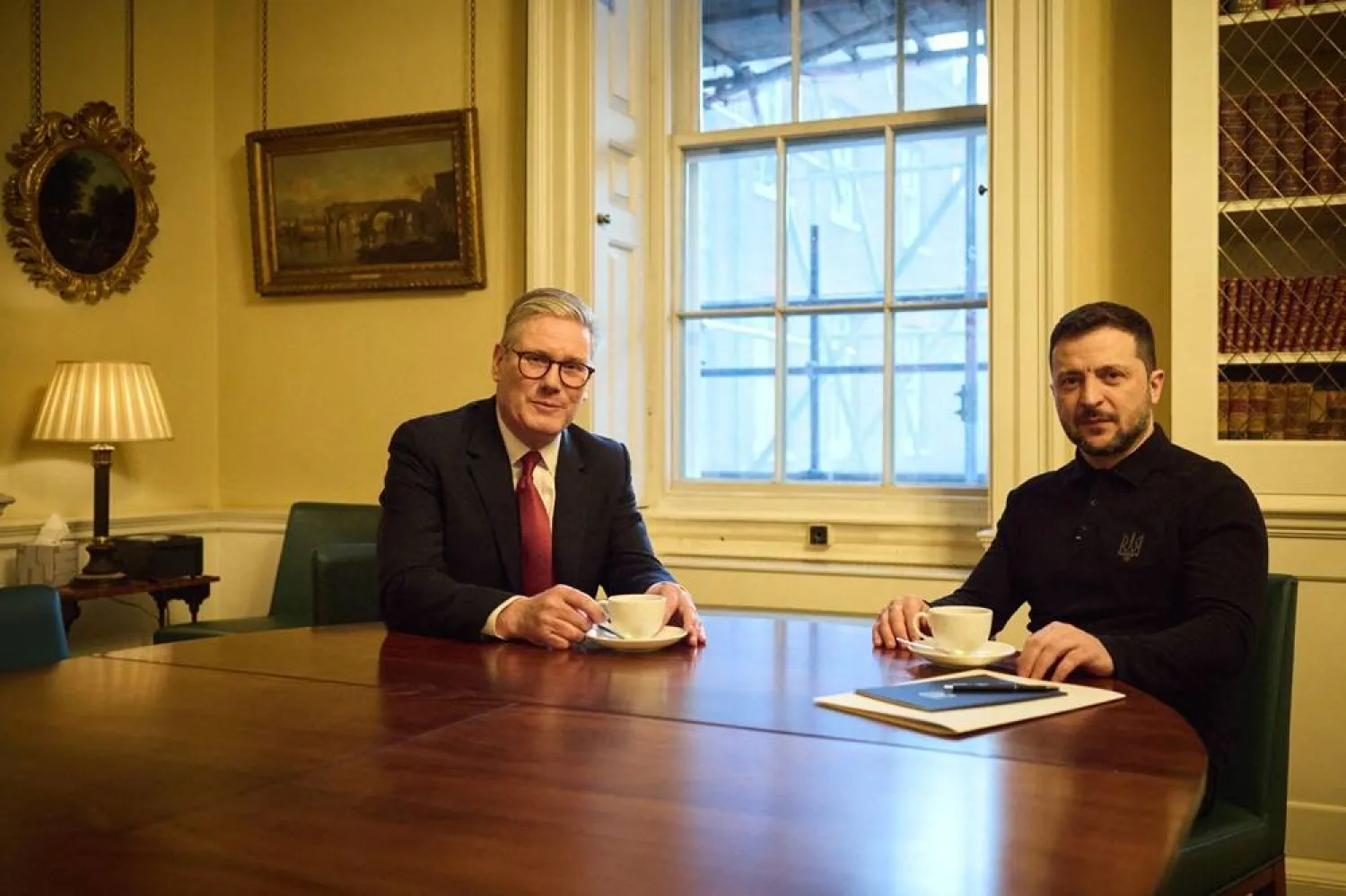
UK's Starmer Says Europe Is at Crossroads in History as World Leaders Discuss Ending War in Ukraine

In this handout photograph taken and released by the Ukrainian Presidential Press Service on March 1, 2025, Ukraine's President Volodymyr Zelenskyy (R) and Britain's Prime Minister Keir Starmer (L) pose for a photo during their talks in London, amid the Russian invasion of Ukraine. (Photo by Handout / Ukrainian Presidential Press Service / AFP)
TT

UK's Starmer Says Europe Is at Crossroads in History as World Leaders Discuss Ending War in Ukraine

In this handout photograph taken and released by the Ukrainian Presidential Press Service on March 1, 2025, Ukraine's President Volodymyr Zelenskyy (R) and Britain's Prime Minister Keir Starmer (L) pose for a photo during their talks in London, amid the Russian invasion of Ukraine. (Photo by Handout / Ukrainian Presidential Press Service / AFP)

British Prime Minister Keir Starmer said Sunday Europe was at a crossroads in history and must do the heavy lifting to defend itself as world leaders met in London to discuss ways of working together to stop Russia's war in Ukraine.

Starmer pledged to supply more arms to defend Ukraine, announcing that the UK will use 1.6 billion pounds ($2 billion) in export financing to supply 5,000 air defense missiles.

His call for European allies to increase their arms spending to shore up their own defenses and Ukraine's was not a sign that he thought the United States had become an unreliable ally, he said. No two countries are closely aligned than the UK and the US, Starmer said.

"One thing our history tells us is that if there is conflict in Europe, it will wash up on our shores," he said.

The summit comes two days after US support for Ukraine appeared in greater jeopardy after President Donald Trump lashed out at Ukrainian President Volodymyr Zelenskyy and said he wasn’t grateful enough for US support.

"Even while Russia talks about peace, they are continuing their relentless aggression," Starmer said at the outset of the meeting.

Starmer, flanked by Zelenskyy and French President Emmanuel Macron, said the three of them had agreed to work on a peace plan to take to the US, which has discussed brokering a peace deal.

"To support peace in our continent, and to succeed, this effort must have strong US backing," he said.

The meeting had been overshadowed by the extraordinary scolding of Zelenskyy by Trump.

Starmer said he's focused on being a bridge to restore peace talks, whose collapse he used as an opportunity to re-engage with Trump, Zelenskyy and Macron rather than "ramp up the rhetoric."

Starmer says he trusts Trump but not Putin Sunday’s summit included talks on establishing a European military force to be sent to Ukraine to underpin a ceasefire. Starmer said it would involve "a coalition of the willing."

Starmer told the BBC he does not trust Russian President Vladimir Putin but does trust Trump. "Do I believe Donald Trump when he says he wants lasting peace? The answer to that is yes," he said.

Starmer said there are "intense discussions" to get a security guarantee from the US.

"If there is to be a deal, if there is to be a stopping of the fighting, then that agreement has to be defended, because the worst of all outcomes is that there is a temporary pause and then (Russian President Vladimir) Putin comes again," Starmer said.

The three essentials Starmer listed for a successful peace deal were: arming the Ukrainians to put them in a position of strength; including a European element to guarantee security; and providing a "US backstop," to prevent Putin from breaking promises.

Starmer hosted the meeting at Lancaster House, a 200-year-old mansion near Buckingham Palace, following a charm offensive last week to persuade Trump to put Ukraine at the center of negotiations and tilt his allegiances toward Europe.

Leaders from Germany, Denmark, Italy, Netherlands, Norway, Poland, Spain, Canada, Finland, Sweden, the Czech Republic and Romania were at the summit. The Turkish foreign minister, NATO secretary-general and the presidents of the European Commission and European Council were also in attendance.

European leaders are backing Zelenskyy Zelenskyy received broad support from leaders across Europe after the White House fiasco, an exceptional attack on an ally broadcast on live television.

Starmer embraced Zelenskyy as he arrived at the meeting Sunday.

Europe has been anxious since Trump initiated direct peace talks with Putin, who had been isolated by most Western leaders since invading Ukraine three years ago. The scramble to remain relevant and protect European interests as their once stalwart ally appeared to be cozying up to Putin was even more troubling when Trump called Zelenskyy a dictator and falsely said Ukraine started the war.

Meetings in recent days had provided some hope — until Zelenskyy’s visit to the White House.

Visits to the Oval Office by Macron, who had declared his visit a "turning point," and Starmer were seen as steps in the right direction. The meetings were cordial and Trump even took a gentler tone toward Ukraine, though he would not commit to providing US security guarantees and maintained Europe would need to provide peacekeeping troops.

Within 12 hours of Starmer's return from Washington, the talk of peace seemed to collapse as Vice President JD Vance berated Zelenskyy for challenging Trump's assertions that Russian President Vladimir Putin could be trusted.

"Starmer did an impressive job of asserting Europe’s agency in the war on Ukraine and conveying to President Trump that Europe is willing and able to take a leading role in implementing any credible peace deal," said Rachel Ellehuus, director-general of Royal United Services Institute, a defense and security think tank. "Unfortunately, Friday’s White House meeting was a major step backward."

Ukraine can no longer count on military or political support from the US after Trump declared himself neutral in negotiations, Ellehuus said. She said Europe needs to step in and could release some 200 billion euros ($207 billion) in seized Russian assets to help fund that effort.

European leaders pledge to increase military spending Starmer pledged this week to boost military spending to 2.5% of gross domestic product by 2027. Other European nations may follow suit.

Czech Prime Minister Petr Fiala said Saturday that Europe faces a historic test and has to look after itself. He said European countries have to increase their arms spending to reach at least 3% of GDP.

"If we don’t increase our effort fast enough and let the aggressor dictate its conditions, we won’t end up well," he said.

Macron, who said it was legitimate for the US to shift its focus to dealing with China and Asia, also called for more defense spending.

"We should have woken up earlier," Macron said. "I’ve been saying for years that we need a more sovereign, more united, more independent Europe."


Report: Trump Tells Advisers He May Hold Off on Iran Attacks Barring New Provocations

US President Donald Trump attends a Veterans Day ceremony at Arlington National Cemetery in Arlington, Virginia, US, November 11, 2026. (Reuters)
TT

Report: Trump Tells Advisers He May Hold Off on Iran Attacks Barring New Provocations

US President Donald Trump attends a Veterans Day ceremony at Arlington National Cemetery in Arlington, Virginia, US, November 11, 2026. (Reuters)

President Donald Trump has told senior advisers in recent days that he may hold off on attacking Iran if the US faces no new provocations from Tehran or the Iran-backed Houthis in Yemen, according to three people familiar with the matter.

Trump has alternated between threats of escalating the war with new strikes and winding down hostilities, and current and former officials say he does not appear to have made up his mind about how to resolve the unpopular conflict, which he launched in February with Israel.

But in meetings with his national security advisers and after a series of intelligence briefings, Trump said he was considering holding off on strikes, said the people, who, like others interviewed for this story, spoke on condition of anonymity.

The war has hiked global fuel ‌prices and proven unpopular with ‌US voters, who handed control of Congress to the Democrats in last week's midterm elections. In ‌a Reuters/Ipsos ⁠poll taken shortly before ⁠the November 3 elections, 55% of Americans said the war was not worth the cost, and Vice President JD Vance cited it as the reason Trump's Republicans lost Congress.

Trump's private comments build on public remarks playing down the likelihood of major warfare resuming.

"As Commander-in-Chief, President Trump is the architect and sole decision-maker who holds all the cards and will always ensure that America’s interests are protected," a White House official said in a statement. "The United States is in a very strong position with control of the Strait of Hormuz and the Iranian economy collapsing. Only President Trump knows what he will do, and when."

The CIA and Office of the Director of National Intelligence did not respond to requests for comment.

US intelligence agencies have assessed that the US naval blockade and economic sanctions are hurting the Iranian economy and would continue to put pressure on Tehran, two US officials briefed on the intelligence said.

Building on its months-long ‌blockade of Iranian sea traffic, the US military is also seeking to prevent weapons and other sanctioned material from entering the country by land or through the Caspian Sea, Reuters first reported last week.

MILITARY OPTIONS

At ⁠the same time, the US military ⁠is ready to escalate if needed, three more people familiar with US planning said.

A third aircraft carrier is moving into the Middle East in the coming days to replace one of the two currently operating in the region, but all three carriers could stay if needed, the people said.

Trump could opt to bomb Iran's underground nuclear facilities, one of the people familiar with Trump's talks said. But the US has already struck those facilities, and it is unclear whether further strikes would be successful.

US intelligence agencies have assessed that renewed strikes would not significantly shift Iran’s demands in negotiations, two US officials said.

Trump was also briefed on US weapon stockpiles, some of which have drawn down to worrying levels, the two people familiar with the intelligence briefings said. Reuters reported in August that the US had used “virtually all” of its long-range precision munitions, and another person briefed on the matter said they have not been replenished.

"The United States Military has enough munitions and ammo to serve all of the Commander-in-Chief’s strategic goals and beyond," the White House official said.

ISRAELI PRESSURE

Israeli officials have continued to lobby the administration to engage in another military campaign, according to a US official.

Trump signaled this week that the US has already achieved what it could from negotiations, but did not say whether he would resume strikes.

“We don’t need a deal with Iran,” Trump said in a social media post on Thursday. “We’ve got their money, Hundreds of Billions of Dollars, and we’ve got their Strait!”


Trump Is Taking Elon Musk on His Asia Trip, but He Plans to Avoid Talking About Nvidia Scandal

US President Donald Trump presents the National Medal of Science to Tesla and SpaceX CEO Elon Musk during the "A New Golden Age" summit at the US Institute of Peace, renamed The Donald J. Trump Institute of Peace by the Trump administration, in Washington, DC, US, October 8, 2026. (Reuters)
TT

Trump Is Taking Elon Musk on His Asia Trip, but He Plans to Avoid Talking About Nvidia Scandal

US President Donald Trump presents the National Medal of Science to Tesla and SpaceX CEO Elon Musk during the "A New Golden Age" summit at the US Institute of Peace, renamed The Donald J. Trump Institute of Peace by the Trump administration, in Washington, DC, US, October 8, 2026. (Reuters)

President Donald Trump plans to take the world's wealthiest man, Elon Musk, with him next week when he travels to the Philippines and China.

As the head of SpaceX and Tesla, Musk has economic and national security interests that make him a valuable adviser to Trump, according to administration officials who insisted on anonymity as a condition for previewing the president's plans on a Friday call with reporters.

The journey comes as the fallout spreads from Jensen Huang being ousted as the CEO of Nvidia for having an extramarital affair with an alleged agent of the Chinese government. Beijing denies that Alice Huang is a spy. Her company Megaspeed was accused last year of shipping Nvidia's advanced computer chips into China.

But Trump does not plan to confront Chinese leader Xi Jinping on the matter and administration officials do not expect Chinese retaliation for any follow-up actions to prohibit China from smuggling or using advanced computer chips, officials told reporters.

The administration believes the situation with Nvidia should not have any bearing on the trip, as the US does not make its use of export controls subject to negotiations with foreign countries. Trump's aides are discussing the possibility of closing loopholes in existing trade measures, including the use of export licensing and preventing the ability of Chinese firms to use advanced chips over the internet through remote access.

The trip will be capped with a historic trilateral meeting with Xi and Russian leader Vladimir Putin, where efforts to limit nuclear weapons will be a chief topic. Still, there are no plans for Trump to meet with North Korean leader Kim Jong Un, whose nuclear arsenal has been a source of consternation to the US and its allies.

Trump is set to arrive Tuesday in the Philippines to meet with his counterparts in the Association of Southeast Asian Nations. While in Manila, he intends to sign a trade deal with Thailand and meet with the Quad, an alliance composed of the US, India, Australia and Japan.

On Wednesday, Trump will leave for the Asia-Pacific Economic Cooperation summit in Shenzhen, China, where he’ll have his third in-person meeting this year with Xi. Afterward, Trump and Xi will hold their joint meeting with Putin.

The leaders are expected to talk about the Iran war, but Russia's war in Ukraine is not expected to be part of the agenda, officials said and Musk, whose Starlink system has been integral to Ukraine's ability to fight back against Russia's invasion, will not be part of the trilateral meeting.


South Sudan Delays Election to February 2027

South Sudan People's Defense Forces (SSPDF) officers attend the funeral of Sudan's late former Vice President Joseph Lagu, near the Dr John Garang Mausoleum in Juba, South Sudan, November 13, 2026. (Reuters)
TT

South Sudan Delays Election to February 2027

South Sudan People's Defense Forces (SSPDF) officers attend the funeral of Sudan's late former Vice President Joseph Lagu, near the Dr John Garang Mausoleum in Juba, South Sudan, November 13, 2026. (Reuters)

South Sudan has pushed back its national elections to February 11, 2027, according to a timetable issued by the country's National Elections Commission, in another delay to its first election since independence in 2011. No ‌reason was ‌given for the ‌postponement.

⁠Presidential and parliamentary ⁠elections were scheduled for December 22.

In September, the United Nations Commission on Human Rights in South Sudan said the ⁠country lacked safeguards ‌and conditions for ‌peaceful and credible elections.

"This is ‌the timeline we ‌have come up with after a thorough consultation with the stakeholders," Josephine Achiro Fortelo, commissioner of ‌the National Election Commission and its spokesperson, told ⁠Reuters ⁠on Saturday, confirming the electoral date had been changed.

South Sudan has been formally at peace since a 2018 deal ended a five-year conflict responsible for hundreds of thousands of deaths, but violence between rival communities flares frequently.