


Ukraine Says It Will Do All It Can to Maintain US Ties After Trump Pauses Aid 

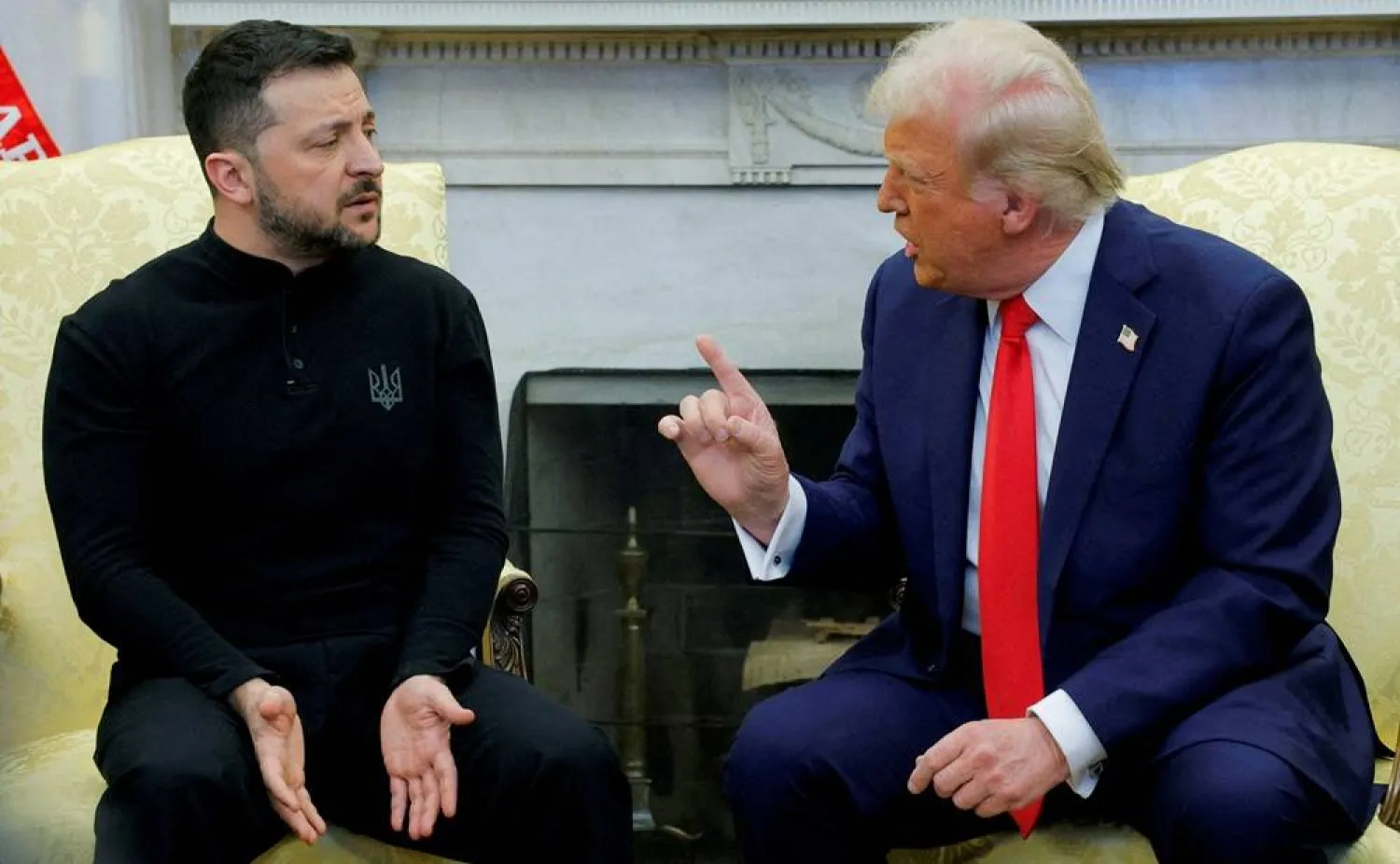
US President Donald Trump meets with Ukrainian President Volodymyr Zelenskiy at the White House in Washington, DC, US, February 28, 2025. (Reuters)
TT

Ukraine Says It Will Do All It Can to Maintain US Ties After Trump Pauses Aid 

US President Donald Trump meets with Ukrainian President Volodymyr Zelenskiy at the White House in Washington, DC, US, February 28, 2025. (Reuters)

Ukraine said on Tuesday it would do all it can to maintain its ties with the United States, after President Donald Trump paused military aid to Kyiv in the most dramatic step yet in his pivot towards closer ties with Russia. 

Trump has upended US policy on Ukraine and Russia, culminating in an explosive confrontation at the White House on Friday, when Trump upbraided President Volodymyr Zelenskiy for being insufficiently grateful for Washington's backing. 

"President Trump has been clear that he is focused on peace. We need our partners to be committed to that goal as well. We are pausing and reviewing our aid to ensure that it is contributing to a solution," a US official said on Monday. 

Ukraine's Prime Minister Denys Shmyhal said Kyiv still had the means to supply its frontline forces. US military aid was precious and saving thousands of lives, he said, and Kyiv would do all it could to maintain relations with Washington. 

"We will continue to work with the US through all available channels in a calm manner," Shmyhal told a press conference. "We only have one plan - to win and to survive. Either we win, or the plan B will be written by someone else." 

The Kremlin, for its part, said cutting off military aid to Ukraine was the best possible step towards peace, although it was still waiting to confirm Trump's move. 

Military experts say it could take time for the impact of missing US aid to be felt on the battlefield. When US assistance was held up for several months last year by Republicans in Congress, the most notable initial impact was shortages of air defenses to shoot down incoming Russian missiles and drones. Later, Ukrainian forces in the east complained of shortages of ammunition, including for artillery. 

The pause puts more pressure on European allies, led by Britain and France, whose leaders both visited the White House last week and have publicly embraced Zelenskiy since the Oval Office blow-up. 

Europeans are racing to boost their own military spending and provide alternative support for Kyiv, including a plan to put troops on the ground to support any ceasefire, though they say they still need some form of US support. 

France condemned the aid freeze. Suspending arms to Ukraine made peace "more distant, because it only strengthens the hand of the aggressor on the ground, which is Russia," said French junior minister for Europe, Benjamin Haddad. 

Britain was more circumspect. A government spokesperson said London remained committed to securing peace in Ukraine. 

Ukrainians, who have endured three years of war against a more powerful foe, were stunned by a move many described as a betrayal. Oleksandr Merezhko, head of the Ukrainian parliament's foreign affairs committee, said it looked like Trump was "pushing us towards capitulation". 

"Yes, it is betrayal, let's call it like it is," said lawyer Olena Bilova, 47 in Kyiv. "But let's hope that American civil society and the elites of the European Union will not leave us alone." 

European Commission President Ursula von der Leyen unveiled proposals to boost spending on defense in the EU, which she said could mobilize up to 800 billion euros ($840 billion). The EU is holding an emergency summit on Thursday. 

'KICKED THE DOOR WIDE OPEN FOR PUTIN' 

Since Russia's invasion three years ago, the US Congress has approved $175 billion in total assistance for Ukraine, according to the nonpartisan Committee for a Responsible Federal Budget. 

The Trump administration inherited $3.85 billion worth of Congressionally approved authority to dip into US arms stocks for Ukraine. Monday's move also appeared to halt deliveries of military equipment approved by former President Joe Biden, including munitions, missiles and other systems. 

Trump's abrupt pivot towards Russia may be the most dramatic US geopolitical shift in generations. Defending Europe from a hostile Kremlin has been the lodestar of US foreign policy under both parties since the 1940s. Trump's moves have appalled Democrats and some Republicans, although there has been little pushback from Republican leaders in Congress, including those who were once strong backers of Ukraine. 

"By freezing military aid to Ukraine, President Trump has kicked the door wide open for Putin to escalate his violent aggression against innocent Ukrainians," said Senator Jeanne Shaheen, the top Democrat on the Senate Foreign Relations Committee. 

Trump suggested on Monday that a deal to open up Ukraine's minerals to US investment could still be agreed, and Shmyhal said Ukraine could still sign it. The deal was meant to be signed in Washington on Friday before Zelenskiy departed after the Oval Office bust-up. 

When asked on Monday if the deal was dead, Trump said: "No, I don't think so." 

In an interview on Fox News, Vice President JD Vance called on Zelenskiy to accept it. 

"If you want real security guarantees, if you want to actually ensure that Vladimir Putin does not invade Ukraine again, the very best security guarantee is to give Americans economic upside in the future of Ukraine," Vance said. 

Zelenskiy has made clear that a ceasefire must carry explicit security guarantees from the West to ensure that Russia, which holds about 20% of Ukraine's land, does not attack again. Trump has so far refused to give any such guarantees. 


UK PM's Top Aide Quits over Mandelson-Epstein Scandal

FILE PHOTO: British Prime Minister Keir Starmer talks with Britain's ambassador to the United States Peter Mandelson during a welcome reception at the ambassador's residence on February 26, 2025, in Washington, DC, US. Carl Court/Pool via REUTERS/File Photo
TT

UK PM's Top Aide Quits over Mandelson-Epstein Scandal

FILE PHOTO: British Prime Minister Keir Starmer talks with Britain's ambassador to the United States Peter Mandelson during a welcome reception at the ambassador's residence on February 26, 2025, in Washington, DC, US. Carl Court/Pool via REUTERS/File Photo

British Prime Minister Keir Starmer's chief of staff, Morgan McSweeney, quit on Sunday, saying he took responsibility for advising Starmer to name Peter Mandelson as ambassador to the US despite his known links to Jeffrey Epstein.

After new files revealed the depth of the Labour veteran's relationship with the late sex offender, Starmer is facing what is widely seen as the gravest crisis of his 18 months in power over his decision to send Mandelson to Washington in 2024, Reuters reported.

The loss of McSweeney, 48, a strategist who was instrumental in Starmer's rise to power, is the latest in a series of setbacks, less than two years after the Labour Party won one of the largest parliamentary majorities in modern British history.

With polls showing Starmer is hugely unpopular with voters after a series of embarrassing U-turns, some in his own party are openly questioning his judgment and his future, and it remains to be seen whether McSweeney's exit will be enough to silence critics.

The files released in the US on January 30 sparked a police investigation for misconduct in office over indications that Mandelson leaked market-sensitive information to Epstein when he was a government minister during the global financial crisis in 2009 and 2010.

In a statement, McSweeney said: "The decision to ⁠appoint Peter Mandelson was wrong. He has damaged our party, our country and trust in politics itself.
"When asked, I advised the Prime Minister to make that appointment and I take full responsibility for that advice."

The leader of the opposition Conservative Party, Kemi Badenoch, said the resignation was overdue and that "Keir Starmer has to take responsibility for his own terrible decisions".

Nigel Farage, head of the populist Reform UK party, which is leading in the polls, said he believed Starmer's time would soon be up.

Starmer has spent the last week defending McSweeney, a strategy that could prompt further questions about his own judgment. In a statement on Sunday, Starmer said it had been "an honor" working with him.

Many Labour members of parliament had blamed McSweeney for the appointment of Mandelson and the damage caused by the publication of the exchanges between Epstein ⁠and Mandelson. Others have said Starmer must go.

One Labour lawmaker, speaking on condition of anonymity, said McSweeney's resignation had come too late: "It buys the PM time, but it's still the end of days."

Starmer sacked Mandelson as ambassador in September over his links to Epstein.

The government agreed last week to release virtually all previously private communications between members of his government from the time when Mandelson was being appointed.

That release could come as early as this week, creating a new headache for Starmer just as he hopes to move on. If previously secret messages about how London planned to approach its relationship with Donald Trump are made public, it could damage Starmer's relationship with the US President.

McSweeney had held the role of chief of staff since October 2024, when he was handed the job following the resignation of Sue Gray after a row over pay and donations.

Starmer on Sunday appointed his deputy chiefs of staff, Jill Cuthbertson and Vidhya Alakeson, to serve as joint acting chiefs of staff.


Iran Sentences Nobel Laureate Narges Mohammadi to 7 More Years in Prison

(FILES) A handout photo provided by the Narges Mohammadi Foundation on October 2, 2023 shows an undated, unlocated photo of Iranian rights campaigner Narges Mohammadi. (Photo by Handout / NARGES MOHAMMADI FOUNDATION / AFP)
TT

Iran Sentences Nobel Laureate Narges Mohammadi to 7 More Years in Prison

(FILES) A handout photo provided by the Narges Mohammadi Foundation on October 2, 2023 shows an undated, unlocated photo of Iranian rights campaigner Narges Mohammadi. (Photo by Handout / NARGES MOHAMMADI FOUNDATION / AFP)

Iran sentenced Nobel Peace Prize laureate Narges Mohammadi to over seven more years in prison after she began a hunger strike, supporters said Sunday.

Mohammadi’s supporters cited her lawyer, who spoke to Mohammadi.

The lawyer, Mostafa Nili, confirmed the sentence on X, saying it had been handed down Saturday by a Revolutionary Court in the city of Mashhad. Such courts typically issue verdicts with little or no opportunity for defendants to contest their charges.

“She has been sentenced to six years in prison for ‘gathering and collusion’ and one and a half years for propaganda and two-year travel ban,” he wrote, according to The Associated Press.

She received another two years of internal exile to the city of Khosf, some 740 kilometers (460 miles) southeast of Tehran, the capital, the lawyer added.

Supporters say Mohammadi has been on a hunger strike since Feb. 2. She had been arrested in December at a ceremony honoring Khosrow Alikordi, a 46-year-old Iranian lawyer and human rights advocate who had been based in Mashhad. Footage from the demonstration showed her shouting, demanding justice for Alikordi and others.

Supporters had warned for months before her December arrest that Mohammadi, 53, was at risk of being put back into prison after she received a furlough in December 2024 over medical concerns.

While that was to be only three weeks, Mohammadi’s time out of prison lengthened, possibly as activists and Western powers pushed Iran to keep her free. She remained out even during the 12-day war in June between Iran and Israel.

Mohammadi still kept up her activism with public protests and international media appearances, including even demonstrating at one point in front of Tehran’s notorious Evin prison, where she had been held.

Mohammadi had been serving 13 years and nine months on charges of collusion against state security and propaganda against Iran’s government.

She also had backed the nationwide protests sparked by the 2022 death of Mahsa Amini, which have seen women openly defy the government by not wearing the hijab.

Mohammadi suffered multiple heart attacks while imprisoned before undergoing emergency surgery in 2022, her supporters say. Her lawyer in late 2024 revealed doctors had found a bone lesion that they feared could be cancerous that later was removed.

“Considering her illnesses, it is expected that she will be temporarily released on bail so that she can receive treatment,” Nili wrote.

However, Iranian officials have been signaling a harder line against all dissent since the recent demonstrations. Speaking on Sunday, Iranian judiciary chief Gholamhossein Mohseni-Ejei made comments suggesting harsh prison sentences awaited many.

“Look at some individuals who once were with the revolution and accompanied the revolution," he said. "Today, what they are saying, what they are writing, what statements they issue, they are unfortunate, they are forlorn (and) they will face damage.”


Nigeria's President to Make a Sate Visit to the UK in March

Nigeria’s President Bola Tinubu gives a joint statement with Brazil’s President Luiz Inacio Lula da Silva, at the Planalto presidential palace, in Brasilia, Brazil, Aug. 25, 2025. (AP Photo/Eraldo Peres, File)
TT

Nigeria's President to Make a Sate Visit to the UK in March

Nigeria’s President Bola Tinubu gives a joint statement with Brazil’s President Luiz Inacio Lula da Silva, at the Planalto presidential palace, in Brasilia, Brazil, Aug. 25, 2025. (AP Photo/Eraldo Peres, File)

Nigeria’s president is set to make a state visit to the UK in March, the first such trip by a Nigerian leader in almost four decades, Britain’s Buckingham Palace said Sunday.

Officials said President Bola Tinubu and first lady Oluremi Tinubu will travel to the UK on March 18 and 19, The AP news reported.

King Charles III and Queen Camilla will host them at Windsor Castle. Full details of the visit are expected at a later date.

Charles visited Nigeria, a Commonwealth country, four times from 1990 to 2018 before he became king. He previously received Tinubu at Buckingham Palace in September 2024.m

Previous state visits by a Nigerian leader took place in 1973, 1981 and 1989.

A state visit usually starts with an official reception hosted by the king and includes a carriage procession and a state banquet.

Last year Charles hosted state visits for world leaders including US President Donald Trump, French President Emmanuel Macron and German President Frank-Walter Steinmeier.
