


Trade Wars Erupt as Trump Hits Canada, Mexico, China with Steep Tariffs

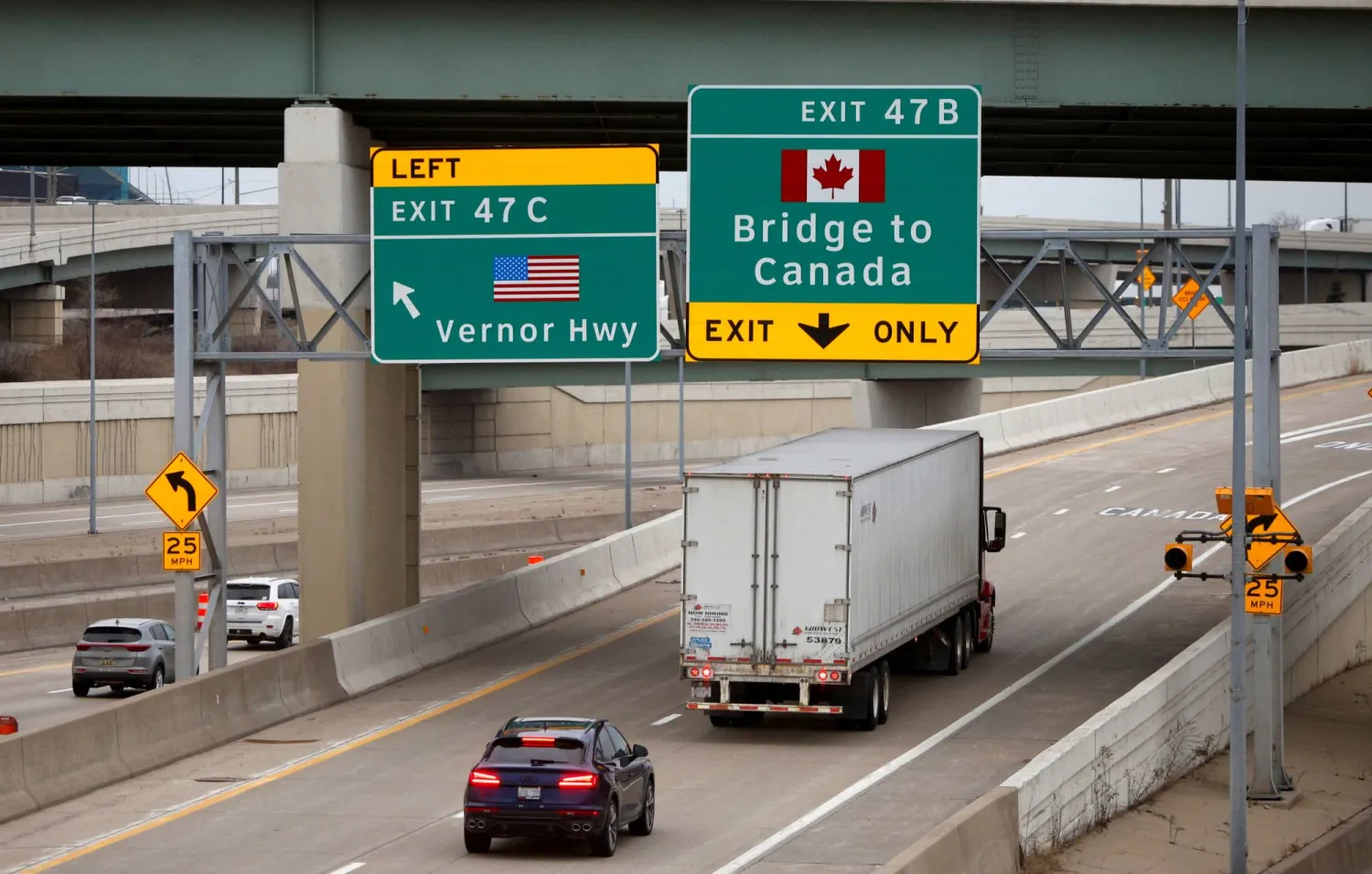
A commercial truck drives towards the Ambassador Bridge to Windsor, Ontario, Canada from Detroit, Michigan. US, March 3, 2025. REUTERS/Rebecca Cook
TT

Trade Wars Erupt as Trump Hits Canada, Mexico, China with Steep Tariffs

A commercial truck drives towards the Ambassador Bridge to Windsor, Ontario, Canada from Detroit, Michigan. US, March 3, 2025. REUTERS/Rebecca Cook

US President Donald Trump's new 25% tariffs on imports from Mexico and Canada took effect on Tuesday, along with a doubling of duties on Chinese goods to 20%, launching new trade conflicts with the top three US trading partners.

The tariff actions, which could upend nearly $2.2 trillion in two-way annual US trade went live at 12:01 a.m. EST (0501 GMT), hours after Trump declared that all three countries had failed to do enough to stem the flow of the deadly fentanyl opioid and its precursor chemicals into the US, Reuters reported.

China responded immediately after the deadline, announcing additional tariffs of 10%-15% on certain US imports from March 10 and a series of new export restrictions for designated US entities.

Canada and Mexico, which have enjoyed a virtually tariff-free trading relationship with the US for three decades, were poised to immediately retaliate against their longtime ally.

Canadian Prime Minister Justin Trudeau said Ottawa would respond with immediate 25% tariffs on C$30 billion ($20.7 billion) worth of US imports, and another C$125 billion ($86.2 billion) if Trump's tariffs were still in place in 21 days. He said previously that Canada would target American beer, wine, bourbon, home appliances and Florida orange juice.

"Tariffs will disrupt an incredibly successful trading relationship," Trudeau said, adding that they would violate the US-Mexico-Canada free trade agreement signed by Trump during his first term.

Ontario Premier Doug Ford told NBC that he was ready to cut off shipments of nickel and transmission of electricity from his province to the US in retaliation.

Mexican President Claudia Sheinbaum was expected to announce her response during a morning news conference in Mexico City on Tuesday, the country's economy ministry said.

STACKING CHINA TARIFFS

The extra 10% duty on Chinese goods adds to a 10% tariff imposed by Trump on February 4 to punish Beijing over the US fentanyl overdose crisis. The cumulative 20% duty also comes on top of tariffs of up to 25% imposed by Trump during his first term on some $370 billion worth of US imports.

Some of these products saw US tariffs increase sharply under former president Joe Biden last year, including a doubling of duties on Chinese semiconductors to 50% and a quadrupling of tariffs on Chinese electric vehicles to over 100%.

The 20% tariff will apply to several major US consumer electronics imports from China previously untouched by prior duties, including smartphones, laptops, videogame consoles, smartwatches and speakers and Bluetooth devices.

China's new tariffs announced on Tuesday targeted a wide range of US agricultural products including certain meats, grains, cotton, fruit, vegetables and dairy products.

It also added 15 US entities to its export control list and 10 US entities to its unreliable entity list.

The commerce ministry earlier in the day said Washington mistakenly "shifted the blame" for its fentanyl crisis to Beijing.

The state-backed Global Times newspaper said on Monday Beijing's retaliation would most likely target US agricultural and food products.

US farmers were hard hit by Trump's first-term trade wars, which cost them about $27 billion in lost export sales and conceded share of the Chinese market to Brazil.

RECESSION FEARS

The tariffs on Mexican and Canadian products could have much deeper repercussions for a highly integrated North American economy that depends on cross-border shipments to build cars and machinery, refine energy and process agricultural goods.

"Today's reckless decision by the US administration is forcing Canada and the US toward recessions, job losses and economic disaster," Canadian Chamber of Commerce CEO Candace Laing said in a statement.

She said the US tariffs will fail to usher in a "golden age" coveted by Trump but instead raise costs for consumers and producers and disrupt supply chains. "Tariffs are a tax on the American people."

Matt Blunt, president of the American Automotive Policy Council representing Detroit automakers, called for vehicles that meet the US-Mexico-Canada Agreement's regional content requirements to be exempted from the tariffs.

Even before Trump's tariffs announcement, US data on Monday showed factory gate prices jumped to a nearly three-year high, suggesting that a new wave of tariffs could soon undercut production.

Trump's confirmation that the tariffs would proceed sent financial markets reeling with global stocks tumbling and safe-haven bonds rallying. Both the Canadian dollar and Mexican peso fell against the greenback.

PILING ON

Trump has maintained a blistering pace of tariff actions since taking office in January, including fully restored 25% tariffs on steel and aluminum imports that take effect March 12, rescinding prior exemptions.

Trump's "America First" agenda, aimed at redrawing trade relationships in favor of the US, is expected to be a centerpiece of his Tuesday night address to a joint session of Congress.

Trump on Saturday opened a national security investigation into imports of lumber and wood products that could result in steep tariffs. Canada, already facing 14.5% US tariffs on softwood lumber, would be hit particularly hard.

A week earlier, Trump revived a probe into countries that levy digital services taxes, proposed fees of up to $1.5 million on every Chinese-built ship entering a US port and launched a tariff investigation into copper imports.

These add to his plans for higher "reciprocal tariffs" to match the levies of other countries and offset their other trade barriers, a move that could hit the European Union hard.




How 2025 Decisions Redrew the Future of Riyadh’s Real Estate Market

Construction is seen at a real estate project in Riyadh. (SPA)
TT

How 2025 Decisions Redrew the Future of Riyadh’s Real Estate Market

Construction is seen at a real estate project in Riyadh. (SPA)

The Saudi capital underwent an unprecedented structural shift in its real estate market in 2025, driven by a forward-looking agenda led by Prince Mohammed bin Salman, Crown Prince and Prime Minister. Far from incremental regulation, the year’s measures amounted to a deep corrective overhaul aimed at dismantling long-standing distortions, breaking land hoarding, expanding affordable housing supply, and firmly rebalancing landlord-tenant relations.

Together, the decisions ended years of speculation fueled by artificial scarcity and pushed the market toward maturity, one grounded in real demand, fair pricing, and transparency.

Observers dubbed 2025 a “white revolution” for Saudi real estate. The reforms severed the link between property and short-term speculation, restoring housing as a sustainable residential and investment product. Below is a detailed outline of the most significant of these historic decisions:

1- Unlocking land, boosting supply

In March, authorities lifted restrictions on sale, subdivision, development permits, and planning approvals for 81 million square meters north of Riyadh. A similar decision in October freed another 33.24 million square meters to the west.

The Royal Commission for Riyadh City was also mandated to deliver 10,000 - 40,000 fully serviced plots annually at subsidized prices capped at SAR 1,500 per square meter, curbing price manipulation and offering real alternatives for citizens.

2- Rent controls and contractual fairness

To stabilize households and businesses, the government froze annual rent increases for residential and commercial leases in Riyadh for five years starting in September. Enforced through the upgraded “Ejar” platform, the move halted arbitrary hikes while aligning growth with residents’ quality of life.

3- Tougher fees

An improved White Land Tax took effect in August, extending beyond vacant plots to include unoccupied built properties. Annual fees rose to as much as 10% of land value for parcels of 5,000 square meters or more within urban limits, raising the cost of land hoarding and incentivizing prompt development.

4- Investment openness and digital governance

A revised foreign ownership regime allowed non-Saudis - individuals and companies - to own property in designated zones under strict criteria, injecting international liquidity. Transparency was reinforced by the launch of the “Real Estate Balance” platform, providing real-time price indicators based on actual transactions and curbing phantom pricing.

5- Quality and urban standards

Policy shifted from quantity to quality with mandatory application of the Saudi Building Code and sustainability standards for all new developments, ensuring long-term operational value and preventing low-quality sprawl.

Structural shift

Sector specialists told Asharq Al-Awsat the measures represent a qualitative leap in market management, moving Riyadh from a scarcity and speculation-led cycle to a balanced market governed by genuine demand, efficient land use, disciplined contracts, and transparent indicators.

Khaled Al-Mobid, CEO of Menassat Realty Co., said the reforms were timely and corrective after years of rapid price escalation. He noted early positives: slowing price growth, a return to realistic negotiations, increased supply in some districts, and better-quality offerings focused on intrinsic value rather than quick appreciation.

Abdullah Al-Moussa, a real estate expert and broker, described the steps as addressing root causes, not symptoms.

He observed a behavioral shift, especially in northern Riyadh, from “hold and wait” to reassessment, alongside calmer price momentum, renewed interest in actual development, and clearer rental dynamics.

Saqr Al-Zahrani, another market expert, told Asharq Al-Awsat that the reforms tackled structural imbalances by breaking artificial scarcity created by undeveloped land banks.

Opening vast tracts north and west and introducing market-wide indicators restored “organized abundance,” aligning prices with real demand and purchasing power without heavy-handed intervention, he remarked.

He added that recent months have seen weaker demand for raw land and stalled auctions, contrasted with rising interest in off-plan sales and partnerships with developers.

Banks, too, have reprioritized toward projects with operational viability, lifting overall supply quality despite a temporary slowdown in some transactions.

Consumers, meanwhile, are showing greater patience and interest in self-build options, signaling a maturing market awareness.

Outlook

Experts expect the effects to continue through 2027, delivering broad price stability with limited corrections in overheated locations rather than sharp declines.

Homeownership, especially among young buyers, is projected to rise as capital shifts from land speculation to long-term development.

The 2025 decisions were not short-term fixes but the launch of a new social and economic trajectory for Riyadh’s property market, redefining real estate as a housing service and value-adding investment, not a speculative vessel.

As Riyadh advances toward becoming one of the world’s ten largest city economies, its real estate reset offers a model for aligning regulation with quality of life, transparency, and sustainable growth.


Deal to Export Oil from Kurdish Region to Continue with No Issues, Kurdish Rudaw Reports

A staff at an oilfield holds the flag of Kurdistan. (X)
TT

Deal to Export Oil from Kurdish Region to Continue with No Issues, Kurdish Rudaw Reports

A staff at an oilfield holds the flag of Kurdistan. (X)

Kurdistan broadcaster Rudaw quoted the ​vice president of Iraq's state oil company SOMO as saying ‌on Saturday that ‌the ‌oil ⁠export ​deal ‌between Baghdad and Erbil is set to be renewed with ⁠out issues, Reuters reported.

In September, ‌Iraq restarted ‍the ‍export of ‍oil from its Kurdish region to Türkiye after ​an interruption of more ⁠than two years following a deal between Baghdad and the Kurdish regional government.


Musk Wins Appeal that Restores 2018 Tesla Pay Deal Now Worth about $139 Billion

FILE PHOTO: Elon Musk attends the Breakthrough Prize awards in Los Angeles, California, U.S., April 13, 2024. REUTERS/Mario Anzuoni/File Photo
TT

Musk Wins Appeal that Restores 2018 Tesla Pay Deal Now Worth about $139 Billion

FILE PHOTO: Elon Musk attends the Breakthrough Prize awards in Los Angeles, California, U.S., April 13, 2024. REUTERS/Mario Anzuoni/File Photo

Elon Musk's 2018 pay package from Tesla, once worth $56 billion, was restored by the Delaware ​Supreme Court on Friday, nearly two years after a lower court struck down the compensation deal as "unfathomable." The ruling overturns a decision that had prompted a furious backlash from Musk and damaged Delaware's business-friendly reputation. It assures Musk greater control over the company, which he has said is his main concern, even after shareholders recently approved a new pay package that could be worth $878 billion if Tesla meets certain targets, Reuters reported.

The Supreme Court said a 2024 ruling that rescinded the pay package had been improper and inequitable to Musk. The remedy of total rescission "leaves Musk uncompensated for his time and efforts over a period of six years," the 49-page ruling issued on Friday stated.

The 2018 pay package is now worth about $139 billion based on the price of Tesla's stock at the close of trading on Friday. "For ‌Elon, this is ‌a win because he gets control faster," said Gene Munster, managing partner at Tesla ‌investor ⁠Deepwater ​Asset Management.

If Musk ‌exercises all the stock options from the 2018 package, his stake in Tesla would grow from about 12.4% to 18.1% of an expanded share base. The company is issuing shares tied to his new pay package, although he must earn them by hitting performance goals.

Tesla shares were up less than 1% in after-hours trading following the ruling.

Tesla did not immediately respond to a request for comment. Musk posted on X that he was "vindicated." Lawyers who challenged the pay package said in a statement that they were considering their next steps and were "proud to have participated in the historic verdict below, calling to account the Tesla board and its largest stockholder for their breaches of fiduciary duty." The pay package was by ⁠far the largest ever until Tesla shareholders approved the new pay plan in November. If Tesla’s appeal had failed, it could have triggered a $26 billion hit to profit over two ‌years to account for the replacement stock-compensation package it had promised Musk – at ‍today’s much higher stock price.

The 2018 pay deal provided Musk options ‍to acquire about 304 million Tesla shares at a deeply discounted price if the company hit various milestones, which it did. ‍The options represent around 9% of Tesla's outstanding stock. Musk never collected his stock options because soon after shareholders approved the 2018 compensation, the board was sued by Richard Tornetta, an investor with nine Tesla shares.

UNFRIENDLY TO BUSINESS?

In 2024, after a five-day trial, Delaware Judge Kathaleen McCormick concluded that Tesla's directors were conflicted and key facts were hidden from shareholders when they voted to approve the plan. She ordered that the 2018 plan be rescinded.

Musk ​accused Delaware judges of being activists who are hostile to tech founders and he urged businesses to follow Tesla and reincorporate elsewhere. Dropbox, Roblox, Trade Desk and Coinbase were among the handful of large companies that moved ⁠their legal homes to Nevada or Texas. However, Delaware remains by far the most popular legal home for U.S. public companies.

Tesla's board had warned that Musk, the world's richest person who also leads the SpaceX rocket venture and artificial intelligence startup xAI, could leave the electric car company if he did not get the pay he wanted and an increase in his voting power. The Delaware Supreme Court may have been reluctant to annul Musk's pay package because shareholders had overwhelmingly voted in favor of it, said Brian Dunn, director of the Institute for Compensation Studies at Cornell University’s School of Industrial and Labor Relations. "I think that there's some belief that maybe the courts shouldn't get between the shareholders and the decisions that they make," said Dunn. Shareholders approved the new pay package in November and Tesla has taken steps to reduce the risk that a shareholder could tie up the 2025 package in the courts.

The Austin-based company is now incorporated in Texas, which allows Tesla to require that any investor or group of investors must own 3% of the company stock before suing for an alleged corporate law violation. A ‌stake of that size would be worth around $30 billion and Musk is the only individual with that much stock.