
Syria’s Sharaa Says Killings of Alawites Threaten Unity, Vows Justice

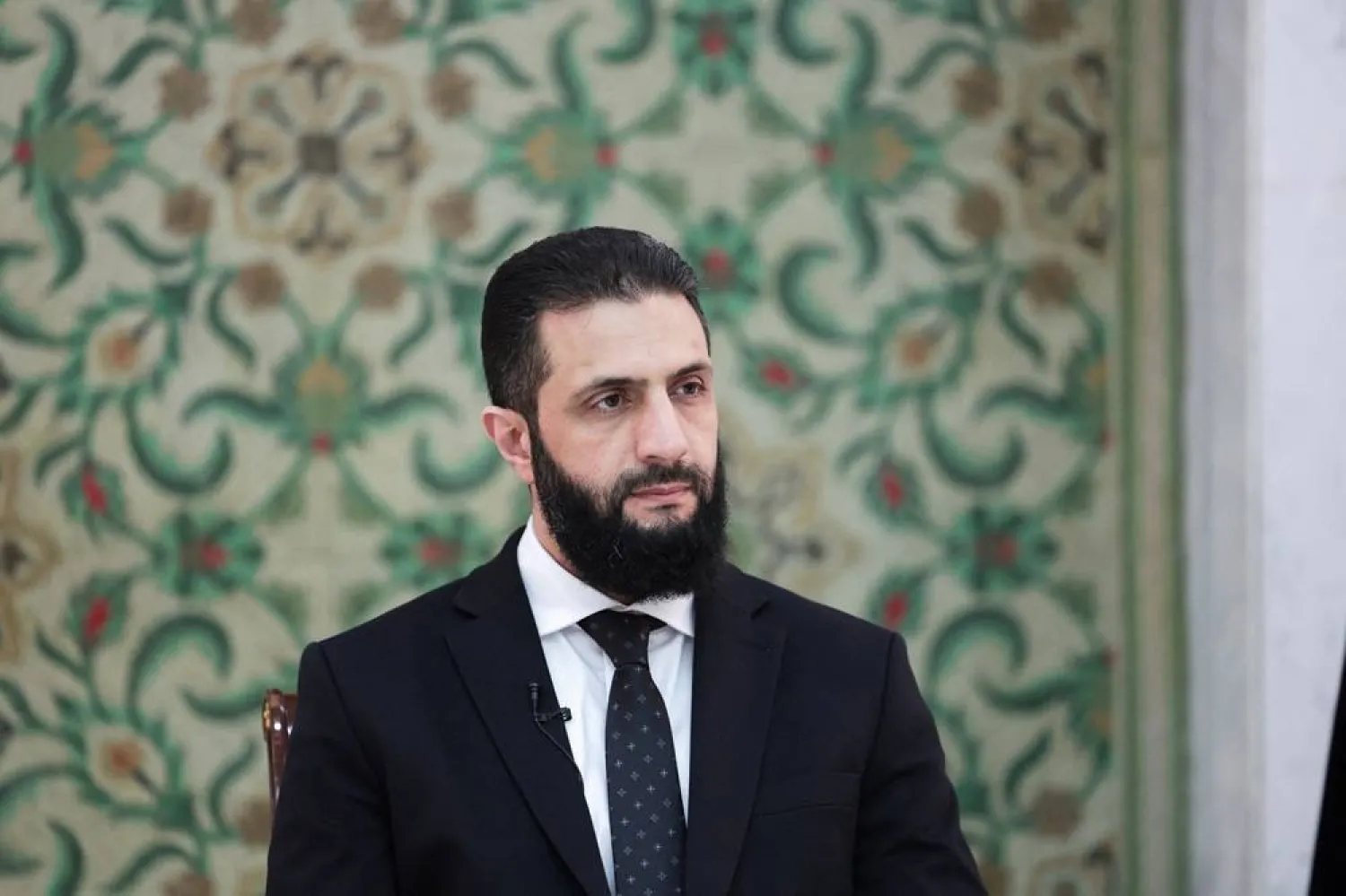
 Syria’s interim President Ahmed al-Sharaa attends an interview with Reuters at the presidential palace, in Damascus, Syria March 10, 2025. (Reuters)
Syria’s interim President Ahmed al-Sharaa attends an interview with Reuters at the presidential palace, in Damascus, Syria March 10, 2025. (Reuters)
TT

Syria’s Sharaa Says Killings of Alawites Threaten Unity, Vows Justice

 Syria’s interim President Ahmed al-Sharaa attends an interview with Reuters at the presidential palace, in Damascus, Syria March 10, 2025. (Reuters)
Syria’s interim President Ahmed al-Sharaa attends an interview with Reuters at the presidential palace, in Damascus, Syria March 10, 2025. (Reuters)

Syria's interim President Ahmed Sharaa said mass killings of members of ousted President Bashar al-Assad's minority sect were a threat to his mission to unite the country, and promised to punish those responsible, including his own allies if necessary.

In his first interview to a global news agency, held after hundreds died in four days of clashes between Alawite Muslims and Syria's new authorities, Sharaa blamed pro-Assad groups backed by foreigners for triggering the bloodshed but acknowledged that revenge killings had followed.

"Syria is a state of law. The law will take its course on all," he told Reuters from the Damascus presidential palace, where Assad resided until Sharaa's forces toppled him on December 8, forcing the ousted ruler to flee to Moscow.

"We fought to defend the oppressed, and we won't accept that any blood be shed unjustly, or goes without punishment or accountability, even among those closest to us," Sharaa said.

In a wide-ranging interview, Sharaa also said that his government had had no contacts with the United States since President Donald Trump had taken office. He repeated pleas for Washington to lift sanctions imposed in the Assad era.

He also held out the prospect of restoring relations with Moscow, Assad's backer throughout the war, which is trying to retain two major military bases in Syria.

He rejected criticism from Israel, which has captured territory in southern Syria since Assad was toppled. And he said he aimed to resolve differences with Kurds, including by meeting the head of a Kurdish-led group long backed by Washington.

While he blamed the outbreak of violence in recent days on a former military unit loyal to Assad's brother and an unspecified foreign power, he acknowledged that in response "many parties entered the Syrian coast and many violations occurred".

"It became an opportunity for revenge" for years of pent-up grievances, he said, although he said the situation had since been largely contained.

Sharaa said 200 members of the security forces had been killed in the unrest, while declining to say the overall death toll pending an investigation, which will be conducted by an independent committee announced on Sunday before his interview.

A UK-based war monitoring group, the Syrian Observatory for Human Rights, said that as of Sunday night as many as 973 Alawite civilians had been killed in revenge attacks, after fighting in which more than 250 Alawite fighters and more than 230 members of the security forces had died.

'MY CHEST TIGHTENS IN THIS PALACE'

After years in the field at the helm of a guerrilla movement that broke off from Al-Qaeda, the 42-year-old son of an Arab nationalist was soft-spoken.

"To be honest, my chest tightens in this palace. I'm astonished by how much evil against society emanated from every corner," Sharaa said.

The unrest of recent days, the bloodiest since Assad was ousted, was his biggest setback as he seeks international legitimacy, to fully lift US and other Western sanctions and assert his rule over a country fractured by 14 years of war.

He quickly welcomed a stream of foreign dignitaries and, along with his close circle, has toured the region to court support. But three months in, joy at Assad's ouster has largely been replaced by concern over the formidable challenges at home.

The economy remains in tatters, large parts of the country including its oil-rich northeast, are out of state control and Israel has struck an increasingly threatening tone backed by airstrikes, incursions and seizure of territory.

Sharaa recognized the violence of the past days threatened to derail his attempt to bring Syria together.

It "will impact this path," Sharaa said, but he vowed to "rectify the situation as much as we can".

To do that, Sharaa has set up an independent committee - the first body created by him that includes Alawites - to probe the killings within 30 days and bring perpetrators to account.

A second committee was set up "to preserve civil peace and reconciliation, because blood begets more blood," he added.

Sharaa declined to answer whether foreign fighters and other allied factions or his own security forces were involved in the mass killings, saying these were matters for the investigation.

The killings have shaken to the core Syria's coastal towns and cities of Latakia, Banyas and Jableh, forcing thousands of Alawites to flee to mountainous villages or cross the border into Lebanon.

Sharaa said Assad loyalists belonging to the 4th Division of Assad's brother, Maher, and an allied foreign power had triggered the clashes on Thursday "to foment unrest and create communal discord".

He did not identify the foreign power, but pointed to "parties that had lost out from the new reality in Syria", an apparent reference to long-time Assad ally Iran, whose embassy in Damascus is still closed. Tehran has rejected any suggestion it was involved in the violence.

'OUR DOOR IS OPEN'

Sharaa said security and economic prosperity were directly tied to lifting US sanctions imposed against Assad.

"We cannot establish security in the country with sanctions still in place against us."

But there has not been any direct contact with Trump's administration in the nearly two months since he took office, amid skepticism over Sharaa's former Al-Qaeda ties.

When asked why, he said: "The Syrian file is not on US's list of priorities. You should ask this question to them. Syria's door is open."

Meanwhile, talks are ongoing with Moscow over its military presence in the two strategic Mediterranean military bases, Tartous Naval Base and Hmeimin air base.

Sharaa said Moscow and Damascus had agreed to review all former agreements, but there had not yet been enough time to get into details.

"We do not want there to be a rift between Syria and Russia, and we do not want the Russian presence in Syria to pose a danger or threat to any country in the world, and we want to preserve these deep strategic relations," he added.


Rescue Teams Search for Survivors in Building Collapse that Killed at Least 2 in Northern Lebanon

A Lebanese flag is pictured, in the aftermath of a massive explosion, in Beirut's damaged port area, Lebanon August 17, 2020. REUTERS/Hannah McKay
TT

Rescue Teams Search for Survivors in Building Collapse that Killed at Least 2 in Northern Lebanon

A Lebanese flag is pictured, in the aftermath of a massive explosion, in Beirut's damaged port area, Lebanon August 17, 2020. REUTERS/Hannah McKay

At least two people were killed and four rescued from the rubble of a multistory apartment building that collapsed Sunday in the city of Tripoli in northern Lebanon, state media reported.

Rescue teams were continuing to dig through the rubble. It was not immediately clear how many people were in the building when it fell.

The bodies pulled out were of a child and a woman, the state-run National News Agency reported.

Dozens of people crowded around the site of the crater left by the collapsed building, with some shooting in the air.

The building was in the neighborhood of Bab Tabbaneh, one of the poorest areas in Lebanon’s second largest city, where residents have long complained of government neglect and shoddy infrastructure. Building collapses are not uncommon in Tripoli due to poor building standards, according to The AP news.

Lebanon’s Health Ministry announced that those injured in the collapse would receive treatment at the state’s expense.

The national syndicate for property owners in a statement called the collapse the result of “blatant negligence and shortcomings of the Lebanese state toward the safety of citizens and their housing security,” and said it is “not an isolated incident.”

The syndicate called for the government to launch a comprehensive national survey of buildings at risk of collapse.


Israel to Take More West Bank Powers and Relax Settler Land Buys

A view of Israeli settlement of Maale Adumim, in the West Bank, Sunday, June 18, 2023. (AP)
TT

Israel to Take More West Bank Powers and Relax Settler Land Buys

A view of Israeli settlement of Maale Adumim, in the West Bank, Sunday, June 18, 2023. (AP)

Israel's security cabinet approved a series of steps on Sunday that would make it easier for settlers in the occupied West Bank to buy land while granting Israeli authorities more enforcement powers over Palestinians, Israeli media reported.

The West Bank is among the territories that the Palestinians seek for a future independent state. Much of it is under Israeli military control, with limited Palestinian self-rule in some areas run by the Western-backed Palestinian Authority (PA).

Citing statements by Finance Minister Bezalel Smotrich and Defense Minister Israel Katz, Israeli news sites Ynet and Haaretz said the measures included scrapping decades-old regulations that prevent Jewish private citizens buying land in the West Bank, The AP news reported.

They were also reported to include allowing Israeli authorities to administer some religious sites, and expand supervision and enforcement in areas under PA administration in matters of environmental hazards, water offences and damage to archaeological sites.

Palestinian President Mahmoud Abbas said the new measures were dangerous, illegal and tantamount to de-facto annexation.

The Israeli ministers did not immediately respond to requests for comment.

The new measures come three days before Prime Minister Benjamin Netanyahu is scheduled to meet in Washington with US President Donald Trump.

Trump has ruled out Israeli annexation of the West Bank but his administration has not sought to curb Israel's accelerated settlement building, which the Palestinians say denies them a potential state by eating away at its territory.

Netanyahu, who is facing an election later this year, deems the establishment of any Palestinian state a security threat.

His ruling coalition includes many pro-settler members who want Israel to annex the West Bank, land captured in the 1967 Middle East war to which Israel cites biblical and historical ties.

The United Nations' highest court said in a non-binding advisory opinion in 2024 that Israel's occupation of Palestinian territories and settlements there is illegal and should be ended as soon as possible. Israel disputes this view.


Arab League Condemns Attack on Aid Convoys in Sudan

A general view shows the opening session of the meeting of Arab foreign ministers at the Arab League Headquarters (Reuters)
TT

Arab League Condemns Attack on Aid Convoys in Sudan

A general view shows the opening session of the meeting of Arab foreign ministers at the Arab League Headquarters (Reuters)

Arab League Secretary-General Ahmed Aboul Gheit strongly condemned the attack by the Rapid Support Forces on humanitarian aid convoys and relief workers in North Kordofan State, Sudan.

In a statement reported by SPA, secretary-general's spokesperson Jamal Rushdi quoted Aboul Gheit as saying the attack constitutes a war crime under international humanitarian law, which prohibits the deliberate targeting of civilians and depriving them of their means of survival.

Aboul Gheit stressed the need to hold those responsible accountable, end impunity, and ensure the full protection of civilians, humanitarian workers, and relief facilities in Sudan.