

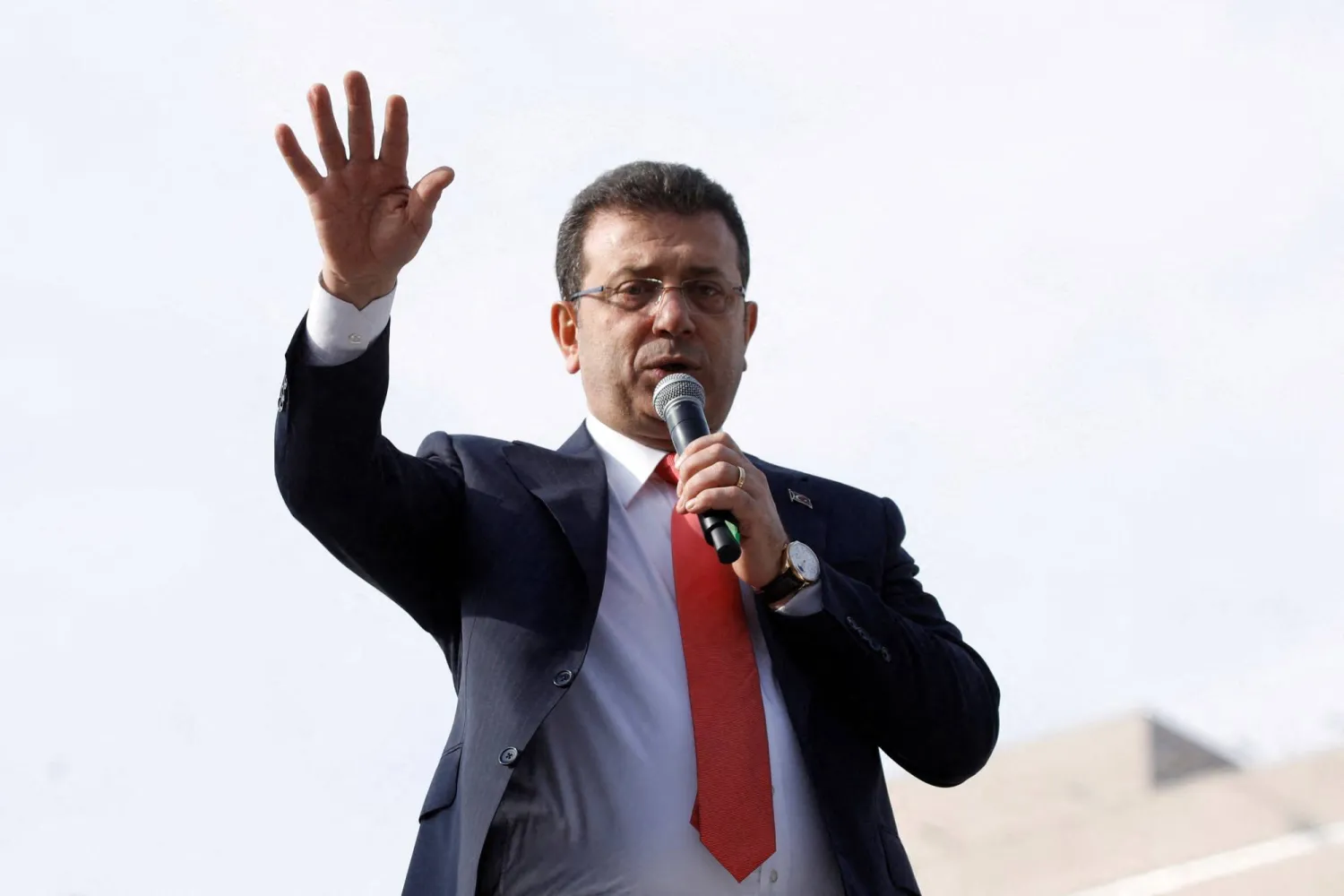

Police Arrest Istanbul Mayor Over Alleged Corruption and Terror Links

FILE PHOTO: Istanbul Mayor Ekrem Imamoglu addresses his supporters from the top of a bus after giving testimony to judicial authorities at the Justice Palace, known as Caglayan Courthouse, in Istanbul, Türkiye, January 31, 2025. REUTERS/Dilara Senkaya/File Photo
TT

Police Arrest Istanbul Mayor Over Alleged Corruption and Terror Links

FILE PHOTO: Istanbul Mayor Ekrem Imamoglu addresses his supporters from the top of a bus after giving testimony to judicial authorities at the Justice Palace, known as Caglayan Courthouse, in Istanbul, Türkiye, January 31, 2025. REUTERS/Dilara Senkaya/File Photo

Turkish police on Wednesday arrested Istanbul’s mayor — a key rival of President Recep Tayyip Erdogan — as part of an investigation into alleged corruption and terror links, media reports said.

The state-run Anadolu Agency said prosecutors issued detention warrants for the mayor, Ekrem Imamoglu, and some 100 other people. Among those detained was Imamoglu's close aid, Murat Ongun.
Authorities closed several roads around Istanbul and banned demonstrations in the city for four days in an apparent effort to prevent protests following the arrest.
The arrest came during a search of Imamoglu's home, but it was not immediately clear if police confiscated anything at the site.
A day earlier, a university invalidated Imamoglu's diploma, effectively disqualifying the popular opposition figure from running in the next presidential race. Having a university degree is a requisite for running in elections under Turkish law.
The mayor’s party — the main opposition Republican People’s Party, or CHP — was to hold a primary on Sunday where Imamoglu was expected to be chosen for its candidate in future presidential elections. Türkiye’s next presidential vote is scheduled for 2028, but early elections are likely.
With all the arrests on Wednesday, it was unlikely that vote would be held.
“We are facing great tyranny, but I want you to know that I will not be discouraged,” Imamoglu said earlier on Wednesday in a video message posted on social media. He accused the government of “usurping the will” of the people.
CHP's chairman, Ozgur Ozel, denounced Imamoglu's detention as a “coup.”
“Currently, there is a power in place to prevent the nation from determining the next president,” he said. "We are facing an attempted coup against our next president.”
Separately, police also detained a prominent investigative journalist, Ismail Saymaz, for questioning, the opposition-aligned Halk TV reported.
In nullifying Imamoglu’s diploma, Istanbul University cited alleged irregularities in his 1990 transfer from a private university in northern Cyprus to its Faculty of Business Administration. Imamoglu said he would challenge the decision.
The opposition leader faces multiple lawsuits, including allegations of trying to influence a judicial expert investigating opposition-led municipalities. The cases could result in prison sentences and a political ban.



US Aircraft Carrier Arrives in Thailand After Months at Sea

Tugboats prepare to guide US nuclear-powered aircraft carrier USS Abraham Lincoln (CVN-72) (C) towards Laem Chabang Port, near the city of Pattaya on September 2, 2026. (AFP)
TT

US Aircraft Carrier Arrives in Thailand After Months at Sea

Tugboats prepare to guide US nuclear-powered aircraft carrier USS Abraham Lincoln (CVN-72) (C) towards Laem Chabang Port, near the city of Pattaya on September 2, 2026. (AFP)

A US aircraft carrier at the center of controversy over conditions on board arrived in Thailand on Wednesday for its first port call in nine months.

The 5,000 sailors and Marines on board the USS Abraham Lincoln, arriving from the war in the Middle East, are headed for the Thai resort of Pattaya, a rest-and-recreation stop for US troops since the Vietnam War.

Tugs guided the huge nuclear-powered carrier, dozens of warplanes lined up on its flight deck, towards the port of Laem Chabang on Wednesday morning, AFP reporters saw.

"Our arrival in Laem Chabang provides a well-deserved opportunity for our Sailors and Marines to rest and recharge," Rear Admiral Robert Loughran, commander of the US Carrier Strike Group 3, said in a statement.

The Lincoln's commanding officer, Captain Dan Keeler, added that its first port visit of the "historic deployment" -- after 286 days at sea -- would allow "our crew to enjoy this beautiful and historic country".

An official in Pattaya said it was due to dock shortly before lunchtime.

The Lincoln left California in November 2025 for duty in the South China Sea and was rerouted to the Middle East before US-Israeli attacks on Iran that began six months ago.

Reports of deteriorating living conditions and poor mental health on board -- including attempted suicides -- made headlines in the United States and provoked criticism of President Donald Trump's war against Iran.

Pattaya is hugely popular with foreign tourists, known for its beaches and a nightlife scene.

- Safety and fair pricing -

Pattaya's mayor Poramase Ngampiches said buses have been laid on to transport the sailors from the ship to Pattaya and back until the carrier departs on Sunday.

"They come to relax," Poramase said in a video posted on Facebook.

"Our preparations will focus on safety and ensuring fair pricing, so we don't take advantage of them."

He said the sailors have been banned from water sports such as jet skis, and from taking advantage of Thailand's lax cannabis laws.

But he encouraged them to enjoy the city's many other attractions, from malls to religious sites.

Democratic lawmakers have called for an investigation into conditions on the USS Abraham Lincoln following reports of food shortages, broken plumbing and mental health crises.

But Trump dismissed the concerns, as well as the suggestion the ship had been deployed for too long.

"A small number of mental health cases were treated with no loss of life," acting Navy Secretary Hung Cao said in mid-August, blaming the media for "trying to paint our warriors as victims".

The carrier was replaced in the Middle East by the USS George Washington, which had been in Japan, as the US-Israel war with Iran drags on.

That ship in turn will be relieved by the USS Theodore Roosevelt, which will sail from San Diego in the coming weeks, according to private military association the US Naval Institute.

The US has maintained an aircraft carrier in the Arabian Sea for strike missions over Iran since the US and Israel launched the war at the end of February, and subsequently to enforce a naval blockade of Iranian ports.


US Defends Trump Venezuela Oil Deal as Energy Secretary Lands in Caracas

US Energy Secretary Chris Wright disembarks a plane as he arrives in Maiquetia, Venezuela, September 1, 2026. (Reuters)
TT

US Defends Trump Venezuela Oil Deal as Energy Secretary Lands in Caracas

US Energy Secretary Chris Wright disembarks a plane as he arrives in Maiquetia, Venezuela, September 1, 2026. (Reuters)

US officials on Tuesday defended President Donald Trump's oil deal with Venezuela, saying it would lower oil prices for Americans and counter Russian and Chinese influence on Washington's doorstep.

Venezuela's government-dominated National Assembly on Tuesday backed the multibillion-dollar agreement that grants the United States control of about one-fifth of Venezuelan reserves.

But there have been major questions about the deal, which comes as Washington maintains an unprecedented grip on the government in Caracas after toppling Venezuelan president Nicolas Maduro in January.

Late Tuesday, US Energy Secretary Chris Wright arrived in Venezuela, with a signing of the agreement set for Wednesday.

Oil giant Chevron is expected to announce a major expansion in Venezuela on the same day.

Trump earlier met oil executives at the White House as he tries to tame gas prices that are spiraling because of the Iran war, with his administration hoping the Venezuela deal could help.

"We are unleashing American Energy Dominance!" Trump said on his Truth Social network after the meeting.

In a Spanish-language interview posted Tuesday to YouTube, Secretary of State Marco Rubio told US-based Venezuelan journalist Sergio Novelli that a private company is working with the United States to "normalize the Venezuelan economy."

"Essentially, this is now an agreement with the US government -- specifically involving the Defense Department, which holds a special account allowing it to take possession of a certain percentage of these assets," Rubio said.

"Now, we have a system where this company will increase production. With US support, it will be able to attract the private investment needed to develop the productive capacity of these fields," Rubio said, adding that the "vast majority" of the 17 fields were "in Chinese and Russian hands" until now.

- Under US control -

In Caracas, some opposition lawmakers abstained from the show-of-hands vote to approve the US deal, arguing they should first be able to view the written terms.

"We need and are obliged to know what is written in the fine print," opposition lawmaker Luis Emilio Rondon said.

But National Assembly chief Jorge Rodriguez said the money from the deal would help Venezuelans.

"Who benefits from this oil if it stays underground?" said Rodriguez.

Venezuela's Defense Minister Gustavo Gonzalez Lopez gave the deal full military backing, describing it as "prosperity and well-being for the country."

"Turning a political difference into an economic cooperation agreement is simply a decision to choose peace; it is not subordination," he stated.

The deal granting the US preferential access to 17 oil fields will notably see the takeover of facilities previously run by Russian and Chinese companies.

One of the most controversial aspects is the involvement of Alejandro Betancourt, a Venezuelan businessman linked to shady dealings under the late Hugo Chavez's socialist administration.

Betancourt runs North American Blue Energy Partners (NABEP), Venezuela's second-largest private oil company, in which the US government is taking a 35 percent stake under the deal.

He was accused of involvement in a corruption scheme at Venezuela's state-run PDVSA oil company.

But a US official said Betancourt was a "proven operator," while acknowledging that geopolitics sometimes involved dealing with "imperfect" characters.

"I'm not nominating anyone for sainthood here. What I am telling you is that this is a person that, in the past, has been helpful to the United States government," the official added.

Under the deal, NABEP will grant Washington the right to buy 20 percent of the oil pumped by the firm at production cost, the White House said.

US citizens must constitute a majority of the firm's board of directors, giving Washington effective control, and the US government will have veto power over its members.

The official said US control would end corruption in the run-down Venezuelan oil industry, while stopping Caracas from giving much of its supplies away to its ally Cuba.

"It was used as a personal piggy bank" by Maduro's government, the official said.

Cheaper oil is a priority for the Trump administration ahead of crucial US midterm elections in November, in which his Republican Party could lose control of Congress.


Iran Strikes Back Against Latest US Attacks

A screengrab from a video obtained from social media on September 1, 2026, shows a view shortly before what US Central Command (CENTCOM) says was a US strike on an Iranian military target. (US Central Command/Handout via Reuters)
TT

Iran Strikes Back Against Latest US Attacks

A screengrab from a video obtained from social media on September 1, 2026, shows a view shortly before what US Central Command (CENTCOM) says was a US strike on an Iranian military target. (US Central Command/Handout via Reuters)

Iran struck US interests around the Middle East on Wednesday, vowing "severe" consequences for renewed American attacks on the country.

The latest fighting over the Strait of Hormuz once again expanded to US military bases in the region and drew Gulf countries deeper into the six-month conflict.

US President Donald Trump had warned earlier of "much harder and higher" attacks if Iran retaliated to the US strikes which Iranian state media said had killed 11 people in the country's south and southwest.

Tehran said it launched ballistic missile attacks on two US bases in Jordan, according to Iranian media.

The Jordanian army said it intercepted 10 ballistic missiles fired from Iran, and did not confirm any injuries or hits.

Three other missiles landed in remote areas, it said.

Missile and drone attacks were also reported in Kuwait, where the army said they were responding to Iranian hostilities, and AFP reporters in Bahrain heard air raid alerts ring out early Wednesday.

In Iraq's autonomous Kurdistan region, Iran's Revolutionary Guards said Wednesday that they struck US bases with missiles and drones, destroying a maintenance center, warehouses and equipment, state-run IRNA reported.

The latest round of conflict began when Washington hit Iranian targets on Sunday, the first known strikes in several weeks, after which Tehran's forces targeted US troops in Jordan, and projectiles struck two oil tankers in unclaimed attacks.

More US strikes came on Tuesday, with Iranian state television reporting explosions in the country's south along the Hormuz strait and on an island in the Gulf, and that US forces hit an airport in the southern province of Kerman.

And IRNA reported that "four projectiles hit areas within the counties of Chabahar and Konarak", without specifying whether there was any damage.

Seven people were killed and eight others wounded in a missile attack in the southern Khuzestan province, IRNA reported.

Earlier, Iran's Red Crescent had said shrapnel from a US missile killed four people, including a child, and wounded more than 50 in Kuhestak, Hormozgan province.

The US military did not address the wedding strike directly.

US Central Command (CENTCOM) spokesman Tim Hawkins said "the US military never targets civilians, unlike the IRGC", referring to Iran's Revolutionary Guards.

- 'Large, powerful strikes' -

Trump said the "large and powerful" strikes were "in retaliation for the Iranians' failed attempt at adding sea mines to the Strait" and "the Iranians shooting eight missiles, all successfully knocked down, at our Military Base in Jordan".

Revolutionary Guards spokesman Hossein Mohebi warned on X that Washington "will regret its new attacks", saying that "severe punishment awaits the aggressors".

And Ebrahim Zolfaghari, the spokesperson for Iran's Khatam-al Anbiya central military command, warned Wednesday that "any country that cooperates with the aggressive American army will face more severe, more widespread and destructive responses".

After six months of war, the foes remain at an impasse, with Iran keeping the Strait of Hormuz closed and the United States persisting with a counter-blockade of Iranian ports.

Washington said its forces attacked Iranian rocket launchers on the island of Larak on Sunday to prevent Tehran from planting mines in the strait's key shipping lanes.

The Middle East war began in late February with US-Israeli attacks on Iran that killed its supreme leader Ali Khamenei.

A fragile ceasefire between the United States and Iran collapsed after attacks on commercial ships in the Hormuz strait, through which one-fifth of world oil supplies flowed before the war.

Trump warned on his Truth Social platform Tuesday that if Iran retaliated, "they will be hit again at a much harder and higher level, but it will not be the biggest attack of them all."

"That is waiting in the wings and, when it is over, there will be very little left of the Islamic Republic of Iran!" he wrote.

Separately, he said that he was "not trying to force Iran to the bargaining table", adding that he "couldn't care less if they sign a worthless, to them, agreement".

He also asked: "When are the Iranian people going to rise up and fight?"

Despite the diplomatic deadlock, Iran's President Masoud Pezeshkian vowed on Tuesday to match any US move to return to a deal aimed at ending the war.

He also warned that a return by the United States to "a policy of pressure and threats could derail the path of diplomacy".