


Ukraine and Russia’s Truce Agreements Run into Trouble within Hours

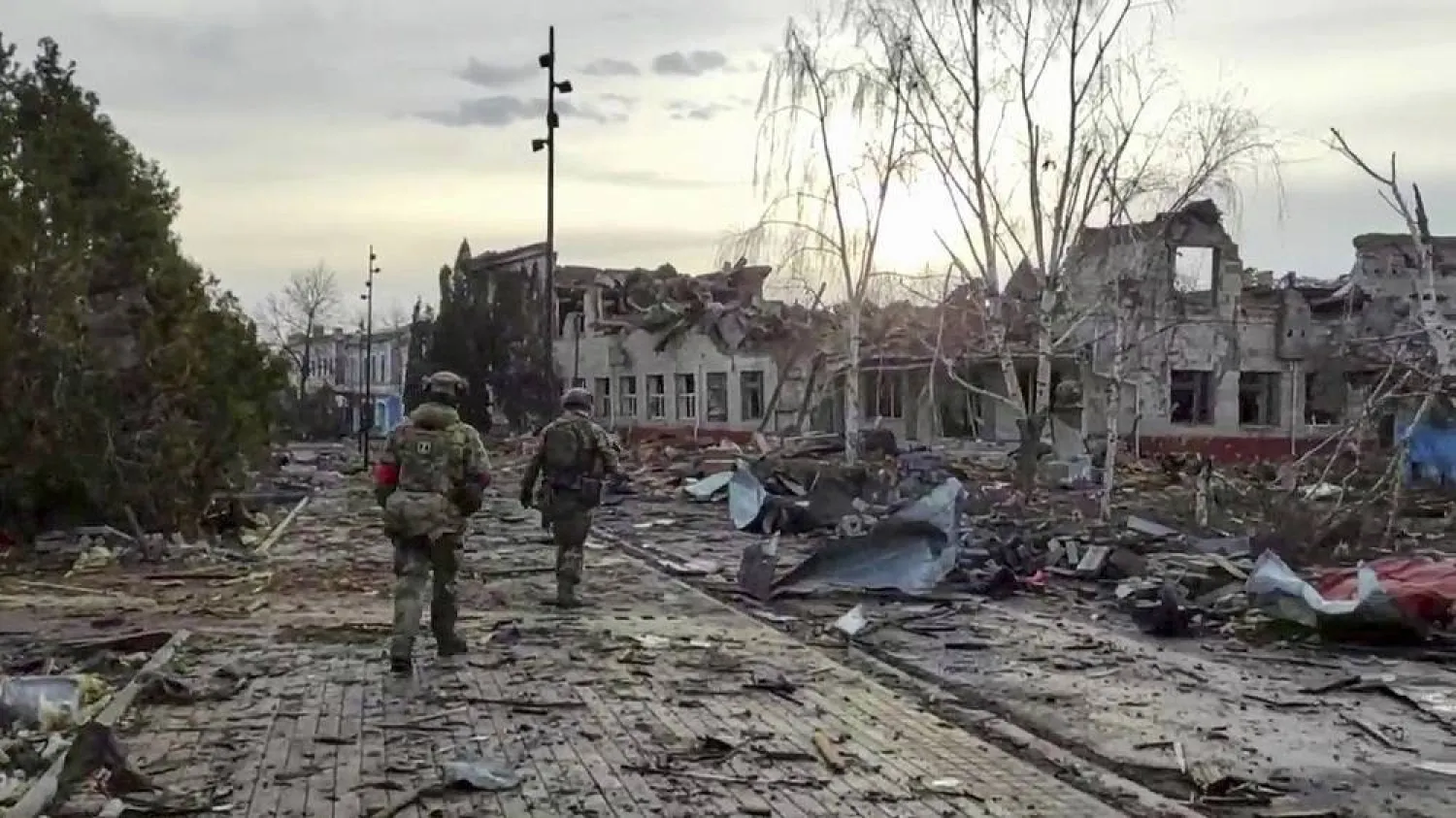
In this photo taken from video distributed by the Russian Defense Ministry Press Service on Thursday, March 13, 2025, Russian soldiers patrol an area in Sudzha, in the Kursk region of Russia, after it was taken over by Russian troops. (Russian Defense Ministry Press Service via AP) 
TT

Ukraine and Russia’s Truce Agreements Run into Trouble within Hours

In this photo taken from video distributed by the Russian Defense Ministry Press Service on Thursday, March 13, 2025, Russian soldiers patrol an area in Sudzha, in the Kursk region of Russia, after it was taken over by Russian troops. (Russian Defense Ministry Press Service via AP) 

Ukraine and Russia accused one another on Wednesday of flouting a truce on energy strikes brokered by the United States, and the European Union said it would not meet conditions set by Russia for a planned ceasefire in the Black Sea.

The United States announced separate agreements with Ukraine and Russia on Tuesday to pause their strikes in the Black Sea and against each other's energy targets, but the rhetoric from Moscow and Kyiv suggested they remained far apart.

Ukraine's president, Volodymyr Zelenskiy, said the US side told Kyiv the deals were effective as soon as they were announced. But the Kremlin said the Black Sea agreement would not enter force until a sanctioned Russian state bank was reconnected to the international payment system. Europe said that would not happen until a Russian withdrawal from Ukraine.

The Kremlin contends it has already been implementing a pause on energy attacks since March 18, though a senior Ukrainian presidential official said Russia had attacked eight Ukrainian energy facilities since that date.

On paper, the agreements are a tangible step towards a ceasefire after Russia launched its February 2022 invasion, unleashing the biggest conflict in Europe since World War Two that rages on along a 1,000-km (600-mile) front line.

Led by Donald Trump, who wants a quick peace, the United States on Tuesday published two separate joint statements with Moscow and Kyiv outlining the deals, but neither document set out a clear timeline for their implementation.

Overnight, Russia said it had taken down nine drones, including two over the Black Sea. It also said Ukraine tried to attack a gas storage facility in Russian-occupied Crimea and energy infrastructure in Russia's Kursk and Bryansk regions. Ukraine said it conducted no such strikes.

Ukraine's military reported 117 Russian drone attacks overnight. Local officials said the city of Kryvyi Rih had been hit by the biggest drone attack it has faced yet.

Zelenskiy called on the United States to further sanction Moscow, which he said was clearly not pursuing a "real peace" after the latest night of Russian drone attacks.

"Launching such large-scale attacks after ceasefire negotiations is a clear signal to the whole world that Moscow is not going to pursue real peace," Zelenskiy wrote on X.

ACTIONS NOT WORDS

Diplomats have told Reuters that most of the curbs the Kremlin says should be lifted before a Black Sea truce comes into effect relate to European Union sanctions and restrictions.

The EU said it was not targeting trade in food, grain or fertilizers in any way and made clear it would not budge on sanctions while Russian forces remained in Ukraine.

"The end of the Russian unprovoked and unjustified aggression in Ukraine and unconditional withdrawal of all Russian military forces from the entire territory of Ukraine would be one of the main preconditions to amend or lift sanctions," a spokesperson for the EU's executive commission said.

European nations trying to create security arrangements for Ukraine are shifting from sending troops to alternative ways of protecting Ukraine's skies, seas and borders as they face political and logistical constraints, officials told Reuters.

A senior European defense official said everything would depend on prospects for a ceasefire, adding that he was not optimistic.

Nightly Russian drone attacks have been a feature of life in Ukrainian cities for many months. So have power outages as missiles have hammered the power grid, although Russian attacks have targeted gas facilities more recently. Kyiv has used drones to hit Russian oil facilities to strike back at its larger foe.

Zelenskiy said: "Everyone who was affected must be given assistance. But there must also be clear pressure and strong action from the world on Russia – more pressure, more sanctions from the United States – to stop Russian strikes."

The Ukrainian statements did not say that Russia had hit energy infrastructure with its latest attack.

At least 15 explosions detonated in Zelenskiy's hometown of Kryvyi Rih overnight during a Russian drone attack, though no one was killed or injured, according to Oleksandr Vilkul, head of the military administration.

"Apparently, this is how the occupiers 'want peace'," he said.

Seven Russian drones were shot down over the southern region of Mykolaiv, whose port provides access to the Black Sea and has been closed since Russia's full-scale invasion, the governor said.

In the city of Okhtyrka in the border region of Sumy, the local governor said Russian drones damaged two apartment buildings, an administrative building and businesses.

Reuters could not independently verify the reports from either side about the various attacks.


Satellite Imagery Shows ‘Recent Activity’ at Iran Nuclear Facility

An inspector of the International Atomic Energy Agency sets up surveillance equipment at a uranium conversion facility in Iran in 2005. Photograph: Mehdi Ghasemi/AP
TT

Satellite Imagery Shows ‘Recent Activity’ at Iran Nuclear Facility

An inspector of the International Atomic Energy Agency sets up surveillance equipment at a uranium conversion facility in Iran in 2005. Photograph: Mehdi Ghasemi/AP

New satellite imagery shows recent activity at the Natanz nuclear facility that was damaged during June's 12-day war with Israel, according to the US-based Institute for Science and International Security (ISIS).

During the June conflict, the IAEA confirmed Israeli strikes hit Iran's Natanz underground enrichment plant.

The think tank said the satellite imagery from December 13 show panels placed on top of the remaining anti-drone structure at the Pilot Fuel Enrichment Plant (PFEP), providing cover for the damaged facility.

It suggested the new covering allows Iran to examine or retrieve materials from the rubble while limiting external observation.

The Natanz uranium enrichment facility, located some 250 km south of the Iranian capital Tehran, is one of Iran's most important and most controversial nuclear facilities in the Middle East.

Although the facility “likely held several kilograms of highly enriched uranium,” ISIS stressed that such material is “not negligible” in the broader context of Iran’s nuclear capabilities.

While PFEP shows renewed activity, ISIS said it has not observed similar signs at other major nuclear sites, including the underground Fordow facility also damaged in June by airstrikes.

Inspections
On December 15, IAEA chief Rafael Grossi has reiterated that Iran must allow inspectors access to the three key nuclear facilities that enrich uranium and were hit by the US and Israeli airstrikes last June.

Speaking to RIA Novosti, Grossi said the agency’s activities in Iran are very limited. “We are only allowed to access sites that were not hit.”

In October, the head of the UN nuclear watchdog told AP that Iran does not appear to be actively enriching uranium but that the agency has recently detected renewed movement at the country’s nuclear sites.

Grossi said that despite being unable to fully access Iranian nuclear sites, inspectors have not seen any activity via satellite to indicate that Tehran has accelerated its production of uranium enriched beyond what it had compiled before the 12-day war with Israel in June.

“However, the nuclear material enriched at 60% is still in Iran,” Grossi said in an interview at the United Nations headquarters in New York.

“And this is one of the points we are discussing because we need to go back there and to confirm that the material is there and it’s not being diverted to any other use,” he added, “This is very, very important.”

Iran’s Foreign Minister Abbas Araghchi said on December 8 that resuming the agency’s inspections is currently not possible because “there is no protocol or guideline” for inspecting facilities he described as “peaceful.”

ISIS reported on October 3 that new satellite imagery shows that Iran is ongoing construction efforts at a mountainous area just south of the Natanz enrichment site known as Kuh-e Kolang Gaz La, or Pickaxe Mountain.

On Sept. 26, The Washington Post said according to a review of satellite imagery and independent analysis, Iran has increased construction at a mysterious underground site in the months since the US and Israel pummeled its main nuclear facilities, suggesting Tehran has not entirely ceased work on its suspected weapons program and may be cautiously rebuilding.


Rubio: Venezuela Cooperates with Iran, Hezbollah

Secretary of State Marco Rubio speaks during a news conference at the State Department, Friday, Dec. 19, 2025, in Washington. (AP Photo/Julia Demaree Nikhinson)
TT

Rubio: Venezuela Cooperates with Iran, Hezbollah

Secretary of State Marco Rubio speaks during a news conference at the State Department, Friday, Dec. 19, 2025, in Washington. (AP Photo/Julia Demaree Nikhinson)

US Secretary of State Marco Rubio has accused the illegitimate regime in Venezuela of cooperating with criminals that threaten the national security of the United States.

Rubio said Friday the regime of President Nicolas Maduro openly cooperates with Iran, Hezbollah, and drug trafficking groups.

“They (Venezuela regime) operate and cooperate with terrorist organizations against the national interest of the United States, not just cooperate, but partner with and participate in activities to threaten the national interest of the United States,” he told reporters at a news conference at the State Department.

According to Rubio, Venezuela is a country that is not just an illegitimate regime that does not cooperate with the US but also a regime that openly cooperates with criminal and terrorist elements, including Hezbollah, Iran and others.

“And clearly these narco groups cooperate openly from there,” the Secretary of State said.

“We have a regime that cooperates with Iran, that cooperates with Hezbollah; that cooperates with narcotrafficking and narcoterrorist organizations, inclusive not just protecting their shipments and allowing them to operate with impunity, but also allows some of them to control territory,” he added.

Earlier, US President Donald Trump said he was leaving the possibility of war with Venezuela on the table, according to an interview with NBC News published on Friday.

“I don't rule it out, no,” he told NBC News in a phone interview.

Trump also said there would be additional seizures of oil tankers near Venezuelan waters, according to the interview. The US seized a sanctioned oil tanker off the coast of Venezuela last week.

“If they're foolish enough to be sailing along, they'll be sailing along back into one of our harbors,” he told NBC News.

On Tuesday, Trump ordered a “blockade” of all sanctioned oil tankers entering and leaving Venezuela, in Washington's latest move to increase pressure on Nicolas Maduro's government, targeting its main source of income, following which Venezuela's government said it rejected Trump's “grotesque threat.”


Iran Says it Executed Man Accused of Spying for Israel

A general view of the snow-covered mountains surrounding Tehran, Iran, 19 Dec 2025. EPA/ABEDIN TAHERKENAREH
TT

Iran Says it Executed Man Accused of Spying for Israel

A general view of the snow-covered mountains surrounding Tehran, Iran, 19 Dec 2025. EPA/ABEDIN TAHERKENAREH

Iran executed on Saturday a man convicted of spying for the Israeli intelligence and army, state media reported.

According to The Associated Press, State TV identified the executed man as Aghil Keshavarz, saying he had “close intelligence cooperation” with the Mossad and took photos of Iranian military and security areas.

Keshavarz was arrested while taking pictures of a military headquarters in the northwestern city of Urmia, some 600 kilometers northwest of the capital Tehran in May. He was accused of carrying out more than 200 similar assignments for the Mossad in various cities of Iran, including Tehran.

He was tried and given the death sentence, a ruling the Supreme Court upheld, the report said.

Keshavarz, 27, reportedly studied architecture.

Iran is known to have executed 11 people for espionage since a 12-day air war that Israel waged against Iran in June, killing nearly 1,100 people, including military commanders and nuclear scientists. In return, Iran’s missile barrage killed 28 in Israel.

In October, Iran executed an unknown person convicted of spying for Israel’s intelligence agency Mossad in the city of Qom.
