Doctor Cites the Pope's 'Surprising Improvement' after Surviving Life-Threatening Criseshttps://english.aawsat.com/world/5127081-doctor-cites-popes-surprising-improvement-after-surviving-life-threatening-crises
Doctor Cites the Pope's 'Surprising Improvement' after Surviving Life-Threatening Crises
Pope Francis appears at a window of the Agostino Gemelli Polyclinic in Rome, Sunday, March 23, 2025, where he has been treated for bronchitis and bilateral pneumonia since Feb. 14. (AP)
TT
TT
Doctor Cites the Pope's 'Surprising Improvement' after Surviving Life-Threatening Crises
Pope Francis appears at a window of the Agostino Gemelli Polyclinic in Rome, Sunday, March 23, 2025, where he has been treated for bronchitis and bilateral pneumonia since Feb. 14. (AP)
Pope Francis has shown ''a truly surprising improvement'' since returning to the Vatican to convalesce after surviving a life-threatening bout with double-pneumonia, the doctor who coordinated the pontiff's five-week hospitalization said Saturday.
“I find him very lively,” Dr. Sergio Alfieri said, after visiting the pope at his apartment in the Santa Marta Domus on Wednesday, three days after his release from Rome's Gemelli hospital. “I believe that he will return if not to 100%, 90% of where he was before.”
Francis appeared frail and weak as he greeted a crowd of well-wishers from a hospital balcony on Sunday. His voice was waning as he praised a woman in the crowd for bringing yellow flowers. He was able to only partially lift his arm to bless the people and he gasped for air as he was wheeled back inside.
Alfieri said the pope's voice was regaining strength, and that his reliance on supplemental oxygen has decreased. The limited mobility of his arm was due to an unspecified trauma he sustained before being hospitalized, and that will take time to heal, Alfieri said.
The 88-year-old pope was hospitalized on Feb. 14 after a long bout with bronchitis that left him breathless at times, and which quickly developed into double pneumonia and revealed a polymicrobial (viral, bacterial and fungal) respiratory infection. Throughout the ordeal, doctors emphasized the complexity of his condition, given his age, lack of mobility requiring a wheelchair, and the removal of part of a lung as a young man.
Alfieri repeated that he didn't think the pope would make it after a severe respiratory crisis a week after being hospitalized, and he informed the pope that a “decisive” treatment necessary to save him would put his organs at risk.
“He gave his consent, and then he looked at Massimiliano Streppetti, whom he named his personal health assistant who assumed the responsibility, to say, 'We approve everything,' also at the price of coming out with damaged kidneys or bone marrow that produces damaging red blood cells,” said Alfieri.
Alfieri preferred to describe the treatment as “decisive,” and not aggressive, and emphasized that no extraordinary, life-extending measures were ever taken. The Feb. 22 incident was one of several critical moments when the pope's life hung in the balance, the doctor said.
While Francis beat the double pneumonia in the hospital, Alfieri said he is continuing to treat the fungal infection, which he said will take months to resolve. The pope is also receiving physical, respiratory and speech therapy.
Alfieri continues to consult the pope's personal medical team daily, and will visit Francis in the Vatican every week.
The pope demonstrated his trademark humor in this week's visit, responding to a comment by Alfieri that the 88-year-old pontiff had the mentality of a 50- or 60-year-old. “As I leaned in, he said, 'Not 50, 40,'” Alfieri recalled. “So his good sense of humor is back.”
Doctors have ordered the pope to rest for at least two months and to avoid crowds. But after seeing the pope's improvements and knowing his work ethic, Alfieri warned that “if he recovers so quickly, they will have to put on the brakes.”
People stroll at Konak Square in the western of Izmir, Türkiye, October 18, 2026. REUTERS/Ali Dinc
Eight people were shot dead in three villages in western central Türkiye on Thursday, local officials said, as a major manhunt was underway to find the gunman.
"Unfortunately, eight of our citizens have lost their lives, and one has been seriously injured in armed attacks in our province," the Afyonkarahisar governor's office said.
The incident occurred in the early evening in a rural area near Afyonkarahisar, a town half way between the capital Ankara and the coastal city of Izmir, AFP reported.
Two women with gunshot wounds were found on a road in Yukaritandir village, but despite being rushed to hospital, both died, Anadolu state news agency said.
Three more bodies were found in Kiyir village, which lies a half-hour drive to the northeast, and another three in Ayazini village, a further half-hour drive further east, it said.
Another person found in a critical condition was fighting for their life in hospital, it said, without saying where they had been injured.
NTV private television said police were chasing a suspect driving a red car who was seen fleeing the scene.
More Than a Dozen Flights in Europe Receive Bomb Threats that an Official Calls 'Malicious' Hoaxeshttps://english.aawsat.com/world/5338044-more-dozen-flights-europe-receive-bomb-threats-official-calls-malicious-hoaxes
This video grab from AFPTV footage shows a Finnair plane taking off from Fiumicino Airport after it was diverted due to a bomb threat, with Italian air force jets having escorted it from Helsinki to Rome on November 5, 2026. (Photo by Andrea BERNARDI / AFP)
More Than a Dozen Flights in Europe Receive Bomb Threats that an Official Calls 'Malicious' Hoaxes
This video grab from AFPTV footage shows a Finnair plane taking off from Fiumicino Airport after it was diverted due to a bomb threat, with Italian air force jets having escorted it from Helsinki to Rome on November 5, 2026. (Photo by Andrea BERNARDI / AFP)
Bomb threats targeted more than a dozen flights in Europe on Thursday, leading to a slew of emergency landings and military escorts in some cases, authorities said. No hazardous or suspicious materials have been found in what a British official called “malicious" hoaxes.
Several similar threats targeted planes earlier this week, prompting searches and diversions. Europe has experienced a slew of other disruptions recently, such as attacks on supermarket refrigeration systems, drone incursions and mysterious triggers to alert apps.
While fake bomb threats are relatively common, it is unusual to see so many in a single day. They come at a time of increased geopolitical tensions and warnings from authorities that Russia may be ramping up so-called hybrid threats in Europe.
It was not known whether this week's threats were linked, who sent them or what their aims were.
An email containing the threat to Rome-bound planes was sent on behalf of a group that describes itself as anti-feminist, according to a copy provided by an airport official and reviewed by The Associated Press.
An official from another European airport said the threat they received also came from a group calling itself anti-feminist, and used some of the same language. It wasn't clear if the two threats were sent by the same group. Both officials spoke on condition of anonymity because they weren’t authorized to share the information.
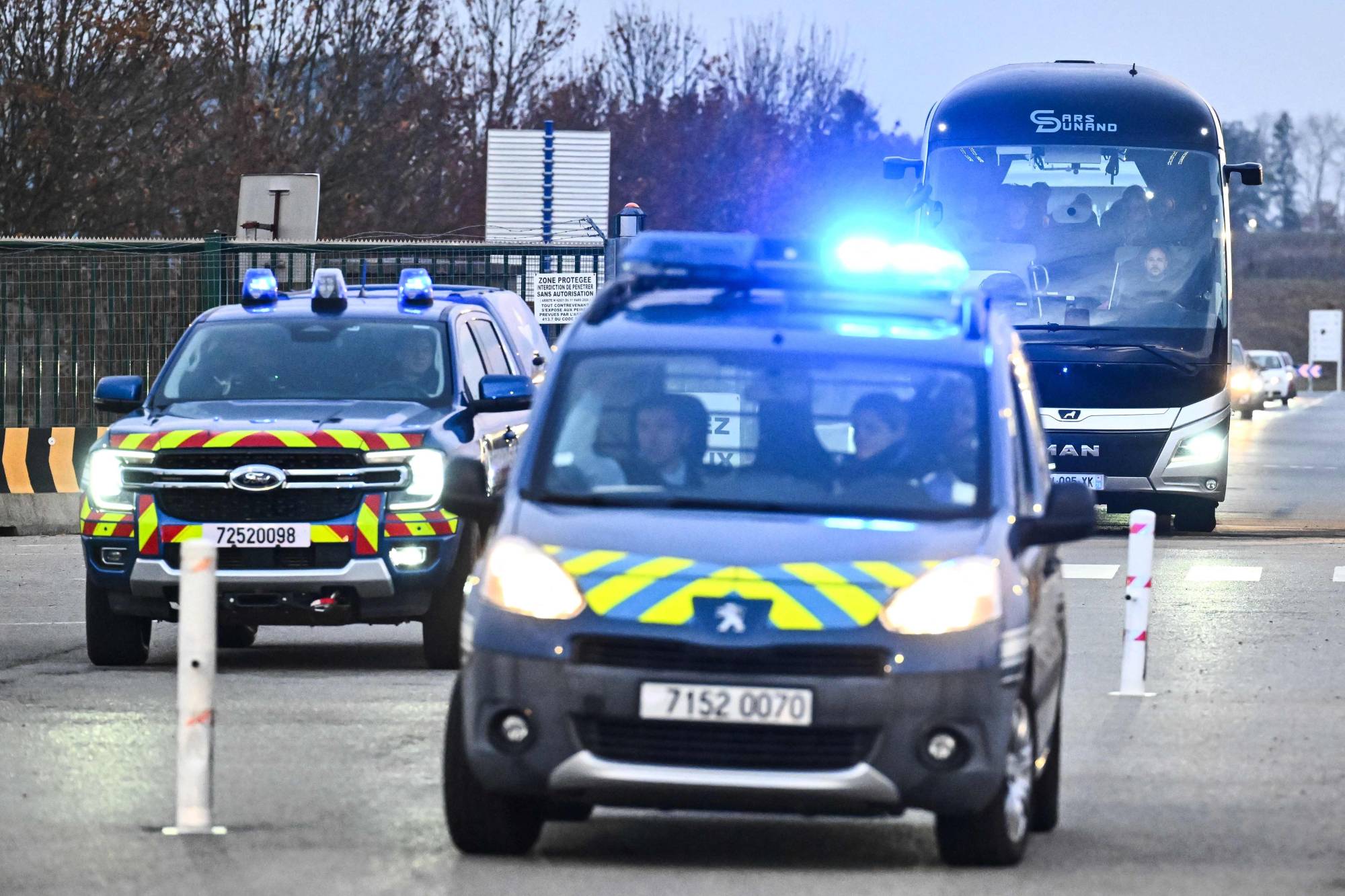
Passengers of Aer Lingus aircraft from Dublin to Rome, leave in a bus the Evreux-Fauville Air Base after their plane had been rerouted and escorted by military aircraft after a suspected bomb threat, on November 5, 2026. (Photo by Guillaume Saligot / AFP)
Jacob Funk Kirkegaard, senior fellow at the Bruegel think tank in Brussels, said the threats were “stress-testing” how European governments and airport officials respond, and whether their responses were coordinated.
The idea behind the threats “appears to be to sow chaos, uncertainty, about the reliability of air traffic across Europe” and could have “cascading effects” — like economic damage and costs related to inspection, investigation and cleaning aircraft.
Joji Waites, who heads flight safety at the British Airline Pilots’ Association, said the industry has put in place “proved mechanisms” for dealing with such threats, including a team of assessors to grade the level of threat in a red-amber-green color-coding system, quick notification of flight crews, and the evacuation of planes on the ground.
Each flight disruption could cost airlines as much as $250,000, on a par with the possible costs of dealing with an unruly passenger, said Philip Baum, a visiting professor of aviation security at Coventry University in England.
“And that’s because you might end up with the crew going out of hours. You might need replacement crew. You have got passengers that miss their flight connections," Baum said. "It knocks everything out of sync for the rest of the day for the airline in question.”
Military escorts incur expenses, too, which would be borne by governments rather than airlines, he added.
Officials decry the hoaxes Britain's transport secretary, Heidi Alexander, told British broadcasters that flights across Europe have been hit by “malicious hoax threats.”
European Union Transport Commissioner Apostolos Tzitzikostas told reporters in Dublin that it was “too early to draw conclusions on whether the reported incidents are linked.”
“National investigations remain ongoing,” he said, adding that an EU information-sharing mechanism on aviation security had been activated.
An Aer Lingus flight from Dublin to Rome was diverted to a military air base in France after receiving a threat, French Prime Minister Sébastien Lecornu’s office said. The flight landed safely at the base in Evreux, which was under high alert, and military bomb disposal teams were examining the plane, the office said.
Lecornu ordered warplanes to intercept the plane because the pilot “didn’t cooperate as expected with the authorities,” his office said. It declined to comment further.
Hours after the flight landed, the plane was sitting on the tarmac with a Red Cross vehicle nearby while explosive experts with dogs examined it.
An investigation was opened by French aviation security authorities. The regional prosecutor, Remi Coutin, said in a statement that the pilot and co-pilot were being questioned about what happened.
Italian air force jets escort a Finnair flight Italian air force fighter jets escorted a Finnair flight that departed Helsinki bound for Rome after an email threat was received, the air force said in a statement.
Finnair said that two of its flights, including the one that received the military escort and landed safely in Rome, “faced unfounded hoax bomb scares.” The other flight, operated by Jettime from Helsinki to Vienna, landed safely at its destination, and was expected to return to service after an inspection, Finnair said.
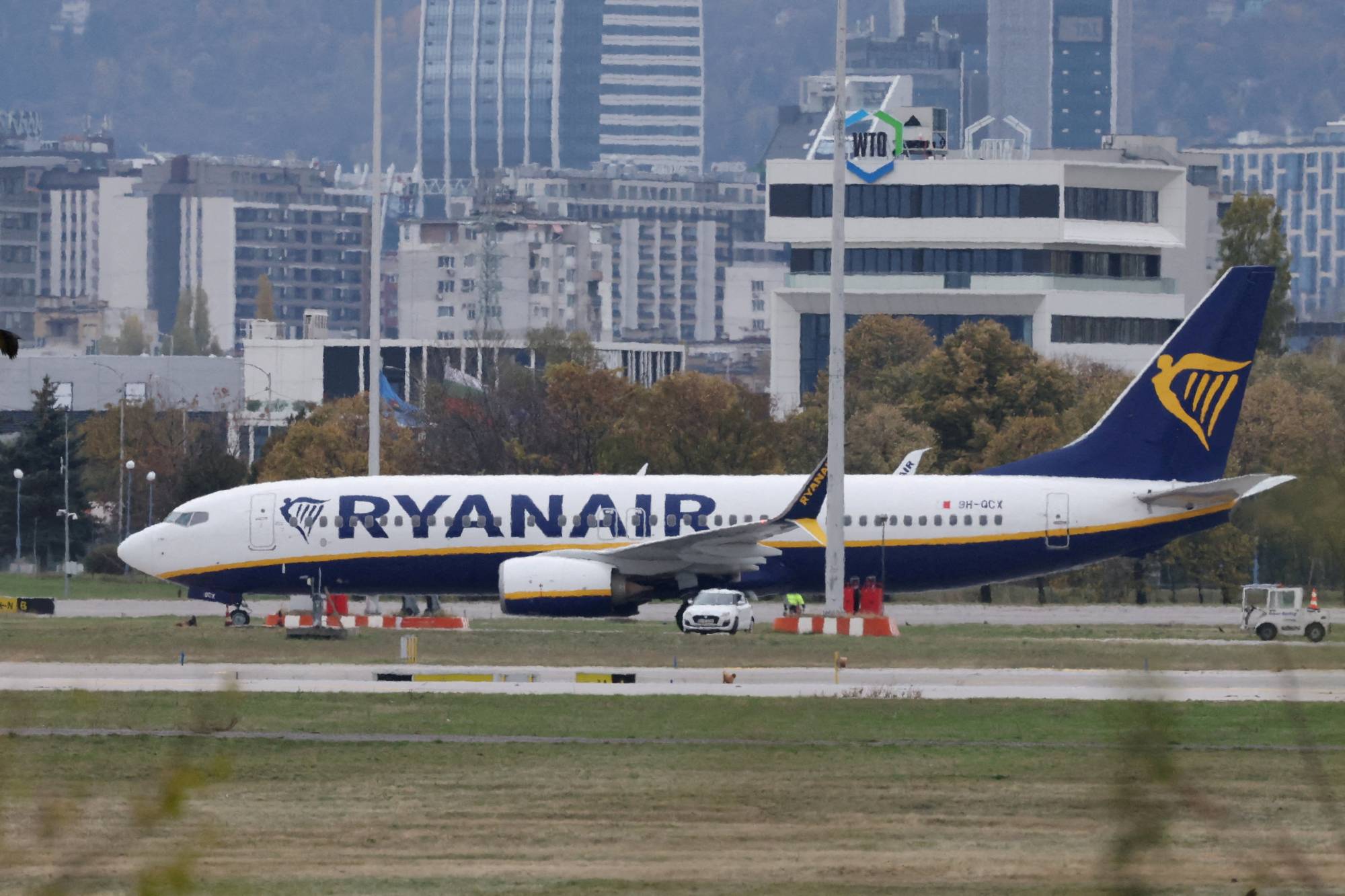
Three Ryanair flights bound for Sofia, Bulgaria, meanwhile, also received military escorts and made emergency landings after bomb threats, officials said. Two of the flights — one from Copenhagen, Denmark, and the other from Madrid — landed safely in Sofia, airport officials told reporters. The third, from London, was diverted and landed safely in Plovdiv, Bulgaria’s second-largest city, Plovdiv Airport CEO Krassimir Peshev said.
Several flights across Europe received bomb threats earlier this week, officials said.
The flights included ones operated by Polish airline LOT, Scandinavian Airlines, Wizz Air and Ryanair. The hoax threats came after a plane headed for Bulgaria was diverted to Hungary upon receiving a similar bomb threat while in the air. No one was injured.
A Ryanair aircraft at Sofia Airport after airplanes flying from Copenhagen and Madrid landed in Sofia, according to the Bulgarian interior minister, as bomb threats forced airliners to make unplanned landings across Europe, in Sofia, Bulgaria, November 5, 2026. REUTERS/Stoyan Nenov TPX IMAGES OF THE DAY
A slew of other flights were disrupted Thursday. Among those incidents:
— Czech police said searches of four planes that landed in Prague after being targeted by bomb threats turned up nothing. They have not given details on where the flights originated, and said they took precautions despite not finding the threats credible.
— A LOT Polish Airlines flight from Warsaw to Brussels landed at its destination, where inspections found no hazardous or suspicious items, the airline said.
— A Wizz Air flight from Milan to Bucharest landed safely in Bucharest following a bomb threat, airport spokesman Teo Postelnicu said. Checks turned up no bomb.
— A flight to Warsaw landed in Vienna after an email to Polish authorities containing an abstract threat, said Stefan Loidl, a police spokesperson in Lower Austria province. Nothing was found and the plane continued to Warsaw. He said there was also an abstract threat to Vienna Airport concerning four other flights, which he declined to identify, but operations were not disrupted.
- Air Serbia said a flight from Belgrade to Romania’s capital, Bucharest, received a bomb threat that turned out to be a hoax. The plane landed in Bucharest, underwent checks and resumed regular operations.
Paraguay President Resigns Following Bank Collapsehttps://english.aawsat.com/world/5338035-paraguay-president-resigns-following-bank-collapse
FILE PHOTO: Paraguay's President Santiago Peña speaks during an interview with Reuters, in Asuncion, Paraguay August 21, 2024. REUTERS/Cesar Olmedo/File Photo
Paraguay President Resigns Following Bank Collapse
FILE PHOTO: Paraguay's President Santiago Peña speaks during an interview with Reuters, in Asuncion, Paraguay August 21, 2024. REUTERS/Cesar Olmedo/File Photo
Paraguayan President Santiago Peña resigned on Thursday as calls for his removal swelled following the collapse of digital lender ueno that left millions of customers unable to access their accounts.
"I do so with the stability of our country, social peace, and the need to preserve our democratic institutions in mind," he said in a video recorded address on Thursday.
Peña, an ally of US President Donald Trump, is stepping down after the opposition called an extraordinary session to begin the process of filing an impeachment motion in Congress, and as protesters demanded his resignation.
Earlier on Thursday Peña lost backing from members of his own conservative party. Vice President Pedro Alliana is set to take office as his replacement.
Lawmakers had accused Peña of conflicts of interest, misuse of pension funds and institutional cover-ups linked to the collapse of ueno, which had grown quickly from a niche fintech player into a mid-tier bank administering close to $850 million in public funds.
"My greatest wish is that the return of those funds be guaranteed, that the deposit guarantee fund fulfill its purpose, and that public funds - as well as the resources that belong to all Paraguayans - be protected," Peña added in his address.
Paraguay's central bank intervened in ueno after determining that it had breached minimum solvency requirements, setting off a crisis that has left the company's roughly 3 million customers, in a country of 6.5 million people, unable to access accounts.
Ueno has made no public statement on the issue.
Hundreds of employees of Ueno Bank and other companies belonging to Grupo Vázquez, the bank’s parent conglomerate, protested outside the Labor Ministry on Thursday, demanding severance and unpaid wages with their jobs in limbo and their salaries trapped at the failed bank.
A day earlier, hundreds of retirees, depositors, university students and workers flooded the streets of Asunción, the capital.
“We want your head, Peña!” they shouted. Their signs demanded Peña’s impeachment, called him “the enemy of savers” and pleaded “Give us back our money.” Riot police fired pepper spray and rubber pellets to push back the crowds.
لم تشترك بعد
انشئ حساباً خاصاً بك لتحصل على أخبار مخصصة لك ولتتمتع بخاصية حفظ المقالات وتتلقى نشراتنا البريدية المتنوعة