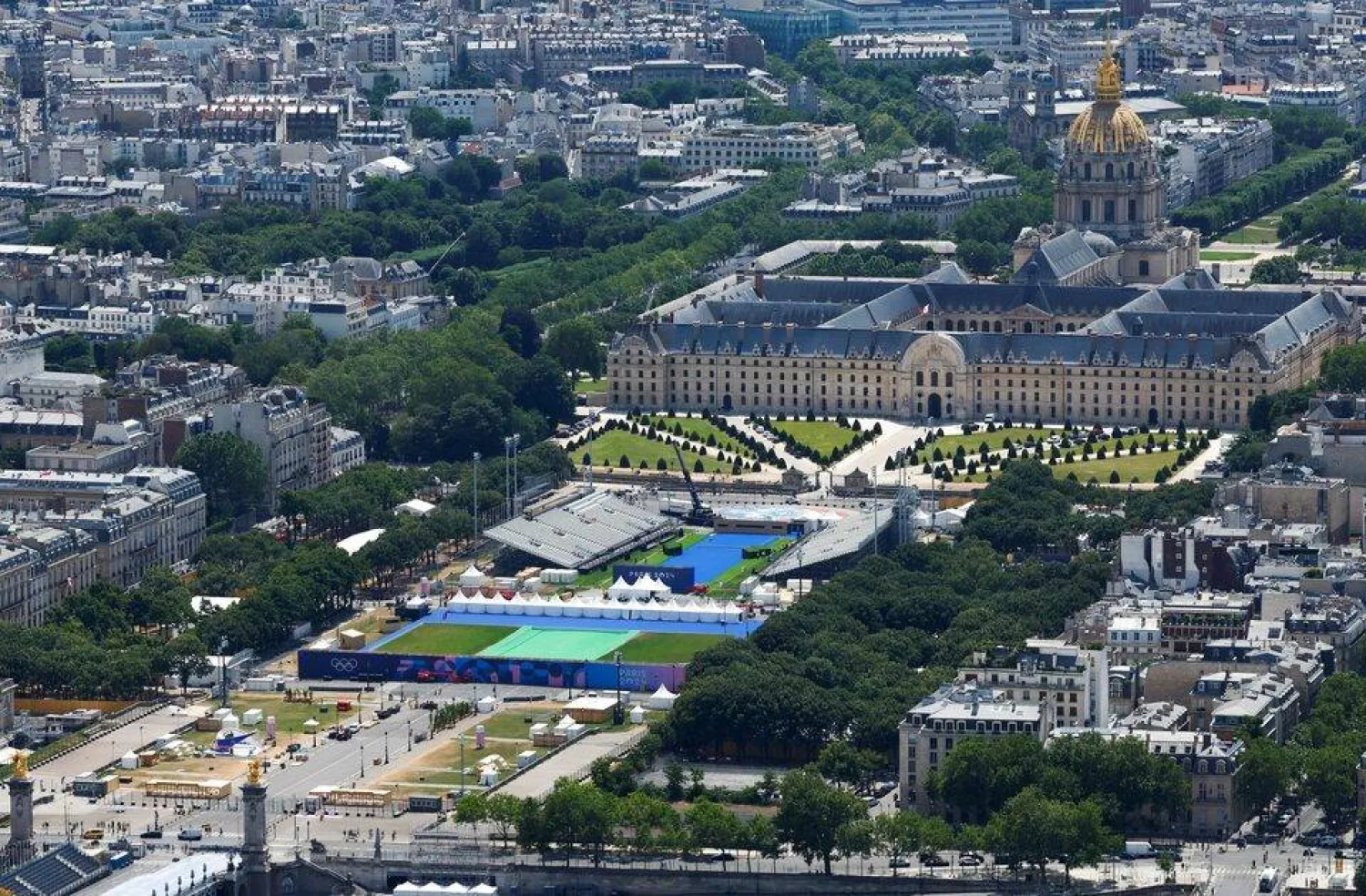
French Prime Minister Sébastien Lecornu will receive on Monday Prince Minister Mohammed bin Salman, Saudi Crown Prince and Prime Minister, in the Cour d’Honneur, or Court of Honor, at the historic Les Invalides complex in Paris, according to a statement from the French PM’s office.
The complex houses the Army Museum and Napoleon Bonaparte’s tomb and is crowned by its famous gilded dome.
Three-and-a-half centuries of history
Les Invalides, officially known as the Hôtel National des Invalides, dates back more than three-and-a-half centuries, to 1670, when King Louis XIV ordered and financed its construction to house sick, wounded and elderly soldiers.
A site was chosen on the Grenelle plain near Paris, on the banks of the Seine. Architect Libéral Bruant carried out the project between 1671 and 1675, designing a quadrangular complex whose buildings stand behind a monumental facade leading to a central courtyard.
The complex welcomed its first residents in 1674, before construction was completed, and later housed more than 4,000 veterans. It included a hospital, care home, barracks, monastery and manufacturing workshops. Some residents made shoes, textiles, clothing and illuminated books under a system combining military discipline with religious life.
In the spring of 1676, architect Jules Hardouin-Mansart replaced Bruant and took charge of building the churches. The soldiers’ church was completed in 1679, while Louis XIV inaugurated the domed royal church in 1706.
According to official French sources, the original plans envisaged a church with a double altar, but the site today comprises two separate buildings: the Saint-Louis Cathedral and Dôme Church.
The dome rises 107 meters and remained the tallest structure in Paris until the Eiffel Tower was built. According to information from the Army Museum, it is covered with around 550,000 sheets of gold leaf weighing a total of 12.6 kilograms.
Cour d’Honneur
Located in Paris’ 7th arrondissement, the complex has a northern facade about 195 meters long, with its buildings arranged around 19 interior courtyards.
The Cour d’Honneur is the largest. It measures 102 meters by 64 meters and is surrounded by four buildings with two levels of arcaded galleries.
Used for military and national ceremonies and events, the courtyard displays a collection of 60 bronze cannons documenting 200 years of French field artillery history.
At the center of the southern gallery stands a statue of Napoleon dressed as a colonel of the Chasseurs à Cheval of the Imperial Guard. It was moved to Les Invalides in 1911 after previously standing atop the Vendôme Column.
The complex also played a role in the French Revolution. In July 1789, revolutionaries seized rifles and cannons from Les Invalides and immediately used them in the storming of the Bastille.
The institution came close to being abolished. Saint-Louis Church was closed to worship and used to display flags seized from France’s enemies, while the Dôme Church was transformed into the Temple of Mars.
In 1800, Napoleon ordered the remains of military commander Turenne transferred there, giving the building a new role as a burial place honoring France’s military figures.
Napoleon’s final resting place
After Napoleon died on the island of Saint Helena in 1821, King Louis-Philippe decided in 1840 to return his remains to Paris.
Architect Louis Visconti carried out extensive excavation work to create a tomb beneath the dome, where the emperor’s remains were placed in April 1861.
At its center stands a red quartzite sarcophagus on a green granite base. The site also contains the tomb of military engineer and commander Sébastien Vauban, as well as the graves of Napoleon II, Joseph and Jérôme Bonaparte, generals Bertrand and Duroc, and marshals Ferdinand Foch and Hubert Lyautey.
The Army Museum was established in 1905 through the merger of the Artillery Museum, which had been housed at the complex since 1871, and the Historical Museum of the Army, founded in 1896.
The museum holds around 500,000 objects, including weapons, armor, uniforms, paintings and documents, covering military history from prehistoric times to the 11th century.
Les Invalides also houses the Museum of Relief Maps and Museum of the Order of Liberation, as well as facilities belonging to the National Institution of Invalides, which continues the complex’s original mission of caring for wounded and disabled military personnel and veterans.