Shiny and Deadly, Unexploded Munitions a Threat to Gaza Children

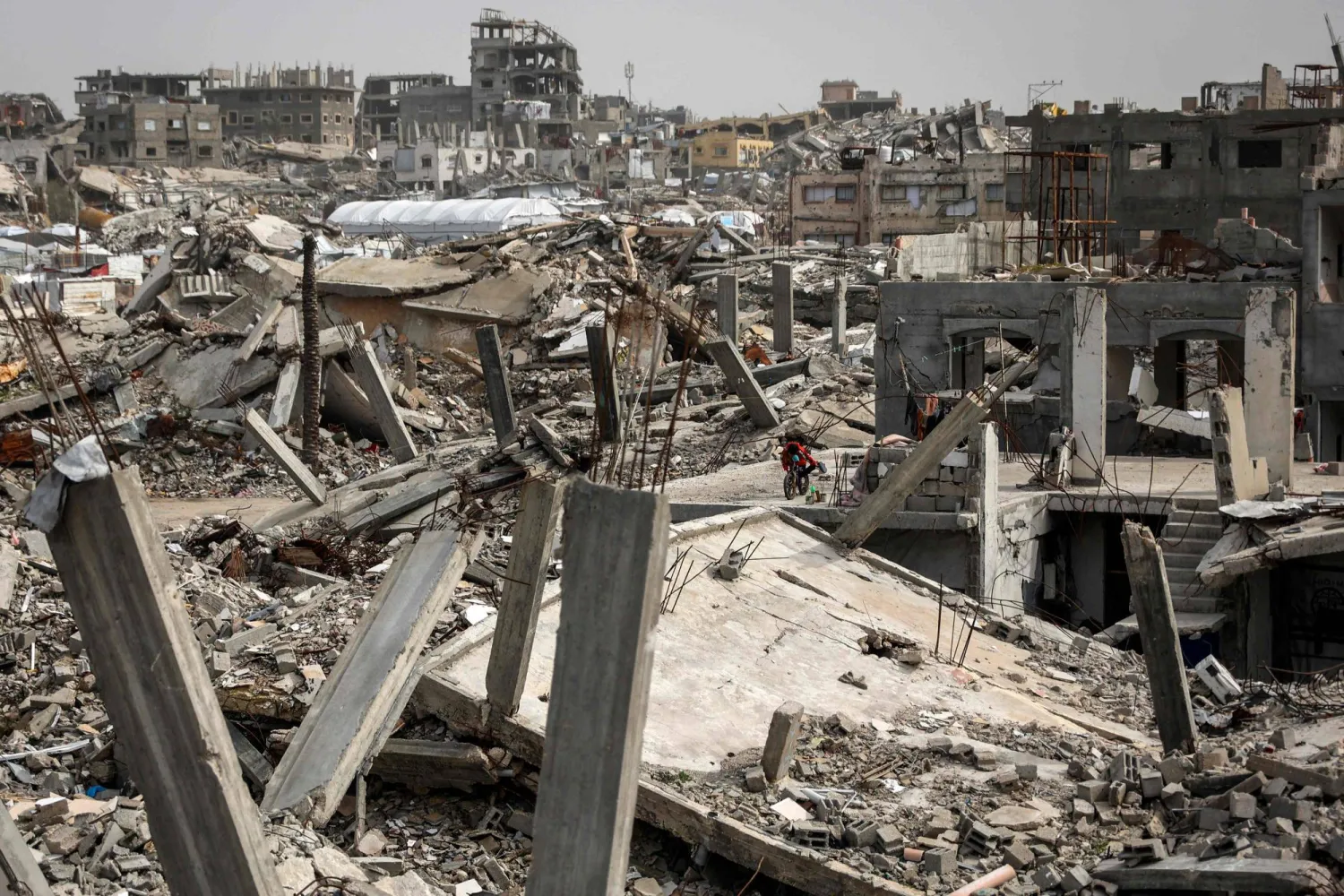
Many casualties are children desperate for something to do or searching through the rubble. Eyad BABA / AFP/File
TT

Shiny and Deadly, Unexploded Munitions a Threat to Gaza Children

Many casualties are children desperate for something to do or searching through the rubble. Eyad BABA / AFP/File

War has left Gaza littered with unexploded bombs that will take years to clear, with children drawn to metal casings maimed or even killed when they try to pick them up, a demining expert said.

Nicholas Orr, a former UK military deminer, told AFP after a mission to the war-battered Palestinian territory that "we're losing two people a day to UXO (unexploded ordnance) at the moment."

According to Orr, most of the casualties are children out of school desperate for something to do, searching through the rubble of bombed-out buildings sometimes for lack of better playthings.

"They're bored, they're running around, they find something curious, they play with it, and that's the end," he said.

Among the victims was 15-year-old Ahmed Azzam, who lost his leg to an explosive left in the rubble as he returned to his home in the southern city of Rafah after months of displacement.

"We were inspecting the remains of our home and there was a suspicious object in the rubble," Azzam told AFP.

"I didn't know it was explosive, but suddenly it detonated," he said, causing "severe wounds to both my legs, which led to the amputation of one of them."

He was one of hundreds of thousands of Palestinians returning home during a truce that brought short-lived calm to Gaza after more than 15 months of war, before Israel resumed its bombardment and military operations last month.

For Azzam and other children, the return was marred by the dangers of leftover explosives.

'Attractive to kids'

Demining expert Orr, who was in Gaza for charity Handicap International, said that while no one is safe from the threat posed by unexploded munitions, children are especially vulnerable.

Some ordnance is like "gold to look at, so they're quite attractive to kids", he said.

"You pick that up and that detonates. That's you and your family gone, and the rest of your building."

Another common scenario involved people back from displacement, said Orr, giving an example of "a father of a family who's moved back to his home to reclaim his life, and finds that there's UXO in his garden".

"So he tries to help himself and help his family by moving the UXO, and there's an accident."

With fighting ongoing and humanitarian access limited, little data is available, but in January the UN Mine Action Service said that "between five and 10 percent" of weapons fired into Gaza failed to detonate.

It could take 14 years to make the coastal territory safe from unexploded bombs, the UN agency said.

Alexandra Saieh, head of advocacy for Save The Children, said unexploded ordnance is a common sight in the Gaza Strip, where her charity operates.

"When our teams go on field they see UXOs all the time. Gaza is littered with them," she said.

'Numbers game'

For children who lose limbs from blasts, "the situation is catastrophic", said Saieh, because "child amputees require specialized long-term care... that's just not available in Gaza".

In early March, just before the ceasefire collapsed, Israel blocked all aid from entering Gaza. That included prosthetics that could have helped avoid long-term mobility loss, Saieh said.

Unexploded ordnance comes in various forms, Orr said. In Gaza's north, where ground battles raged for months, there are things like "mortars, grenades, and a lot of bullets".

In Rafah, where air strikes were more intense than ground combat, "it's artillery projectiles, it's airdrop projectiles", which can often weigh dozens of kilograms, he added.

Orr said he was unable to obtain permission to conduct bomb disposal in Gaza, as Israeli aerial surveillance could have mistaken him for a militant attempting to repurpose unexploded ordnance into weapons.

He also said that while awareness-raising could help Gazans manage the threat, the message doesn't always travel fast enough.

"People see each other moving it and think, 'Oh, they've done it, I can get away with it,'" Orr said, warning that it was difficult for a layperson to know which bombs might still explode, insisting it was not worth the risk.

"You're just playing against the odds, it's a numbers game."


Salam Concludes Visit to South Lebanon: Region Must Return to State Authority

Lebanon's Prime Minister Nawaf Salam (L) holds bouquets of flower as he stands next to the mayor of the heavily-damaged southern village of Kfar Shouba, near the border with Israel, during his visit on February 8, 2026. (AFP)
TT

Salam Concludes Visit to South Lebanon: Region Must Return to State Authority

Lebanon's Prime Minister Nawaf Salam (L) holds bouquets of flower as he stands next to the mayor of the heavily-damaged southern village of Kfar Shouba, near the border with Israel, during his visit on February 8, 2026. (AFP)

Lebanese Prime Minister Nawaf Salam vowed on Sunday to work on rebuilding infrastructure in southern villages that were destroyed by Israel during its last war with Hezbollah.

On the second day of a tour of the South, he declared: “We want the region to return to the authority of the state.”

He was warmly received by the locals as he toured a number of border villages that were destroyed by Israel during the conflict. His visit included Kfar Kila, Marjeyoun, Kfar Shouba and Kfar Hamam. He kicked off his tour on Saturday by visiting Tyre and Bint Jbeil.

The visit went above the differences between the government and Hezbollah, which has long held sway over the South. Throughout the tour, Salam was greeted by representatives of the “Shiite duo” of Hezbollah and its ally the Amal movement, as well as MPs from the Change bloc and others opposed to Hezbollah.

In Kfar Kila, the locals raised a banner in welcome of the PM, also offering him flowers and an olive branch. The town was the worst hit during the war with Israel, which destroyed nearly 90 percent of its buildings and its forces regularly carrying out incursions there.

Salam said the town was “suffering more than others because of the daily violations and its close proximity to the border.”

He added that its residents cannot return to their homes without the reconstruction of its infrastructure, which should kick off “within the coming weeks.”

“Our visit underlines that the state and all of its agencies stand by the ruined border villages,” he stressed.

“The government will continue to make Israel commit” to the ceasefire agreement, he vowed. “This does not mean that we will wait until its full withdrawal from occupied areas before working on rehabilitating infrastructure.”

Amal MP Ali Hassan Khalil noted that the people cannot return to their town because it has been razed to the ground by Israel and is still coming under its attacks.

In Marjeyoun, Salam said the “state has long been absent from the South. Today, however, the army has been deployed and we want it to remain so that it can carry out its duties.”

“The state is not limited to the army, but includes laws, institutions, social welfare and services,” he went on to say.

Reconstruction in Marjeyoun will cover roads and electricity and water infrastructure. The process will take months, he revealed, adding: “The state is serious about restoring its authority.”

“We want this region to return to the fold of the state.”

MP Elias Jarade said the government “must regain the trust of the southerners. This begins with the state embracing and defending its people,” and protecting Lebanon’s sovereignty.

MP Firas Hamdan said the PM’s visit reflects his keenness on relations with the South.

Ali Murad, a candidate who ran against Hezbollah and Amal in Marjeyoun, said the warm welcome accorded to Salam demonstrates that the “state needs the South as much as the people of the South need the state.”

“We will always count on the state,” he vowed.

Hezbollah MP Hussein Jishi welcomed Salam’s visit, hoping “it would bolster the southerners’ trust in the state.”

Kataeb leader MP Sami Gemayel remarked that the warm welcome accorded to the PM proves that the people of the South “want the state and its sovereignty. They want legitimate institutions that impose their authority throughout Lebanon, without exception.”


Three Dead After Flooding Hits Northwest Syria

A child watches as civil defense teams open flooded roads in Idlib. (SANA)
TT

Three Dead After Flooding Hits Northwest Syria

A child watches as civil defense teams open flooded roads in Idlib. (SANA)

Two children and a Syrian Red Crescent volunteer have died as a result of flooding in the country's northwest, state media said on Sunday.

The heavy rains in Syria's Idlib region and the coastal province of Latakia have also wreaked havoc in displacement camps, according to authorities, who have launched rescue operations and set up shelters in the areas.

State news agency SANA reported "the death of a Syrian Arab Red Crescent volunteer and the injury of four others as they carried out their humanitarian duties" in Latakia province.

The Syrian Red Crescent said in a statement that the "a mission vehicle veered into a valley", killing a female volunteer and injuring four others, as they went to rescue people stranded by flash floods.

"A fifth volunteer was injured while attempting to rescue a child trapped by the floodwaters," it added.

SANA said two children died on Saturday "due to heavy flooding that swept through the Ain Issa area" in the north of Latakia province.

Authorities said Sunday they were working to clear roads in displacement camps in flooded parts of Idlib province.

The emergencies and disaster management ministry said 14 displacement camps in part of Idlib province were affected, with tents swamped, belongings swept away and around 300 families directly impacted.

Around seven million people remain internally displaced in Syria, according to the United Nations refugee agency, some 1.4 million of them living in camps and sites in the country's northwest and northeast.

The December 2024 ouster of longtime ruler Bashar al-Assad after more than 13 years of civil war revived hopes for many to return home, but the destruction of housing and a lack of basic infrastructure in heavily damaged areas has been a major barrier.


Hamas’s Meshal Rejects Disarmament or 'Foreign Rule'

Boys walk past the rubble of destroyed buildings in the Jabalia camp for Palestinian refugees in the northern Gaza Strip on February 8, 2026. (Photo by Omar AL-QATTAA / AFP)
TT

Hamas’s Meshal Rejects Disarmament or 'Foreign Rule'

Boys walk past the rubble of destroyed buildings in the Jabalia camp for Palestinian refugees in the northern Gaza Strip on February 8, 2026. (Photo by Omar AL-QATTAA / AFP)

A senior Hamas leader said Sunday that the Palestinian movement would not surrender its weapons nor accept foreign intervention in Gaza, pushing back against US and Israeli demands.

"Criminalizing the resistance, its weapons, and those who carried it out is something we should not accept," Khaled Meshal said at a conference in Doha.

"As long as there is occupation, there is resistance. Resistance is a right of peoples under occupation ... something nations take pride in," said Meshal, who previously headed the group.

A US-brokered ceasefire in Gaza is in its second phase, which foresees that demilitarization of the territory -- including the disarmament of Hamas -- along with a gradual withdrawal of Israeli forces.

Hamas has repeatedly said that disarmament is a red line, although it has indicated it could consider handing over its weapons to a future Palestinian governing authority.

Israeli officials say that Hamas still has around 20,000 fighters and about 60,000 Kalashnikovs in Gaza.

A Palestinian technocratic committee has been set up with a goal of taking over the day-to-day governance in the battered Gaza Strip, but it remains unclear whether, or how, it will address the issue of demilitarization.

The committee operates under the so-called "Board of Peace," an initiative launched by US President Donald Trump.

Originally conceived to oversee the Gaza truce and post-war reconstruction, the board's mandate has since expanded, prompting concerns among critics that it could evolve into a rival to the United Nations.

Trump unveiled the board at the World Economic Forum in the Swiss ski resort of Davos last month, where leaders and officials from nearly two dozen countries joined him in signing its founding charter.

Alongside the Board of Peace, Trump also created a Gaza Executive Board - an advisory panel to the Palestinian technocratic committee - comprising international figures including US envoys Steve Witkoff and Jared Kushner, as well as former British prime minister Tony Blair.

On Sunday, Meshal urged the Board of Peace to adopt what he called a "balanced approach" that would allow for Gaza's reconstruction and the flow of aid to its roughly 2.2 million residents, while warning that Hamas would "not accept foreign rule" over Palestinian territory.

"We adhere to our national principles and reject the logic of guardianship, external intervention, or the return of a mandate in any form," Meshal said.
"Palestinians are to govern Palestinians. Gaza belongs to the people of Gaza and to Palestine. We will not accept foreign rule," he added.