


Gaza Hospital Chief Held in 'Inhumane' Conditions by Israel, Says lawyer

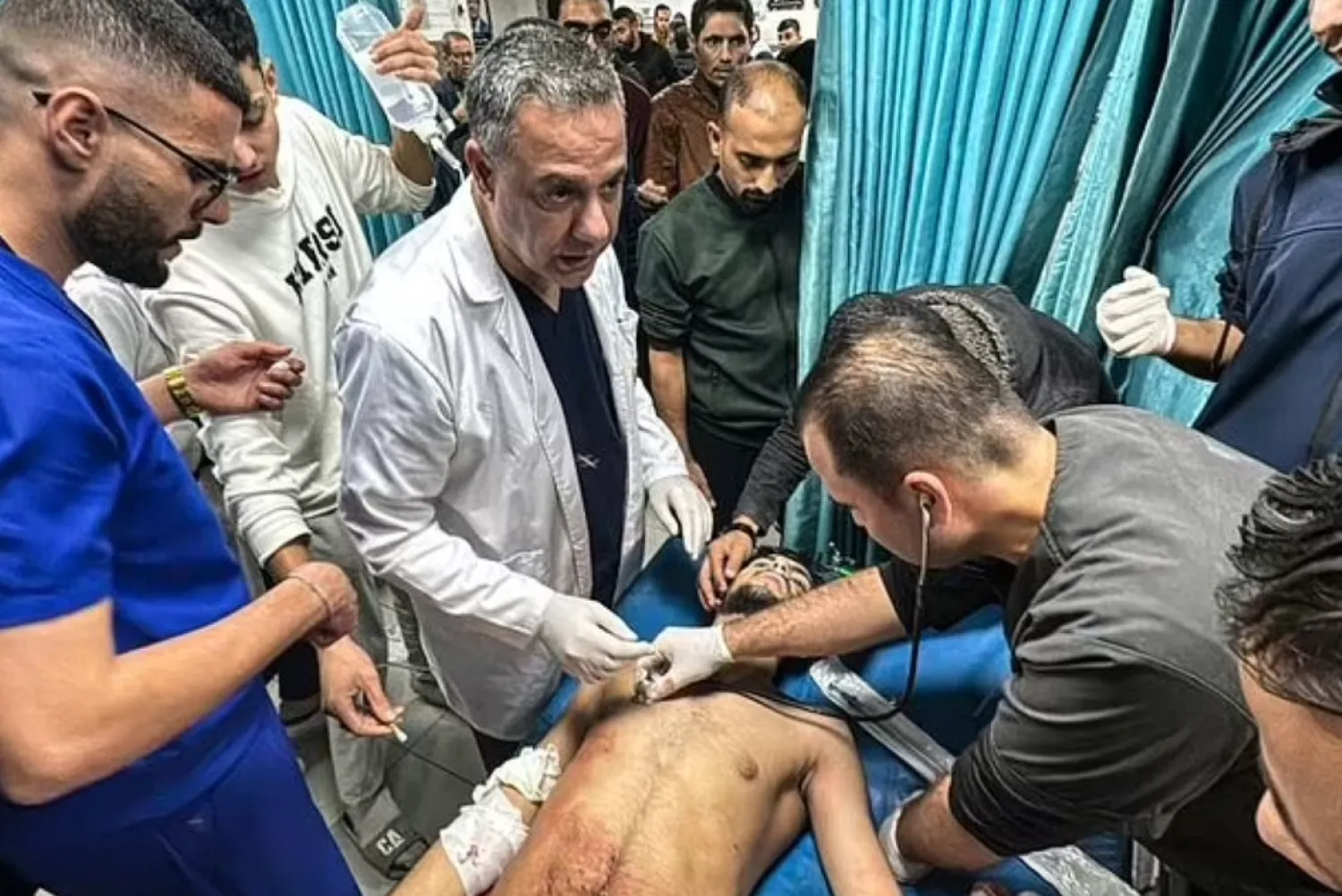
In this file photo, Hussam Abu Safiya, the director of the Kamal Adwan Hospital who has since been detained, supervises the treatment of a Palestinian man injured in an Israeli strike - AFP
TT

Gaza Hospital Chief Held in 'Inhumane' Conditions by Israel, Says lawyer

In this file photo, Hussam Abu Safiya, the director of the Kamal Adwan Hospital who has since been detained, supervises the treatment of a Palestinian man injured in an Israeli strike - AFP

The director of Gaza's Kamal Adwan hospital who was detained by Israeli forces in December is being held in "inhumane" conditions by Israel and subjected to "physical and psychological intimidation", his lawyer told AFP.

Hussam Abu Safiya, a 52-year-old paediatrician, rose to prominence last year by posting about the dire conditions in his besieged hospital in Beit Lahia during a major Israeli offensive.

On December 27, Israeli forces began an assault on the facility which they labelled a Hamas "terrorist centre", and arrested dozens of medical staff including Abu Safiya.

Abu Safiya's lawyer, Gheed Qassem, was able to visit the doctor on March 19 in Ofer prison in the occupied West Bank.

"He is suffering greatly, he is exhausted from the torture, the pressure and the humiliation he has endured to force him to confess to acts he did not commit," said Qassem who met an AFP correspondent in Nazareth.

The Israeli military did not respond to a request for comment from AFP about the conditions in which Abu Safiya is being held.

- 'Beatings and torture' -

After initially spending two weeks in the Sde Teiman military base in southern Israel's Negev desert, Abu Safiya was transferred to Ofer, where Israel keeps hundreds of Palestinian prisoners.

In Sde Teiman, Abu Safiya was subjected to interrogations "involving beatings, mistreatment and torture", Qassem said, before he was transferred to a cramped cell in Ofer for 25 days, where he was also subjected to questioning.

The Israeli authorities have designated the medic an "illegal combatant" for an "unlimited period of time", Qassem said, and his case has been designated confidential by the military, meaning Abu Safiya's defence cannot access the files.

She denounced what she said were restrictions imposed on legal visits, which have prevented lawyers from informing detainees about "the war, the date, the time or their geographic location".

Her meeting with Abu Safiya, which took place under tight surveillance, lasted for only 17 minutes, she said.

Adopted in 2002, Israel's law concerning "illegal combatants" permits the detention of suspected members of "hostile forces" outside of normal legal frameworks.

In January, rights group Amnesty International demanded Abu Safiya's release, citing witness testimonies describing "the horrifying reality" in Israeli prisons, where Palestinian detainees are subjected to "systematic acts of torture and other mistreatment".

A social media campaign using the hashtag #FreeDrHussamAbuSafiya has brought together healthcare organizations, celebrities and UN leaders.

That includes the director of the World Health Organization, Tedros Adhanom Ghebreyesus, who demanded Abu Safiya's release in a post on X.

- 'Human duty' -

Qassem warned that her client's health was "very worrying".

"He is suffering from arterial tension, cardiac arrhythmia and vision problems," she said, adding "he has lost 20 kilos in two months and fractured four ribs during interrogations, without receiving proper medical care".

The doctor remains calm, she said, but "wonders what crime he has committed" to be subjected to "such inhumane conditions".

According to the lawyer, Abu Safiya's jailers are demanding that he confess to having operated on members of Hamas or Israeli hostages held in Gaza, but he has refused to do so and denies the accusations.

The doctor insists that he is just a paediatrician, "and everything he did was out of a moral, professional and human duty towards the patients and the wounded", Qassem said.

Since October 7, 2023, around 5,000 Gazans have been arrested by Israel, and some were subsequently released in exchange for hostages held in Gaza.

In general, they are accused of "belonging to a terrorist organizfation" or of posing "a threat to Israel's security," the lawyer said.

Qassem said that a number of detainees are being held without charge or trial and that their lawyers often did not know where their clients were during the first months of the war.


Türkiye Plans First Overseas Deepwater Drilling in Somalia Next Month

Türkiye Minister of Energy and Natural Resources Alparslan Bayraktar speaks during the conference 'Energy Security in the World and Türkiye: Risks and Solutions in Critical Minerals' at the Sabanci University Istanbul International Center for Energy and Climate (IICEC), in Istanbul, Türkiye, December 26, 2025. REUTERS/Umit Bektas
TT

Türkiye Plans First Overseas Deepwater Drilling in Somalia Next Month

Türkiye Minister of Energy and Natural Resources Alparslan Bayraktar speaks during the conference 'Energy Security in the World and Türkiye: Risks and Solutions in Critical Minerals' at the Sabanci University Istanbul International Center for Energy and Climate (IICEC), in Istanbul, Türkiye, December 26, 2025. REUTERS/Umit Bektas

Türkiye will send a drilling vessel to Somalia in February to carry out the country's first deepwater exploration project abroad, ‌Energy Minister ‌Alparslan Bayraktar ‌said.

He ‌said the operation with the Cagri Bey vessel will focus on offshore areas ⁠in Somali waters but did not ‍provide ‍details on targeted ‍reserves or investment size.

In 2024, Türkiye signed an energy exploration deal with Somalia. It has been ⁠seeking to diversify its energy sources and reduce reliance on imports, investing in exploration at home and overseas.


Libya Says UK to Analyze Black Box from Crash That Killed General

Military personnel carry portraits of the Libyan chief of staff, General Mohamed al-Haddad (2-R), and his four advisers, who were killed in a plane crash in Türkiye, during an official repatriation ceremony at the Ministry of Defense headquarters in Tripoli, Libya, 27 December 2025. (EPA)
TT

Libya Says UK to Analyze Black Box from Crash That Killed General

Military personnel carry portraits of the Libyan chief of staff, General Mohamed al-Haddad (2-R), and his four advisers, who were killed in a plane crash in Türkiye, during an official repatriation ceremony at the Ministry of Defense headquarters in Tripoli, Libya, 27 December 2025. (EPA)

Libya said on Thursday that Britain had agreed to analyze the black box from a plane crash in Türkiye on December 23 that killed a Libyan military delegation, including the head of its army.

General Mohammed al-Haddad and four aides died after a visit to Ankara, with Turkish officials saying an electrical failure caused their Falcon 50 jet to crash shortly after takeoff.

Three crew members, two of them French, were also killed.

The aircraft's black box flight recorder was found on farmland near the crash site.

"We coordinated directly with Britain for the analysis" of the black box, Mohamed al-Chahoubi, transport minister in the Government of National Unity (GNU), said at a press conference in Tripoli.

Haddad was very popular in Libya despite deep divisions between west and east.

Haddad was chief of staff for the Tripoli-based GNU.

Chahoubi told AFP a request for the analysis was "made to Germany, which demanded France's assistance" to examine the aircraft's flight recorders.

"However, the Chicago Convention stipulates that the country analyzing the black box must be neutral," he said.

"Since France is a manufacturer of the aircraft and the crew was French, it is not qualified to participate. The United Kingdom, on the other hand, was accepted by Libya and Turkey."

After meeting the British ambassador to Tripoli on Tuesday, Foreign Minister Taher al-Baour said a joint request had been submitted by Libya and Türkiye to Britain "to obtain technical and legal support for the analysis of the black box".

Chahoubi told Thursday's press briefing that Britain "announced its agreement, in coordination with the Libyan Ministry of Transport and the Turkish authorities".

He said it was not yet possible to say how long it would take to retrieve the flight data, as this depended on the state of the black box.

"The findings will be made public once they are known," Chahoubi said, warning against "false information" and urging the public not to pay attention to rumors.


STC Says Handing over Positions to National Shield Forces in Yemen's Hadhramaut, Mahra

National Shield forces in Hadhramaut. (National Shield forces)
TT

STC Says Handing over Positions to National Shield Forces in Yemen's Hadhramaut, Mahra

National Shield forces in Hadhramaut. (National Shield forces)

Southern Transitional Council (STC) forces in Yemen began on Thursday handing over military positions to the government’s National Shield forces in the Hadhramaut and al-Mahra provinces in eastern Yemen.

Local sources in Hadhramaut confirmed to Asharq Al-Awsat that the handover kicked off after meetings were held between the two sides.

Speaking on condition of anonymity, the sources said the National Shield commanders met with STC leaderships to discuss future arrangements. The sourced did not elaborate, but they confirmed that Emirati armored vehicles, which had entered Balhaf port in Shabwah were seen departing on a UAE vessel, in line with a Yemeni government request.

The National Shield is overseen by Presidential Leadership Council (PLC) Chairman Dr. Rashad al-Alimi.

A Yemeni official described Thursday’s developments as “positive” step towards uniting ranks and legitimacy against a common enemy – the Houthi groups.

The official, also speaking on condition of anonymity, underscored to Asharq Al-Awsat the importance of “partnership between components of the legitimacy and of dialogue to resolve any future differences.”

Meanwhile, on the ground, Yemeni military sources revealed that some STC forces had refused to quit their positions, prompting the forces to dispatch an official to Hadhramaut’s Seiyun city to negotiate the situation.