Syrian Presidency: SDF Call for Federalism Threatens the Country’s Unity, Safety
Syria’s interim President Ahmed al-Sharaa attends an interview with Reuters at the presidential palace, in Damascus, Syria March 10, 2025. (Reuters)
Syria's leaders said on Sunday that Kurdish demands for the country to adopt a decentralized system of government in a post-Assad political order posed a threat to national unity.
"We clearly reject any attempt to impose a partition or create separatist cantons under the terms of federalism or self-autonomy without a national consensus," Syrian President Ahmed al-Sharaa's office said in a statement.
"The unity of Syrian territory and its people is a red line," the statement said.
Rival Syrian Kurdish parties, including the dominant faction in the Kurdish-run northeast, agreed at a meeting in Syria's Kurdish-controlled city of Qamishli on Saturday on a common political vision for Syria's Kurdish minority.
A communique at the end of the conference, which was attended by US officials, demanded that a future Syrian constitution should enshrine respect for Kurdish national rights in Syria after the ouster of Bashar al-Assad.
"A joint Kurdish political vision has been formulated that expresses a collective will and its project for a just solution to the Kurdish issue in Syria as a decentralized democratic state," the pan-Kurdish statement said.
The Kurdish-led Syrian Democratic Forces (SDF), backed by the US, last month signed a deal with Damascus on merging Kurdish-led governing bodies and security forces with the central government.
The Syrian presidency's statement also said recent statements by SDF leaders advocating a federal solution went clearly against that deal.
The agreement with the SDF could be a "constructive step forward if it was implemented with national spirit, away from narrow agendas," it continued.
It warned against obstructing state institutions in regions held by the SDF and against imposing a monopoly on resources. "The SDF leadership cannot take unilateral decisions in northeastern Syria. There can be no stability and no future without real partnership," it declared.
During the 14-year civil war, Kurdish-led groups took control of roughly a quarter of Syrian territory, where most of the country's oil wealth is found along with fertile arable land that produces a major proportion of the country's wheat.
Kurdish officials have objected to the way Syria's new rulers are shaping the transition from Assad's rule, saying they are failing to respect Syria's diversity despite promises of inclusivity.
The presidency statement stressed that "Kurdish rights are being protected under the one state, without the need for foreign intervention or hegemony." It called on the SDF to commit to the agreement reached in March and to prioritize national interests.
Yemen Introduced the World to Coffee. Now, Its Coffeehouse Culture Is Booming in the UShttps://english.aawsat.com/culture/5268899-yemen-introduced-world-coffee-now-its-coffeehouse-culture-booming-us
Franchisee Ahmad Badr serves a drink and treat sampler at Arwa Yemeni Coffee on April 6, 2026, in Sunnyvale, Calif. (AP)
TT
TT
Yemen Introduced the World to Coffee. Now, Its Coffeehouse Culture Is Booming in the US
Franchisee Ahmad Badr serves a drink and treat sampler at Arwa Yemeni Coffee on April 6, 2026, in Sunnyvale, Calif. (AP)
Hundreds of years ago, Yemen helped introduce the world to coffee. Lately, the mountainous, war-ravaged country that borders Saudi Arabia and Oman is exporting something else: its coffee culture.
Yemeni coffeehouses are opening at a rapid pace across the US. The number of cafes run by six major chains that serve Yemeni-style drinks grew 50% last year to 136, according to Technomic, a restaurant industry consulting company. The count doesn’t include the many smaller chains and independent cafes serving coffees and teas imported from Yemen.
Yemeni coffeehouses are meeting the moment for several reasons. They stay open late — sometimes past 3 a.m., especially during Ramadan — and provide a place to socialize for the growing number of Americans who don’t drink alcohol. Last year, a Gallup poll found that just 54% US adults reported drinking alcohol, the lowest percentage in 90 years.
“Generally in the Middle East, our nightlife is coffee, right? People hang out at coffee shops, they play cards, they talk. We wanted to bring that here,” said Ahmad Badr, who owns an Arwa Yemeni Coffee franchise in Sunnyvale, California.
Another reason for the cafes’ popularity is the growing number of Americans of Arab descent. Between 2010 and 2024, the Arab American population in the US rose by 43%, compared to around 10% growth for the US population as a whole, according to the Arab American Institute.
While most Yemeni coffee shops are in places with high concentrations of Arab Americans, including Michigan, California and Texas, they’re also opening in locations as diverse as Alpharetta, Georgia; Overland Park, Kansas; and Portland, Maine.
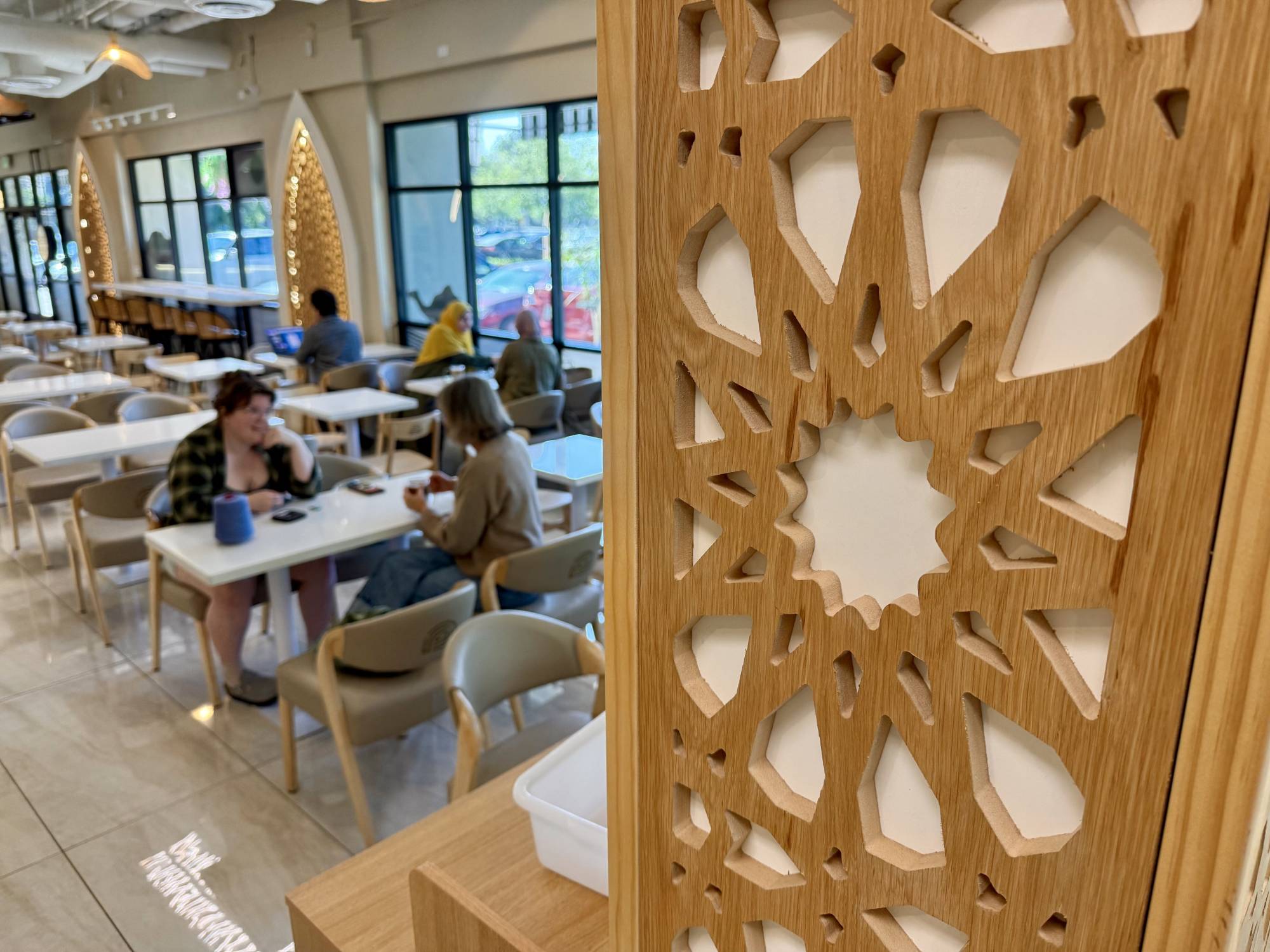
Customers are seen inside Arwa Yemeni Coffee on April 6, 2026, in Sunnyvale, Calif. (AP)
A taste of home
Faris Almatrahi is the co-founder and owner of Texas-based Arwa Yemeni Coffee, a chain with 11 cafes across the US and 30 more in development. He said an ongoing civil war in Yemen that began in 2014 has prevented Yemeni Americans like himself from visiting their homeland, so he has tried to evoke Yemen in his cafes.
Arwa locations are painted in natural desert tones, with archways that mimic mosques and lampshades shaped like the hats worn by Yemen’s coffee farmers.
“One of the ways to actually visit without traveling there was to bring that experience to the US, and that was a huge passion for us when we opened our first location,” Almatrahi said. “It was extremely emotional for all of us due to the fact that it really transported us to Yemen."
But Almatrahi noted that most of his customers aren’t of Arab descent. In fact, Americans of all backgrounds are seeking out new global flavors and authentic experiences, according to market research company Datassential. Food trends are also spreading quickly through social media.
Menus vary, but Yemeni cafes generally serve specialties like Adeni tea, a spiced tea similar to chai, and qishr, a traditional drink made from the dried husks of coffee cherries. Familiar drinks like lattes might contain special spices or honey; at Arwa, lattes features the outline of a camel stenciled in spices.
Bakery cases might contain khaliat nahal, or Yemeni honeycomb bread, a cheese-filled pastry drizzled with honey, or basboosa, a cake soaked in sugar syrup and often flavored with lemon or rose water. Many Yemeni menus also mix in more typical US coffeeshop fare, like matcha lattes or berry refreshers.
Franchisee Samir Irani pours Adeni tea inside Arwa Yemeni Coffee on April 6, 2026, in Sunnyvale, Calif. (AP)
Choices for coffee lovers
Peter Giuliano, a researcher with the Specialty Coffee Association, a California-based nonprofit, said culturally specific cafes have been a key growth driver in the US coffee industry for the last few years. In addition to Yemeni cafes, he cited the Latin-style chain Tierra Mia in California and Nguyen Coffee Supply, a New York-based company that roasts Vietnamese beans.
A customer who visited Badr's shop in Sunnyvale for the first time said an internet search brought her there on a recent weekday. Cindy Donovan said she’s always on the hunt for good coffee and was excited by Yemeni coffees she tried.
“I think they're much more refined and mellow, and much more full of flavor than a regular cup of dark roast, for instance,” Donovan said. “The cardamom in the drinks is fantastic. Very, very flavorful, rich but not heavy.”
Most Yemeni coffee is sun-dried, which enhances its flavor and brings out undertones of chocolate and fruit, Almatrahi said. Yemeni cafes often mix coffee with special spice mixes – or hawaij – that may contain cardamon, ginger, cinnamon, cloves, coriander or nutmeg.
“Our coffee and teas are not just made through a fully automatic machine,” said Mohamed Nasser, the director of operations for Haraz Coffee House, a Dearborn, Michigan-based chain with 50 US outlets and another 50 in development. “We have to manually blend and mix our coffee and tea, boil it with water and evaporated milk, make sure that it comes out (with the) perfect taste, perfect color.”
Yemen's flavorful history
Coffee has a long history in Yemen. While the plant was likely discovered in Ethiopia, by the 1400s it was being cultivated in Yemen, where monks brewed it to stay awake during prayers, according to the National Coffee Association, a US trade group.
Yemen monopolized the coffee trade for around 200 years until Dutch merchants smuggled coffee seeds to Indonesia and began growing plants there.
Almatrahi said a revitalization of the Yemeni coffee industry over the last two decades, led by coffee companies, foundations and young entrepreneurs, helped make the current US boom possible.
Coffee is one of the most promising sectors for economic development in Yemen, where more than 80% of the population lives in poverty, according to the Food and Agriculture Organization of the United Nations.
“We are ambassadors for our culture and our people. So when we open these shops, we want to perform the outreach, to show the hospitality, to show what we have to offer,” Almatrahi said.
RSF Drone Strike Kills Five in Sudan Capitalhttps://english.aawsat.com/arab-world/5268895-rsf-drone-strike-kills-five-sudan-capital
A painting depicting people holding the Sudanese flag is seen on a wall damaged by bullets and shrapnel in Omdurman, on the outskirts of Khartoum, Sudan, Thursday, April 23, 2026. (AP)
TT
TT
RSF Drone Strike Kills Five in Sudan Capital
A painting depicting people holding the Sudanese flag is seen on a wall damaged by bullets and shrapnel in Omdurman, on the outskirts of Khartoum, Sudan, Thursday, April 23, 2026. (AP)
A paramilitary drone killed five civilians on Saturday when it hit a vehicle in greater Khartoum, a rights group said, the second such attack in the Sudanese capital this week.
Drone attacks by both Sudan's army and the paramilitary Rapid Support Forces (RSF) -- which have been at war since April 2023 -- have intensified across the country in recent months, at times killing dozens of people in a single strike.
Emergency Lawyers, a Sudanese legal advocacy group documenting abuses during the conflict, said an RSF drone struck a civilian vehicle on the Jammouiya Triangle road Saturday morning in southern Omdurman -- just across the Nile from Khartoum proper -- killing all those on board.
The vehicle was travelling from the Sheikh al-Siddiq area in White Nile state, about 90 kilometers (56 miles) south of Khartoum, the group said.
Last Tuesday, a drone strike hit a hospital in the Jebel Awliya area, around 40 kilometers (25 miles) south of central Khartoum, a security source and eyewitnesses told AFP.
It was the first such attack on the capital in months, after the area was recaptured by the army a year ago from its paramilitary rivals.
Jebel Awliya had been the RSF's last foothold in Khartoum state before the army's rapid counteroffensive, which pushed the paramilitary west towards its stronghold in the Darfur region.
The RSF carried out a series of drone strikes on Khartoum last year, largely targeting military sites, power stations and water infrastructure.
In recent months, however, the capital has seen relative calm. More than 1.8 million displaced residents have returned and the airport has resumed domestic flights, although much of the city remains without electricity or basic services.
Fighting has since been concentrated in Darfur, where the army lost its last base in October, and in Kordofan, where the RSF has sought to regain control of Sudan's key east-west highway.
Violence has also spread to southeastern Blue Nile state near the border with Ethiopia, raising fears of a more prolonged and fragmented conflict.
Now in its fourth year, the war has killed tens of thousands of people -- with some estimates putting the death toll above 200,000 -- displaced millions and triggered one of the world's largest humanitarian crises.
Israel Says Two Gaza Flotilla Activists Brought in for Questioninghttps://english.aawsat.com/arab-world/5268893-israel-says-two-gaza-flotilla-activists-brought-questioning
Vessels of the Global Sumud Flotilla, which was intercepted on international waters by the Israeli Navy, sail off the city of Ierapetra, on the island of Crete, Greece, May 1, 2026. (Reuters)
TT
TT
Israel Says Two Gaza Flotilla Activists Brought in for Questioning
Vessels of the Global Sumud Flotilla, which was intercepted on international waters by the Israeli Navy, sail off the city of Ierapetra, on the island of Crete, Greece, May 1, 2026. (Reuters)
Two activists who participated in a Gaza-bound aid flotilla have been brought to Israel for questioning, the foreign ministry said Saturday, after the vessels were intercepted by Israeli forces.
The flotilla of more than 50 vessels had set sail from ports in France, Spain and Italy with the aim of breaking an Israeli blockade of Gaza and bringing supplies to the devastated Palestinian territory.
They were intercepted by Israeli forces in international waters off Greece early on Thursday.
Israel said it had removed around 175 activists from the flotilla, but organizers accused Israeli personnel of "kidnapping" 211 people.
Two of them, Saif Abu Keshek from Spain and Thiago Avila, a Brazilian, were taken to Israel "for questioning by law enforcement authorities", the foreign ministry said on X.
Spanish Foreign Minister Jose Manuel Albares denounced Israel's detention of Abu Keshek as "illegal", warning it came at a moment of already deteriorating ties between the two countries.
"We are facing an illegal detention in international waters, outside any jurisdiction of the Israeli authorities so Saif Abu Keshek must be released immediately so that he can return to Spain," Albares told Rac1 radio.
"This is an episode that further strains our relationship... (with Israel) because of how unacceptable this situation is, because a state does not conduct itself in this manner."
- Worsening ties -
Ties between Israel and Spain have nosedived since the Gaza war sparked by the October 2023 Hamas cross-border attacks, with Israel angered by Prime Minister Pedro Sanchez's unrelenting criticism of its bombardment of the Palestinian territory.
Both countries have withdrawn their ambassadors.
Israel's foreign ministry said the two activists were affiliated with an organization that was sanctioned by the US Treasury.
That group -- the Popular Conference for Palestinians Abroad (PCPA) -- has been accused by Washington of "clandestinely acting on behalf of" Palestinian group Hamas.
The Treasury said the organization had played a role in organizing other Gaza-bound flotillas aimed at breaking Israel's blockade.
Israel's foreign ministry said Abu Keshek was a leading member of the PCPA. It said Avila was also linked to the organization and was "suspected of illegal activity".
"Both will receive a consular visit from the representatives of their respective countries in Israel," the ministry said.
Albares rejected the allegation, saying: "The information I myself have requested indicates that no link can be established between Saif Abu Keshek and Hamas".
Avila was among the organizers of a flotilla that tried to bring aid to Gaza last year. That effort was also intercepted by Israeli forces.
- Activists 'beaten' -
Israel controls all entry points into Gaza and the territory has been under Israeli blockade since 2007.
Throughout the Gaza war, there have been shortages of critical supplies in the Palestinian territory, with Israel at times cutting off aid entirely.
Organizers of the latest flotilla said the Israeli interception took place more than 1,000 kilometers from Gaza.
They said their equipment was smashed and the intervention left them facing a "calculated death trap at sea".
Dozens of intercepted activists disembarked on Friday at the Greek island of Crete, according to an AFP journalist.
Organizers published photos on X showing two activists with bruises on their faces, while one participant said in footage that Israeli forces had "beaten" them "several times".
Hamas condemned the interception, urging rights groups to pursue legal action against Israeli authorities for "crimes against the Global Sumud Flotilla, ensuring they do not enjoy impunity".
The Global Sumud Flotilla's first Mediterranean voyage to Gaza in the summer and autumn of 2025 drew worldwide attention, before Israeli forces intercepted the boats off the coasts of Egypt and Gaza in early October.
Crew members, including Swedish activist Greta Thunberg, were arrested and expelled by Israeli forces.
لم تشترك بعد
انشئ حساباً خاصاً بك لتحصل على أخبار مخصصة لك ولتتمتع بخاصية حفظ المقالات وتتلقى نشراتنا البريدية المتنوعة