Yemen Appoints Salem Bin Buraik as New Prime Minister

Salem Saleh bin Buraik. (SPA)
TT

Yemen Appoints Salem Bin Buraik as New Prime Minister

Salem Saleh bin Buraik. (SPA)

Yemen’s Presidential Leadership Council on Saturday appointed Salem Saleh bin Buraik as the new Prime Minister replacing Ahmed Awad bin Mubarak who resigned earlier in the day.
Bin Buraik previously served as Minister of Finance in the former government.
A presidential decree issued by Council Chairman Rashad al-Alimi confirmed the appointment and stated that current ministers will continue in their roles, Yemen’s official news agency reported.
The decree also named bin Mubarak as an advisor to the Council’s president.
Bin Mubarak had resigned on Saturday citing political struggles.


Al-Zaidi Targets 'Intermediary Companies' in Defense Industry Contracts

PM Ali Al-Zaidi during his visit to the Defense Industries Commission. (INA)
TT

Al-Zaidi Targets 'Intermediary Companies' in Defense Industry Contracts

PM Ali Al-Zaidi during his visit to the Defense Industries Commission. (INA)

Iraqi Prime Minister Ali Al-Zaidi has ordered the Defense Industries Commission to bypass intermediary firms and contract directly with manufacturing companies, aiming to curb funding channels linked to armed factions.

The directive seeks to tighten oversight on government procurement by eliminating middlemen networks, which informed sources state serve as vital economic pipelines for various armed groups.

The policy shift arrives amid mounting tension between the government and certain factions, driven by Al-Zaidi’s broader push to restructure the relationship between state institutions and armed formations, including their commercial ventures. Sources familiar with the matter noted that the restriction has sparked significant concern among stakeholders who rely on intermediary networks tied to lucrative state contracts.

During a visit to the Defense Industries Commission on Thursday, Al-Zaidi stressed the "necessity of dealing directly with parent manufacturing companies, and absolutely not dealing with intermediary companies."

According to a statement from his media office, the directive is designed to ensure contract transparency while eliminating intermediary loops and vulnerabilities to corruption.

Al-Zaidi affirmed that Iraq possesses the capability to manufacture its weapons and equipment needs through national expertise, stating that building an advanced defense industry represents a fundamental pillar of national sovereignty. He stressed the importance of research and development, as well as keeping pace with technological advancements in military industries.

The Defense Industries Commission, which replaced the Military Industrialization Commission established by the former regime during the Iran-Iraq War, is one of the state institutions responsible for producing and developing military equipment.

Shadow companies

The government directive has renewed focus on the network of intermediary companies active in state contracting. Sources said that these firms are linked to the economic interests of factions and exploit political and administrative influence to expand their operations inside state institutions.

Some of these companies operate within a network linked to Al-Muhandis Company - one of the formations of the Popular Mobilization Forces (PMF) - or its front companies. Sources said that these entities are used to secure government contracts and provide financial resources to armed groups.

An informed source told Asharq Al-Awsat that these companies serve as "part of a financing mechanism for armed factions operating through two tracks: first, generating revenue from contracting and state procurement, and second, laundering funds to legitimize income derived from illicit activities, including oil and drug smuggling."

The source added that the operations of these firms are not confined to a specific authority or ministry. Instead, they extend across various state institutions, leveraging political and administrative clout to secure government contracts that provide their commercial transactions with official cover.

In the political context, disputes have begun to escalate between certain armed factions and parties within the Coordination Framework. Amid these tensions, factions are accusing political and government forces of cooperating with Al-Zaidi to reduce their economic and security influence in response to external pressures.

A recent wave of reports has emerged highlighting the commercial activities of figures and leaders within armed factions, including Kataib Hezbollah, though the accuracy of these accounts could not be independently verified.

Public debate is intensifying over the shifting role of these factions from their self-proclaimed status as "resistance forces" to entities managing economic interests and commercial influence networks.

This evolution raises questions regarding the exact nature of these commercial ventures, their relationship to the groups' weapons, and the strategic cost Iraq might ultimately incur should these factions decide to drag the country into a broader regional conflict.

Hussein Allawi, an expert in political affairs, said Al-Zaidi's visit to the Defense Industries Commission carried a message regarding the need to protect public funds and developing Iraqi defense capabilities through direct engagement with international companies.

Allawi told Asharq Al-Awsat that the PM is seeking to "strengthen the defense industry file," describing it as one of the sensitive areas that demand transparency and governance to ensure the quality of weapons and equipment used in Iraq.

He added that adopting direct contracts with international corporations, in accordance with applicable commercial laws and regulations, would curb the additional costs borne by the state due to multiple intermediary loops.

Security affairs researcher Mukhlad Hazem said Al-Zaidi's decision is a major step in confronting corporate networks that exploit the influence of political or armed factions to secure government contracts.

Hazem told Asharq Al-Awsat that these networks are not a new phenomenon, but rather have extended their activities over several years.

He revealed that certain groups monopolize massive state contracts to finance their economic entities, without necessarily delivering a corresponding return in terms of product quality or adherence to execution terms.


Egypt, Iran FMs Discuss Regional Developments

Egypt's Foreign Minister Badr Abdelatty speaks during a plenary session of the International Institute for Strategic Studies (IISS) Manama Dialogue 2026 in Manama on October 31, 2026. (AFP)
TT

Egypt, Iran FMs Discuss Regional Developments

Egypt's Foreign Minister Badr Abdelatty speaks during a plenary session of the International Institute for Strategic Studies (IISS) Manama Dialogue 2026 in Manama on October 31, 2026. (AFP)

Egyptian Foreign Minister Badr Abdelatty held telephone talks on Thursday with his Iranian counterpart Abbas Araghchi on the latest regional developments and efforts to ease tensions, reported dpa.

An Egyptian Foreign Ministry spokesman said the ministers exchanged views on the latest developments and concerns over the possibility of renewed military conflict and its impact on regional and international security and stability.

Abdelatty underlined the importance of prioritizing diplomatic solutions and urged all parties to demonstrate the necessary openness to reach a political settlement to the crisis.

He stressed that exercising flexibility and arriving at compromises would serve the interests of all sides and prevent the region from sliding into a new wave of escalation, which could otherwise yield severe political, economic, and humanitarian repercussions for the region and the entire world.


Yemen Warns against Houthis Using Red Sea to Extort Int’l Community

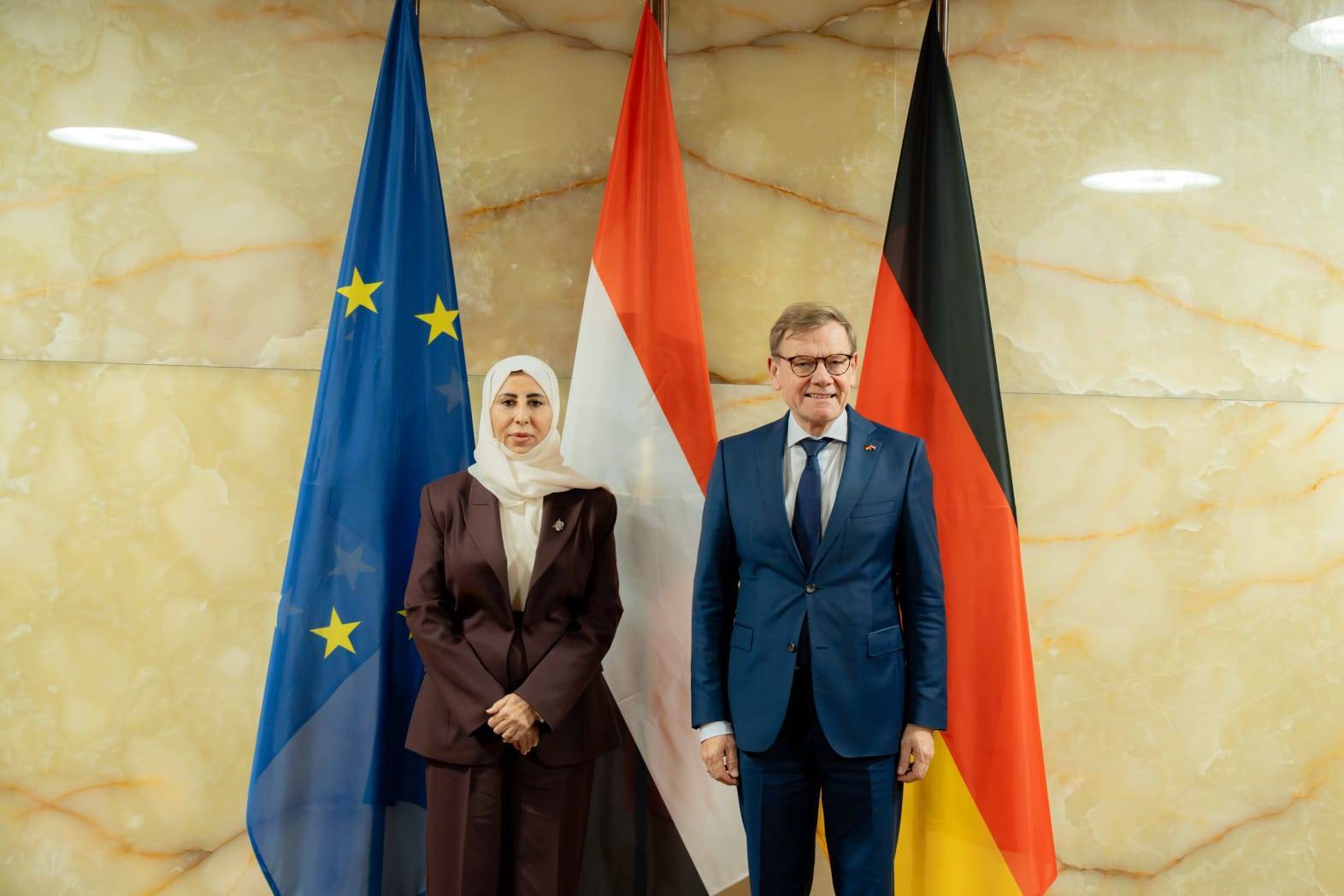
The Yemeni and German delegations meet in Berlin. (Yemeni government media)
TT

Yemen Warns against Houthis Using Red Sea to Extort Int’l Community

The Yemeni and German delegations meet in Berlin. (Yemeni government media)

The Yemeni government warned of an expanding threat posed by the terrorist Houthi militia to regional security and international navigation, citing growing Iranian involvement in managing Houthi military operations and growing ties with terrorist organizations in the Horn of Africa. The warning coincided with continued Houthi attacks on civilians and the tightening of the siege on the city of Taiz.

Yemeni Foreign Minister Afrah Al-Zouba presented these concerns during a series of meetings in Berlin with German officials and experts at think tanks and research centers specialized in Yemeni affairs.

The discussions addressed the developments of the Houthi escalation since last June, as well as its military, humanitarian, and security repercussions on Yemen and the wider region.

Al-Zouba stated that the Houthis intensified their attacks following the landing of an aircraft belonging to Iran's Mahan Air, which is linked to the Iranian Revolutionary Guard Corps (IRGC), at Hodeidah airport.

She explained that the plane carried Iranian experts, funds, and advanced weaponry to support Houthi military operations, in direct violation of Yemeni sovereignty and international laws and resolutions.

The escalation reached the west coast and Bab al-Mandeb regions prior to a government deployment under Operation Dawn of Yemen.

Authorities cautioned against renewed efforts by the militia to expand along the west coast, threaten shipping lanes in the Red Sea and Bab al-Mandeb Strait, and leverage maritime corridors to pressure the international community.

Meeting with German Foreign Minister Johann Wadephul, Al-Zouba warned that the Houthi threat extends beyond Yemen's borders, pointing to the militia’s targeting of Saudi territory and international shipping lanes, and the resulting risks to regional security and global energy and food supplies.

Yemeni Foreign Minister Afrah Al-Zouba meets with her German counterpart Johann Wadephul. (Yemeni government media)

She presented the Yemeni government's announcements regarding the participation of experts from the IRGC and Hezbollah in managing Houthi operations, in addition to the group's links with terrorist organizations in the Horn of Africa, chief among them the Somali Al-Shabaab movement.

These ties raise the level of threat to maritime security and regional stability, she warned.

The two sides discussed ways to develop the capabilities of the Yemeni Coast Guard to protect territorial waters and secure international trade routes, while strengthening bilateral consultation and information exchange regarding security developments in Yemen and the region.

Al-Zouba delivered a written letter from Chairman of the Presidential Leadership Council Dr. Rashad Al-Alimi to German Chancellor Friedrich Merz.

The message addressed bilateral relations, regional issues, and the latest updates on the situation in Yemen.

On the humanitarian level, Al-Zouba highlighted the Houthi siege on the city of Taiz, the targeting of civilian and health facilities, and the resulting closure of medical centers, medicine shortages, and lack of safe corridors, warning of catastrophic impacts on civilians.

She detailed the Houthi recruitment of child soldiers, indiscriminate landmine deployment, and the ongoing detention of UN and humanitarian personnel, noting the death of several detainees including UN staff member Mohammed Ibrahim Al-Shami.