


South Korea's Hanwha Ocean Targets US Navy Orders as Trump Seeks Shipbuilding Ties

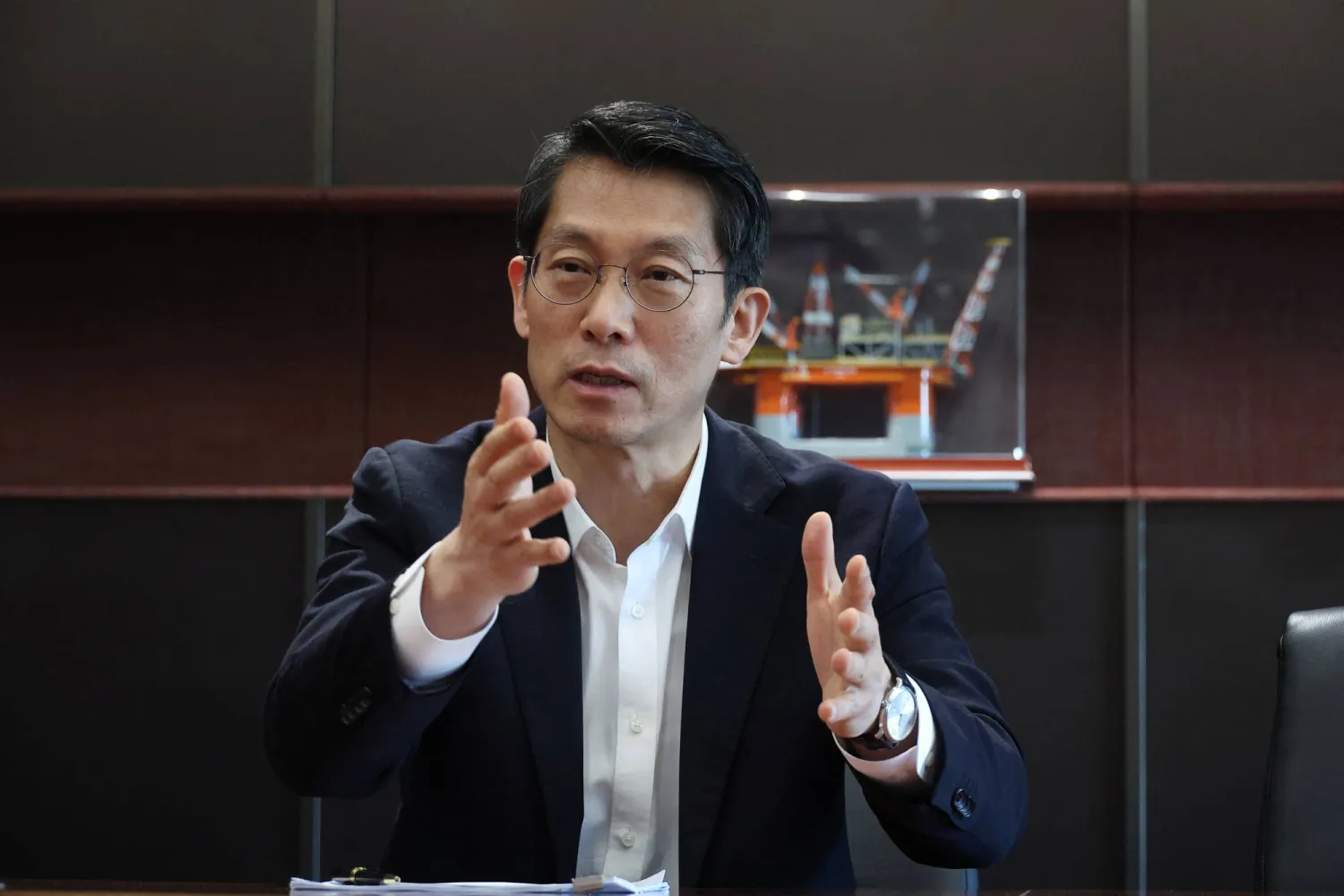
Steve SK Jeong, Head of Naval Ship International Business Department of Hanwha Ocean, speaks during an interview with Reuters in Seoul, South Korea, May 2, 2025.   REUTERS/Kim Hong-Ji
Steve SK Jeong, Head of Naval Ship International Business Department of Hanwha Ocean, speaks during an interview with Reuters in Seoul, South Korea, May 2, 2025. REUTERS/Kim Hong-Ji
TT

South Korea's Hanwha Ocean Targets US Navy Orders as Trump Seeks Shipbuilding Ties

Steve SK Jeong, Head of Naval Ship International Business Department of Hanwha Ocean, speaks during an interview with Reuters in Seoul, South Korea, May 2, 2025.   REUTERS/Kim Hong-Ji
Steve SK Jeong, Head of Naval Ship International Business Department of Hanwha Ocean, speaks during an interview with Reuters in Seoul, South Korea, May 2, 2025. REUTERS/Kim Hong-Ji

South Korean shipbuilder Hanwha Ocean aims to boost its revenue from overseas military vessels to around 4 trillion won ($2.91 billion) by 2030 and hopes to pick up more repair orders from the US Navy, a senior executive told Reuters.

The Asian country is a major global shipbuilder and trade talks with the US on tariffs brought up possible cooperation in the sector after US President Donald Trump signed an executive order to restore US shipbuilding.

Hanwha Ocean, formerly Daewoo Shipbuilding, is one of the largest shipbuilders in the world with an order book of $31.43 billion as of the end of March. It acquired a US shipyard in Philadelphia last year to expand in the market.

Its naval ships business, which has built dozens of submarines and surface vessels used by the South Korean Navy, has won two orders from the US Navy since last year to repair and overhaul its ships for the first time.

"I think we may be the biggest shipyard in the world that has taken on these maintenance, repair and overhaul orders from the US Navy," said Steve SK Jeong, head of the Naval Ship Global Business at Hanwha Ocean, days after US Secretary of the Navy John Phelan visited its shipyard.

"It is not very profitable, but learning the process of working with the US Navy is valuable, which will help if we win newbuild orders."

Hanwha Ocean hoped to win a double-digit number of US Navy maintenance and repair orders before 2030, Jeong said.

Trump has vowed to spend "a lot of money on shipbuilding" to restore US capacity, and cited concern over how his country has fallen behind in an industry that is also dominated by China.

Still, US laws can make it harder for foreign shipyards even if they have US operations. They are prohibited from building US Navy vessels, due to the Byrnes-Tollefson Amendment of the US Department of Defense Appropriations Act.

TRANSPLANTING PROCESSES

Hanwha Ocean's Philadelphia Shipyard is trying to get a license that clears it to build US Navy vessels, but transplanting cutting-edge manufacturing processes honed from competition with other South Korean and Chinese shipyards is not as simple as bringing in some automated welding machines, Jeong said.

"I think the US shipbuilding industry hasn't had to compete very much. Facilities are old, and there's a shortage of technicians," Jeong said.

"We are looking to modernize facilities, train and equip workers, and bring in our manufacturing process that can build the same ship in, I think, two-thirds the time or less as that of a US shipyard."

Jeong said the company is investing in South Korea to use existing facilities and expand naval ship capacity to build five submarines and three surface vessels at the same time by 2029, from two submarines and two surface vessels now.

Despite building 17 submarines for the South Korean Navy since 1987, Hanwha Ocean has only actively competed for overseas orders in the last few years as South Korea's low birthrate and shrinking military-age population risk cooling local demand.

It is competing to export submarines to Poland and Canada, a frigate to Thailand as well as knocking on the door in markets in the Middle East, South America, North Africa and Southeast Asia, to build up a sustained flow of orders that would bring foreign sales to 4 trillion won by 2030, Jeong said.

That would be about four times the size of its 1.05 trillion won of revenue in 2024.


Saudi PIF Backs Multibillion-Dollar Projects to Boost Sustainability

A solar power project in Saudi Arabia (SPA)
TT

Saudi PIF Backs Multibillion-Dollar Projects to Boost Sustainability

A solar power project in Saudi Arabia (SPA)

Saudi Arabia’s Public Investment Fund has fully allocated the proceeds of its green bond issuance, directing $9 billion to eligible projects, in a move that highlights the sovereign wealth fund’s growing role in shaping a more sustainable future and delivering lasting positive impact worldwide.

According to a recent report issued by the Public Investment Fund, reviewed by Asharq Al-Awsat, the expected impact of the fund’s eligible green projects includes generating 427 megawatts of renewable energy, avoiding emissions equivalent to 5.1 million tons of carbon dioxide, and treating 4 million cubic meters of wastewater.

The Public Investment Fund aims to establish itself as an active participant in global debt markets, while also fostering the development of a dynamic domestic market. This would enable the fund to access short- or long-term liquidity through a diverse range of financing instruments.

Financing strategy

The fund’s capital markets program aims to further strengthen its financing strategy and execution capabilities, both at the level of the Saudi sovereign wealth fund and across its portfolio companies, while enabling deeper engagement with global and local debt markets.

The program will also support expanding the fund’s capacity to raise debt and deploy it as a source of investment financing, in line with its overall funding strategy. This approach is designed to instill greater discipline in cash flow management and enhance returns on equity for the fund and its portfolio companies.

The green bond issuance will provide the fund with access to a broader pool of investors who prioritize environmental, social, and governance considerations in their investment decisions. It will also allow investors to diversify their portfolios through green assets, a step expected to help accelerate the pace of green investment globally.

Climate change

The fund has taken concrete steps to advance governance and policy, focusing on sustainability, and is a founding member of the One Planet Sovereign Wealth Funds initiative. This international platform aims to accelerate the integration of climate change considerations into asset management decisions and investment opportunities.

As an investment vehicle, the Public Investment Fund operates through acquiring stakes in companies aligned with its mandate, including ACWA Power and Lucid.

It has also established the Saudi Investment Recycling Company, a leader in waste management and recycling, manages the National Energy Services Company, Tarshid, and supports the creation of a voluntary carbon market in the Middle East and North Africa.

These efforts aim to strengthen Saudi Arabia’s position as one of the world’s most energy-efficient countries.

The green bond issuance will finance tangible projects on the ground, helping to accelerate the green transition and advance the Kingdom’s core targets of achieving net zero emissions by 2060 and generating 50 percent of electricity consumption from renewable energy sources by 2030.

This forms a key pillar of the renewable energy program implemented by the fund, which involves developing 70 percent of renewable power generation capacity.


Saudi E-Commerce Hits Record Monthly Sales over SAR30.7 Billion in October

A view of Riyadh, Saudi Arabia. (SPA file)
TT

Saudi E-Commerce Hits Record Monthly Sales over SAR30.7 Billion in October

A view of Riyadh, Saudi Arabia. (SPA file)

E-commerce sales in Saudi Arabia via "mada" cards soared to an all-time monthly high in October 2025, surpassing SAR30.7 billion.

The surge in sales represents a 68% year-on-year increase, totaling about SAR12.4 billion more than the SAR18.3 billion recorded in October 2024, according to the Saudi Central Bank (SAMA) statistical bulletin on Wednesday.

E-commerce sales for the third quarter (Q3) of 2025 hit SAR88.3 billion, up 15.2% from the previous quarter, representing an increase of about SAR11.6 billion over the SAR76.6 billion recorded in Q2.

On a monthly basis, e-commerce sales in October rose 6%, gaining approximately SAR1.6 billion over September’s total of SAR29.1 billion.

From January to October, "mada" data showed e-commerce sales grew 47.3%, rising by around SAR9.9 billion over the SAR20.9 billion recorded in January.

These figures cover transactions made via "mada" cards on e-commerce websites, apps, and digital wallets, and do not include credit-card payments.


Jeddah's King Abdulaziz Airport Launches First Direct Flight to Moscow

The expansion supports Jeddah Airports Company’s goal of broadening travel options and increasing air traffic revenue, leveraging the Kingdom's strategic location. (SPA)
TT

Jeddah's King Abdulaziz Airport Launches First Direct Flight to Moscow

The expansion supports Jeddah Airports Company’s goal of broadening travel options and increasing air traffic revenue, leveraging the Kingdom's strategic location. (SPA)

Jeddah's King Abdulaziz International Airport (KAIA) celebrated the launch of its first direct flynas flight to Moscow, operating three weekly flights between Jeddah and Vnukovo International Airport.

This initiative, in partnership with the Saudi Tourism Authority and the Air Connectivity Program, boosts air links between Saudi Arabia and Russia.

It marks KAIA's third direct Russian destination, following Makhachkala and Mineralnye Vody, which were inaugurated earlier this month by Azimuth Airlines.

The expansion supports Jeddah Airports Company’s goal of broadening travel options and increasing air traffic revenue, leveraging the Kingdom's strategic location.
