


How Artificial Intelligence Is Reshaping Saudi Arabia’s Labor Market

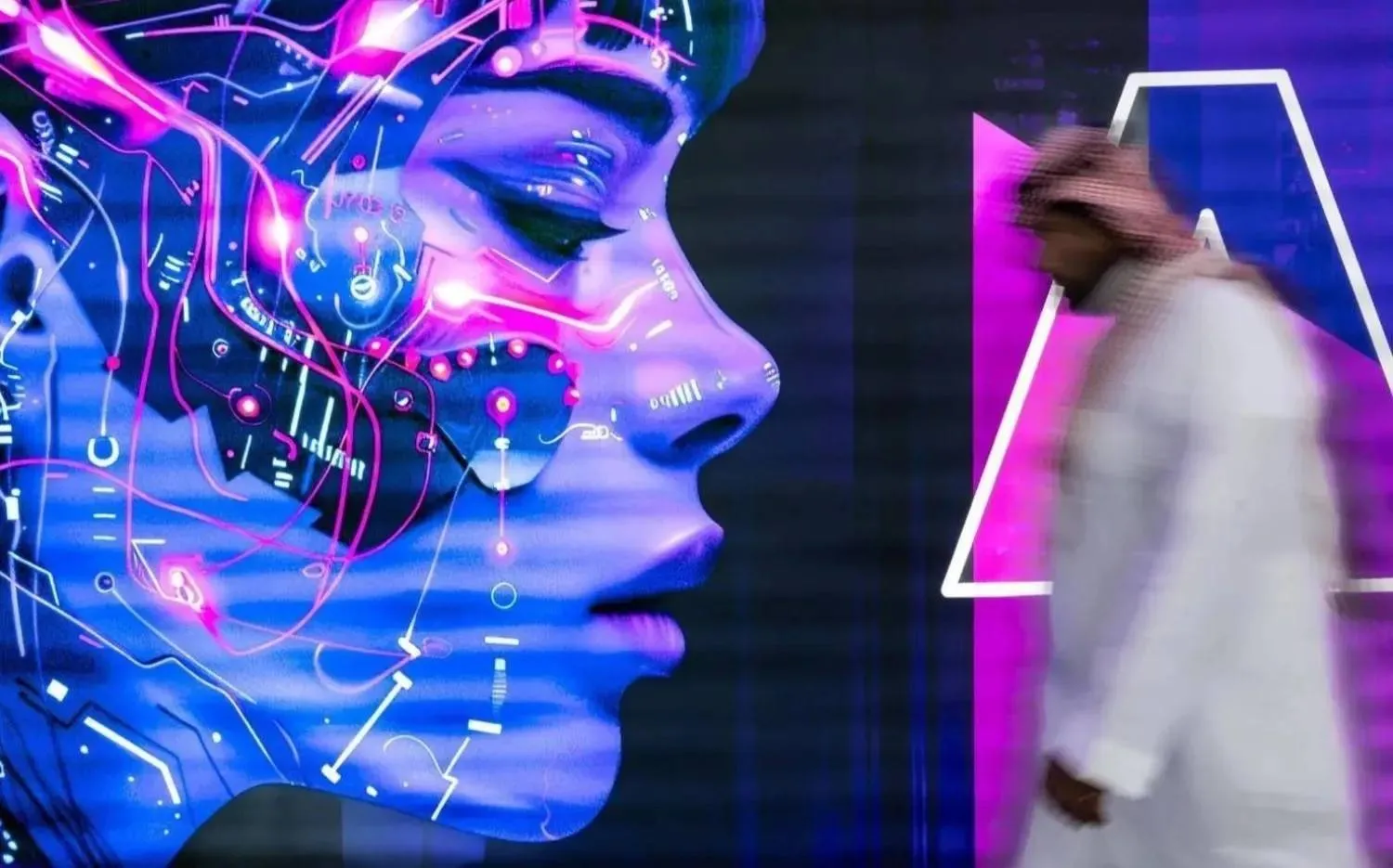
A man walks past an AI screen at the LEAP 25 conference in Riyadh. (SPA)
TT

How Artificial Intelligence Is Reshaping Saudi Arabia’s Labor Market

A man walks past an AI screen at the LEAP 25 conference in Riyadh. (SPA)

Artificial intelligence (AI) and emerging technologies are increasingly becoming the cornerstone of Saudi Arabia’s future labor market as the Kingdom undergoes rapid digital transformation. While automation is boosting efficiency and productivity, it also underscores the urgent need to reskill the current workforce and prepare younger generations with future-ready skills. The widening gap between traditional education and evolving market demands calls for decisive action.

This shift does not signal the disappearance of jobs, but rather their redefinition. Routine tasks are giving way to roles requiring analytical thinking, digital fluency, and creativity. The very nature of employment is transforming from simply executing tasks to managing complex solutions.

AI is accelerating this evolution across key sectors including healthcare, manufacturing, and finance, where local case studies show how the technology is cutting costs and improving operational performance.

Yet, despite the opportunities AI presents for growth and job creation, significant challenges remain. Chief among them are high adoption costs, underdeveloped infrastructure, and a shortage of qualified professionals.

Addressing these issues will require coordinated efforts from the government, private sector, and educational institutions to ensure a balanced digital transformation, one that empowers human potential rather than marginalizing it.

Ali Al-Eid, a human resources expert, told Asharq Al-Awsat that digital transformation, future readiness, and awareness of key job skills are now central pillars of Saudi Arabia’s national development strategy.

While some fear AI may lead to mass job losses, Al-Eid said it will instead reshape existing roles. He expects routine jobs to fade, replaced by positions that demand analytical, digital, and advanced interpersonal skills.

Employment will increasingly prioritize flexibility and innovation over years of experience, he added.

AI is boosting automation, enabling big data analysis, and improving the speed and accuracy of decision-making, he noted. These changes are reducing waste and enhancing efficiency in sectors like healthcare, logistics, finance, and human resources, where faster decisions and improved outcomes are already evident.

He stressed the need for comprehensive strategies that foster innovation, encourage the adoption of new technologies, and ensure a fair transition for workers. This includes investing in reskilling programs and providing social safety nets.

According to Al-Eid, the success of future employment initiatives hinges on the private sector’s commitment to keeping pace with technological change.

Economic policy expert Ahmed Al-Shehri echoed these views, noting that AI is rapidly redrawing the contours of Saudi Arabia’s labor market, fueled by Vision 2030’s push to diversify the economy and drive innovation.

He said AI is automating routine tasks and improving work quality across public and private sectors. Based on global trends, he estimated that between 25 and 30 percent of existing jobs in the Kingdom could be affected by AI by 2030. At the same time, the technology will create new opportunities in high-tech fields and increase productivity by streamlining operations.

The oil sector is already seeing tangible benefits. Saudi Aramco, for example, uses AI for predictive maintenance, reducing costs and boosting operational efficiency by up to 20 percent. Al-Shehri added that many educational institutions and stakeholders are prioritizing future skill development to close the gap between conventional education and the needs of a high-tech economy.

He said current policies are capable of striking a balance between accelerating technological adoption and preserving existing jobs, thanks to incentives and public-private partnerships, such as those driving mega-projects like NEOM.

Tarek Mansour, senior partner at McKinsey, highlighted the findings of recent research by the Future Investment Initiative in collaboration with his firm. According to the study, automation and skill development are key drivers of productivity in the region.

It estimated that productivity could grow by 2.7 percent annually by 2030, driven by modern technologies like generative AI, which boosts human creativity in critical sectors such as healthcare and scientific research.

Mansour noted that the benefits of digital transformation extend beyond productivity gains. New jobs will be created, and talent shortages in specialized fields, particularly in science, technology, engineering, and mathematics, could be eased.

Gulf countries already possess a strong talent pool and can launch large-scale skill-building programs, especially in strategic and technical sectors, to meet evolving labor market demands and improve youth employment prospects, he remarked.

Saudi Arabia, he added, has made impressive strides in embracing technology, with a clear focus on AI readiness and the development of digital infrastructure to keep pace with rapid technological change. A 2024 survey conducted for the study found that 56 percent of companies in the Middle East and North Africa are using AI, compared to 85 percent in the European Union and the United States.

However, Mansour pointed out that key barriers to adopting advanced technologies include implementation costs, infrastructure limitations, and a lack of skilled workers. In the Middle East, 52 percent of business leaders cited high costs as a major obstacle, while 45 percent pointed to infrastructure challenges.


China Approves First Two Level-3 Autonomous Driving Cars from State-owned Automakers

People pass by the entrance to Volkswagen (China) Technology Company, a 3 billion euros ($3.5 billion) R&D center in Hefei in eastern China's Anhui province, on Feb. 25, 2025. (AP Photo/Ken Moritsugu)
TT

China Approves First Two Level-3 Autonomous Driving Cars from State-owned Automakers

People pass by the entrance to Volkswagen (China) Technology Company, a 3 billion euros ($3.5 billion) R&D center in Hefei in eastern China's Anhui province, on Feb. 25, 2025. (AP Photo/Ken Moritsugu)

China's industry regulator on Monday approved two Chinese cars with level-3 autonomous driving capabilities, marking the first time such vehicles have been cleared by the national regulator as legitimate products ready for mass adoption.

The Ministry of Industry and Information Technology approved the two electric sedans from state-owned automakers Changan Auto and BAIC Motor in its latest automobile product entry category, said Reuters.

The two models are allowed to activate conditional autonomous driving in designated areas of Chongqing and Beijing with speed limits of 50km/h and 80km/h, respectively, the ministry said in a statement. The automakers will conduct trial operation with the cars on the specific roads via their ride-hailing units, it added.

The auto industry has defined five levels of autonomous driving, from cruise control at level one to fully self-driving cars at level five, and level three allows drivers to take their eyes and hands off the road in certain situations.

The move underscored China's ambition to lead the development and adoption of autonomous driving, a technology poised to disrupt the auto industry globally. Last year, China lined up nine automakers for public tests to advance the adoption of self-driving cars.

Chinese regulators earlier this year had sharpened scrutiny of the assisted driving technologies following an accident involving a Xiaomi SU7 sedan in March. That incident killed three occupants when their car crashed seconds after the driver took control from the assisted-driving system.

But government officials are pressing Chinese automakers to rapidly deploy even more advanced systems. In their level-3 push, Chinese regulators also are upping the regulatory ante by holding automakers and parts suppliers liable if their systems fail and cause an accident.

Autonomous driving developers such as Pony AI and WeRide have been testing their level-4 cars with licenses granted by local governments across China.

Tesla's Full Self-Driving, a level-2 driver assistance system, has been partially approved in China since February and falls short of its capabilities in the United States.


Elm Company Named Strategic Partner for International Data and AI Conference

Elm Company Named Strategic Partner for International Data and AI Conference
TT

Elm Company Named Strategic Partner for International Data and AI Conference

Elm Company Named Strategic Partner for International Data and AI Conference

The Saudi Data and Artificial Intelligence Authority (SDAIA) announced a strategic partnership with Elm Company for the International Conference on Data and AI Capacity Building (ICAN 2026), enhancing collaboration to empower the data and artificial intelligence ecosystem and promote innovation in education and human capacity development.

This partnership comes as part of preparations for ICAN 2026, organized by SDAIA from January 28 to 29 at King Saud University in Riyadh, with the participation of a select group of specialists and experts from around the world, SPA reported.

The step represents a qualitative addition that contributes to enriching the conference’s knowledge content and expanding partnerships with leading national entities.

Elm Company brings extensive experience in designing digital solutions and building technical capabilities, reinforcing its role as a strategic partner in supporting the conference. It contributes by developing training tracks and digital empowerment programs, participating in the technology exhibition, and presenting qualitative initiatives that help empower national competencies in the fields of data and artificial intelligence.


Foxconn to Invest $510 Million in Kaohsiung Headquarters in Taiwan

Construction is scheduled to start in 2027, with completion targeted for 2033. Reuters
TT

Foxconn to Invest $510 Million in Kaohsiung Headquarters in Taiwan

Construction is scheduled to start in 2027, with completion targeted for 2033. Reuters

Foxconn, the world’s largest contract electronics maker, said on Friday it will invest T$15.9 billion ($509.94 million) to build its Kaohsiung headquarters in southern Taiwan.

That would include a mixed-use commercial and office building and a residential tower, it said. Construction is scheduled to start in 2027, with completion targeted for 2033.

Foxconn said the headquarters will serve as an important hub linking its operations across southern Taiwan, and once completed will house its smart-city team, software R&D teams, battery-cell R&D teams, EV technology development center and AI application software teams.

The Kaohsiung city government said Foxconn’s investments in the city have totaled T$25 billion ($801.8 million) over the past three years.