

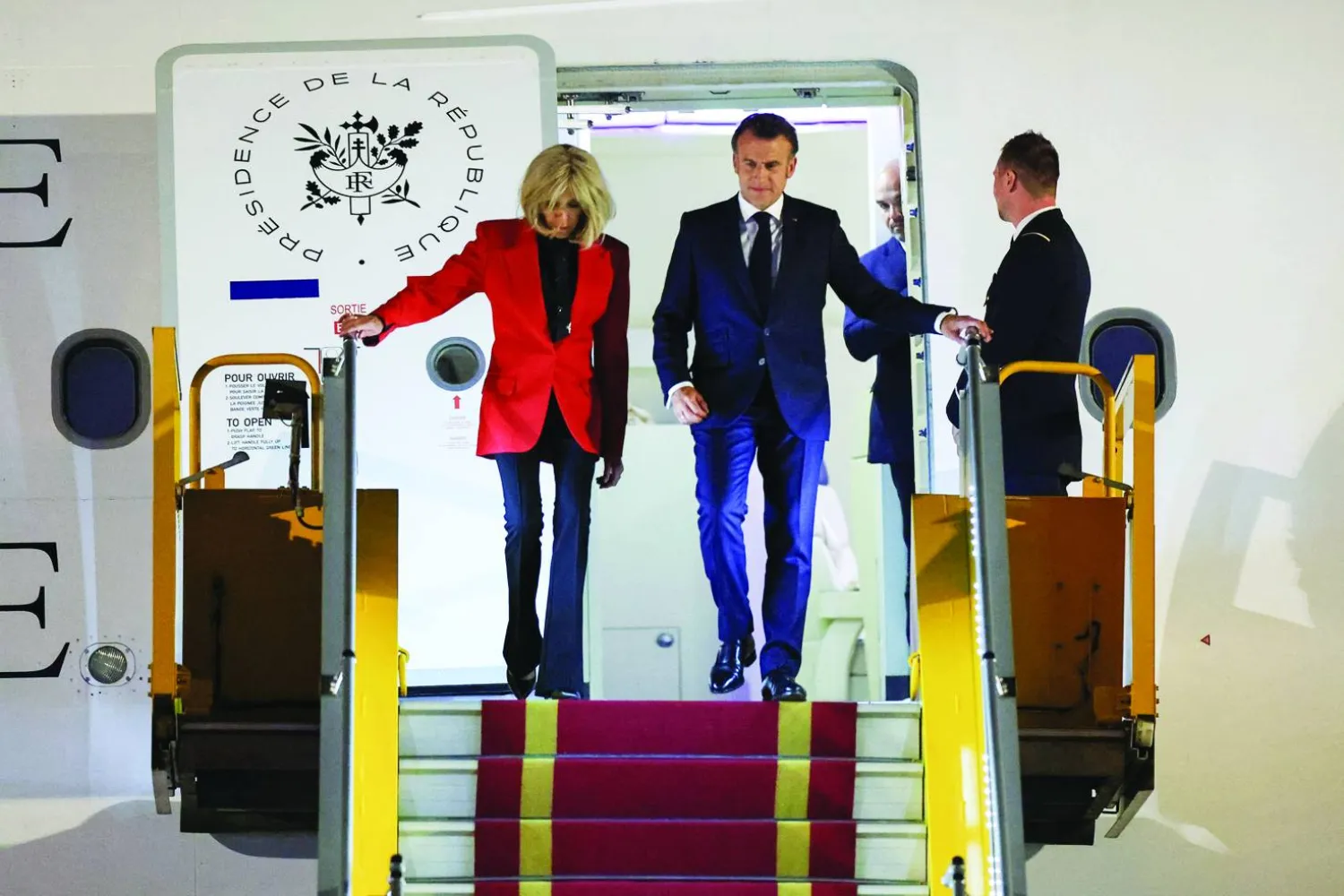

France, Vietnam Sign Airbus, Satellite Deals as Macron Visits Hanoi

France's President Emmanuel Macron and his wife Brigitte Macron arrive at Noi Bai International Airport, marking the first trip to Vietnam by a French president in nearly a decade, in Hanoi, Vietnam, May 25, 2025. REUTERS/Chalinee Thirasupa
TT

France, Vietnam Sign Airbus, Satellite Deals as Macron Visits Hanoi

France's President Emmanuel Macron and his wife Brigitte Macron arrive at Noi Bai International Airport, marking the first trip to Vietnam by a French president in nearly a decade, in Hanoi, Vietnam, May 25, 2025. REUTERS/Chalinee Thirasupa

France and Vietnam signed a deal on Monday for 20 Airbus planes, among other pacts, as President Emmanuel Macron visited Hanoi seeking to boost France's influence in its former colony, grappling with threats of crippling US tariffs.

Macron's first formal visit to Vietnam, the first by a French president in nearly a decade, follows US President Donald Trump's threats on Friday of 50% duties on EU goods from June that sharply fueled tension with the 27-nation bloc.

Export-dependent Vietnam, under pressure from Washington to buy more American goods, has made pledges in trade talks to avert 46% tariffs that could impair its growth, fanning European concerns about deals at the region's expense, said AFP.

Deals signed during Macron's visit covered the plane purchase, cooperation on nuclear energy, railways, Airbus earth-observation satellites and Sanofi vaccines, a list of documents seen by Reuters showed, confirming an earlier report.

In statements to the press with no questions allowed, Macron reiterated France's support of freedom of navigation, an issue dear to Vietnam as it often clashes with Beijing over contested boundaries in the South China Sea.

Macron added the partnership with Vietnam "entails a reinforced defense cooperation", citing the signing of multiple projects on defense and space.

Vietnam's President Luong Cuong said the defense partnership involved "sharing of information on strategic matters" and stronger cooperation in the defense industry, cybersecurity and anti-terrorism.

France ruled the Southeast Asian country for about 70 years until it was forced out in 1954 after a major defeat at Dien Bien Phu in northern Vietnam. Ties have improved in recent decades, being upgraded last year to Vietnam's highest level.

On his trip, the first leg of a Southeast Asian tour that includes Indonesia and Singapore, Macron will visit a university in Hanoi on Tuesday, before flying to Jakarta, the Indonesian capital.

AIRBUS

The deal with European planemaker Airbus for Vietnam's low-cost airline VietJet to buy 20 A330neo wide-body aircraft follows last year's agreement for 20 of the jets.

The signing followed urging by European officials in recent weeks for Vietnam to be careful in concessions made to the White House, two officials based in Vietnam with knowledge of the discussions had told Reuters, referring to concerns on Airbus.

Airbus is the main supplier of jets to Vietnam, contributing 86% of its fleet, data from aviation analytics firm Cirium shows.

A separate agreement with Airbus Defense was also signed during the visit for cooperation with Vietnam on earth-observations satellites.

Airbus has long been in talks with Hanoi for the replacement of Vietnam's earth-observation satellite, built by Airbus' predecessor EADS and launched in 2013.

With an economy heavily dependent on US exports, Vietnam has signaled the possible purchase of at least 250 Boeing planes by flag carrier Vietnam Airlines and rival VietJet.

Officials of both nations have said such deals would help cut its huge trade surplus with the United States and possibly appease Trump.

In talks with the United States, "Vietnam should make sure not to make decisions at the expense of European interests," one of the EU officials said.

Vietnamese leaders have been advised such steps could jeopardize close ties with the EU, which has a free trade deal with Vietnam and is a major buyer of its goods, they added.



Japan Could Consider Hormuz Minesweeping if Ceasefire Reached, Minister Says

Japanese Prime Minister Sanae Takaichi applauds US President Donald Trump during a dinner at the White House in Washington, D.C., US, March 19, 2026. REUTERS/Kevin Lamarque
TT

Japan Could Consider Hormuz Minesweeping if Ceasefire Reached, Minister Says

Japanese Prime Minister Sanae Takaichi applauds US President Donald Trump during a dinner at the White House in Washington, D.C., US, March 19, 2026. REUTERS/Kevin Lamarque

Japan could consider deploying its military for minesweeping in the Strait of Hormuz, a vital artery for global oil supplies, if a ceasefire is reached in the US-Israeli war on Iran, Foreign Minister Toshimitsu Motegi said on Sunday.

"If there were to be a complete ceasefire, hypothetically speaking, then things like minesweeping could come up," Motegi said during a Fuji TV program. "This is purely hypothetical, but if a ceasefire were established ‌and naval ‌mines were creating an obstacle, then I ‌think ⁠that would be ⁠something to consider."

Japan's military actions are limited under its postwar pacifist constitution, but 2015 security legislation allows Japan to use its Self-Defense Forces overseas if an attack, including on a close security partner, threatens Japan's survival and no other means are available to address it.

Tokyo has no ⁠immediate plans to seek arrangements to allow passage ‌through the Strait of ‌Hormuz for stranded Japanese vessels, Motegi said, adding it was "extremely ‌important" to create conditions that allow all ships to ‌navigate through the narrow waterway, the conduit for a fifth of the world's oil shipments.

Iranian Foreign Minister Abbas Araghchi told Japan's Kyodo news agency on Friday that he had spoken to ‌Motegi about potentially letting Japanese-related vessels pass through the strait.

Japan gets around 90% of its ⁠oil shipments ⁠via the strait, which Tehran has largely closed during the war, now in its fourth week. A spike in global oil prices has prompted Japan and other countries to release oil from their reserves.

US President Donald Trump met Japanese Prime Minister Sanae Takaichi on Thursday, urging her to "step up" as he presses allies - so far unsuccessfully - to send warships to help open the strait.

Takaichi told reporters after the Washington summit that she had briefed Trump on what support Japan could and could not provide in the strait under its laws.


UK Minister Says Trump Speaks for Himself on His Deadline for Iran

British Secretary of State for Housing, Communities and Local Government Steve Reed looks on, as he speaks to the press, on the first day of Britain's Labor Party's annual conference, in Liverpool, Britain, September 28, 2025. REUTERS/Phil Noble Purchase Licensing Rights
TT

UK Minister Says Trump Speaks for Himself on His Deadline for Iran

British Secretary of State for Housing, Communities and Local Government Steve Reed looks on, as he speaks to the press, on the first day of Britain's Labor Party's annual conference, in Liverpool, Britain, September 28, 2025. REUTERS/Phil Noble Purchase Licensing Rights

British cabinet minister Steve Reed said on Sunday that US President Trump spoke for himself when he threatened to "obliterate" Iran's power ‌plants if Tehran ‌did not ‌fully ⁠reopen the Strait ⁠of Hormuz within 48 hours.

Asked what Britain's position on Trump's deadline was, Housing Secretary ⁠Reed told ‌Sky ‌News: "The US president ‌is perfectly capable of ‌speaking for himself and defending what it is that he's ‌saying."

"We're not going to be dragged ⁠into ⁠the war, but we will protect our own interests in the region. We will work with our allies to de-escalate the situation."


Cuba Hit by Second Nationwide Blackout in a Week

Cuba has been hit by several blackouts due to an aging power grid and a US fuel embargo. Yamil LAGE / AFP
TT

Cuba Hit by Second Nationwide Blackout in a Week

Cuba has been hit by several blackouts due to an aging power grid and a US fuel embargo. Yamil LAGE / AFP

Cuba plunged into darkness for the second time in less than a week on Saturday after its national power network failed again, strained by aging infrastructure and a US oil blockade.

As night fell, Havana's streets were mostly pitch black, with people navigating using phone lights or flashlights, just five days after the previous blackout.

In the touristy old city, some restaurants were able to stay open thanks to generators, with musicians playing music, but the regular blackouts have made life more difficult for Cubans.

"This is becoming unbearable," Ofelia Oliva, a 64-year-old Havana resident, told AFP.

"It hasn't even been a week since we experienced a similar situation. It is getting tiresome," Oliva said as she returned home after giving up on plans to visit her daughter.

The "total disconnection" of the national electricity system was due to an outage in a power unit at one of the country's thermoelectric plants, causing a "cascading effect", the state-owned Cuban Electric Union said.

It said it was activating micro-grids to provide power to critical facilities, including hospitals and water treatment plants.

"I wonder if we're going to be like this our whole lives. You can't live like this," Nilo Lopez, a 36-year-old taxi driver, told AFP.

- US blockade -

The country's electricity generation is sustained by a network of eight aging thermoelectric plants -- some in operation for over 40 years -- that suffer frequent breakdowns or must be shut down for maintenance cycles.

Cubans face daily blackouts of up to 15 hours in Havana. In the interior of the island, these outages can exceed 40 hours.

The breakdowns have intensified since Cuba's main regional ally and oil supplier, Venezuela's socialist leader Nicolas Maduro, was captured in a US military operation in January.

And US President Donald Trump has threatened to impose tariffs on countries that sell oil to Cuba.

No oil has been imported to the island since January 9, hitting the power sector while also forcing airlines to curtail flights to the island, a blow to the all-important tourism sector.

The blackout occurred as an international aid convoy began to arrive in Havana this week, bringing sorely-needed medical supplies, food, water and solar panels to the island.

- 'Honor of taking Cuba' -

The crisis in the country of 9.6 million people comes as Trump has made no secret of his desire to see regime change in Havana.

"I do believe I'll be...having the honor of taking Cuba," he said.

"Whether I free it, take it -- think I could do anything I want with it, you want to know the truth. They're a very weakened nation right now."

The next day, Cuban President Miguel Diaz-Canel warned that "any external aggressor will encounter an unbreakable resistance."

Tanieris Dieguez, Cuba's deputy chief of mission in Washington, told AFP earlier this week that Havana was open to broad talks with Washington and allowing more investment.

But she said Cuba's political system would "never" be part of the negotiations.

The outages as well as regular shortages of food, medicine and other basics are spurring frustrations, with demonstrators vandalizing a provincial office of the Cuban Communist Party last weekend.

With Cuba in desperate need of fuel, maritime trackers reported this week that two tankers carrying Russian oil and diesel appeared to be on their way to the island, but their status remains unclear.

Some took the latest outage in stride.

Meiven Rodriguez, 40, kept working in a small shop, selling cigarettes and using her phone light to count money.

"You have to keep going, otherwise you won't bring money home," she said.

A few fishermen cast for sardines into the dark waters of the oceanfront city.

"What would we do at home?" said Leonsio Suarez, 50.