


Ancient Bread Rises Again as Türkiye Recreates 5,000-year-old Loaf 

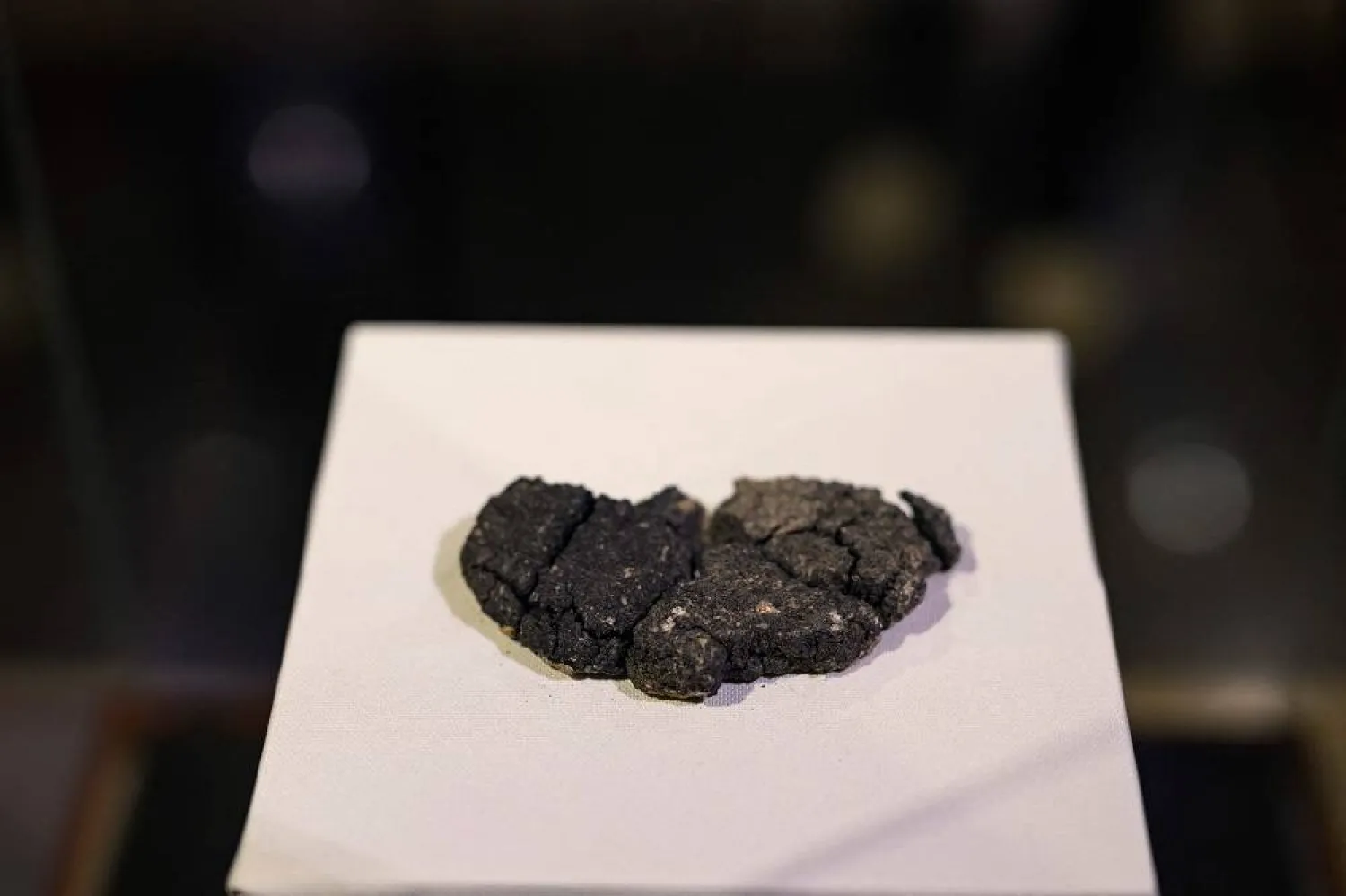
This photograph shows Kulluoba bread, a 5,000-year-old bread unearthed in an archeological excavation in Eskisehir province, in central Türkiye, exhibited at Eskisehir ETI archeology museum, on May 23, 2025. (AFP)
TT

Ancient Bread Rises Again as Türkiye Recreates 5,000-year-old Loaf 

This photograph shows Kulluoba bread, a 5,000-year-old bread unearthed in an archeological excavation in Eskisehir province, in central Türkiye, exhibited at Eskisehir ETI archeology museum, on May 23, 2025. (AFP)

In the early Bronze Age, a piece of bread was buried beneath the threshold of a newly built house in what is today central Türkiye.

Now, more than 5,000 years later, archaeologists have unearthed it, and helped a local bakery to recreate the recipe with customers lining up to buy it.

Round and flat like a pancake, 12 centimeters (five inches) in diameter, the bread was discovered during excavations at Kulluoba, a site near the central Anatolian city of Eskisehir.

"This is the oldest baked bread to have come to light during an excavation, and it has largely been able to preserve its shape," said Murat Turkteki, archaeologist and director of the excavation.

"Bread is a rare find during an excavation. Usually, you only find crumbs," he told AFP.

"But here, it was preserved because it had been burnt and buried," he said.

The bread was charred and buried under the entrance of a dwelling built around 3,300 BC.

A piece had been torn off before the bread was burnt, then buried when the house was built.

"It makes us think of a ritual of abundance," Turkteki said.

Unearthed in September 2024, the charred bread has been on display at the Eskisehir Archaeological Museum since Wednesday.

"We were very moved by this discovery. Talking to our excavation director, I wondered if we could reproduce this bread," said the city's mayor, Ayse Unluce.

Analyses showed that the bread was made with coarsely ground emmer flour, an ancient variety of wheat, and lentil seeds, with the leaf of an as yet undetermined plant used as yeast.

Ancient emmer seeds no longer exist in Türkiye.

To get as close as possible to the original recipe, the municipality, after analyzing the ancient bread, decided to use Kavilca wheat, a variety that is close to ancient emmer, as well as bulgur and lentils.

At the Halk Ekmek bakery (meaning "People's Bread" in Turkish), promoted by the municipality to offer low-cost bread, employees have been shaping 300 loaves of Kulluoba by hand every day.

"The combination of ancestral wheat flour, lentils and bulgur results in a rich, satiating, low-gluten, preservative-free bread," said Serap Guler, the bakery's manager.

The first Kulluoba loaves, marketed as 300-gram (11-ounce) cakes that cost 50 Turkish lira (around $1.28), sold out within hours.

"I rushed because I was afraid there wouldn't be any left. I'm curious about the taste of this ancient bread," said customer Suzan Kuru.

In the absence of written traces, the civilization of Kulluoba remains largely mysterious.

In the Bronze Age, the Hattians, an Anatolian people who preceded the Hittites, lived in the Eskisehir region.

"Kulluoba was a medium-sized urban agglomeration engaged in commercial activities, crafts, agriculture and mining. There was clearly a certain family and social order," said archaeologist Deniz Sari.

The rediscovery of the bread has sparked interest in the cultivation of ancient wheats better adapted to drought.

Once rich in water sources, the province of Eskisehir is today suffering from drought.

"We're facing a climate crisis, but we're still growing corn and sunflowers, which require a lot of water," said Unluce, the local mayor.

"Our ancestors are teaching us a lesson. Like them, we should be moving towards less thirsty crops," she added.

The mayor wants to revive the cultivation of Kavilca wheat in the region, which is resistant to drought and disease.

"We need strong policies on this subject. Cultivating ancient wheat will be a symbolic step in this direction," she said.

"These lands have preserved this bread for 5,000 years and given us this gift. We have a duty to protect this heritage and pass it on."



Louvre Workers Announce Strike Over Work Conditions and Security After $102M Heist

A rainbow emerges over the Louvre museum, bathed in late afternoon sunlight, in Paris, on December 6, 2025. (AFP)
TT

Louvre Workers Announce Strike Over Work Conditions and Security After $102M Heist

A rainbow emerges over the Louvre museum, bathed in late afternoon sunlight, in Paris, on December 6, 2025. (AFP)

Workers at the Louvre Museum voted Monday for strikes to protest their work conditions, a ticket-price hike for non-European visitors and security weaknesses that a brazen daylight theft of France’s Crown Jewels highlighted in October.

In a letter announcing the strike action starting next Monday, which was addressed to France's culture minister and seen by The Associated Press, the CGT, CFDT and Sud unions asserted that “visiting the Louvre has become a real obstacle course” for the millions of people who come to admire its huge collections of art and artifacts.

The museum is in “crisis,” with insufficient resources and “increasingly deteriorated working conditions," said the unions’ strike notice to Culture Minister Rachida Dati.

“The theft of 19 October 2025 highlighted shortcomings in priorities that had long been reported,” the unions alleged.

The robbery gang made off with loot worth an estimated 88 million euros ($102 million). The museum director subsequently acknowledged a ″terrible failure" in security. The thieves took less than eight minutes to force their way into the museum and leave, using a freight lift to reach one of the building’s windows, angle grinders to cut into jewelry display cases, and motorbikes to make their escape.

The haul hasn’t been recovered. It includes a diamond-and-emerald necklace Napoleon gave to Empress Marie-Louise, jewels tied to two 19th century queens, Marie-Amélie and Hortense, and Empress Eugénie’s pearl-and-diamond tiara.

Upkeep of the museum's vast and historic buildings, which were a former palace for French royals, also hasn't kept pace with its success as one of France's leading attractions.

A water leak on Nov. 26 damaged several hundred publications stored in the museum's library of works specializing in Egyptian antiquities. The damaged works included revues and documents from the 19th and 20th century, the museum said. The opening of a valve triggered the leak in a network of water pipes that are due to be replaced next year, the museum said.

Last month, the Louvre also announced the temporary closure of some employees’ offices and one public gallery because of weakened floor beams.

In their strike notice, the unions said that antiquated facilities and insufficient staffing are impacting the visitor experience, forcing the closure of some displays. They demanded that resources be focused on building improvements and safeguarding the museum, its collections, visitors and employees.

“We are in a run-down museum which has shown its security weaknesses,” Christian Galani, a CGT union official representing Louvre workers, said in an AP interview. He said the strike-action vote by employees on Monday morning was unanimous and that the planned rolling strikes risked forcing the museum's closure.

“We need a change of gear,” he said.


Diriyah Art Futures Hosts Second Open Studio of Mazra’ah Media Arts Residency

The event, dedicated to digital media artists and held under the theme "High Resolution Dreams of Sand," explores the connections between environment, technology, and culture - SPA
TT

Diriyah Art Futures Hosts Second Open Studio of Mazra’ah Media Arts Residency

The event, dedicated to digital media artists and held under the theme "High Resolution Dreams of Sand," explores the connections between environment, technology, and culture - SPA

Diriyah Art Futures, the first specialized center for New Media Arts in the Middle East and North Africa, hosted the second edition of the Open Studio for the Mazra’ah Media Arts Residency at its headquarters in Diriyah.

The event, dedicated to digital media artists and held under the theme "High Resolution Dreams of Sand," explores the connections between environment, technology, and culture, SPA reported.

The event was attended by Diriyah Art Futures Director Dr. Haytham Nawar and the center’s Education Director Tegan Bristow.
Visitors were given the opportunity to view the projects that artists and researchers are developing for the Fall–Winter 2025 season, engage directly with resident artists such as Diane Cescutti, Juan Covelli, and Calin Segal, and learn about their creative work and research at the center.

Participating researchers in the program, entrepreneur Dr. Areej Al-Wabil and researcher Rahel Aima, delivered a presentation to attendees. Their presentations reflected the experimental and diverse nature of the Mazra’ah program, which encourages artists to work across multiple techniques and media.

The program provides selected participants with access to state-of-the-art production tools within a dedicated studio, fostering collaboration and the exchange of knowledge within the global artistic community.

The Open Studio represents an important milestone in Diriyah Art Futures’ efforts to play an active role in the global dialogue on New Media and Digital Arts. Resident artists will continue developing their projects until December 2025, with future public showcases planned.

The center also provides opportunities for artists and researchers to take part in its public events, educational programs, and artistic and scientific residencies, thereby enriching the Kingdom’s art scene and strengthening its position as a global destination for New Media and Digital Arts, while highlighting local talents in the fields of art, science, and technology. This reflects the Ministry of Culture’s commitment to preserving national heritage and supporting artistic practices that shape the future of the arts and humanities.


Literature Commission Prepares to Launch Jeddah Book Fair 2025

Literature Commission Prepares to Launch Jeddah Book Fair 2025
TT

Literature Commission Prepares to Launch Jeddah Book Fair 2025

Literature Commission Prepares to Launch Jeddah Book Fair 2025

The Literature, Publishing and Translation Commission is preparing to organize the Jeddah Book Fair 2025, scheduled to take place from December 11 to 20 at the Jeddah Superdome.

The fair will see the participation of more than 1,000 local and international publishing houses and agencies representing 24 countries, distributed across 400 exhibition booths, SPA reported.

The event will host a distinguished group of writers, thinkers and intellectuals from within the Kingdom and abroad, offering visitors a rich and diverse cultural program over ten days that spans literary, intellectual and scientific fields.

CEO of the commission Dr. Abdullatif bin Abdulaziz Alwasel said that the Jeddah Book Fair is a prominent cultural event reflecting the rapid growth of the literature, publishing and translation sector, supported by the continuous backing of the wise leadership.

He emphasized that the fair is among the most important cultural platforms contributing to the objectives of Vision 2030 by promoting creative industries and intellectual engagement.

Dr. Alwasel added that the exhibition will feature an extensive cultural program comprising more than 170 events, including lectures, seminars and workshops. It will also include a dedicated children’s area designed to cater to different age groups, offering literary, cultural and recreational activities, as well as competitions aimed at inspiring children and adolescents, nurturing their love of reading and exploration and developing their talents.