

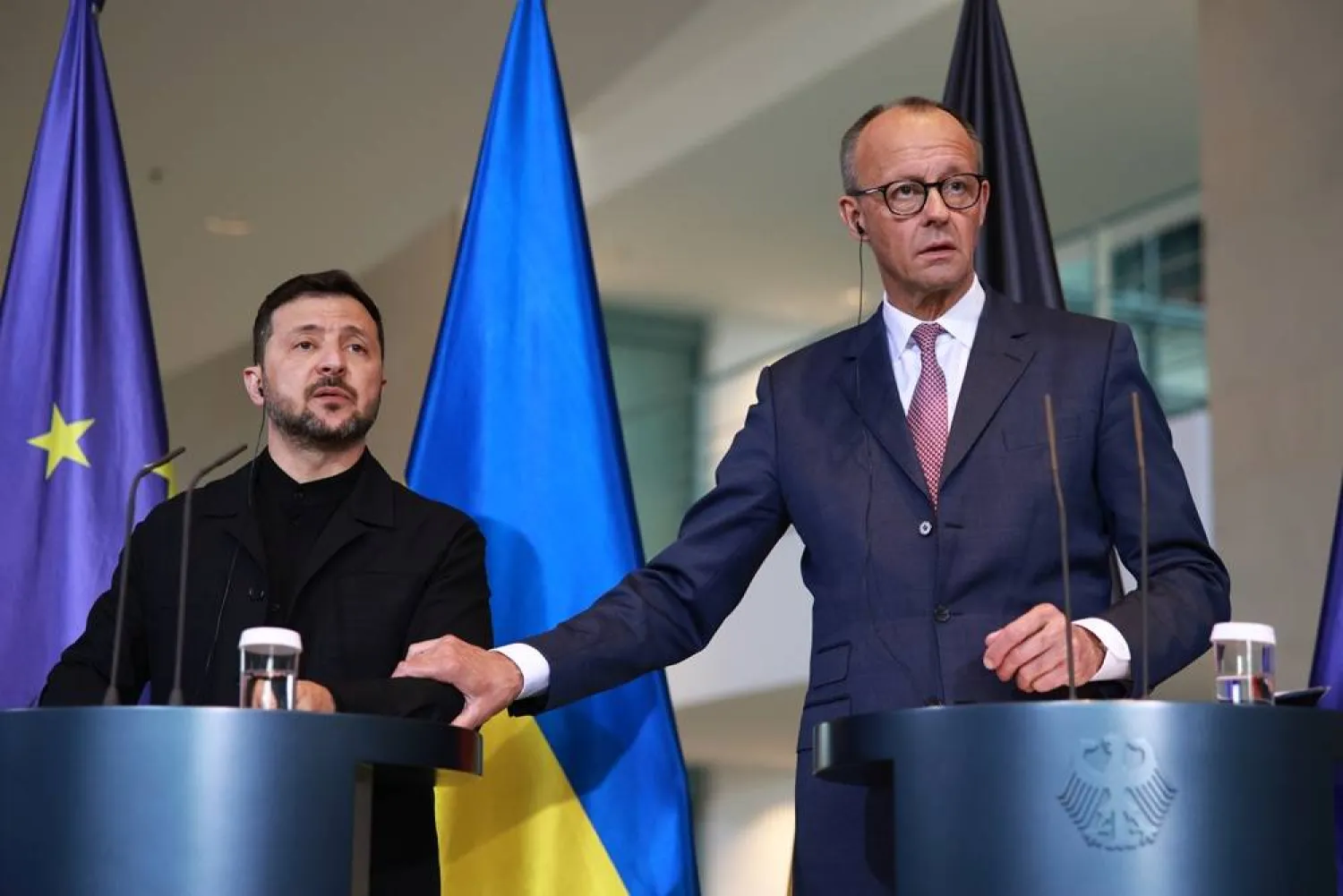

Germany’s Merz Offers to Help Ukraine Develop Its Own Long-Range Missiles to Hit Russia

German Chancellor Friedrich Merz (R) and Ukrainian President Volodymyr Zelenskyy (L) attend a joint press conference at the Chancellery in Berlin, Germany, 28 May 2025. (EPA)
TT

Germany’s Merz Offers to Help Ukraine Develop Its Own Long-Range Missiles to Hit Russia

German Chancellor Friedrich Merz (R) and Ukrainian President Volodymyr Zelenskyy (L) attend a joint press conference at the Chancellery in Berlin, Germany, 28 May 2025. (EPA)

German Chancellor Friedrich Merz pledged Wednesday to help Ukraine develop its own long-range missile systems that would be free of any Western-imposed limitations on their use and targets as the Kyiv government fights to repel Russia’s invasion.

Some of the advanced weapon systems that Kyiv’s allies supplied to Ukraine during the three-year-old war were subject to range and target restrictions — a fraught political issue stemming from fears that if the weapons struck deep inside Russia, the Kremlin might retaliate against the country that provided them and draw NATO into Europe’s biggest conflict since World War II.

Standing beside visiting Ukrainian President Volodymyr Zelenskyy, Merz said that under an intensified cooperation agreement, Germany “will strive to equip the Ukrainian army with all the capabilities that truly enable it to successfully defend the country,” including upgraded domestic missile production.

After the United States, Germany has been the biggest individual supplier of military aid to Ukraine.

“Ukraine will be able to fully defend itself, including against military targets outside its own territory” with its own missiles, Merz said at a joint news conference.

Merz's pledge came as the past few months of intense US-led peace efforts have brought no significant breakthrough and with analysts saying Russia is poised to launch a major summer offensive.

German Foreign Minister Johann Wadephul was in Washington on Wednesday to meet with US Secretary of State Marco Rubio.

Merz declined to say whether Germany will supply its advanced Taurus long-range cruise missile to Ukraine, long a request by Kyiv and a step that Berlin has resisted.

Asked about Germany's offer to fund long-range missile production in Ukraine, Kremlin spokesman Dmitry Peskov responded that the move was an obstacle to reaching a peace agreement.

Both Merz and Zelenskyy criticized the Kremlin’s effective rejection of an unconditional ceasefire proposed by the US, which Kyiv accepted. Kyiv says Moscow has been slow to respond to proposals for a settlement.

Merz said last Monday that Germany and other major allies were no longer imposing range limits on weapons they send to Ukraine, although he indicated their use was limited to Russian military targets. Ukraine has launched its own long-range drones at sites that support Russia's military efforts, including refineries and chemical plants.

Then-US President Joe Biden last year authorized Ukraine to use US-supplied missiles for limited strikes in Russia. The decision allowed Ukraine to use the Army Tactical Missile System, known as ATACMS against Russia.

In Berlin, Zelenskyy called for deeper defense cooperation across Europe and with Washington, stressing the need for long-range capabilities and sustained military funding to ensure Ukraine’s resilience.

“We need sufficient long-range capabilities. That’s why we must be certain of the financing of our army and the stability of Ukraine,” he said.

He said the cooperation projects already exist. “We simply want (the missiles) to be produced in the quantity we need,” Zelenskyy told reporters.

Zelenskyy said Tuesday that Ukraine is ready to hold peace talks at the highest level, including a trilateral meeting with himself, Russian President Vladimir Putin and US President Donald Trump.

“We are ready to meet at the level of leaders. Both the American side knows this, and the Russian side knows this,” he said. Zelenskyy said he would accept any configuration of talks, whether that includes one trilateral meeting or separate meetings with Trump.

Peskov, the Kremlin spokesman, said Russia is grateful to Trump for his mediation efforts.

“At the same time, there is a big number of nuances to be discussed that can’t be neglected and which neither party is going to sacrifice, because of its national interests,” Peskov told reporters. “Just like the United States, Russia has its national interests that are of primary importance to us.”

He said that Moscow will “soon” deliver its promised memorandum on a framework for a peace settlement.

Meanwhile, fighting has continued along the roughly 1,000-kilometer (620-mile) front line, where Ukraine's army is shorthanded against its bigger adversary. Zelenskyy claimed Tuesday that Russia is mobilizing up to 45,000 men every month, while Ukraine mobilizes between 25,000-27,000.

Both sides are continuing to conduct deep strikes. Russia launched its biggest drone attack of the war against Ukraine on Sunday.

Russian air defenses downed 296 Ukrainian drones over 13 Russian regions late Tuesday and early Wednesday, Russia’s Defense Ministry said, in what appeared to be one of the biggest Ukrainian drone assaults of the war.

Ukraine is increasing its domestic production of drones and missiles, according to Zelenskyy. He said late Tuesday that Ukraine wants European countries to help it invest in the manufacture of attack drones, air defense interceptors, cruise missiles and ballistic systems.

Moscow Mayor Sergei Sobyanin said that air defenses shot down Ukrainian 33 drones heading toward the capital.

Moscow regional Gov. Andrei Vorobyov said 42 drones were downed. He said that drone fragments damaged three residential buildings in the village of Troitskoye, but no one was hurt.

More than 60 flights were canceled Wednesday in Moscow as the capital’s airports were forced to ground planes amid drone warnings, said the federal aviation agency, Rosaviatsiya.

Overnight, Russian forces launched an attack on Ukraine using five Iskander ballistic missiles, one guided air-launched missile and 88 drones, Ukraine’s air force said. Air defense units shot down 34 drones, and 37 drones were jammed.



Flooding Kills Two as Vietnam Hit by Dozens of Landslides

Deadly flooding inundated thousands of homes in Vietnam's Lam Dong province in what authorities say is a record-breaking year of natural disasters. Quoc Nguyen / AFP
TT

Flooding Kills Two as Vietnam Hit by Dozens of Landslides

Deadly flooding inundated thousands of homes in Vietnam's Lam Dong province in what authorities say is a record-breaking year of natural disasters. Quoc Nguyen / AFP

Heavy rain in Vietnam triggered flooding that killed at least two people and caused more than a dozen landslides, state media said Friday, adding to what authorities called the "most unusual" year of natural disasters in the country's history.

South-central Vietnam has been lashed by weeks of heavy rain, submerging hundreds of thousands of homes in coastal tourism hotspots and causing deadly landslides in mountainous regions.

Downpours inundated thousands more homes in Lam Dong province on Thursday and killed at least two people, the Voice of Vietnam news outlet reported.

It added that 16 landslides struck the province, damaging roads and bridges and forcing the evacuation of hundreds of homes.

Floodwaters up to two meters deep were still sloshing through Ham Thang commune in Lam Dong on Friday, resident Pham Thi Ngoc Yen told AFP, adding authorities were delivering food and water by boat.

"Our province has always been very safe from floods or typhoons. This year was so weird," she said.

"I hope that the water will recede a lot in the next two days so that our life can get back to normal."

Record year

"2025 has been the year with the most unusual natural disasters in history," Hoang Duc Cuong, deputy director of the environment ministry's meteorology and hydrology department, said in a statement Friday.

A total of 21 storms, including 15 typhoons and 6 tropical depressions, have affected Vietnam this year, the highest number since records began in 1961, according to the environment ministry's statement.

Vietnam is in one of the most active tropical cyclone regions on Earth, but in a typical year it is affected by around 10 typhoons or storms.

The country has also experienced extreme rainfall and widespread flooding this year, with rivers setting new high-water marks from the northern regions through central and down to the lower Mekong Delta.

"Never before have such exceptionally large and historical floods occurred simultaneously in one year on 20 rivers," the environment ministry said.

One area of central Vietnam recorded up to 1,739 millimeters (5.7 feet) of rain in just 24 hours.

Elsewhere in Asia, devastating floods in recent days have killed more than 1,500 people and displaced hundreds of thousands across four countries, including Indonesia and Sri Lanka.

In Vietnam, natural disasters have left more than 400 people dead or missing this year and caused more than $3.6 billion in damage, according to the ministry.

The Southeast Asian nation is prone to heavy rain between June and September, but scientists have identified a pattern of human-driven climate change making extreme weather more frequent and destructive.


Israel Sets 2026 Defense Budget at $34 Billion Despite Ceasefire in Gaza

FILED - 25 June 2024, Israel, Jerusalem: Israeli Defense Minister Israel Katz is pictured during an event in Jerusalem. Photo: Hannes P Albert/dpa
TT

Israel Sets 2026 Defense Budget at $34 Billion Despite Ceasefire in Gaza

FILED - 25 June 2024, Israel, Jerusalem: Israeli Defense Minister Israel Katz is pictured during an event in Jerusalem. Photo: Hannes P Albert/dpa

Israel's defense budget for 2026 has been set at 112 billion shekels ($34.63 billion), the defense minister's office said on Friday, up from 90 billion shekels budgeted in an earlier draft.

Defense Minister Israel Katz and Finance Minister Bezalel Smotrich agreed on the defense spending framework as the cabinet has begun debating next year's budget, which needs to be approved by March or could lead to new elections.

Ministers began what is usually a marathon session on Thursday ahead of a vote that could come early on Friday. If it passes, it heads to parliament for its initial vote.

Katz said the military will continue its to address the needs of its fighters and reduce the burden on reservists.

"We will continue to act decisively to reinforce the IDF and to fully address the needs of the fighters and to reduce the burden on reservists - in order to ensure the security of the State of Israel on every front," his office quoted him as saying.

The Gaza war has been costly for Israel, which spent $31 billion in 2024 on its military conflicts with Hamas and with Hezbollah in Lebanon.

Israel has since entered ceasefire deals with both militant groups.

Smotrich's office said that the 2026 defense budget has seen an increase of 47 billion shekels compared to 2023 on the eve of the war.

"We are allocating a huge budget to strengthen the army this year, but also one that allows us to return the State of Israel to a path of growth and relief for citizens,"
Smotrich said, according to his office.


India Rolls Out Red Carpet for Russia's Putin

In this pool photograph distributed by the Russian state agency Sputnik, Russia's President Vladimir Putin and Indian Prime Minister Narendra Modi look out from a car prior to an informal dinner at Modi's residence. Alexander KAZAKOV / POOL/AFP
TT

India Rolls Out Red Carpet for Russia's Putin

In this pool photograph distributed by the Russian state agency Sputnik, Russia's President Vladimir Putin and Indian Prime Minister Narendra Modi look out from a car prior to an informal dinner at Modi's residence. Alexander KAZAKOV / POOL/AFP

India's Prime Minister Narendra Modi hosts Russia's President Vladimir Putin at a summit on Friday, with defense and trade ties taking center stage as New Delhi faces heavy US pressure to stop buying Moscow's oil.

Both leaders will also discuss the geopolitical situation in the wake of the Russian invasion of Ukraine and global trade disruptions triggered by tariffs imposed by US President Donald Trump, said AFP.

Big ticket defense sales and co-production ventures, energy purchases, and wider economic engagement are on the agenda, Putin's first visit to India since the Ukraine war.

Modi welcomed Putin at the airport on Thursday with a warm hug on a red carpet, before the two rode together in the same car to a private dinner -- mirroring a lift that Putin gave Modi when they last met in China in September.

"India-Russia friendship is a time-tested one that has greatly benefitted our people," Modi wrote in a post on social media, accompanying a photograph of them grinning together inside the vehicle.

It was a symbolic show of friendship, after US President Donald Trump imposed 50-percent tariffs on most Indian products in August, citing Delhi's continued purchases of Russian oil -- revenue Washington argues helps fund the war in Ukraine.

In an interview with India Today, Putin said he was "very happy" to be meeting "my friend" Modi.

"The range of our cooperation with India is huge," he said in remarks translated by the broadcaster, citing ship and aircraft manufacturing, nuclear energy and space exploration.

"This visit is part of India's diversification strategy, both in terms of strategic and economic, especially at a time when the US tariffs have hurt India," Ashok Malik of business consultancy The Asia Group told AFP.

On Friday, Putin is due to be given an honor guard welcome at the presidential palace in New Delhi, before meeting with Modi.

'Balancing acts'

India is walking a diplomatic tightrope -- relying on strategic Russian oil imports while trying not to provoke Trump during ongoing tariff negotiations.

"Balancing acts are second nature to Indian foreign policy making", wrote Pankaj Saran, a former Indian envoy to Russia, writing in the Times of India.

The leaders will also address business and industry leaders before Putin attends a state banquet hosted by the Indian President Droupadi Murmu.

India, the world's most populous nation, has become a major buyer of Russian oil, saving itself billions of dollars and providing Moscow with a much-needed export market after it was cut off from traditional buyers in Europe because of the war.

Putin also told India Today that Modi is "not someone who gives in to pressure", when asked about the impact of US tariffs.

The Russian share of India's arms imports fell from 76 percent in 2009-13 to 36 percent in 2019-23, according to the Stockholm International Peace Research Institute.

Besides discussions around cutting-edge defense hardware, which includes air defense systems, fighter jets, and nuclear submarines, New Delhi will push for easier access to the wider Russian market.

Bilateral trade reached $68.7 billion in 2024-25 -- almost six times higher than the pre-pandemic levels -- but Indian exports accounted for only $4.88 billion.

The two countries are expected to announce an agreement on easier mobility of Indian workers into Russia.