
Displaced Syrians Leave Camps to Pitch Tents near Destroyed Homes

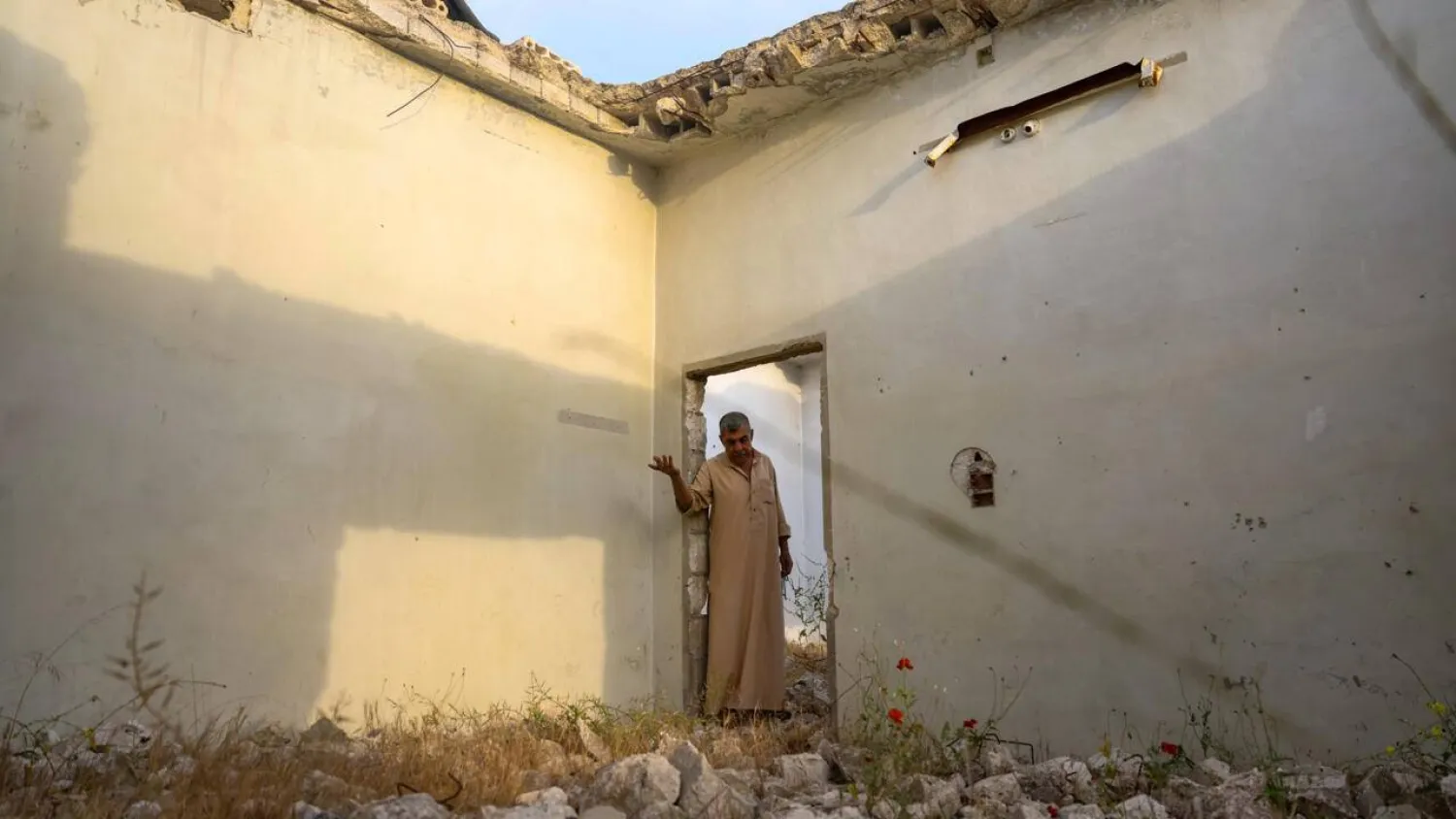
Aref Shamtan, 73: 'I feel good here, even among the rubble'. Omar HAJ KADOUR / AFP
TT

Displaced Syrians Leave Camps to Pitch Tents near Destroyed Homes

Aref Shamtan, 73: 'I feel good here, even among the rubble'. Omar HAJ KADOUR / AFP

Aref Shamtan, 73, preferred to pitch a tent near his destroyed home in northwest Syria rather than stay in a camp for the displaced following longtime ruler Bashar al-Assad's ouster.

"I feel good here, even among the rubble," Shamtan said, sipping tea at the tent near his field.

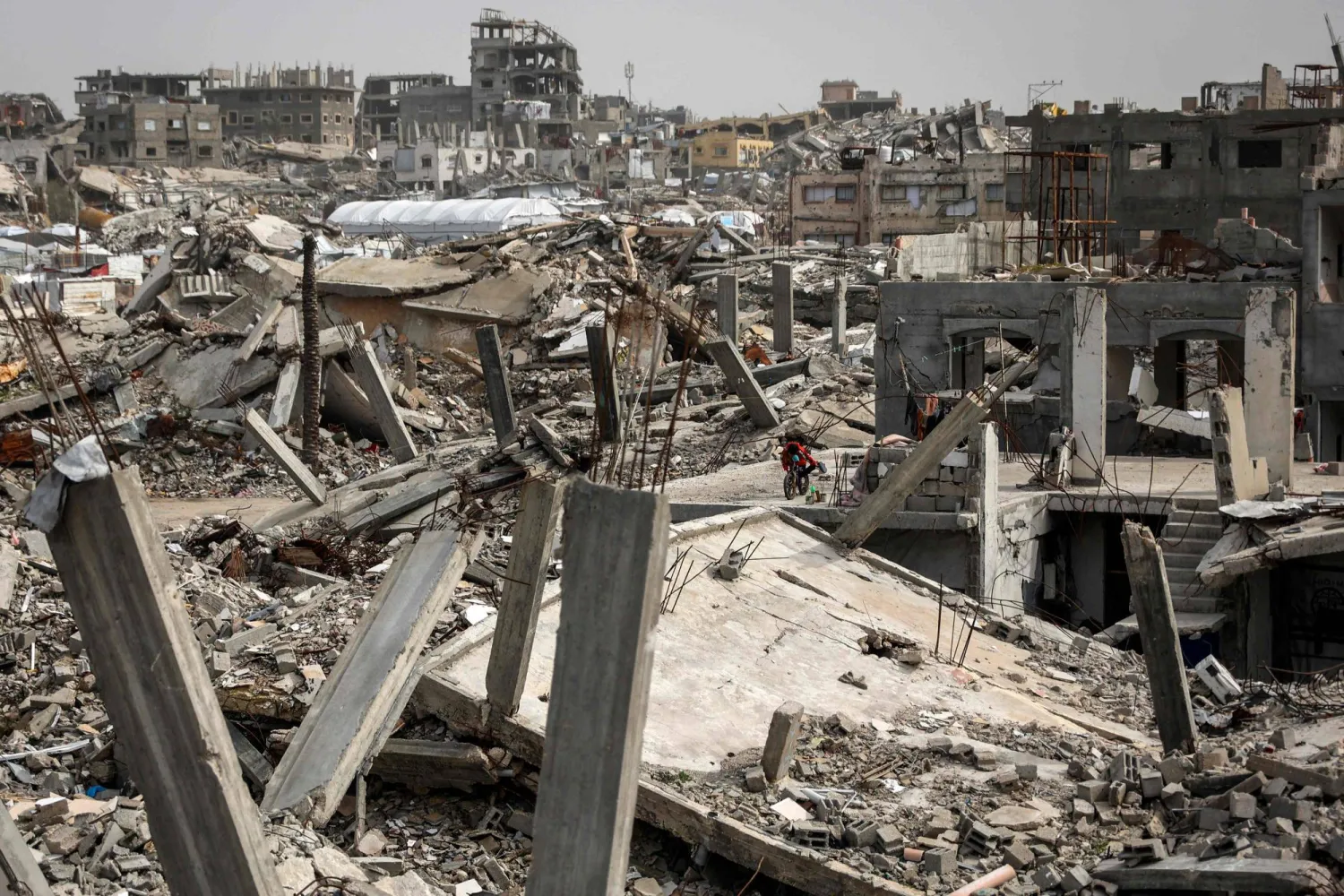
When he and his son returned after Assad's December 8 overthrow, Shamtan found his village of Al-Hawash, nestled among farmland in central Hama province, badly damaged.

The roof of their house was gone and its walls were cracked.

But "living in the rubble is better than living in the camps" near the border with Türkiye, where he had been since 2011 after fleeing the fighting, Shamtan said.

Since the opposition factions ousted Assad after nearly 14 years of war, 1.87 million Syrians who were refugees abroad or internally displaced have returned to their areas of origin, the United Nations' International Organization for Migration says.

The IOM says the "lack of economic opportunities and essential services pose the greatest challenge" for those returning home.

Shamtan, who cannot afford to rebuild, decided around two months ago to leave the camp with his family and young grandchildren, and has started planting his farmland with wheat, said AFP.

Al-Hawash had been controlled by Assad's forces and was along the front lines with neighboring Idlib province, which became a bastion for opposition factions, particularly Hayat Tahrir al-Sham, the group that led the offensive that toppled Assad.

'Nothing here'

"We can't stay in the camps," Shamtan insisted, even if "the village is all destroyed... and life is non-existent", lacking basic services and infrastructure.

"We decided... to live here until things improve. We are waiting for organizations and the state to help us," he said.

"Life is tough."

Local official Abdel Ghafour al-Khatib, 72, has also returned after fleeing in 2019 with his wife and children for a camp near the border.

"I just wanted to get home. I was overjoyed... I returned and pitched a worn-out tent. Living in my village is the important thing," he said.

"Everyone wants to return," he said. But many cannot even afford the transport to do so in a country where 90 percent of people live in poverty.

"There is nothing here -- no schools, no health clinics, no water and no electricity," Khatib said, sitting on the ground in the tent near the remains of his home.

The war, which erupted in 2011 after Assad's brutal repression of anti-government protests, killed more than 500,000 people and displaced half of the pre-war population internally or abroad, with many fleeing to Idlib province.

More than six million people remain internally displaced, according to the IOM.

With the recent lifting of Western sanctions, Syria's new authorities hope for international support to launch reconstruction, which the UN estimates could cost more than $400 billion.

IOM chief Amy Pope said on Monday that "the lifting of sanctions sends a powerful message of hope to millions of displaced Syrians", cautioning, however, that "hope must be matched with concrete support".

'No home'

After being repeatedly displaced, Souad Othman, 47, returned with her three daughters and son to Al-Hawash around a week ago.

"Everything has changed -- the homes are damaged and there is nothing left in their place," said Othman, whose husband died during the war.

The roof of her home has collapsed and its walls are cracked, but she still chose to return, eking out a living through manual labor.

A small bed sits out in the open, protected only by blankets on a clothesline, with a makeshift cooking area set up on the rubble.

She said she borrowed $80 to pay for a battery for two solar panels.

"There are snakes and insects here. We can't live without light during the night," she said.

AFP aerial footage of camps in northwest Syria showed some former structures empty of residents.

Jalal al-Omar, 37, who is responsible for part of a camp near the village of Qah in Idlib province, said around 100 families had left for his home village of Treimsa in the Hama region.

But around 700 other families cannot afford to return, he said, also noting the lack of infrastructure in Treimsa, where people have to travel miles just to buy bread.

"People don't want to stay in the camps, they want to return to their villages. But the lack of essential services... prevents their return," he said.

"I myself have no home. I'm waiting... for a place to shelter in the village," he added.


Italy Arrests 7 Accused of Raising Millions for Hamas

Palestinian Hamas members secure the area as Egyptian workers accompanied by members of the International Committee of the Red Cross (ICRC) search for the remains of the last Israeli hostage in the Zeitoun neighborhood of Gaza City on December 8, 2025. (Photo by Omar AL-QATTAA / AFP)
TT

Italy Arrests 7 Accused of Raising Millions for Hamas

Palestinian Hamas members secure the area as Egyptian workers accompanied by members of the International Committee of the Red Cross (ICRC) search for the remains of the last Israeli hostage in the Zeitoun neighborhood of Gaza City on December 8, 2025. (Photo by Omar AL-QATTAA / AFP)

Italian police said Saturday that they have arrested seven people suspected of raising millions of euros for Palestinian group Hamas.

Police also issued international arrests for two others outside the country, said AFP.

Three associations, officially supporting Palestinian civilians but allegedly serving as a front for funding Hamas, are implicated in the investigation, said a police statement.

The nine individuals are accused of having financed approximately seven million euros ($8 million) to "associations based in Gaza, the Palestinian territories, or Israel, owned, controlled, or linked to Hamas."

While the official objective of the three associations was to collect donations "for humanitarian purposes for the Palestinian people," more than 71 percent was earmarked for the direct financing of Hamas" or entities affiliated with the movement, according to police.

Some of the money went to "family members implicated in terrorist attacks," the statement said.

Among those arrested was Mohammad Hannoun, president of the Palestinian Association in Italy, according to media reports.

Interior Minister Matteo Piantedosi posted on X that the operation "lifted the veil on behavior and activities which, pretending to be initiatives in favor of the Palestinian population, concealed support for and participation in terrorist organizations."


Türkiye Holds Military Funeral for Libyan Officers Killed in Plane Crash

The Libyan national flag flies at half-mast in Tripoli on December 24, 2025, after the head of Libya's armed forces and his four aides died in a plane crash in Türkiye. (AFP)
TT

Türkiye Holds Military Funeral for Libyan Officers Killed in Plane Crash

The Libyan national flag flies at half-mast in Tripoli on December 24, 2025, after the head of Libya's armed forces and his four aides died in a plane crash in Türkiye. (AFP)

Türkiye held a military funeral ceremony Saturday morning for five Libyan officers, including western Libya’s military chief, who died in a plane crash earlier this week.

The private jet with Gen. Muhammad Ali Ahmad al-Haddad, four other military officers and three crew members crashed on Tuesday after taking off from Ankara, Türkiye’s capital, killing everyone on board. Libyan officials said the cause of the crash was a technical malfunction on the plane.

Al-Hadad was the top military commander in western Libya and played a crucial role in the ongoing, UN-brokered efforts to unify Libya’s military.

The high-level Libyan delegation was on its way back to Tripoli, Libya’s capital, after holding defense talks in Ankara aimed at boosting military cooperation between the two countries.

Saturday's ceremony was held at 8:00 a.m. local time at the Murted Airfield base, near Ankara, and attended by the Turkish military chief and the defense minister. The five caskets, each wrapped in a Libyan national flag, were then loaded onto a plane to be returned to their home country.

Türkiye’s military chief, Selcuk Bayraktaroglu, was also on the plane headed to Libya, state-run news agency TRT reported.

The bodies recovered from the crash site were kept at the Ankara Forensic Medicine Institute for identification. Justice Minister Yilmaz Tunc told reporters their DNA was compared to family members who joined a 22-person delegation that arrived from Libya after the crash.

Tunc also said Germany was asked to help examine the jet's black boxes as an impartial third party.


Syrian Foreign Ministry: Talks with SDF Have Not Yielded Tangible Results

SDF fighters are seen at a military parade in Qamishli. (Reuters file)
TT

Syrian Foreign Ministry: Talks with SDF Have Not Yielded Tangible Results

SDF fighters are seen at a military parade in Qamishli. (Reuters file)

A source from the Syrian Foreign Ministry said on Friday that the talks with the Kurdish Syrian Democratic Forces (SDF) over their integration into state institutions “have not yielded tangible results.”

Discussions about merging the northeastern institutions into the state remain “hypothetical statements without execution,” it told Syria’s state news agency SANA.

Repeated assertions over Syria’s unity are being contradicted by the reality on the ground in the northeast, where the Kurds hold sway and where administrative, security and military institutions continue to be run separately from the state, it added.

The situation “consolidates the division” instead of addressing it, it warned.

It noted that despite the SDF’s continued highlighting of its dialogue with the Syrian state, these discussions have not led to tangible results.

It seems that the SDF is using this approach to absorb the political pressure on it, said the source. The truth is that there is little actual will to move from discussion to application of the March 10 agreement.

This raises doubts over the SDF’s commitment to the deal, it stressed.

Talk about rapprochement between the state and SDF remains meaningless if the agreement is not implemented on the ground within a specific timeframe, the source remarked.

Furthermore, the continued deployment of armed formations on the ground that are not affiliated with the Syrian army are evidence that progress is not being made.

The persistence of the situation undermines Syria’s sovereignty and hampers efforts to restore stability, it warned.