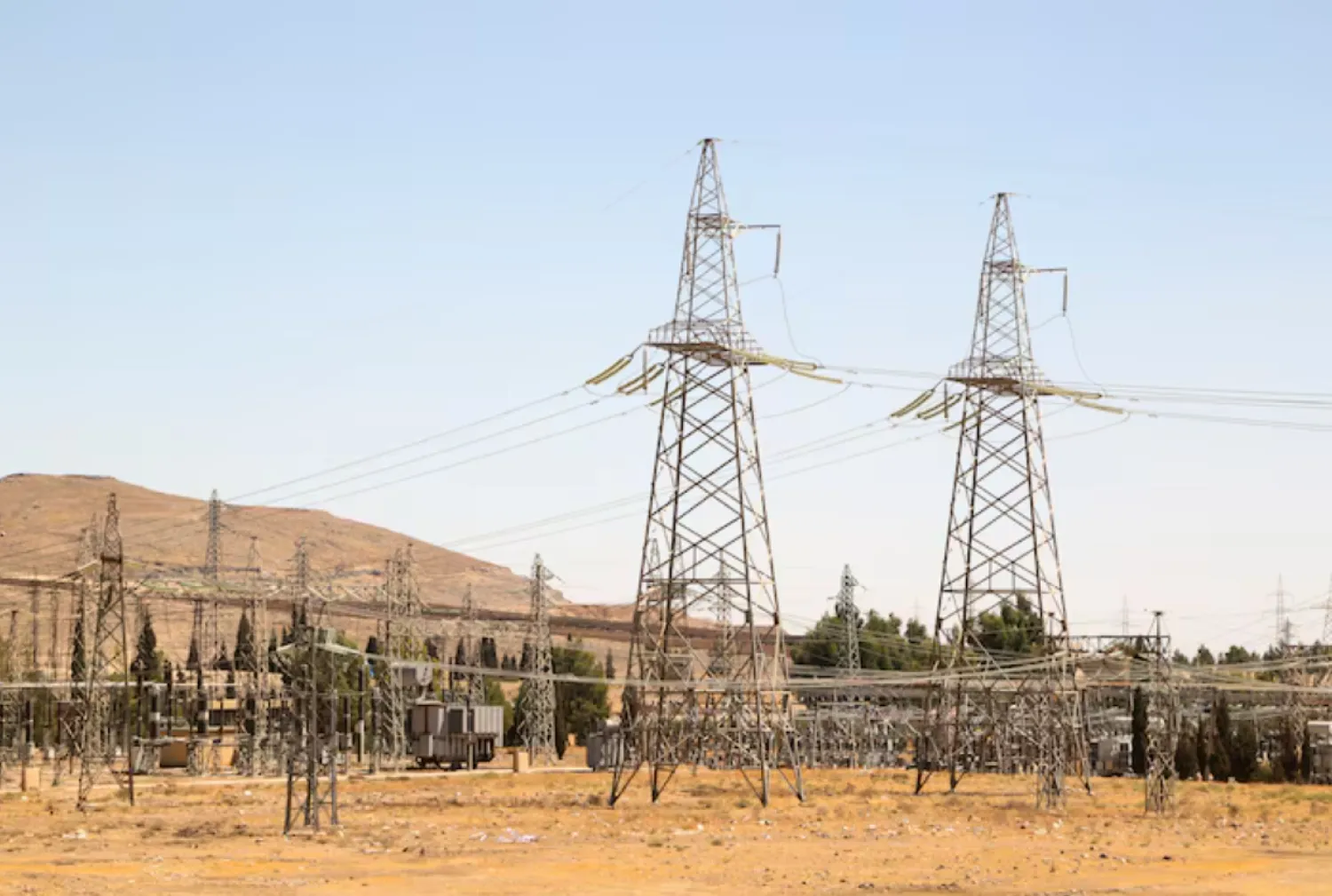
Syria Signs $7 billion Power Deal with Qatar's UCC Holding-led Consortium

A view shows electricity pylons in Kiswah, Damascus suburbs, Syria September 8, 2021. Picture taken September 8, 2021. REUTERS/Yamam al Shaar/File Photo
TT

Syria Signs $7 billion Power Deal with Qatar's UCC Holding-led Consortium

A view shows electricity pylons in Kiswah, Damascus suburbs, Syria September 8, 2021. Picture taken September 8, 2021. REUTERS/Yamam al Shaar/File Photo

Syria has signed a memorandum of understanding with a consortium of international companies led by Qatar's UCC Holding to develop major power generation projects with a foreign investment valued at about $7 billion, UCC said in a statement on Thursday.

The agreement involves building four combined-cycle gas turbine power plants with a total capacity of 4,000 megawatts, plus a 1,000-MW solar power plant in southern Syria, according to Reuters.

"This agreement marks a crucial step in Syria's infrastructure recovery plan," said Syrian Energy Minister Mohammed al-Bashir, who signed the deal in Damascus in the presence of Syrian President Ahmed al-Sharaa and US envoy for Syria, Thomas Barrack.

Construction is expected to begin after final agreements and financial close, and is targeted to finish within three years for the gas plants and less than two years for the solar plant.

Once completed, the projects are expected to provide over 50% of Syria’s electricity needs.

After 14 years of war, Syria's electricity sector has been suffering from severe damage to its grid and power stations, aging infrastructure, and persistent fuel shortages, generating only 1.6 gigawatts of electricity, down from 9.5 GW before 2011.

Reconstructing the power sector is expected to cost around $11 billion and the new administration is betting on the private sector shouldering the burden, underlining a shift from the state-led economic policies of the Assad era.

The projects will be financed through regional and international banks, in addition to capital injection from the partners, UCC Holding CEO Ramez Al Khayyat said.

They are expected to create 50,000 direct and 250,000 indirect jobs during execution, the UCC Holding CEO said.


Saudi Stock Market Falls to Lowest Close Since April 2021

A trader monitors stocks in Saudi Arabia (Reuters)
TT

Saudi Stock Market Falls to Lowest Close Since April 2021

A trader monitors stocks in Saudi Arabia (Reuters)

Saudi Arabia's benchmark Tadawul All Share Index (TASI) ended Tuesday's session down 1.7 percent, shedding 172 points to close at 9,952, its lowest closing level since April 2021, with total trading turnover reaching approximately SAR 3.8 billion.

The index fluctuated between an intraday low of 9,941 points and a high of 10,116 points. Since the beginning of the year, it has lost around 540 points, equivalent to 5.1 percent.

Several heavyweight stocks declined during the session, with Saudi Aramco falling 1 percent to SAR 25.48 and Al Rajhi Bank dropping by the same percentage to SAR 60.15.

Shares of Mobily, BSF and Yamama Cement fell between 1 and 3 percent, while Yansab dropped 7 percent.

SABIC Agri-Nutrients and Bank Albilad each declined 3 percent, closing at SAR 109.80 and SAR 21.47, respectively, following the release of their financial results for the third quarter of 2026.

Tihama led the session's decliners, falling 8 percent, while Azm topped the gainers with a 4 percent increase.


Ferrari: Saudi Arabia Has Become a Key Driver of Our Growth in the Middle East

Ferrari's new showroom in the Saudi capital, Riyadh (Asharq Al-Awsat)
TT

Ferrari: Saudi Arabia Has Become a Key Driver of Our Growth in the Middle East

Ferrari's new showroom in the Saudi capital, Riyadh (Asharq Al-Awsat)

Saudi Arabia has emerged as one of the main drivers of Italian luxury sports carmaker Ferrari's growth in the Middle East, fueled by an expanding population of high-net-worth individuals, a new generation of customers and growing interest in luxury sports cars.

Despite accelerating demand across the region, the company remains committed to a strategy centered on limited production and preserving the exclusivity of its brand.

Giorgio Turri, Regional Director of Ferrari Middle East, said Saudi Arabia is no longer simply a market experiencing rising demand, but has become a strategic market for Ferrari's presence, future growth and innovation in the Middle East.

Speaking to Asharq Al-Awsat, Turri explained that the economic and social transformations associated with Saudi Vision 2030 have contributed to a shift in the company's customer demographics, with growing numbers of younger buyers interested in sports cars, vehicle personalization and motorsports.

Riyadh Showroom Reflects Market's Importance

Turri said the opening of Ferrari's new showroom in Riyadh, the first in the Middle East and Asia to adopt the company's new corporate identity, reflects the growing importance of the Saudi market within its regional strategy.

He added that demand in the Kingdom continues on an upward trajectory among both existing and first-time customers.

Ferrari is seeking to broaden its customer base by developing new models, building on the success of vehicles such as the California, Roma and Purosangue, while looking ahead to the introduction of the Luce, its first fully electric vehicle and first five-seat model.

Growth Versus Exclusivity

Despite rising demand, Turri stressed that Ferrari does not pursue higher sales volumes as an end in themselves.

"We" do not seek to increase sales volumes as a goal in itself, he said, explaining that expansion requires carefully balancing market demand with the company's commitment to limited production.

He noted that Ferrari customers in the Middle East are among the youngest worldwide, a trend also evident in Saudi Arabia, where interest in vehicle personalization programs and participation in driving and racing activities is increasing.

Turri said the Kingdom is home to one of the most active Ferrari owners' clubs globally, while Saudi customers demonstrate detailed knowledge of vehicle specifications, technology and performance.

Saudi Arabia, UAE and Qatar Lead Regional Demand

Discussing regional market performance, Turri said economic transformation and growing wealth are supporting long-term demand for luxury vehicles.

He noted that demand is accelerating more rapidly in Saudi Arabia, the United Arab Emirates and Qatar than in other markets across the region.

More than 40 percent of new Ferraris delivered annually in the Middle East go to first-time buyers of the brand, he revealed, while the proportion exceeds 50 percent in the pre-owned vehicle market.

These trends coincide with Ferrari's plan to introduce an average of four new models annually between 2026 and 2030.

Regional Disruptions Force Changes to Shipping Routes

Addressing the impact of recent geopolitical disruptions, Turri said the main effects were felt in supply chains and logistics, after the closure of the Strait of Hormuz forced Ferrari to adjust shipping routes to Gulf markets.

He explained that the company managed the challenges during March and resumed its normal pace of operations in April by rerouting maritime shipments and using air freight when necessary.

Turri confirmed that showrooms and service centers continued operating and that demand had not changed significantly, with the economic and demographic factors supporting the Gulf market remaining intact.

An Ecosystem Beyond Car Sales

Turning to Ferrari's strategy in Saudi Arabia, Turri said the next phase would focus on expanding activities associated with vehicle ownership, including driving programs, racing events and exclusive customer experiences.

He explained that the Jeddah Corniche Circuit has been part of Ferrari's programs since 2023 and is scheduled to host the Ferrari Challenge championship for the first time in February 2027, amid growing participation by Saudi amateur drivers.

Turri also highlighted the company's first customer tour in AlUla in 2025, alongside other events organized during the holy month of Ramadan.

He said these activities have become an integral part of Ferrari's strategy to deepen customers' connection with the brand.

Turri emphasized that Saudi Arabia represents a significant growth opportunity in the coming years, driven not only by increasing demand for sports cars but also by an expanding customer base and growing interest in motorsports across the Kingdom.


IEA Ready to Go if Further Oil Stocks Release Needed, Chief Says

A pumpjack operates after sunrise in Kern County, which has a long history of oil production, in California's 22nd Congressional District on October 16, 2026 near Bakersfield, California. (Getty Images/AFP)
TT

IEA Ready to Go if Further Oil Stocks Release Needed, Chief Says

A pumpjack operates after sunrise in Kern County, which has a long history of oil production, in California's 22nd Congressional District on October 16, 2026 near Bakersfield, California. (Getty Images/AFP)

The International Energy Agency is ready to go if a further release of oil from members' emergency oil reserves is needed, the agency's top official said on Tuesday.

The IEA decided last week to accelerate the release of oil remaining from a record emergency reserves release pledged in March, including more than 20 million barrels of diesel as soon as possible to boost supply ‌and cool ‌soaring prices.

"If it is needed...and if ‌our ⁠countries consider it’s ⁠time to push the button, as the International Energy Agency, we are ready to go,” IEA Executive Director Fatih Birol said at a conference in London organized by the Financial Times, when asked about the prospect of an additional release.

The timeline for the ⁠release of 20 million barrels of ‌diesel depends on individual countries, ‌he said, without giving a specific timeframe.

"How much is ‌released and when depends on the countries, depends on ‌the situation of winter markets," Birol said.

War in Iran and conflict in Ukraine have disrupted oil supplies, sending diesel prices to record highs in many markets and turning ‌the fuel that underpins trucking, agriculture and industry into a political and economic ⁠concern.

"We’re trying ⁠to front-load those diesel deliveries,” Birol added.

Brent crude oil rose to more than $111 a barrel on Tuesday, a five-month high. European benchmark diesel futures were trading at $1482.25 per metric ton, up almost 4% since the IEA’s decision on Thursday.

The IEA coordinates industrialized nations' releases of oil from emergency stocks. In March, countries had pledged to release more than 400 million barrels of crude and oil products as prices soared.

Members have so far released 80% of the 400 million barrels, Birol said.