



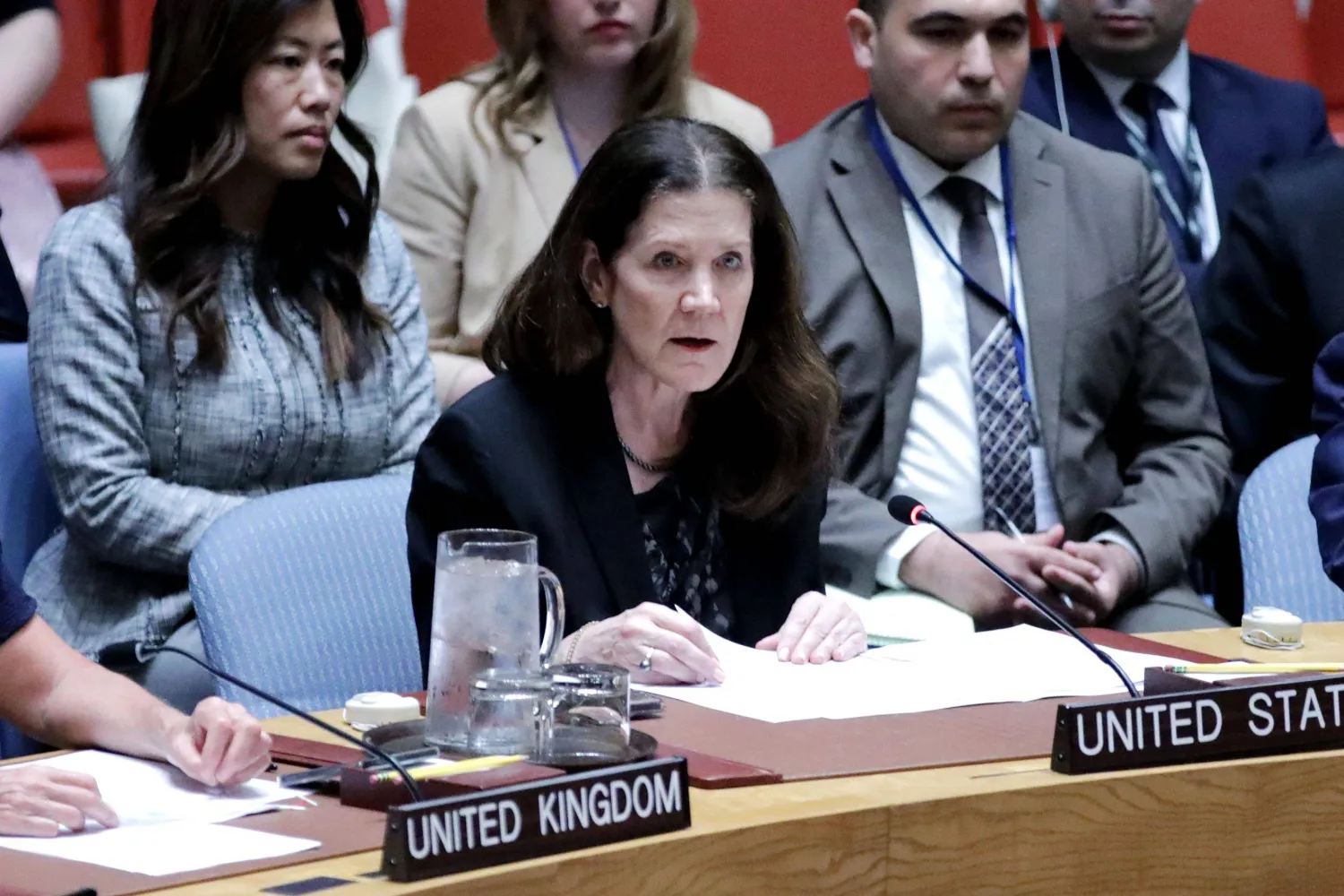

The United States on Wednesday vetoed a UN Security Council resolution demanding an immediate and permanent ceasefire in Gaza because it was not linked to the release of hostages, saying it would embolden Hamas militants.
All 14 other members of the council voted in favor of the resolution, which described the humanitarian situation in Gaza as “catastrophic” and called on Israel to lift all restrictions on the delivery of aid to the 2.1 million Palestinians in the territory.
The resolution before the UN's most powerful body also did not fulfill two other US demands: It did not condemn Hamas’ deadly attack in Israel on Oct. 7, 2023, which ignited the war, or say the militant group must disarm and withdraw from Gaza, The Associated Press reported.
Acting US Ambassador Dorothy Shea, speaking to the council immediately before the vote, said the resolution would undermine the security of Israel. a close US ally, and diplomatic efforts to reach a ceasefire “that reflects the realities on the ground."
US Secretary of State Marco Rubio said the resolution would only have empowered Hamas. “Hamas could end this brutal conflict immediately by laying down its arms and releasing all remaining hostages,” he said in a statement.
Israel’s UN Ambassador Danny Danon thanked the United States for refusing to abandon the hostages. He said the resolution’s failure to make the release of hostages a condition for a ceasefire would have put all the pressure on Israel and handed Hamas “time, leverage and political cover.”
What other members of the Security Council say
But the US veto of the resolution — its fifth since the start of the war — was roundly criticized by other members of the council, who accused the United States of providing Israel with impunity.
The Chinese ambassador to the UN said Israel's actions have “crossed every red line” of international humanitarian law and seriously violated UN resolutions. “Yet, due to the shielding by one country, these violations have not been stopped or held accountable," Ambassador Fu Cong said.
Britain’s UN Ambassador Barbara Woodward, a usual US ally, lashed out at Israel. “This Israeli government’s decisions to expand its military operations in Gaza and severely restrict aid are unjustifiable, disproportionate and counterproductive, and the UK completely opposes them,” she said.
Pakistan's Ambassador Asim Iftikhar Ahmad said the US veto "will be remembered as a complicity, a green light for continued annihilation. A moment where the entire world was expecting action. But yet again, this council was blocked and prevented by one member from carrying out its responsibility.”
Slovenia’s UN Ambassador Samuel Žbogar, the coordinator for the council's 10 elected members, stressed that it was never the intention to provoke a veto and therefore the resolution focused on the humanitarian crisis and the urgent need for unimpeded access to deliver aid.
“Starving civilians and inflicting immense suffering is inhumane and against international law,” he told the council after the vote. “No war objective can justify such action. We had hoped and expected that this was our shared understanding.”
Palestinian UN Ambassador Riyad Mansour said Palestinians are now urging governments to take “real measures” to pressure Israel to get out of Gaza before it implements what he called an Israeli plan “to destroy our people."
And in the coming days, he said, the Palestinians will head to the 193-member General Assembly, where there are no vetoes, with a similar humanitarian-focused resolution. Unlike in the Security Council, assembly resolutions are not legally binding, though they are seen as a barometer of world opinion.
The US vetoed the last Security Council resolution on Gaza in November, under the Biden administration, also because the ceasefire demand was not directly linked to the release of all hostages. Similarly, the current resolution demands those taken by Hamas and other groups be released, but it does not make it a condition for a truce.
President Donald Trump's administration has tried to ramp up its efforts to broker peace in Gaza after 20 months of war. However, Hamas has sought amendments to a US proposal that special envoy Steve Witkoff has called “totally unacceptable.”
Why food aid is not reaching people in Gaza
The vote followed a decision by an Israeli and US-backed foundation to pause food delivery in Gaza after health officials said dozens of Palestinians were killed in a series of shootings this week. Israel and the United States say the new system was designed to prevent Hamas from stealing aid previously distributed by the UN.
The United Nations has rejected the new system. The UN says its distribution system worked very well during the March ceasefire and is carefully monitored.
Gaza is almost completely reliant on international aid because Israel’s offensive has destroyed nearly all food production capabilities. Israel imposed a blockade on supplies into Gaza on March 2, and limited aid began to enter again late last month after pressure from allies and warnings of famine.
The war began when Hamas-led militants stormed into southern Israel on Oct. 7, 2023, killing around 1,200 people and abducting 251. They are still holding 58 hostages, a third of them believed to be alive, after most of the rest were released in ceasefire agreements or other deals.
Israel’s military campaign has killed more than 54,000 Palestinians, mostly women and children, according to Gaza’s Health Ministry, which doesn’t say how many of the dead were civilians or combatants.
The ministry is led by medical professionals but reports to the Hamas-run government. Its toll is seen as generally reliable by UN agencies and independent experts, though Israel has challenged its numbers


